
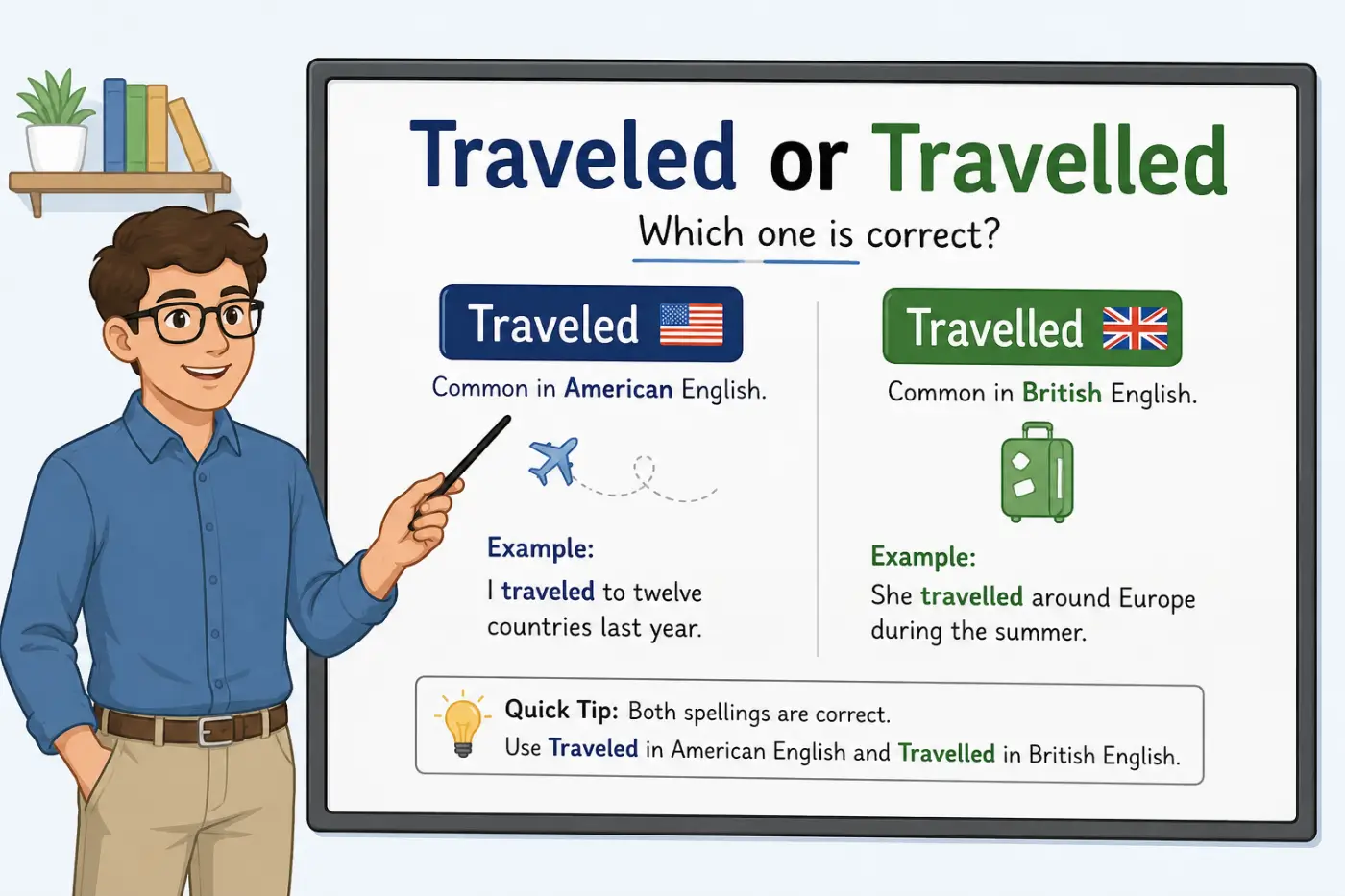
If you are wondering about traveled or travelled, both spellings are correct. The main difference is the kind of English being used. Traveled is the standard spelling in American English, while travelled is the standard spelling in British English and many other varieties of English.
Both words come from the verb travel. They have the same meaning and pronunciation. The only difference is the spelling. For example, an American writer may say, “I traveled to New York last summer.” A British writer may write, “I travelled to London last summer.”
The same spelling difference appears in other forms of the word. You may see traveling in American English and travelling in British English. So, if you are writing for a US audience, traveled is usually the better choice. If you are following British English, travelled is the usual spelling.
Many readers also check Camisole Meaning Slang: Complete Simple Guide 2026.
Simple Answer in One Look
Traveled is correct in American English.
Travelled is correct in British English.
Both mean the same thing. The difference is mainly based on regional spelling rules.
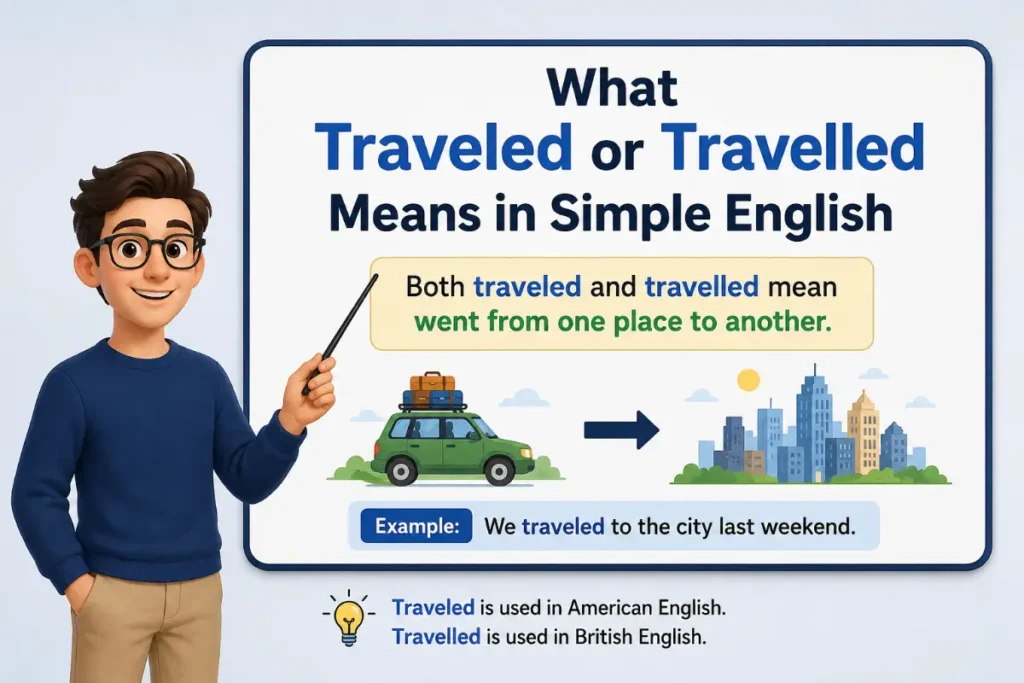
What Traveled or Travelled Means in Simple English
The word means that someone went from one place to another. It can describe a short trip, a long journey, or movement from one area to another.
For example:
“I traveled to Chicago last week.”
This means that I went to Chicago from another place.
In British English, the same sentence may appear as:
“I travelled to London last week.”
The meaning does not change.
The spelling changes because American and British English developed different spelling preferences over time. This happens with many English words.
For example, American English often uses:
- traveled
- traveling
- traveler
British English often uses:
- travelled
- travelling
- traveller
The extra l is the main difference.
This can seem confusing at first. However, the basic rule is easy to remember. American English usually uses one l before the ending. British English usually uses two l letters.
The difference becomes easier when you see the words in real sentences.
An American writer might say:
“I traveled across the country by car.”
A British writer might say:
“I travelled across the country by car.”
Both sentences tell the same story.
The word can describe many kinds of movement. You can travel by car, plane, train, bus, boat, bicycle, or even on foot.
For example:
“She traveled by train.”
“He travelled around Europe.”
“They traveled across the United States.”
“We travelled to visit our family.”
The word can also describe movement over a distance.
For example:
“The sound traveled through the room.”
“The message travelled quickly from one city to another.”
In these examples, travel does not always mean taking a vacation. It simply means moving from one place to another.
Why People Mix Traveled and Travelled
People often mix up words because both spellings appear online and in books. English is spoken in many countries. Different countries have their own spelling habits. American English is commonly used in the United States. British English is commonly used in the United Kingdom. Other countries may follow British spelling or use a mixture of common English forms.
For example, an American website may say:
“She traveled to California for work.”
A British website may say:
“She travelled to Manchester for work.”
A learner may look at these sentences and wonder which one is wrong.
Neither one is wrong.
The difference comes from the English variety being used.
Another reason for confusion is that the word travel ends in a consonant followed by a vowel and another consonant. When endings are added, the final l can behave differently in American and British spelling.
This creates forms such as:
American English:
travel → traveled → traveling
British English:
travel → travelled → travelling
The pronunciation stays almost the same.
The meaning also stays the same.
That makes the difference mainly a spelling issue.
You may also see the same pattern with the noun describing a person.
American English uses traveler.
British English uses traveller.
For example:
“The traveler packed a small bag.”
“The traveller packed a small bag.”
Again, both sentences are correct in their own spelling system.
Think of it like two roads leading to the same place. The roads look different, but they reach the same destination.
Clear Difference Explained Simply
The difference between is simple. Both words mean the same thing. The spelling depends on the type of English you are using.
| American English | British English |
|---|---|
| traveled | travelled |
| traveling | travelling |
| traveler | traveller |
| traveled by car | travelled by car |
| traveled abroad | travelled abroad |
Here is the easiest rule:
Use traveled for American English.
Use travelled for British English.
You do not need to learn two different meanings. You only need to remember the spelling difference.
Traveled in American English
American English usually spells the past form as traveled.
Examples include:
“I traveled to Texas last year.”
“She traveled by plane.”
“We traveled across the country.”
“He traveled for work.”
“They traveled together.”
If you are writing an essay, website article, email, or school assignment for a US audience, traveled is usually the safest choice.
Travelled in British English
British English usually spells the past form as travelled.
Examples include:
“I travelled to Scotland last year.”
“She travelled by train.”
“We travelled across the country.”
“He travelled for work.”
“They travelled together.”
The meaning is exactly the same.
Only the spelling changes.
Why Does American English Use One L
American English has several spelling patterns that differ from British English.
One familiar example is the difference between color and colour. Another is center and centre.
American English generally uses traveled.
British English generally uses travelled.
This does not mean American English is more correct. It simply follows a different spelling style.
Which Form Should You Use Traveled vs Travelled
If you are asking which is correct, the answer depends on your audience.
Use traveled when writing in American English.
Use travelled when writing in British English.
If you are writing for an American school, company, website, or audience, choose traveled.
If you are writing for a British audience, choose travelled.
The most important thing is consistency.
Do not switch between the two forms without a reason.
For example, an American article should normally use:
“I traveled to Boston.”
It should not suddenly change to:
“I travelled to Boston.”
The second spelling is not grammatically wrong, but it does not match the usual American spelling style.
The same rule works for related words.
If you choose American English, use:
traveled
traveling
traveler
If you choose British English, use:
travelled
travelling
traveller
This keeps your writing clean and consistent.
A Quick Rule to Remember
Think about the audience first.
If your audience is in the United States, use traveled.
If your audience follows British English, use travelled.
You are learning American English, you can simply remember:
travel + ed = traveled
For British English, remember:
travel + led = travelled
The second version adds another l.
Easy Real-Life Sentences You Can Use
Here are some simple examples that show how words works in everyday English.
- I traveled to New York last summer.
This is the American spelling.
- I travelled to London last summer.
This is the British spelling.
- She traveled by plane for the first time.
This sounds natural in American English.
- He travelled by train across England.
This follows British English spelling.
- We traveled for three days before reaching our destination.
The word describes movement over a period of time.
- My family travelled to the coast during the holiday.
This uses the British spelling.
- They traveled across the country by car.
This uses the American spelling.
- The news travelled quickly through the small town.
Here, travel describes information moving from one person to another.
Notice that the meaning remains clear in every example. The spelling changes based on the English style.
How to Use Correctly
You can use when talking about a trip or movement that already happened.
For example:
“I traveled to Florida last month.”
The trip happened in the past.
You can also use the word when describing movement across a place.
For example:
“She traveled across the desert.”
You can use it with different forms of transportation.
For example:
“He traveled by bus.”
“They traveled by train.”
“We traveled by car.”
You can also use it with places.
For example:
“I traveled to Canada.”
“She traveled around Europe.”
“They traveled across Asia.”
The word can also describe something other than a person moving.
For example:
“The sound traveled through the walls.”
“The message travelled across the country.”
In these sentences, the idea is still movement.
The word travel has a broad meaning. It can describe people, objects, sounds, information, or other things moving from one place to another.
In Past Tense
The word traveled is the American past form of travel.
The word travelled is the British past form of travel.
For example:
American English:
“I traveled yesterday.”
British English:
“I travelled yesterday.”
Both sentences are correct.
The same pattern appears when you use the word with helping verbs.
For example:
“I have traveled to several states.”
British English:
“I have travelled to several countries.”
The spelling changes, but the basic meaning stays the same.
With Other Words
You will often see these words with expressions such as abroad, around the world, across the country, by car, and by plane.
Examples include:
“She traveled abroad last year.”
“He travelled around Europe.”
“We traveled across the United States.”
“They travelled by train.”
“I traveled with my family.”
These expressions help show where someone went or how they moved.
The Related Forms of Travel
Understanding the related forms can make traveled or travelled much easier.
The basic word is travel.
American English commonly uses:
travel → traveled → traveling → traveler
British English commonly uses:
travel → travelled → travelling → traveller
The difference is mainly the extra l.
For example:
American:
“She is traveling to Miami.”
British:
“She is travelling to London.”
American:
“He is a frequent traveler.”
British:
“He is a frequent traveller.”
These forms all connect to the same basic idea of going from one place to another.
Where Traveled and Travelled Comes From
The word travel has a long history. It came into English through older forms of French. Its early history is connected with the idea of work, trouble, and making a difficult journey. Over time, the meaning became more closely connected with going from one place to another. Today, travel is a common everyday word. People use it when talking about vacations, business trips, family visits, transportation, and journeys.
The spelling differences developed later as English spelling styles changed in different regions. American English developed its own spelling preferences. British English kept other traditional spelling patterns. That is why we now see words. The two forms have the same basic history and meaning. They simply became standard in different varieties of English.
You may notice this same pattern in other words. American English often simplifies certain spellings, while British English may keep an extra letter.
For example:
American English uses canceled.
British English commonly uses cancelled.
American English uses labeled.
British English commonly uses labelled.
American English uses modeled.
British English commonly uses modelled.
As you move from the basic spelling question into real-world use, the main thing to remember is simple. They are not different words with different meanings. They are two regional spellings of the same word. The right choice depends on the English style you are following.

For another common grammar confusion, see Dysregulated vs Disregulated: Which Spelling Correct (2026).
How Traveled or Travelled Word Is Understood in Culture and Stories
The word travel has a strong place in everyday culture and stories. People have always talked about journeys, new places, long roads, and adventures. Travel often means more than simply moving from one place to another. In stories, a journey can show a person changing. A character may leave home, face problems, meet new people, and return with a new understanding of life. The physical trip becomes part of the story.
You can see this idea in many kinds of stories. A person may travel to find someone they love. Another person may travel to escape danger. Someone else may travel to discover a new place or learn something about themselves. This does not give a different dictionary meaning. The two spellings still mean the same thing. The cultural meaning comes from the idea of travel itself. Travel can represent freedom, discovery, adventure, change, and learning.
For example, someone might say:
“I traveled across the country to find a fresh start.”
The word traveled simply tells us that the person went from one place to another. The larger story may suggest that the person wanted a new beginning.
A British writer could write the same idea as:
“I travelled across the country to find a fresh start.”
The spelling changes, but the feeling of the sentence stays the same. Travel is also common in stories about family. A person may travel a long distance to see a parent, child, friend, or loved one. In this setting, travel can represent care and connection.
It can also represent curiosity. A person who travels may want to see something new, understand another culture, or experience life outside their normal surroundings. So, when you see in a story, focus first on the basic meaning. The person or thing moved from one place to another. The story around that movement gives the word its deeper feeling.
Biblical and Mythological Meaning of Traveled vs Travelled
There is no special biblical meaning attached specifically to the spelling. The two spellings are simply regional forms of the same English word. However, travel and journeys appear often in religious and ancient stories. People in these stories sometimes leave their homes and travel to another place because of a promise, a mission, a danger, or a personal calling.
For example, many biblical stories include journeys. People move between cities, countries, deserts, and other places. These journeys can be part of a larger story about faith, family, survival, or purpose.
The idea of a journey can also have a simple symbolic meaning. A person may travel physically from one place to another, while the story shows a change in that person’s life. Ancient myths also contain many journeys. Heroes often leave home, face challenges, and travel through unfamiliar places. Their journey may help them become stronger or wiser. Again, this does not mean traveled has a special religious meaning. It simply shows how the idea of travel has been used in stories for a very long time.
The spelling remains a language choice.
American English uses traveled.
British English uses travelled.
Neither spelling has a special biblical or mythological meaning.
Symbolism Explained in Simple Words
Travel often carries simple symbolic ideas in stories and everyday speech. A journey can represent a change in life, a search for something, or a move toward a new goal.
The spelling itself does not create the symbolism.
This is an important point.
What One Version Represents
Traveled represents the American English spelling of the word.
It can appear in American books, websites, school assignments, news articles, emails, and everyday writing.
For example:
“She traveled to California.”
The word simply tells us that she went to California.
In a story, the larger context may make the journey represent freedom, change, discovery, or a new beginning. Those ideas come from the story, not from the spelling.
What the Other Version Represents
Travelled represents the British English spelling.
It is common in British writing and is also used in many places that follow British spelling traditions.
For example:
“She travelled to Scotland.”
The meaning is exactly the same as:
“She traveled to Scotland.”
The extra l does not add a new meaning.
The easiest way to remember this is:
Traveled = American spelling.
Travelled = British spelling.
Both versions describe the same action.
Related Words You Should Know
Learning a few related words makes the difference between words are easier to understand.
Travel
Travel means to go from one place to another. Example:
“I love to travel.”
Traveled
Traveled is the common American English past form of travel. Example:
“I traveled to Florida last year.”
Travelled
Travelled is the common British English past form of travel. Example:
“I travelled to France last year.”
Traveling
Traveling is the common American English form used for an action that is happening or continuing. Example:
“I am traveling tomorrow.”
Travelling
Travelling is the common British English spelling of the same form. Example:
“I am travelling tomorrow.”
Traveler
Traveler is the common American English noun for a person who travels. Example:
“She is an experienced traveler.”
Traveller
Traveller is the common British English spelling of the noun. Example:
“She is an experienced traveller.”
Trip
A trip is a journey to another place. Example:
“We took a trip to Chicago.”
Journey
Journey means traveling from one place to another. It can also describe a longer or more meaningful experience. Example:
“The journey took three days.”
Vacation
Vacation usually means a period when someone takes time away from work or school for rest or travel. Example:
“We traveled to Florida for our vacation.”
Destination
A destination is the place someone is traveling to. Example:
“New York was our final destination.”
Traveler
A traveler is a person who goes from one place to another. Example:
“The traveler carried a small backpack.”
These words often appear near travel-related sentences. Learning them can help you understand English more naturally.
How People Actually Use Traveled or Travelled in Daily English
People use words in many everyday situations. You may hear the word when someone talks about a vacation, work, family, school, or a long journey.
Here are some natural examples.
Talking About a Vacation
“I traveled to Miami last summer.”
This is a normal American English sentence.
A British speaker may say:
“I travelled to Spain last summer.”
Talking About Work
“My brother traveled to New York for work.”
The sentence means he went to New York because of his job.
Talking About Family
“We traveled to see our grandparents.”
The trip was made to visit family.
Talking About Transportation
“She traveled by train.”
This tells us how she made the journey.
Talking About a Long Journey
“They traveled across the country.”
This means they moved from one part of the country to another.
Talking About International Travel
“He traveled to several countries.”
The sentence means he visited or moved through several countries.
Talking About a Past Experience
“I traveled a lot when I was younger.”
This means the person made many trips in the past.
Talking About a School Trip
“Our class traveled to Washington, DC.”
This describes a trip made by the class.
Talking About Movement
“The sound traveled through the room.”
Here, travel does not describe a person. It describes movement from one place to another.
Talking About Information
“The news traveled quickly.”
This means the information spread from one person or place to another.
These examples show why context matters. Travel is not limited to vacations. It can describe many kinds of movement.
Common Mistakes People Make
The most common mistake is thinking that one spelling is always wrong.
That is not true.
Traveled is correct in American English.
Travelled is correct in British English.
The mistake usually happens when writers do not know that English has different regional spelling styles.
Mistake 1 Mixing the Two Styles
A writer may use traveled in one paragraph and travelled in another.
For example:
“I traveled to London last year. My sister travelled with me.”
If the whole piece follows American English, the second sentence should normally use traveled.
Better:
“I traveled to London last year. My sister traveled with me.”
If the writing follows British English, use travelled consistently.
Better:
“I travelled to London last year. My sister travelled with me.”
Mistake 2 Thinking Travelled Is Always Wrong
Some American English learners see the extra l and think it is a spelling error.
It is not.
Travelled is a standard British English spelling.
Mistake 3 Thinking Traveled Is Always Wrong
The opposite mistake can also happen.
A British English learner may see traveled and think the word must have been misspelled.
It is not.
Traveled is standard American English.
Mistake 4 Changing the Meaning
They do not.
Both mean that someone or something moved from one place to another.
Mistake 5 Forgetting the Related Forms
Some writers remember traveled but forget that other forms can also change.
American English:
“traveling”
British English:
“travelling”
American English:
“traveler”
British English:
“traveller”
Keeping the same spelling style across related words makes your writing look more natural.
Mistake 6 Using the Wrong Style for Your Audience
If you are writing for readers in the United States, traveled is usually the better choice.
If you are writing for readers who use British English, travelled is usually the better choice.
The key is not to search for one spelling that works for every English audience. Instead, choose the spelling style that matches your audience and stay consistent.
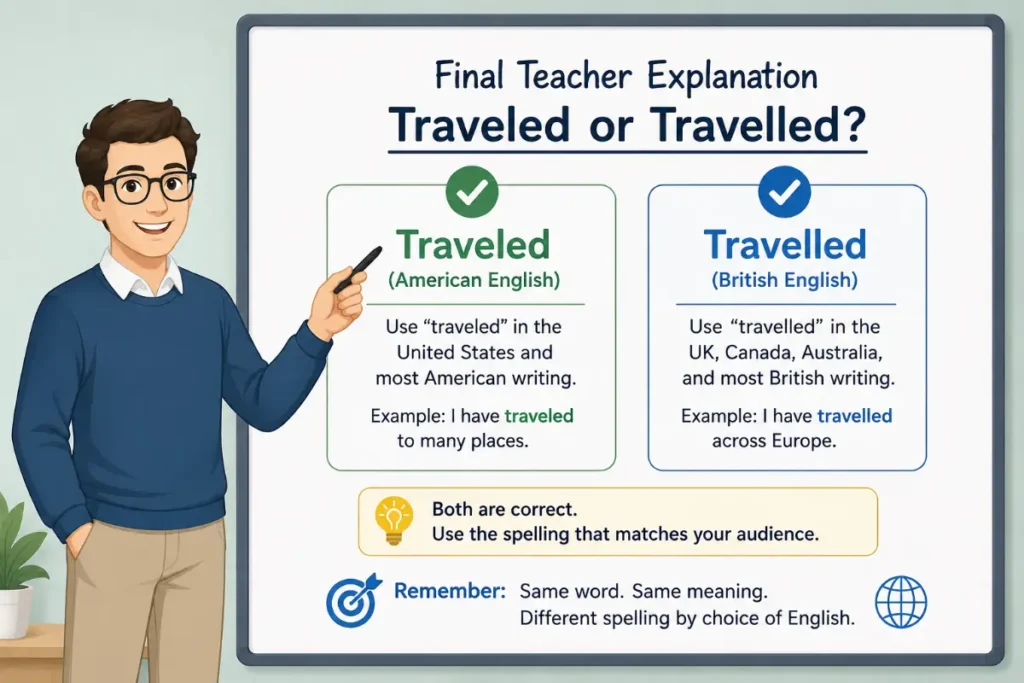
Final Teacher Explanation about Traveled or Travelled
If I were explaining words to a student in class, I would make it very simple.
There are two correct spellings.
Traveled is the usual American English spelling.
Travelled is the usual British English spelling.
Both words mean the same thing.
Imagine that you have two students from different countries. One student writes:
“I traveled to California.”
Another writes:
“I travelled to London.”
Both students have written the word correctly for their English style.
The extra l does not change the meaning.
You do not need to memorize a complicated rule. Just remember the country or English style you are writing for.
For American English, use:
traveled
traveling
traveler
For British English, use:
travelled
travelling
traveller
If you are writing for a US audience, choose traveled. This is especially useful for school work, websites, business writing, and online content aimed at American readers.
If you are writing for a British audience, choose travelled.
Most importantly, do not think of one version as good English and the other as bad English. Both are accepted forms. They simply belong to different spelling traditions.
That is the whole idea.
Final Answer Traveled or Travelled Quick Recap
These are both correct spellings. Traveled is the standard American English form, while travelled is the standard British English form.
Both words mean the same thing. They describe going or moving from one place to another. The extra l in travelled does not change the meaning or pronunciation in normal use.
If you are writing in American English, use traveled. If you are following British English, use travelled. The easiest rule is to choose one English style and use it consistently.
Learn the difference in Indulgent vs Sober: Easy English Lesson With Examples.
Conclusion
The difference between is mainly a spelling difference. Traveled is used in American English, while travelled is used in British English. Both words have the same meaning.
You can use either form correctly when it matches the English style of your writing. For a US audience, traveled is the best choice. For British English, use travelled.
The easy takeaway is: Traveled for American English, travelled for British English.
Frequently Asked Questions FAQs
Which is correct?
Both are correct. Traveled is standard in American English, while travelled is standard in British English.
Is traveled American English?
Yes. Traveled is the usual American English spelling of the past form of travel.
Is travelled British English?
Yes. Travelled is the usual British English spelling.
Do traveled and travelled mean the same thing?
Yes. They have the same meaning. The main difference is the regional spelling.
Can I use travelled in American English?
You can, and readers will understand it, but traveled is the usual American spelling and is better for consistent US English writing.
Can I use traveled in British English?
Readers will understand it, but travelled is the usual British spelling.
Why does travelled have two Ls?
British English commonly doubles the final l in this form. American English usually writes traveled with one l.
Is traveling or travelling correct?
Both are correct. Traveling is standard American English, while travelling is standard British English.
