
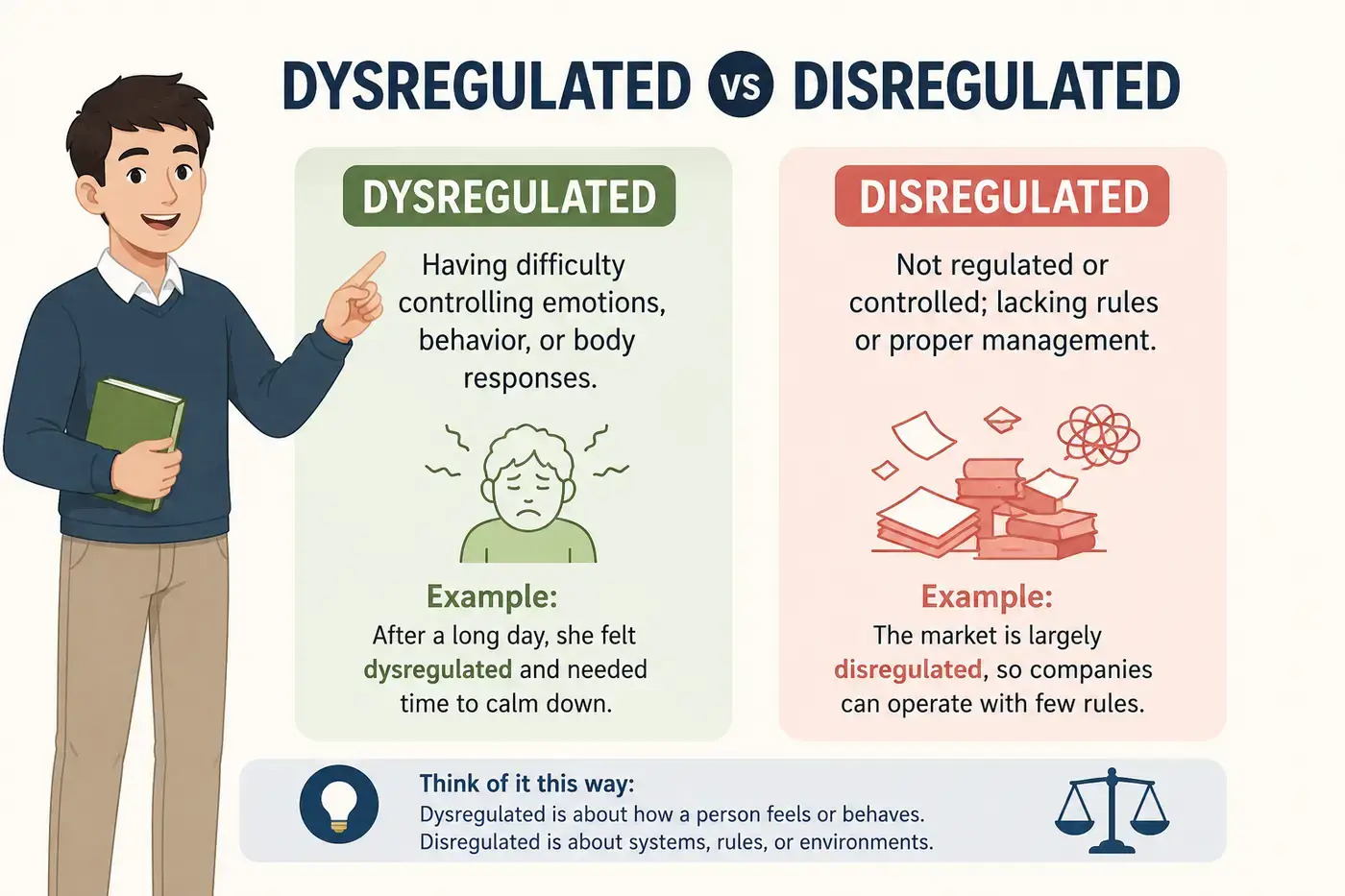
Have you seen dysregulated vs disregulated and wondered which one is right? You are not alone. Many people type these words when talking about emotions, behavior, mental health, or the nervous system. One spelling is correct in standard English, while the other is a common mistake.
The good news is that the answer is simple. Once you understand why these words look so similar, you will remember the correct spelling much more easily. You do not need to memorize difficult grammar rules or medical terms.
In this guide, you will learn the difference. what the correct word means, why people confuse them, and how to use the right spelling with confidence. Every explanation uses simple everyday English.
Still confused? Compare Is It Gray or Grey? Simple Difference and Correct Usage (2026).
Simple Answer in One Look
Dysregulated is the correct spelling.
Disregulated is a misspelling and is not accepted in standard English.
If you are writing about emotions, the brain, behavior, or body systems that are not working normally, always use dysregulated.
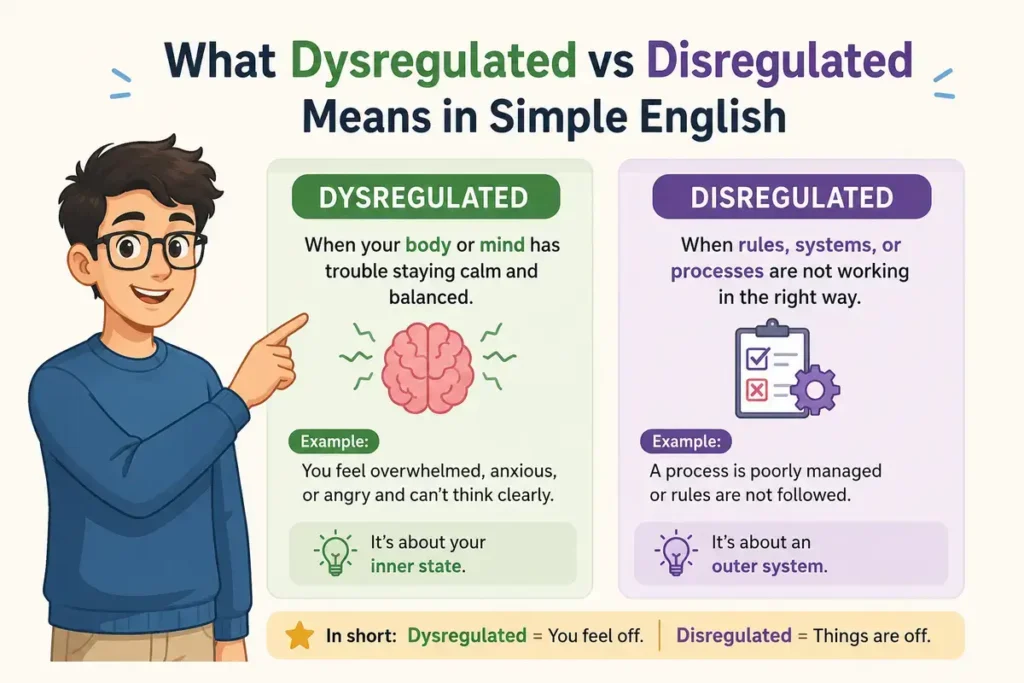
What Dysregulated vs Disregulated Means in Simple English
To understand both words start with the meaning of the correct word. The word dysregulated means that something is not working in its normal or healthy way. It can describe feelings. It can even describe the way someone reacts to stress. Think about a traffic light. When it works, cars stop and go safely. Now imagine the traffic light suddenly stops working. Cars become confused. Traffic slows down.
Some drivers may even have accidents. That traffic system is no longer working the way it should. That is similar to being dysregulated. Your body or mind is not managing things in the normal way. For example, someone may become very upset over a small problem.
Another person may feel worried for hours after something stressful happens. A child may cry for a long time and struggle to calm down. These are simple examples of emotional dysregulation. The word does not mean someone is bad. It does not mean someone is weak. It simply describes that something is not working as smoothly as usual. Doctors, therapists, teachers, and researchers often use this word.
Today, many parents and adults also use it in everyday conversations. You may hear sentences like these. “My child felt dysregulated after the loud noise.” “I became dysregulated during the meeting.” “She needed a quiet place because she felt dysregulated.” Each sentence means that the person’s emotions or reactions became harder to manage.
Why People Mix These Words Dysregulated vs Disregulated
Many people search for these words because the spellings look almost the same. Only one small part changes. That makes it easy to type the wrong version. There are several reasons this happens.
The Beginning Sounds Similar
The first part of dysregulated sounds a little like the word dis. Because of that, many people naturally write disregulated. It feels familiar. But English spelling does not always match pronunciation.
Many English Words Begin With Dis
People already know words like these.
Disagree.
Disappear.
Dislike.
Disconnect.
Because these words start with dis, people often think disregulated should follow the same pattern.
It does not.
Autocorrect Can Be Confusing
Some phones and computers may not recognize medical words very well. They may suggest another spelling. Sometimes they even leave the mistake unchanged. That causes even more confusion.
The Word Is Becoming More Common
Years ago, many people rarely heard the word dysregulated. Now it appears in books, podcasts, schools, therapy offices, and social media. Since more people are using it, more people are also searching for the correct spelling.
The Prefix Is Less Familiar
The beginning dys is less common than dis. Many people have never learned what dys means. Once they understand it, remembering the spelling becomes much easier.
Clear Difference Explained Simply
When comparing the answer is very clear.
| Dysregulated | Disregulated |
|---|---|
| Correct spelling | Incorrect spelling |
| Used in English | Not accepted in standard English |
| Seen in books and dictionaries | Usually a typing mistake |
| Common in psychology and medicine | Avoid using it |
| Means not working normally | Has no accepted meaning |
Here is an easy way to remember it. Think about other words that begin with dys.
Dyslexia.
Dysfunction.
Dysgraphia.
Dysphagia.
All of these describe something that is not working in the usual way. The same pattern appears in dysregulated. The spelling stays the same. The beginning is always dys.
Which Form Should You Use Dysregulated vs Disregulated?
Always choose dysregulated. This is the spelling used by teachers. It is used by doctors. It appears in dictionaries, news articles, research papers, books and educational websites. Avoid writing disregulated. Even if spell check does not notice it, the spelling is still incorrect. Here is a simple rule. If you are talking about emotions, body systems, brain function, stress, or behavior that is not working normally, write dysregulated. Think of these examples.
Correct:
“My emotions became dysregulated.”
Correct:
“The child seemed dysregulated after school.”
Correct:
“Stress can leave someone feeling dysregulated.”
Incorrect:
“My emotions became disregulated.”
Incorrect:
“The child looked disregulated.”
A quick memory trick can help.
Remember the word dysfunction.
Both words begin with dys.
If you remember one, you can remember the other.
Easy Real Life Sentences You Can Use
Here are simple examples using the correct spelling.
“My son felt dysregulated after the fire alarm.”
“I become dysregulated when I do not sleep well.”
“The loud crowd made her feel dysregulated.”
“He took a short walk because he felt dysregulated.”
“The teacher noticed the student looked dysregulated.”
“Deep breathing helped me feel less dysregulated.”
“The baby became dysregulated after missing a nap.”
“My friend needed some quiet time because she felt dysregulated.”
Notice that every sentence uses dysregulated.
None use disregulated because that spelling is incorrect.
Where Dysregulated vs Disregulated Words Expression Comes From Simple History
The history of dysregulated is actually easy to understand. The beginning dys comes from ancient Greek. It means bad, difficult, or not working properly. The word regulated comes from the idea of keeping something under control or working in an organized way. When these parts join together, they create dysregulated. The word means something is no longer working in its normal or balanced way.
Over time, doctors and scientists began using the word to describe body systems that were not functioning correctly. Later, psychologists and therapists started using it to describe emotions, behavior, and the nervous system. Today, the word is much more common than it was years ago. Parents use it. Teachers use it. Many people also use it when talking about stress, anxiety, or emotional balance in everyday life.
The incorrect spelling disregulated did not develop its own meaning. It mostly appears because people replace dys with the more familiar dis. That small spelling mistake creates the confusion. As you become familiar with the correct prefix, the mistake becomes much easier to avoid.
Now you know the basic difference between and the correct spelling, and how to use it in daily English. In the next section, you will learn how this word is understood in culture, what it symbolizes, how people use it in real conversations, common mistakes to avoid, and helpful tips that will make the correct spelling easy to remember forever.
How does words are Understood in Culture and Stories
The word dysregulated is often connected with the way people handle feelings, stress, and difficult moments. In everyday life, people use it when someone’s emotions feel too strong or hard to control. For example, a person may become very angry after a small problem. A child may cry for a long time after getting upset. Someone may feel overwhelmed in a noisy place. People often describe these moments as being dysregulated.
In many cultures and stories, emotions are shown as something that can rise and fall like waves. A person may feel calm one moment and upset the next. Stories often show characters learning how to understand their feelings and find balance. The idea behind dysregulated is not about being a bad person. It is about having a moment when emotions, thoughts, or reactions become difficult to manage.
Many modern stories, movies, and books show characters who struggle with stress, fear, anger, or sadness. These characters often learn patience, support, and self-control. The word also connects with a common human experience. Everyone has moments when they feel too stressed, too tired, or too emotional. The difference is how long the feeling lasts and how much it affects daily life.
That is why people use words when searching for the correct word. They want to describe a real feeling, but they need the correct spelling. The correct word remains dysregulated.
Learn the difference in Any Time vs Anytime: Which Is Correct and How to Use (2026).
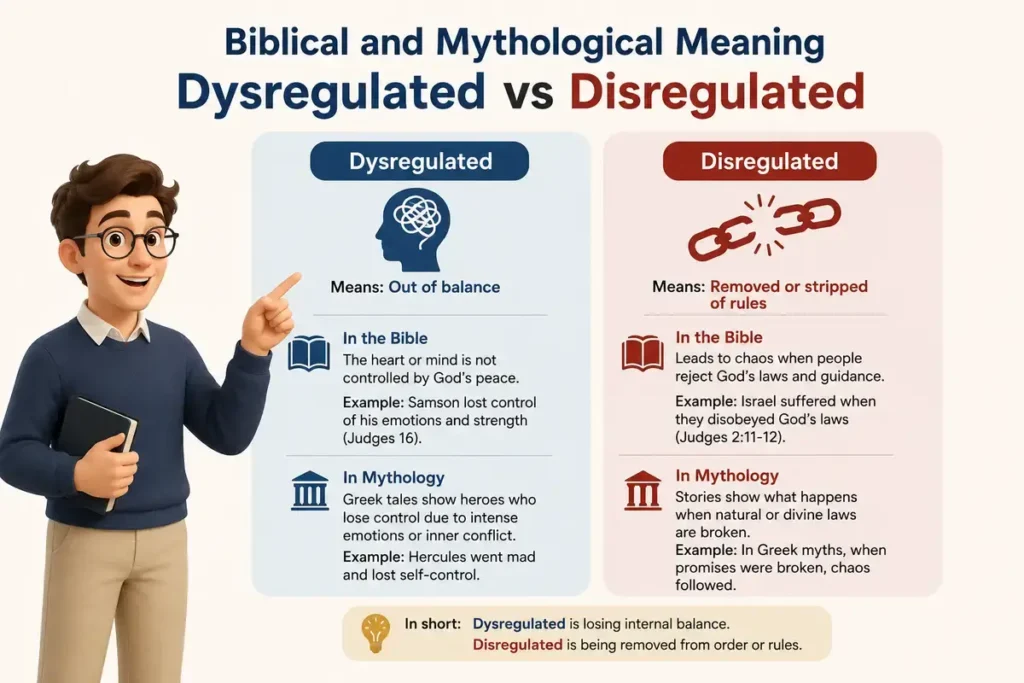
Biblical and Mythological Meaning of Dysregulated vs Disregulated
The word dysregulated does not have a direct meaning in the Bible or ancient mythology because it is a modern word. However, many old stories talk about human emotions and self-control. In biblical stories, people often face moments of anger, fear, sadness, or temptation. These stories show humans struggling with strong feelings and learning wisdom, patience, and forgiveness.
For example, many teachings focus on staying calm during difficult situations and making thoughtful choices instead of reacting quickly. Ancient myths also include characters who experience powerful emotions. Greek myths, for example, often show heroes dealing with pride, anger, fear, or loss. These stories teach lessons about balance and the results of uncontrolled actions.
While these stories do not use the word dysregulated, they share a similar idea. They show what happens when emotions become too powerful and a person loses balance. So, the connection is not about the word itself. It is about the human experience behind the word.
Symbolism Explained in Simple Words
The word dysregulated carries a simple idea. It represents something that has moved away from balance. Think about a musical instrument. When it is tuned correctly, it creates a beautiful sound. When it is out of tune, the sound feels wrong. The instrument is not broken forever. It simply needs adjustment. The same idea can describe emotions and reactions. A person who feels dysregulated may need rest, support, time, or calming activities to return to balance.
What One Version Represents
The correct version, dysregulated, represents imbalance or difficulty managing something. It can represent:
- Strong emotions that feel hard to control.
- A nervous system that reacts strongly to stress.
- A person who needs help calming down.
- A temporary state that can improve.
The word gives the idea that something is not working smoothly. It does not mean a person is weak. It does not mean a person cannot improve.
What the Other Version Represents
The incorrect version, disregulated, does not have a standard meaning in English. It does not represent a different feeling. It does not describe a different condition. Most of the time, it represents a spelling mistake. Many people write it because the prefix “dis” looks familiar. However, in the comparison of these words only dysregulated gives the correct meaning.
Related Words You Should Know
Understanding related words can make the meaning of dysregulated easier.
Regulated
Regulated means controlled, balanced, or managed properly. Example:
“The temperature is regulated by the system.”
Dysregulation
Dysregulation means a problem with controlling or balancing something. Example:
“Emotional dysregulation can make stress harder to manage.”
Emotional Regulation
This regulation means managing feelings in a healthy way. Example:
“Children learn emotional regulation as they grow.”
Self Regulation
Self regulation means controlling your own thoughts, feelings, and actions. Example:
“Taking deep breaths can help with self regulation.”
Nervous System Regulation
This refers to how the body manages stress and calm states. Example:
“Sleep helps nervous system regulation.”
Overwhelmed
Overwhelmed means feeling like something is too much to handle. Example:
“I felt overwhelmed after a busy day.”
Balanced
Balanced means steady and controlled. Example:
“She feels balanced after resting.”
Triggered
Triggered means something causes a strong emotional reaction. Example:
“The loud sound triggered a strong response.”
How People Actually Use Dysregulated vs Disregulated in Daily English
The word dysregulated is used in many real conversations. People often use it when talking about emotions, children, stress, and personal experiences. Here are natural examples. “My daughter became dysregulated after a long day at school.” This means the child had trouble managing emotions. “I felt dysregulated after the stressful conversation.”
This means the person felt emotionally unsettled. “The baby was dysregulated because of a change in routine.” This means the baby had difficulty calming down. “He gets dysregulated when he does not get enough sleep.” This means tiredness affects his emotional control. “The teacher helped the student who was feeling dysregulated.”
This means the student needed support to calm down. “I need some quiet time because I feel dysregulated.” This means the person wants time to feel calm again. “Too much noise can make some people feel dysregulated.” This means noise can create a strong reaction. “She used breathing exercises to become less dysregulated.”
This means she used a calming method. “My emotions felt dysregulated after the unexpected news.” This means the news caused a strong emotional reaction. “The therapist explained how stress can cause dysregulation.” This means stress can affect emotional balance. These examples show that dysregulated is mostly used to describe a state or feeling. It is not usually used to judge someone.
Common Mistakes People Make
Many people make the same mistakes when using both words. Understanding these mistakes can help you avoid them.
Mistake 1 Writing Disregulated
Incorrect:
“I felt disregulated after the argument.”
Correct:
“I felt dysregulated after the argument.”
The problem is the spelling.
The correct beginning is “dys.”
Mistake 2 Thinking Both Words Have Different Meanings
Some people believe dysregulated and disregulated describe two different things.
They do not.
Only dysregulated is correct.
Mistake 3 Using It to Describe Someone as Bad
Incorrect idea:
“He is dysregulated, so he is a bad person.”
Correct idea:
“He became dysregulated during a stressful moment.”
The word describes a condition, not a person’s value.
Mistake 4 Using It Without Understanding
Some people use the word because they hear it online.
Before using any word, understand what it means.
Dysregulated simply means something is not being managed normally.
Mistake 5 Forgetting the Spelling Pattern
A simple trick can help.
Remember:
Dysfunction.
Dysregulation.
Dysregulated.
All three start with “dys.”
Final Teacher Explanation
If I were explaining dysregulated vs disregulated in a classroom, I would say this: “Students, remember one simple thing. The correct word is dysregulated. The other spelling is a mistake.” The word dysregulated describes a time when emotions, reactions, or body systems are not working in a balanced way. Everyone can have moments like this.
A person may feel angry, worried, scared, or overwhelmed. That does not make them a bad person. It only means they are having a difficult moment. The spelling can be remembered easily. The first part is “dys,” not “dis.” Think of words like dysfunction and dysregulation. They follow the same pattern. When you write about emotions, stress, or behavior, use dysregulated.
Avoid disregulated because it is not the accepted spelling. A small spelling difference can change whether a word looks correct or incorrect. Learning this difference helps your writing become clearer and more professional.
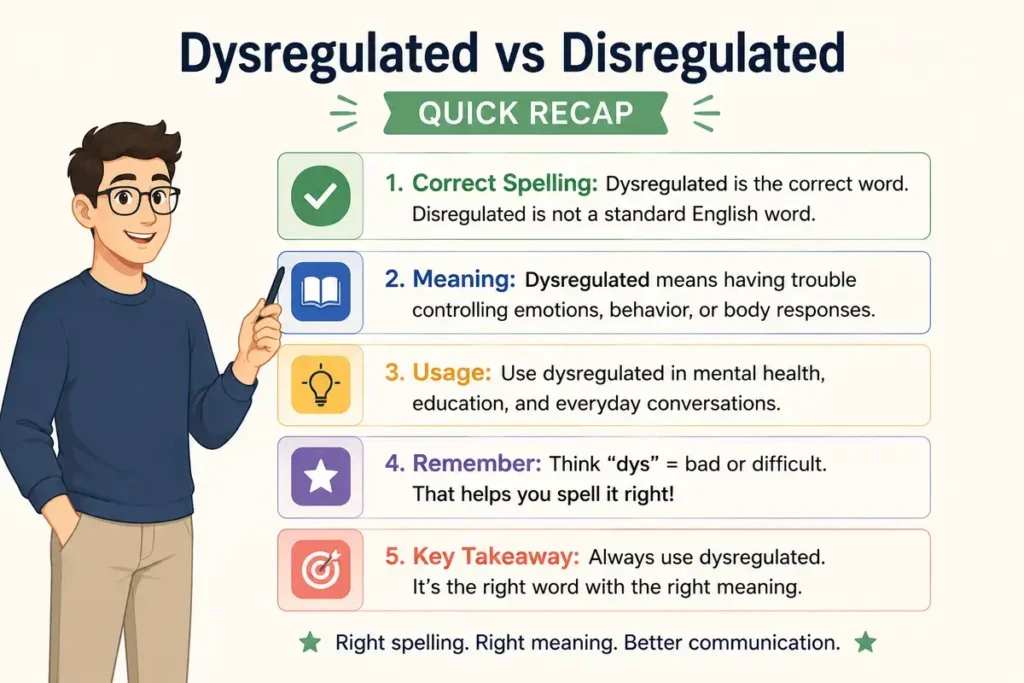
Final Answer about Dysregulated vs Disregulated Quick Recap
The correct spelling is dysregulated.
Disregulated is a common spelling mistake and should not be used.
Use dysregulated when describing emotions, reactions, or systems that are not working normally.
Many readers also check Unkept or Unkempt: Common Mistakes You Should Avoid.
Conclusion
Understanding is simple once you know the correct spelling. The word dysregulated is the right choice in English. It describes a situation where emotions, behavior, or body systems are not working in a balanced way. The spelling disregulated is a common mistake because it looks familiar, but it does not have an accepted meaning in standard English. When you write about stress, emotions, reactions, or self-control, remember to use dysregulated.
Think of it like this: dysregulated means something needs balance or adjustment. It does not mean someone is bad or unable to improve. Everyone can have moments when feelings become difficult to manage. A simple memory trick is to connect dysregulated with other words like dysfunction and dysregulation. They all begin with dys.
Now you know the clear difference between and how to use the correct word, and why people often confuse them. Keep using dysregulated in your writing and conversations, and you will always choose the correct form.
Frequently Asked Questions FAQs
What does dysregulated mean in simple words?
Dysregulated means something is not working in a balanced or normal way.
Is dysregulated or disregulated correct?
Dysregulated is correct. Disregulated is not a standard English word.
When should I use dysregulated?
Use it when talking about emotions, stress, behavior, or body systems that are difficult to manage.
Why do people get confuse?
People confuse them because “dis” is more common in English words, but the correct prefix here is “dys.”
Can I use both forms in writing?
No. Use only dysregulated in correct English writing.
Is dysregulated a medical word?
It is often used in medical and psychology settings, but people also use it in everyday conversations.
Does dysregulated mean someone is bad?
No. It only describes a temporary state or difficulty managing something.
How can I remember the correct spelling?
Remember words like dysfunction and dysregulation. They all start with “dys.”
