
Many English learners get confused about lay vs lie because the words look alike but they do not work the same way. You may hear both words every day, but using the wrong one can make a sentence sound strange. The good news is that this is one of the easiest grammar problems to fix once you know the simple rule.
The difference between words becomes clear when you remember one question. Are you putting something down, or is someone resting by themselves? That single question helps you choose the correct word in most situations.
This guide explains in very simple English. You will learn what each word means, why people mix them up, how to use them correctly, and how to remember the difference without memorizing difficult grammar rules.
You may also want to read Stich vs Stitch: Which Spelling Is Correct?.
Simple Answer in One Look
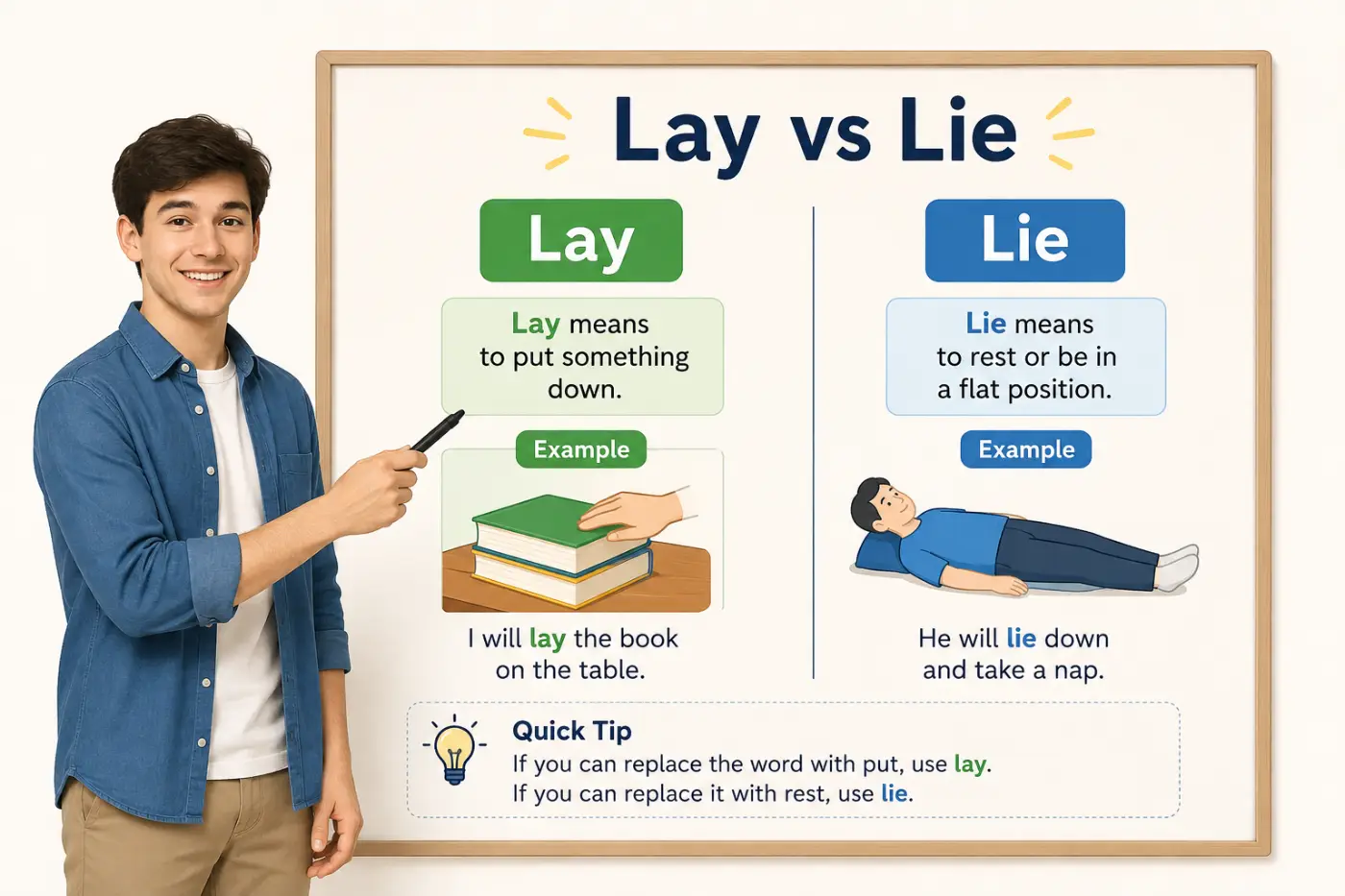
Lay means to put something down.
Lie means to rest or be in a flat position.
Example:
- Please lay the book on the table.
- I want to lie on the couch after work.
What Does Lay Vs Lie Mean in Simple English?
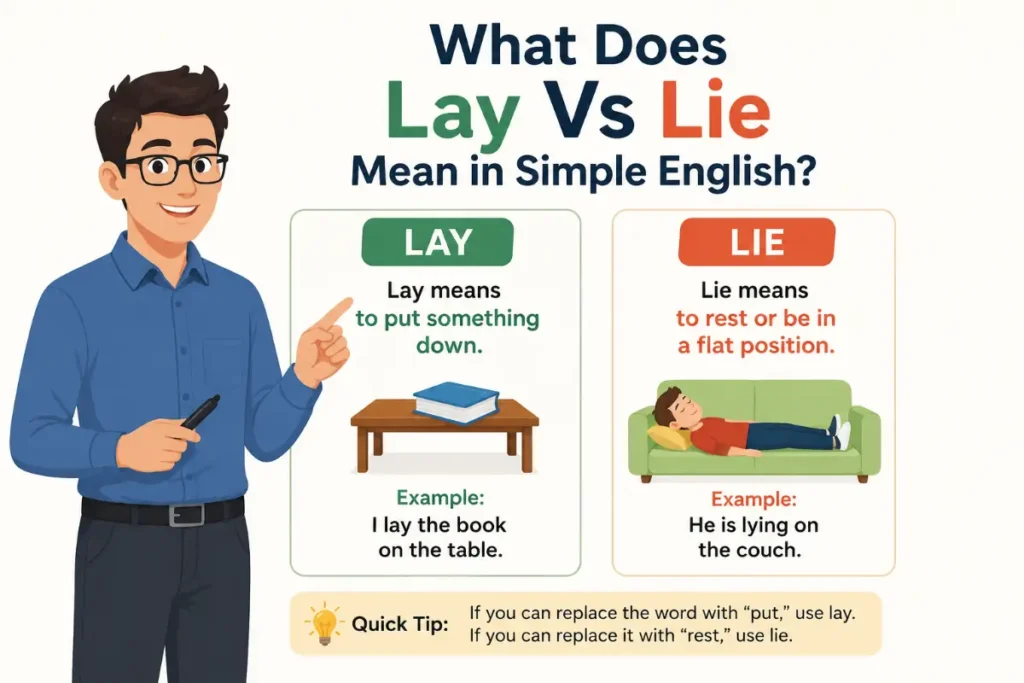
The easiest way to understand these words is to picture two different situations. Imagine you are carrying a backpack. You take it off and put it on the floor. You lay the backpack on the floor. Now imagine you are tired after school. You stretch out on your bed. You lie on the bed. That is the main difference.
Lay is used when something is being placed somewhere.
Examples:
- Lay the keys on the desk.
- Lay your phone next to the laptop.
- Lay the towel on the chair.
- Lay the baby in the crib.
In every example, someone is placing an object or another person somewhere.
Now look at lie.
Lie is used when a person or animal rests or stays in a flat position.
Examples:
- I want to lie down.
- The dog likes to lie near the door.
- The baby will lie in the crib.
- We can lie on the beach all afternoon.
Nobody is placing another object. The subject is simply resting.
Think of it this way.
Lay = put something down.
Lie = rest by yourself.
That simple idea will help you in most everyday conversations.
A Classroom Example
Your teacher says:
“Please lay your notebook on my desk.”
The teacher wants you to put the notebook somewhere.
Now your friend says:
“I’m tired. I want to lie down.”
Your friend is resting.
The actions are different even though the words sound similar.
Another Easy Way to Remember
Ask yourself one question.
Can I say “put” instead?
If the answer is yes, then lay is usually correct.
Example:
- Lay the jacket on the chair.
- Put the jacket on the chair.
Both sentences have almost the same meaning.
Now try this one.
- I want to lie on the sofa.
- I want to put on the sofa.
That does not make sense.
So lie is the correct choice.
Everyday Situations
Morning:
- Lay your clothes on the bed.
- Then lie down for five more minutes.
At school:
- Lay your backpack under your chair.
- Do not lie on the classroom floor.
At home:
- Lay the groceries on the counter.
- The cat likes to lie near the window.
These examples show the difference in real life.
Why Do People Mix These Words Lay And Lie?
Many people make mistakes. Even native English speakers sometimes use the wrong word in casual conversation.
There are several reasons for this confusion.
They Sound Similar
The words are very short.
They also have similar spellings.
When people speak quickly, they can sound almost the same.
The Past Forms Are Confusing
One reason people struggle is that the past forms do not follow the pattern many people expect.
Look at these examples.
Present:
- I lay the book on the table.
- I lie on the bed.
Past:
- Yesterday I laid the book on the table.
- Yesterday I lay on the bed.
Notice something interesting.
The past tense of lie is lay.
That surprises many learners.
Both Words Can Describe Similar Situations
Think about bedtime.
A parent may say:
“Lay your blanket on the bed.”
A few seconds later they may say:
“Now lie down.”
The actions happen in the same place.
One sentence is about placing something.
The other is about resting.
Because they happen together, people often mix the words.
Many People Learn the Wrong Rule
Some people simply copy what they hear around them.
If friends or family often say:
“Go lay down.”
The expression may sound normal.
In everyday conversation, many native speakers say this.
However, careful writing usually prefers:
“Go lie down.”
Fast Speaking Creates Habits
People often speak without thinking about grammar.
That is why mistakes become habits.
Once you learn the simple difference, you will notice these mistakes more often.
Clear Difference Explained Simply
Here is the easiest comparison.
| Lay | Lie |
|---|---|
| Means put something down | Means rest or stay flat |
| Needs something to be placed | Does not need another object |
| Think about moving an object | Think about resting yourself |
You can also remember it this way.
Lay
- Lay the book down.
- Lay the plate on the table.
- Lay the towel on the chair.
- Lay the baby in the crib.
Lie
- Lie on the sofa.
- Lie in bed.
- Lie on the grass.
- Lie quietly for a while.
Picture It in Your Mind
Imagine your bedroom.
You walk in carrying a pillow.
First, you lay the pillow on the bed.
Then you lie on the bed.
One action places something.
The other action describes your body.
That picture is easy to remember.
Quick Memory Trick
Ask yourself:
Am I putting something somewhere?
If yes, use lay.
If not, and someone is simply resting, use lie.
Which Form Should You Use?
The correct choice depends on what is happening in your sentence.
Use lay when someone puts something somewhere.
Examples:
- Lay the dishes on the table.
- Lay your homework on my desk.
- Lay the blanket over the chair.
- Lay the phone beside the computer.
Notice that every sentence has something being moved.
Now use lie when someone rests.
Examples:
- Lie on the couch.
- Lie on the beach.
- Lie in bed.
- Lie quietly for a few minutes.
These sentences describe a person or animal staying in a resting position.
A Simple Question That Always Helps
Before choosing the word, ask yourself:
What is being moved?
If an object is being placed, choose lay.
If someone is resting, choose lie.
Common Mistakes
Wrong:
- Please lie the book on the table.
Correct:
- Please lay the book on the table.
Wrong:
- I want to lay on the sofa.
Correct:
- I want to lie on the sofa.
The Easy Rule
You can remember everything with two short ideas.
- Lay means put.
- Lie means rest.
That simple rule works in most situations.
Easy Real Life Sentences You Can Use Lay Or Lie
Here are simple examples that sound natural in everyday English.
- Please lay your jacket on the chair.
- I need to lie down because I feel tired.
- Lay the keys next to the door.
- The cat likes to lie in the sunshine.
- Lay the dishes on the kitchen counter.
- We will lie on the beach all afternoon.
- Lay the papers on my desk before you leave.
- After dinner I like to lie on the couch and watch a movie.
Read these sentences aloud.
Notice how lay always means placing something.
Notice how lie always means resting.
The more you practice with real sentences, the easier these words become.
Where This Expression Comes From Simple History
The story behind words goes back hundreds of years. Both words come from very old English. Long ago, English had many words that changed forms in unusual ways. Over time, most of those words became simpler. However, lay and lie kept many of their older forms. That is why learners still find them confusing today.
The past tense of lie became lay, while the past tense of lay became laid. These older forms have stayed in modern English for many generations. Even though the history sounds complicated, you do not need to remember every old form. Just remember the simple meanings.
- Lay means put something down.
- Lie means rest.
That simple rule is much more useful than trying to memorize the entire history. As you continue learning, you will see that is more than a grammar rule. These words also appear in stories, famous sayings, everyday conversations, and many common expressions. Understanding how people naturally use them will help you speak and write with more confidence while making English feel easier and more natural.
How Lay And Lie Is Understood in Culture and Stories
The difference between both words are not only about grammar. These words also appear in stories, songs, books, and everyday conversations. People use them to describe simple actions that everyone understands.
The word lay often shows that someone is taking action. A person lays a blanket on the ground before a picnic. A parent lays a baby in a crib. A worker lays bricks to build a house. In each case, someone is doing something with care.
The word lie often shows rest, peace, or waiting. A child lies in bed after a long day. A dog lies near the fireplace. A family lies on the beach during a vacation. These pictures make people think of comfort and quiet moments.
Many children’s stories use these words because they describe common actions. A bird may lay an egg in its nest. A tired bear may lie in its cave during winter. These simple examples help children learn the meanings naturally.
You may also hear these words in songs or poems. Writers often use lie when talking about peaceful places. They use lay when showing someone placing something carefully. Even when people are not thinking about grammar, they usually understand the idea behind each word. Learning helps you understand these stories better because you can clearly see who is doing the action and who is simply resting.
A related grammar guide is Signer or Signor: What’s the Difference (2026 Guide)?.
Biblical And Mythological Meaning Of Lay vs Lie
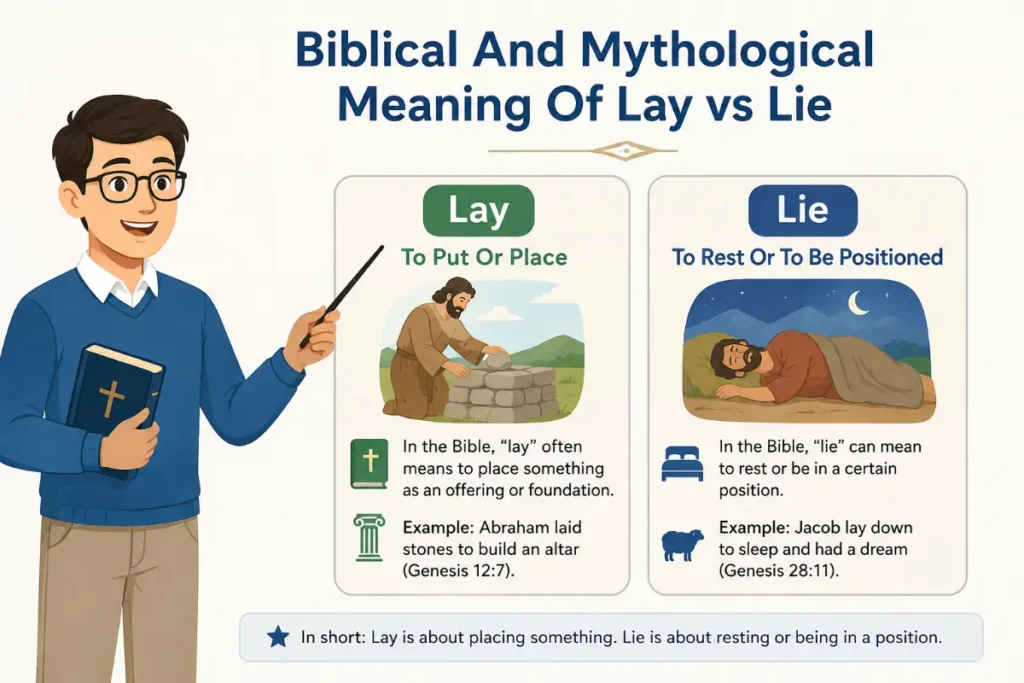
The words lay and lie appear many times in the Bible because they describe normal daily life. For example, people may lay gifts before a king, lay hands on someone during a blessing, or lay a child in a safe place.
In these examples, lay means placing something or someone somewhere with purpose.
The word lie is often used when people rest, sleep, or remain in one place. Someone may lie down to sleep after a long journey or lie quietly while waiting.
These meanings are simple and match the same meanings we use today. In mythology, these words are also common. Heroes may lay down their weapons after a battle. A giant may lie asleep in a mountain. The words describe actions clearly without changing their basic meaning. The cultural meaning has stayed almost the same for hundreds of years. Lay still means putting something somewhere. Lie still means resting or staying flat.
Symbolism Explained In Simple Words
What Lay Represents
In many stories, lay represents action, care, and purpose.
When a parent lays a blanket over a child, it shows love and protection.
When workers lay the foundation of a building, it shows the beginning of something new.
Because someone is doing an action, lay often represents effort, responsibility, and kindness.
What Lie Represents
The word lie often represents peace, rest, and quiet.
When snow lies on the ground, it creates a picture of calm nature.
When a pet lies beside its owner, it shows comfort and trust.
Because no object is being placed, lie often represents stillness, patience, and relaxation.
This simple difference makes the meanings easier to remember.
Lay often shows action.
Lie often shows rest.
Related Words You Should Know
Here are some useful words that are connected.
Laid
This is the past tense of lay. It means something was placed somewhere.
Example: She laid the book on the table.
Lain
This is the past participle of lie. It means someone has rested somewhere.
Example: The dog has lain near the door all afternoon.
Laid Out
This expression means something has been arranged neatly.
Example: The clothes were laid out before school.
Lie Down
This means to rest in a flat position.
Example: I need to lie down after work.
Layer
A layer is one level placed on top of another.
Example: Add another layer of paint.
Placement
Placement means putting something in a certain position.
Example: Good placement makes the room look nicer.
Position
Position means the place where something stays.
Example: Change your sitting position.
Rest
Rest means relaxing after work or activity.
Example: You should get some rest tonight.
These words help you understand situations where lay and lie are commonly used.
How People Actually Use Lay Or Lie In Daily English
Most people use these words while talking about ordinary daily activities.
Here are some natural examples.
- Please lay your phone on the desk.
- I’m tired. I need to lie down for a few minutes.
- Lay your backpack by the door before dinner.
- The baby is lying peacefully in the crib.
- We love to lie on the grass and watch the clouds.
- Lay the groceries on the kitchen counter.
- The cat always lies near the window in the afternoon.
- Lay your notebook beside your computer.
- I just want to lie on the couch after work.
- Lay the clean towels in the bathroom.
These are the kinds of sentences you hear every day at home, at school, and at work.
Common Mistakes People Make
Many learners make the same mistakes because these words look alike.
Here are some common examples.
Mistake
I want to lay on the bed.
Correct
I want to lie on the bed.
The person is resting, not placing something.
Mistake
Please lie your books on the table.
Correct
Please lay your books on the table.
The books are being placed somewhere.
Mistake
The dog laid under the tree all afternoon.
Correct
The dog lay under the tree all afternoon.
The dog was resting.
Another mistake is trying to memorize long grammar rules.
Instead, remember one simple question.
Are you putting something down?
If yes, use lay.
Are you resting?
If yes, use lie.
This simple habit will help you avoid most mistakes.
Final Teacher Explanation About Lay vs Lie
Imagine we are finishing today’s English lesson.
You only need to remember one easy idea.
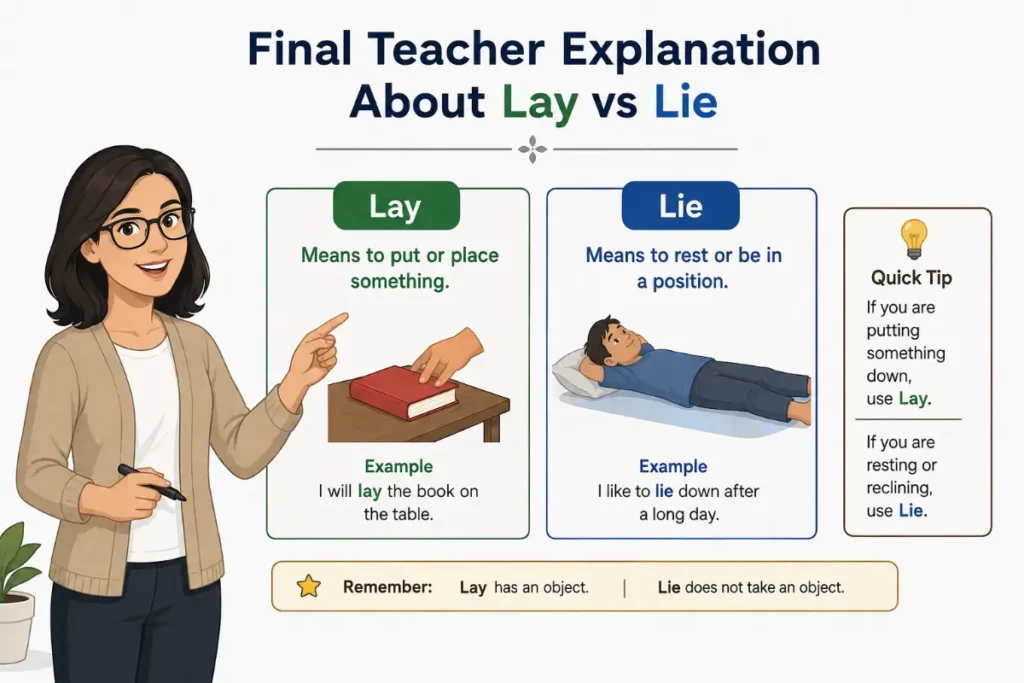
If you are placing something somewhere, use lay.
If a person or animal is resting, use lie.
Do not worry if you forget sometimes. Even many native English speakers pause before choosing the correct word.
Keep practicing with simple daily sentences.
Say things like:
Lay the book on the desk.
Lie on the sofa.
Lay the blanket on the bed.
Lie down and relax.
The more you use these examples, the faster the correct word will come to your mind.
Good English is built through practice, not perfection.
Every small step helps you become a more confident speaker and writer.
Final Answer About Lay Or Lie
The answer to words are easier than many people think. Use lay when someone puts something somewhere. Use lie when someone rests or stays in a flat position. This one rule works in most everyday conversations and writing.
If you cannot decide which word to choose, ask yourself one question. Am I placing something, or am I simply resting? Your answer will usually tell you which word is correct.
Once you practice this simple rule with real-life examples, lay vs lie will stop feeling confusing. You will begin to notice the correct forms naturally when reading, writing, and speaking English.
Learn the difference in Unorganized vs Disorganized Explained Simply in 2026.
Conclusion
Understanding does not have to be difficult. The words may look similar, but their meanings are different. Lay means putting something down, while lie means resting in a flat position.
The easiest way to remember lay vs lie is to think about the action. If something is being placed somewhere, choose lay. If someone is simply resting, choose lie.
Keep using these words in everyday conversations, and they will soon feel natural. The simple takeaway is easy to remember: Lay means put. Lie means rest.
Frequently Asked Questions
What does mean in simple words?
Lay means to put something down. Lie means to rest or stay in a flat position.
Is it correct to say lay down or lie down?
If you are talking about resting yourself, lie down is the correct choice.
Why do people confuse?
The words look alike, sound similar, and their past forms are unusual, so many people mix them up.
When should I use lay?
Use lay when someone places an object or another person somewhere.
When should I use lie?
Use lie when a person or animal rests or stays in a flat position.
Can I use both words in formal writing?
Yes. Both words are correct when used with their proper meanings.
What is the easiest way to remember?
Remember this simple rule: Lay means put. Lie means rest.
Do native English speakers confuse?
Yes. Many native speakers make this mistake in casual speech, but careful writing usually follows the correct forms.
