
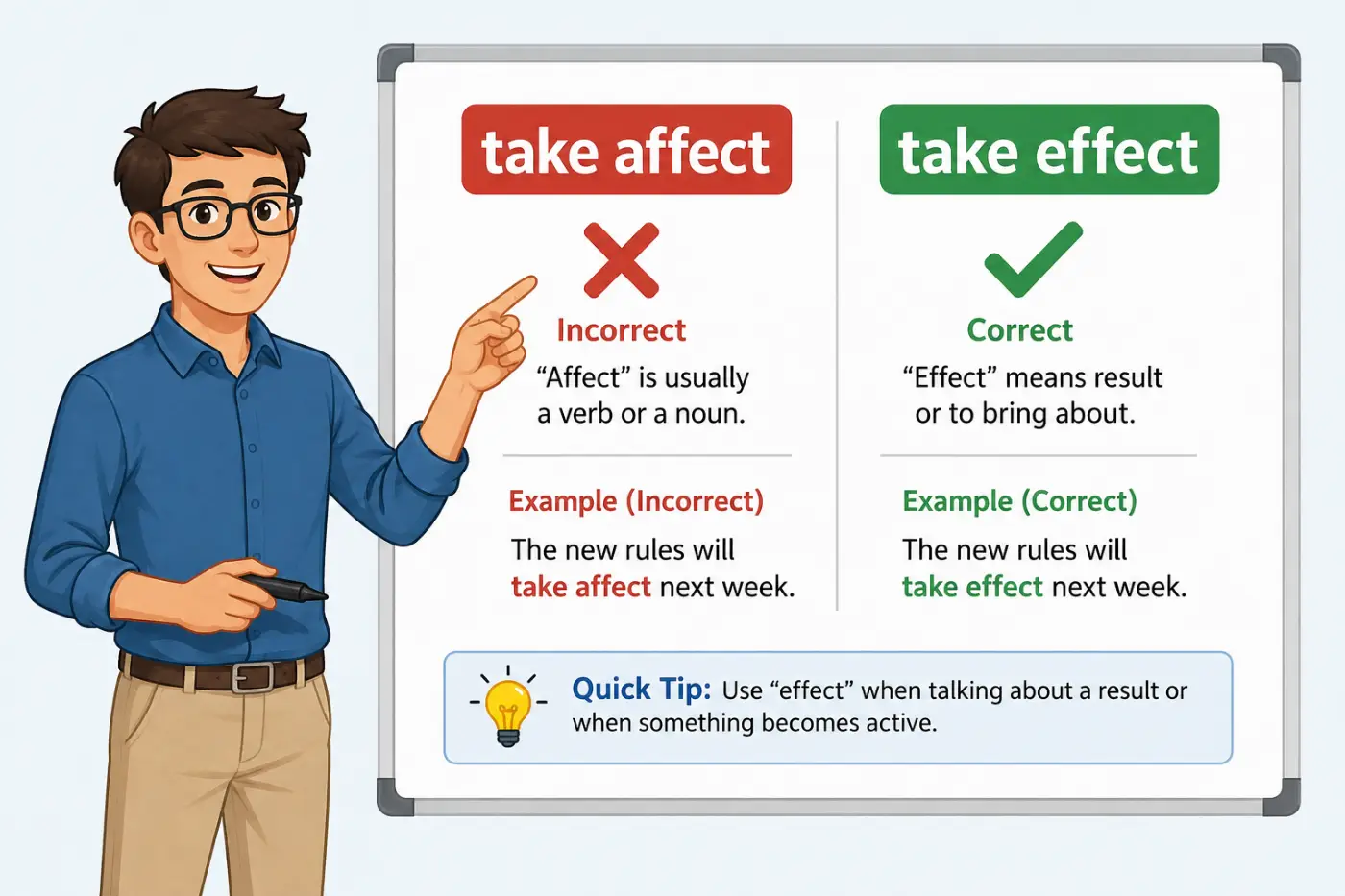
Many English learners get confused about take affect vs take effect because the two phrases sound almost the same. One of them is correct in standard English. The other is usually a mistake. Once you know the difference the choice becomes easy.
If you have ever stopped while writing an email school paper or social media post you are not alone. Many native English speakers also mix up these words because affect and effect look and sound similar.
This guide explain in very simple English. You will learn the meaning the difference easy rules real life examples and a little history so you can use the correct phrase with confidence.
Many readers also check Serpent Vs Snake: Easy Guide Every Student Needs (2026).
Simple Answer In One Look.
Take effect is the correct English phrase. It means that something starts working or starts becoming active.
Take affect is almost always incorrect because the verb take goes with effect not affect.
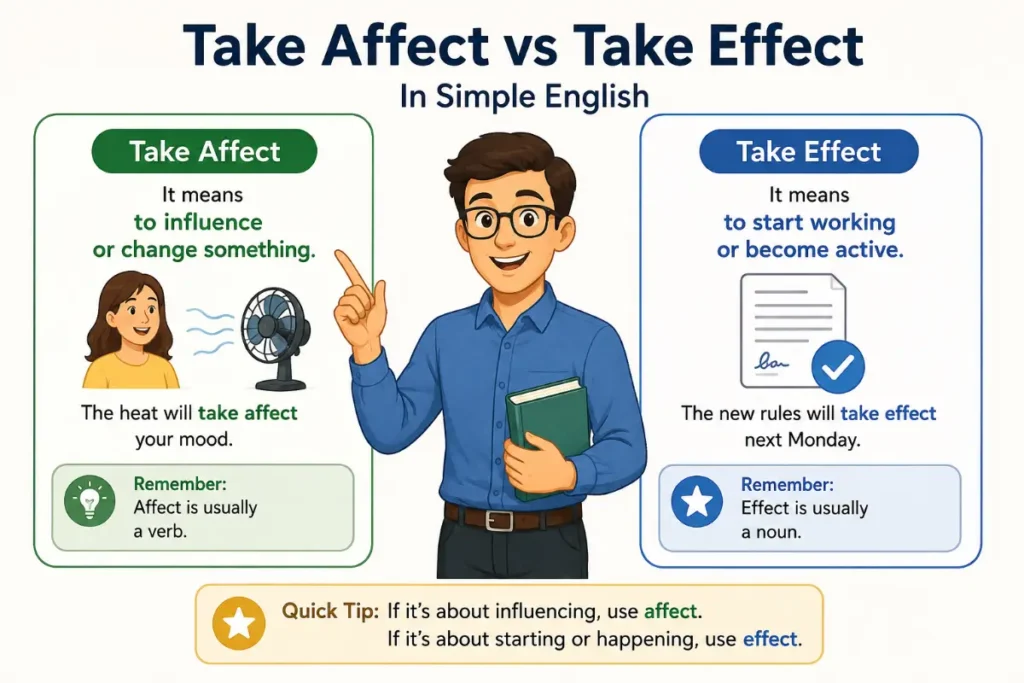
What Does Take Affect vs Take Effect Mean In Simple English.
The easiest way to remember this is to think about something starting.
When a medicine starts working people say it takes effect.
When a new law becomes active people say it takes effect.
The phrase simply means that something begins to work or begins to happen. The phrase take affect does not have this meaning in normal English. Most people write it by mistake because affect and effect sound alike.
Think of it this way.
- Take effect = start working.
- Take affect = usually a spelling mistake.
That one simple idea will help you most of the time.
Why Do People Mix These Words Take Affect vs Take Effect
This mistake is very common for several simple reasons.
They Sound Almost The Same.
When people speak quickly affect and effect can sound very similar. That makes it easy to spell the wrong word.
Both Words Exist.
The confusion becomes bigger because both words are real English words.
Affect is usually a verb.
Effect is usually a noun.
Since both are correct words many writers choose the wrong one without noticing.
Spell Check May Not Help.
A spelling checker often accepts both words because neither one is misspelled.
For example:
- Incorrect: The new policy will take affect.
- Correct: The new policy will take effect.
The computer sees both words as real words so it may not warn you.
People Remember The Wrong Pattern.
Many people know the word affect from phrases like these.
- The rain affected our trip.
- Stress affects your sleep.
- Noise affects your focus.
Because they often see affect they accidentally use it after the word take.
Clear Difference Explained Simply.
Here is the easiest comparison.
| Take Effect | Take Affect |
|---|---|
| Correct English phrase | Usually incorrect |
| Means something starts working | Does not have this meaning |
| Used with laws rules medicine plans and changes | Common spelling mistake |
| Standard in writing and speaking | Should usually be avoided |
You can also remember these simple points.
- Use take effect when something begins.
- Do not write take affect in normal English.
- If you mean start working choose effect.
Easy Memory Trick.
Imagine turning on a light switch.
The moment the light comes on it has taken effect.
The word effect reminds you of the result after something begins.
Which Form Should You Use.
You should almost always use take effect.
Use it when talking about:
- New laws.
- School rules.
- Company policies.
- Medicines.
- Price changes.
- Agreements.
- Contracts.
- Safety rules.
Here are easy examples.
- The new rule will take effect tomorrow.
- The medicine took effect after thirty minutes.
- The price increase takes effect next week.
- The contract will take effect on January first.
- The change took effect immediately.
You should not write:
- The medicine took affect.
- The rule will take affect.
- The contract takes affect.
These are considered mistakes in standard English.
Easy Real Life Sentences You Can Use Take Affect vs Take Effect
These examples sound natural in everyday English.
- The new school rules will take effect on Monday.
- The medicine took effect very quickly.
- Our new work schedule takes effect next month.
- The safety plan will take effect after the meeting.
- The discount takes effect today.
- The agreement took effect as soon as everyone signed it.
- The changes will take effect next year.
- The new password policy takes effect immediately.
Notice that every sentence uses take effect because something starts working or becomes active.
Where This Expression Comes From Simple History.
The phrase take effect has been used in English for hundreds of years. The word effect comes from an old Latin word that means to produce or bring about a result. Over time English speakers began saying that something takes effect when it starts producing its result. That is why people use the phrase for laws medicine agreements rules and many other things. The phrase became common because it clearly tells us that something has started working.
The phrase take affect did not develop in the same way. It appeared mostly because writers confused affect with effect. Since the words sound alike the mistake spread easily. As a result dictionaries style guides teachers and editors continue to recommend take effect as the correct expression.
The more you read newspapers books and official documents the more often you will see take effect used correctly. The good news is that this mistake is easy to fix. Once you remember that something starts working by taking effect you will naturally choose the correct phrase every time.
Understanding this basic rule also prepares you for learning how the words are used in different situations and why the correct phrase appears so often in daily life. In the next section you will see how take effect is understood in culture stories professional writing and everyday communication along with common mistakes related words and a simple final recap.
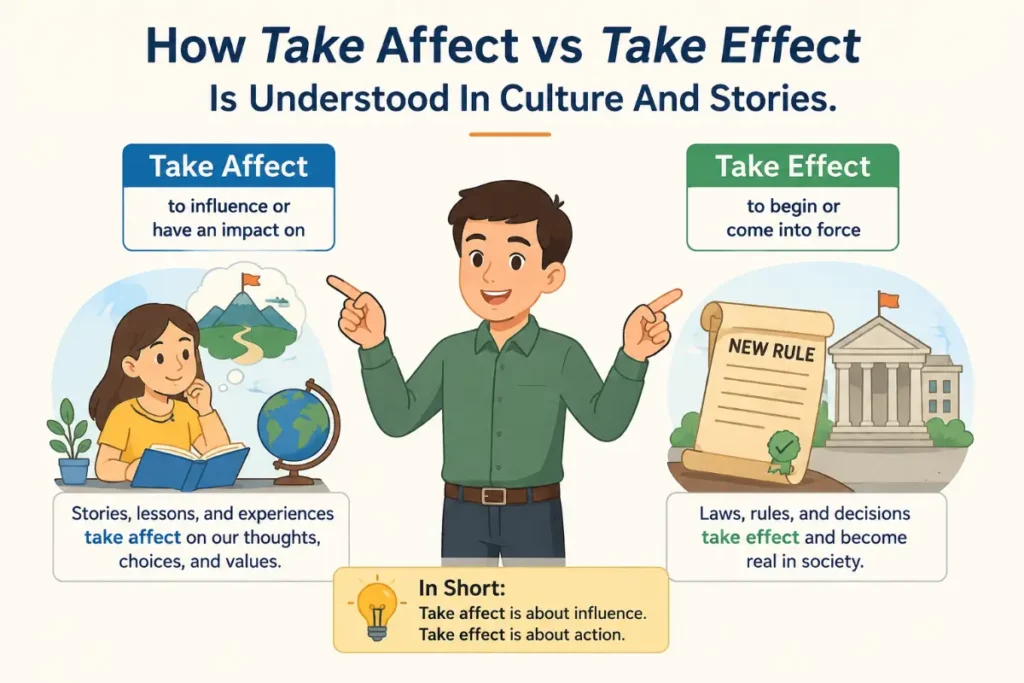
How Take Affect vs Take Effect Is Understood In Culture And Stories.
Language grows through daily life. People hear words from parents teachers friends movies books and news reports. Over time some phrases become trusted because people use them again and again. Take effect is one of those trusted phrases. When people hear take effect they understand that something is about to begin.
They know a rule a law a plan or a change is becoming real. The phrase gives a feeling that something is moving from an idea into action. For example a teacher may say a new classroom rule will take effect tomorrow. Students know the rule starts tomorrow and they should follow it from that day.
You will also hear this phrase in news stories. Reporters often say that a new law will take effect next month. People immediately understand that the law is not active yet but soon it will be. The phrase also appears in stories about medicine. A doctor may explain that a medicine takes effect after about thirty minutes. This tells patients when they should expect the medicine to start working.
You almost never hear people use take affect in books newspapers or official writing because it is not the accepted phrase in standard English. If it appears it is usually a spelling mistake instead of a different meaning. This is why learning is helpful. One phrase is accepted by English speakers everywhere. The other is usually corrected by teachers editors and professional writers.
A related grammar guide is Bearer vs Barer: Which One Should You Use?.
Biblical And Mythological Meaning
There is no special Biblical meaning for take effect or take affect. The Bible does not use these phrases as special religious expressions. There is also no well known mythological meaning connected to these words.
Even so the idea behind take effect can be understood in many stories. A promise begins to matter when people keep it. A command becomes meaningful when people follow it. A change becomes real when it starts happening. This idea is similar to the meaning of take effect.
The phrase itself is simply part of everyday English. It is not a religious or mythological expression.
Symbolism Explained In Simple Words.
What Take Effect Represents.
The phrase take effect represents a beginning.
It reminds people that something has started.
It can represent:
- A fresh start.
- A new rule.
- A positive change.
- A promise becoming real.
- An action producing results.
- Progress.
- Moving forward.
When someone says a plan has taken effect people expect to see real changes.
What Take Affect Represents.
In normal English take affect does not represent a separate idea.
Instead it often represents confusion between two similar words.
When teachers see this phrase they usually know the writer meant take effect.
That is why learning the correct phrase helps your writing look more natural and professional.
Related Words You Should Know
Affect.
Usually means to influence or change something.
Example: Loud music can affect your concentration.
Effect.
Usually means a result or an outcome.
Example: The medicine had a good effect.
Effective.
Means something works well.
Example: This study method is very effective.
Effectively.
Means doing something in a successful way.
Example: She solved the problem effectively.
Affecting.
Means influencing something right now.
Example: The weather is affecting traffic.
Result.
Means the final outcome after something happens.
Example: Hard work often brings good results.
Outcome.
Means what happens at the end of an event.
Example: Everyone hoped for a positive outcome.
Impact.
Means a strong influence on something.
Example: Exercise has a good impact on health.
Knowing these related words makes it easier to remember the difference.
How Take Affect vs Take Effect Is Used In Daily English.
People use take effect every day without thinking about grammar. They simply use it when something starts working.
Here are natural examples.
- The new parking rules take effect tomorrow.
- My allergy medicine took effect after about twenty minutes.
- The price change will take effect next Monday.
- The school schedule takes effect this fall.
- Our agreement takes effect after both people sign it.
- The software update will take effect after you restart your computer.
- The new office hours take effect next week.
- The safety rules took effect immediately after the meeting.
- The coupon takes effect today.
- The new phone plan will take effect at midnight.
These examples sound natural because English speakers use take effect in many everyday situations.
Common Mistakes People Make
Many learners make the same small mistakes. The good news is that they are easy to fix.
Mistake One.
Incorrect: The new rule will take affect.
Correct: The new rule will take effect.
Remember that rules begin to work. They take effect.
Mistake Two.
Incorrect: The medicine is taking affect.
Correct: The medicine is taking effect.
Medicine starts working. It takes effect.
Mistake Three.
Incorrect: The contract takes affect today.
Correct: The contract takes effect today.
Contracts become active. They take effect.
Mistake Four.
Using affect when you really mean result.
Incorrect: The new plan had a good affect.
Correct: The new plan had a good effect.
Easy Memory Tip.
Think about the word effect as a result.
When something begins producing a result it takes effect.
If you remember the word result you will usually choose the correct phrase.
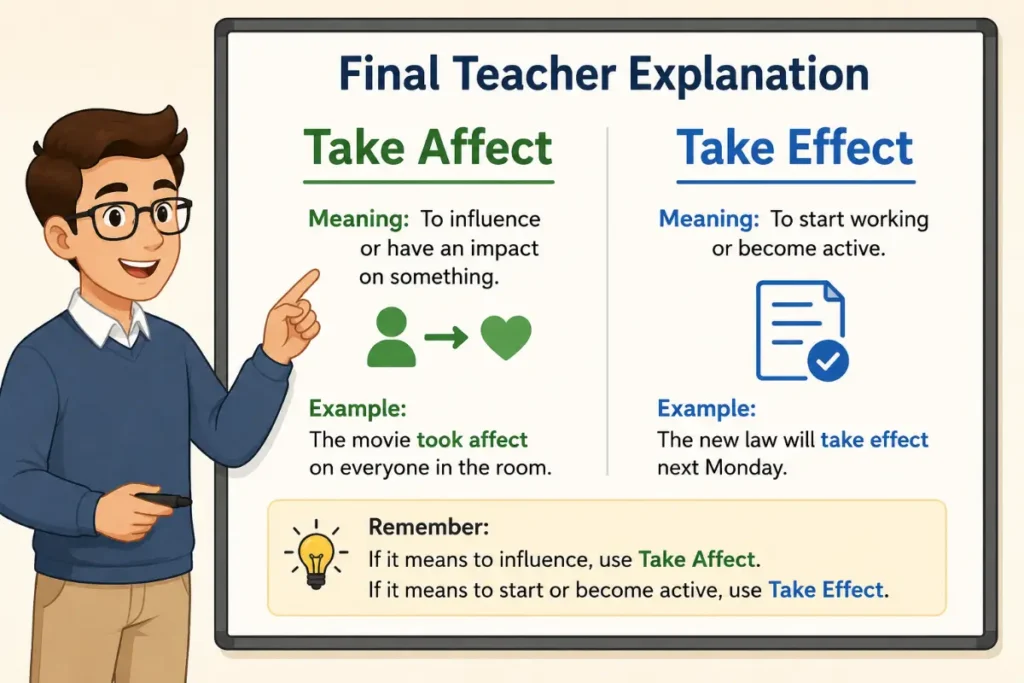
Final Teacher Explanation Of Take Affect vs Take Effect.
Imagine you are sitting in an English classroom. A student asks which phrase is correct.
The answer is simple.
If something starts working use take effect.
If you write take affect you have probably mixed up two words that sound alike.
You do not need to memorize difficult grammar rules.
Just remember one simple idea.
Laws take effect.
Rules take effect.
Medicines take effect.
Plans take effect.
Changes take effect.
That single pattern will help you in school at work and in everyday writing. Many people make this mistake because English has many words that sound similar. Do not worry if you have written take affect before. Now you know the correct phrase and you can use it with confidence. The more you read good English the more natural take effect will feel.
Final Answer About Take Affect vs Take Effect Quick Recap.
The answer to word is clear. Take effect is the correct English phrase. It means something begins to work becomes active or starts producing results. You should use it when talking about laws rules medicines agreements plans and many other changes.
Take affect is almost always a spelling mistake. Even though affect is a real English word it does not belong in this common expression. When you want to say something starts working always choose take effect.
A simple way to remember this is to think about results. When something begins producing results it has started to take effect.
Learn the difference in Apposed vs Opposed: Different Meaning and Usage (2026).
Conclusion
The difference between is easier than many people think. Once you know that take effect means to begin working you can use it correctly in speaking and writing.
You do not need difficult grammar rules or long explanations. Just remember that laws rules medicines contracts and changes all take effect when they become active.
The easiest takeaway is this. If something starts working it always takes effect.
Frequently Asked Questions
What does take effect mean in simple words?
It means something starts working or becomes active.
Is take affect correct?
No. In standard English it is usually a mistake. The correct phrase is take effect.
When should I use take effect?
Use it when a law rule medicine agreement or plan begins to work.
Why do people confuse?
The words sound very similar and both are real English words.
Can I use take affect in formal writing?
No. Professional writing uses take effect.
Does medicine take affect or take effect?
Medicine takes effect when it starts working in your body.
Is take effect used in everyday English?
Yes. Native English speakers use it often when talking about rules laws medicines prices and schedules.
How can I remember the correct phrase?
Think of effect as a result. When something starts producing results it takes effect.
