
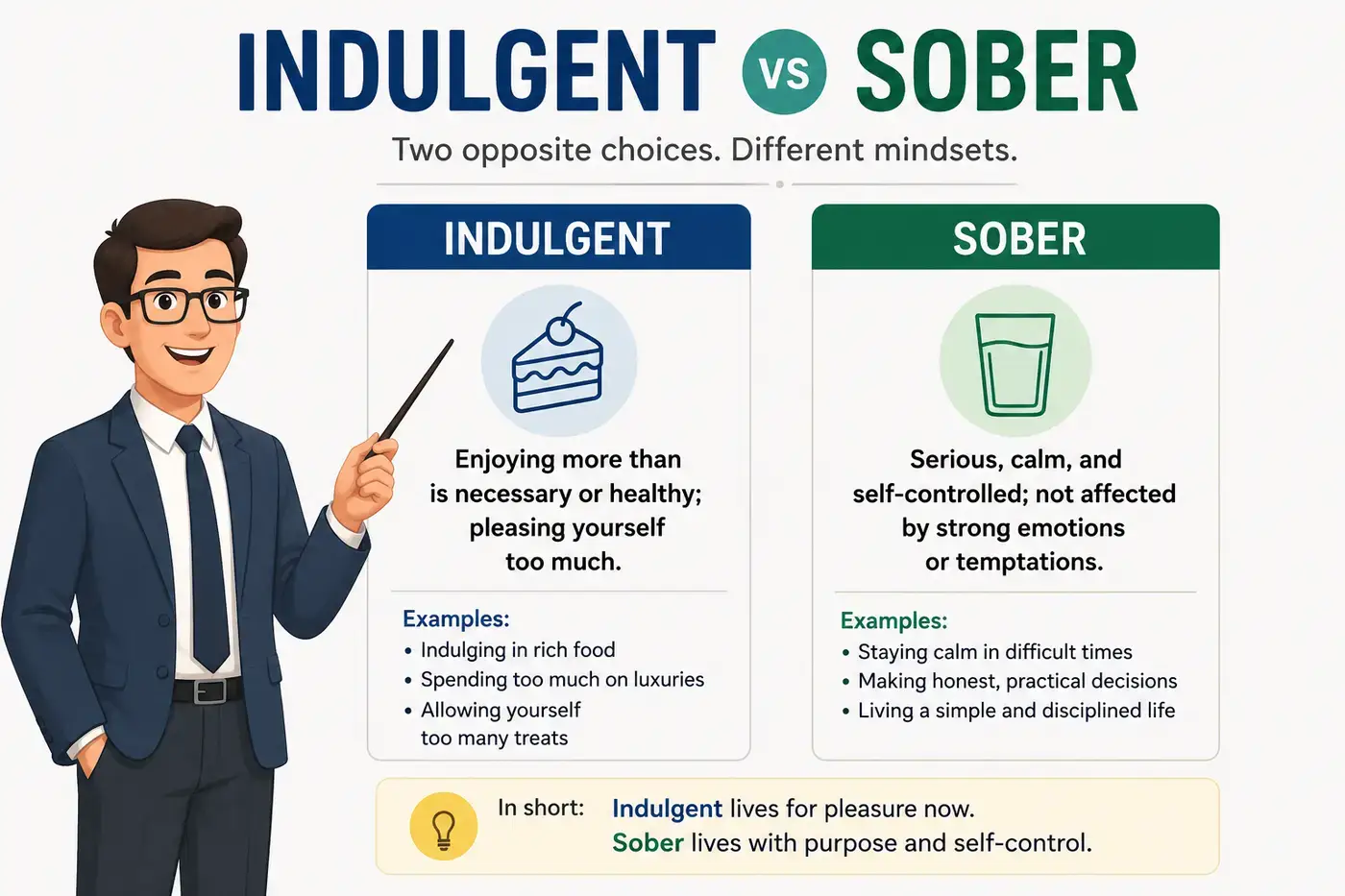
Many people get confused about indulgent vs sober because the two words describe very different ways of thinking, acting, or living. You may see them used in books, conversations, reviews, and everyday situations. Understanding the difference can help you choose the right word and express yourself clearly.
When comparing indulgent vs sober, an indulgent person tends to allow extra pleasure, comfort, or enjoyment. A sober person tends to be serious, controlled, and not excessive. These words often describe attitudes, choices, behavior, and even styles of writing or design.
The good news is that the difference is not difficult to understand. Once you learn the basic meaning of each word, you can quickly tell which one fits a situation better.
For another common grammar confusion, see Any Time vs Anytime: Which Is Correct and How to Use (2026).
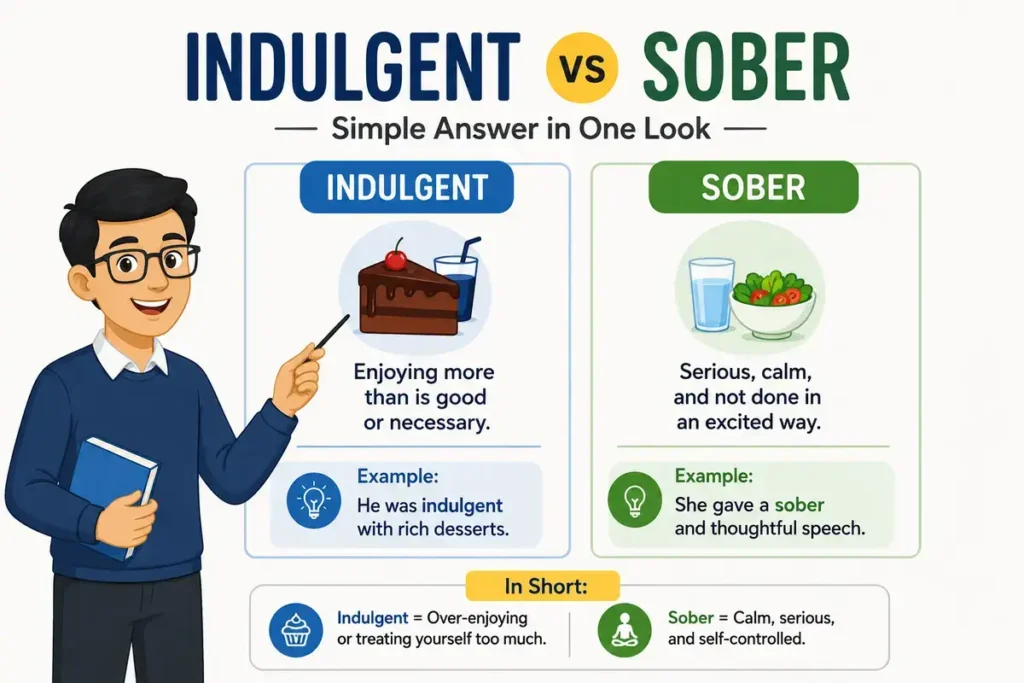
Indulgent vs Sober: Simple Answer in One Look
Indulgent means allowing extra pleasure, comfort, or enjoyment.
Sober means controlled, serious, balanced, and not excessive.
The difference between indulgent vs sober is that one leans toward enjoyment and treating yourself, while the other leans toward self-control and moderation.
What Does Indulgent vs Sober Mean in Simple English?
Think about a person standing in front of a table full of desserts. One person eats several slices of cake because they want to enjoy the moment. That behavior could be called indulgent. Another person chooses a small portion and stops when they have had enough. That behavior could be described as sober or controlled.
What Does Indulgent Mean?
The word indulgent describes someone who gives in to desires, pleasures, or wishes. An indulgent person may:
- Enjoy treats often.
- Spend extra money on comfort.
- Avoid being too strict.
- Allow themselves or others special rewards.
For example:
- An indulgent parent may buy extra toys.
- An indulgent vacation may include luxury hotels.
- An indulgent meal may include rich desserts.
Being indulgent is not always bad. Sometimes it simply means enjoying life and treating yourself.
What Does Sober Mean?
The word sober has more than one meaning. Many people know it as meaning not affected by alcohol. That meaning is common. However, sober can also mean:
- Serious.
- Thoughtful.
- Calm.
- Self-controlled.
- Not excessive.
For example:
- A sober decision is carefully considered.
- A sober discussion is serious and practical.
- A sober lifestyle avoids extremes.
A Simple Way to Remember
Think of these images:
Indulgent = extra enjoyment.
Sober = careful control.
That simple idea helps explain many uses of the words.
Why Do People Mix These Words Indulgent vs Sober?
People often mix up because both words can describe behavior and lifestyle choices. Someone might ask:
- Is it better to be indulgent?
- Is it better to be sober?
- Can a person be both?
These questions create confusion because the words are not exact opposites in every situation.
Real-Life Example
Imagine two friends at a restaurant.
Friend A orders appetizers, dessert, and a fancy drink.
Friend B orders a simple meal and watches their budget.
Many people would describe Friend A as more indulgent and Friend B as more sober in their choices.
Neither choice is automatically right or wrong.
They simply reflect different approaches.
Both Can Sound Positive
Another reason people get confused is that both words often have positive meanings. Indulgent can suggest:
- Generous.
- Enjoyable.
- Relaxed.
- Rewarding.
Sober can suggest:
- Responsible.
- Wise.
- Mature.
- Balanced.
Because both words can be compliments, learners sometimes struggle to understand the difference.
Context Changes Everything
The meaning depends on the situation. Consider these examples:
- An indulgent weekend sounds relaxing and fun.
- A sober plan sounds careful and practical.
Both can be good depending on the goal.
Indulgent vs Sober: Clear Difference Explained Simply
When comparing these words focus on one key question:
Are you emphasizing pleasure or self-control?
If the answer is pleasure, indulgent may fit. If the answer is self-control, sober may fit.
Quick Comparison
| Indulgent | Sober |
|---|---|
| Focuses on enjoyment | Focuses on control |
| Allows extra pleasure | Avoids excess |
| Relaxed approach | Careful approach |
| Often generous | Often disciplined |
| Can be luxurious | Can be simple |
| May involve treating yourself | May involve restraint |
Visual Example
Imagine a weekend.
Indulgent weekend:
- Sleeping late.
- Eating favorite foods.
- Shopping for fun.
- Watching movies all day.
Sober weekend:
- Following a schedule.
- Saving money.
- Finishing tasks.
- Making practical decisions.
Both weekends can be enjoyable. The difference is the overall attitude.
Emotional Difference
Indulgent often feels warm, comfortable, and rewarding. Sober often feels calm, steady, and responsible. That emotional contrast helps explain why writers choose one word over the other.
Indulgent vs Sober: Which Form Should You Use?
The right choice depends on what you want to describe.
Use Indulgent When Talking About Pleasure
Choose indulgent when describing:
- Special treats.
- Luxury experiences.
- Extra comfort.
- Generous behavior.
- Enjoyment without strict limits.
Examples:
- An indulgent dessert.
- An indulgent holiday.
- An indulgent parent.
- An indulgent lifestyle.
Use Sober When Talking About Control
Choose sober when describing:
- Serious thinking.
- Responsible choices.
- Careful planning.
- Balanced behavior.
- Lack of excess.
Examples:
- A sober judgment.
- A sober discussion.
- A sober approach.
- A sober lifestyle.
Ask Yourself One Simple Question
Before choosing between indulgent vs sober, ask:
Am I describing enjoyment or restraint?
If it is enjoyment, use indulgent.
If it is restraint, use sober.
Can Someone Be Both?
Yes. People are rarely one thing all the time. For example:
- A person may make sober financial decisions.
- The same person may enjoy an indulgent vacation.
Real life often includes both qualities.
Indulgent vs Sober in Everyday Situations
Understanding real-life situations makes these words easier to use.
Food
Indulgent:
- Chocolate cake.
- Rich ice cream.
- Large restaurant meals.
Sober:
- Simple healthy meals.
- Careful portions.
- Balanced eating habits.
Spending Money
Indulgent:
- Buying luxury items.
- Shopping for pleasure.
- Spending on comfort.
Sober:
- Following a budget.
- Saving money.
- Avoiding unnecessary purchases.
Parenting
Indulgent:
- Giving children many rewards.
- Saying yes frequently.
- Being less strict.
Sober:
- Setting clear limits.
- Teaching responsibility.
- Making practical decisions.
Work and Business
Indulgent:
- Spending freely on extras.
- Choosing comfort over efficiency.
Sober:
- Careful planning.
- Responsible budgeting.
- Practical decision-making.
Easy Real-Life Sentences You Can Use
Here are simple examples you can use in daily English.
- They enjoyed an indulgent dinner at a fancy restaurant.
- She took an indulgent day off to relax.
- His grandparents were very indulgent with him.
- We stayed in an indulgent hotel during our trip.
- The celebration included many indulgent treats.
- She gave a sober answer to the difficult question.
- He made a sober decision after careful thought.
- The group had a sober discussion about the problem.
More Helpful Examples
- Her indulgent lifestyle included expensive vacations.
- The article had a sober tone.
- They made a sober plan for the future.
- He enjoyed an indulgent weekend at the beach.
- The manager gave a sober assessment of the situation.
These examples show how the words naturally appear in everyday English.
Where Do These Indulgent vs Sober Come From? (Simple History)
Understanding the history of words often makes their meanings easier to remember.
The History of Indulgent
The word indulgent comes from an older word meaning to be kind, favorable, or willing to grant wishes. Over time, it developed the idea of allowing pleasures and giving people what they want. That is why an indulgent person often seems generous or easygoing.
The History of Sober
The word sober comes from an older word connected to seriousness, moderation, and self-control. Its meaning later became strongly connected with not being under the influence of alcohol. Even today, both meanings remain common.
Why the History Helps
The original ideas still appear in modern English:
- Indulgent = allowing enjoyment.
- Sober = showing moderation and control.
Knowing these roots makes the difference easier to remember.
Common Mistakes People Make using Indulgent vs Sober
When learning people sometimes make these mistakes.
Mistake 1: Thinking One Word Is Always Good
Some people think indulgent is always positive. Others think sober is always positive. In reality, both words can be positive or negative depending on context.
Mistake 2: Treating Them as Complete Opposites
They often contrast with each other, but they are not perfect opposites. A person can be sober in some areas of life and indulgent in others.
Mistake 3: Using Sober Only for Alcohol
Many learners know the alcohol-related meaning but forget that sober can also mean serious, calm, and thoughtful. That broader meaning appears often in books, articles, and conversations.
Quick Memory Trick for Indulgent vs Sober
Use this simple memory aid:
Indulgent = “I deserve a treat.”
Sober = “I should think carefully.”
This shortcut helps many learners remember the difference immediately.
Need another quick comparison? Read Impatient vs Inpatient: Easy Difference Explained (2026).
Transition to Deeper Meaning and Cultural Understanding
Now that you understand the basic meaning of indulgent vs sober, the next section will go deeper into symbolism, culture, literature, personality traits, and how these ideas appear in stories and everyday life. That deeper understanding will help you recognize these words even more naturally when reading, writing, and speaking English.
How Is Indulgent vs Sober Understood in Culture and Stories?
The idea of indulgent vs sober appears in many stories, movies, books, and everyday conversations. Writers often use these two ideas to show different personality types. An indulgent character usually enjoys pleasure, comfort, and excitement. They may spend freely, enjoy luxury, or follow their feelings.
A sober character is often careful, practical, and thoughtful. They may think before acting and focus on responsibility. Neither type is always right or wrong. Stories often show that life works best when people find a balance between the two.
Indulgent Characters in Stories
These characters often:
- Love adventure.
- Enjoy special treats.
- Follow their desires.
- Take more risks.
- Live in the moment.
Readers may find them fun, exciting, and interesting.
Sober Characters in Stories
These characters often:
- Think carefully.
- Follow rules.
- Plan ahead.
- Stay calm during problems.
- Make practical choices.
Readers may see them as wise, dependable, and trustworthy.
Why Stories Use Both
Many stories place an indulgent character next to a sober character. This creates contrast. One person wants excitement. The other wants caution. That difference helps create interesting situations and lessons.
Biblical and Mythological Meaning of Indulgent vs Sober
The words themselves are not usually presented as a direct pair in religious or mythological stories, but the ideas behind them often appear.
Biblical Ideas Related to Indulgent vs Sober
In many Bible teachings, self-control is viewed as a valuable quality. People are often encouraged to:
- Think carefully.
- Avoid excess.
- Make wise choices.
- Show discipline.
These ideas are similar to the broader meaning of sober. At the same time, enjoying blessings, celebrations, and good things in life is not automatically viewed as wrong. The focus is usually on balance rather than extremes.
Mythological Ideas
Many myths from around the world include characters who face temptation. Some choose pleasure without limits. Others choose wisdom and restraint. These stories often teach lessons about consequences and balance. That is why the contrast behind appears in many cultures even when the exact words are not used.
Symbolism Indulgent vs Sober Explained in Simple Words
When people talk about they are often discussing more than actions. They are also discussing ideas and values.
What Indulgent Represents in Indulgent vs Sober
Symbolically, indulgent often represents:
- Pleasure.
- Comfort.
- Reward.
- Luxury.
- Freedom.
- Enjoyment.
People may connect indulgence with:
- Celebrations.
- Vacations.
- Special meals.
- Relaxation.
- Personal treats.
Emotionally, it often feels warm, exciting, and satisfying. An indulgent choice says: “I want to enjoy this moment.”
What Sober Represents in Indulgent vs Sober
Symbolically, sober often represents:
- Responsibility.
- Self-control.
- Wisdom.
- Balance.
- Maturity.
- Careful thinking.
People may connect sobriety with:
- Good judgment.
- Planning.
- Stability.
- Long-term goals.
- Practical choices.
Emotionally, it often feels calm, steady, and thoughtful. A sober choice says:
“I want to think carefully before I act.”
Simple Symbolic Comparison of Indulgent vs Sober
| Indulgent | Sober |
|---|---|
| Enjoyment | Self-control |
| Reward | Responsibility |
| Comfort | Discipline |
| Pleasure | Balance |
| Luxury | Practicality |
| Following desires | Managing desires |
This is why indulgent vs sober is about much more than food, money, or lifestyle. It often reflects different ways of approaching life.
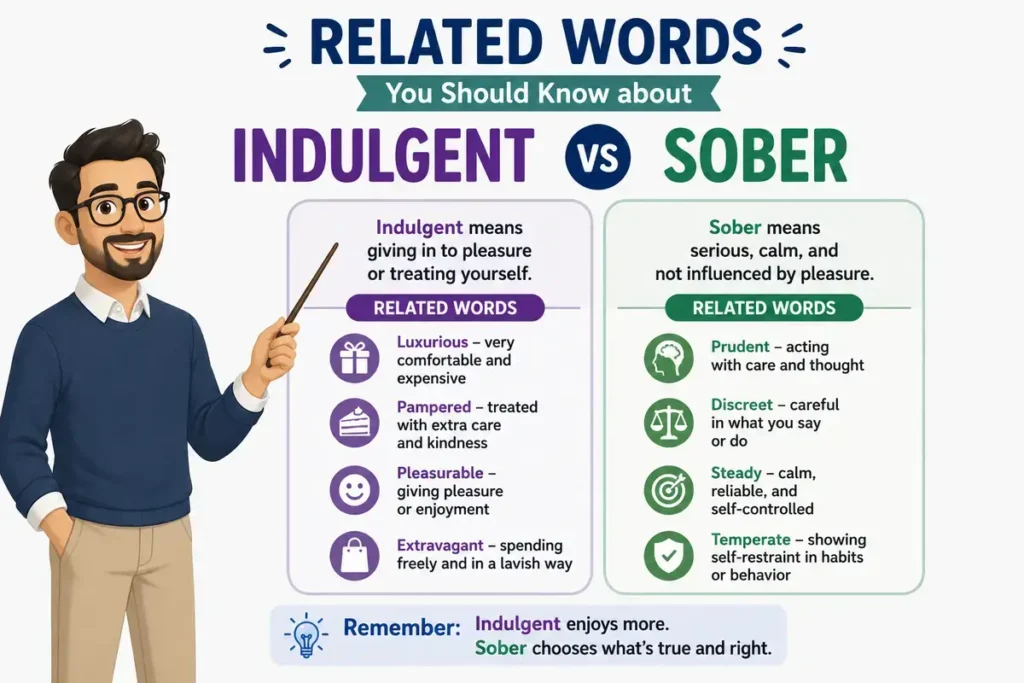
Related Words You Should Know about Indulgent vs Sober
Learning related words makes it easier to understand.
Related Words for Indulgent
Luxurious
Something rich, comfortable, or expensive.
Generous
Willing to give more than expected.
Pampered
Given extra care and comfort.
Self-indulgent
Focusing heavily on personal pleasure.
Relaxed
Not strict or overly controlled.
Related Words for Sober
Responsible
Making wise and dependable choices.
Practical
Focused on what works best.
Disciplined
Able to control actions and habits.
Moderate
Avoiding extremes.
Thoughtful
Carefully considering situations before acting.
Opposite Ideas
People sometimes compare:
- Indulgent vs disciplined.
- Indulgent vs restrained.
- Sober vs reckless.
- Sober vs extravagant.
These comparisons can help you understand the meaning even better.
How Do People Actually Use Indulgent vs Sober in Daily English?
Native speakers use these words in many situations. Here are common examples.
Talking About Food
“I had an indulgent dessert after dinner.”
“The doctor suggested a more sober diet.”
Talking About Money
“They live an indulgent lifestyle.”
“He takes a sober approach to spending.”
Talking About Vacations
“We enjoyed an indulgent weekend at the resort.”
“They planned a sober trip to stay within budget.”
Talking About Decisions
“Her choice was indulgent but fun.”
“His choice was sober and practical.”
Talking About Parenting
“She can be an indulgent parent.”
“He has a more sober parenting style.”
Talking About Work
“The company avoided indulgent spending.”
“The manager gave a sober evaluation.”
Talking About Fashion
“She likes indulgent luxury brands.”
“He prefers a sober style of clothing.”
Talking About Goals
“An indulgent purchase delayed his savings goals.”
“A sober financial plan helped him succeed.”
These examples show how flexible the words are in everyday English.
Common Mistakes People Make With Indulgent vs Sober
Many English learners make similar mistakes. Here are the most common ones.
Mistake 1: Thinking Indulgent Means Bad
Incorrect idea:
“Indulgent always means irresponsible.”
Correction:
Indulgent can be positive.
Sometimes it simply means enjoying something special.
Example:
“An indulgent birthday dinner.”
This sounds pleasant, not negative.
Mistake 2: Thinking Sober Means Boring
Incorrect idea:
“Sober always means dull.”
Correction:
Sober often means thoughtful and responsible. Example:
“A sober plan for the future.”
This usually sounds smart rather than boring.
Mistake 3: Using Sober Only for Alcohol
Incorrect:
“Sober only refers to drinking.”
Correction:
Sober can also mean serious, calm, and balanced. Example:
“A sober discussion.”
No alcohol is involved in that sentence.
Mistake 4: Treating Them as Complete Opposites
People can be both. A person might:
- Make sober financial decisions.
- Enjoy indulgent vacations.
Human behavior is often a mix of both qualities.
Mistake 5: Choosing the Word Without Thinking About Context
Always ask:
“Am I describing pleasure or self-control?”
That question usually gives the correct answer.
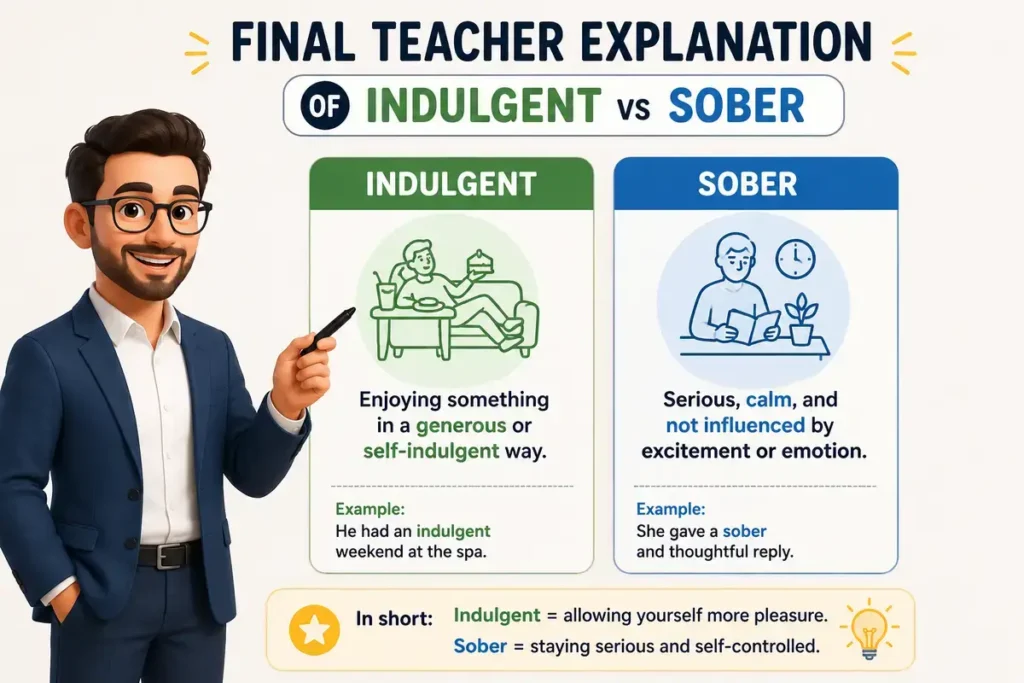
Final Teacher Explanation of Indulgent vs Sober
Imagine I am standing in front of a classroom and a student asks:
“What is the easiest way to understand ?”
I would answer like this: An indulgent person enjoys extra comfort, pleasure, or rewards. A sober person focuses on balance, responsibility, and careful thinking. Neither word is automatically good or bad. The best choice depends on the situation.
Sometimes life calls for a sober decision. Sometimes life allows an indulgent celebration. The key is understanding what each word emphasizes. When you see think about this simple contrast: Enjoyment versus restraint. That idea will help you understand most uses of these words.
Indulgent vs Sober Final Answer (Quick Recap)
Indulgent means allowing extra pleasure, comfort, or enjoyment.
Sober means controlled, serious, balanced, and thoughtful.
The main difference is that indulgent focuses on enjoyment, while sober focuses on self-control and moderation.
Need another quick comparison? Read Writen or Written: Which Is Correct and How Should You Use It?.
Conclusion
The difference between indulgent vs sober is easier than many people think. Indulgent usually describes extra enjoyment, comfort, pleasure, or generosity. Sober usually describes self-control, responsibility, careful thinking, and moderation. Both words have positive uses. Both appear often in daily English. When choosing between them, ask yourself one simple question: Am I describing pleasure or self-control?
If the focus is pleasure, indulgent is usually the better choice. If the focus is restraint and careful judgment, sober is usually the better choice.
Frequently Asked Questions (FAQs)
What does indulgent mean in simple words?
Indulgent means enjoying extra comfort, pleasure, or treats without being very strict.
What does sober mean in simple words?
Sober means calm, responsible, careful, and not excessive.
What is the main difference between?
Indulgent focuses on enjoyment. Sober focuses on control and balance.
Can a person be both indulgent and sober?
Yes. Someone can make sober decisions while still enjoying indulgent experiences sometimes.
Is indulgent always a negative word?
No. It often has a positive meaning, especially when talking about enjoyment or rewards.
Does sober always relate to alcohol?
No. Sober can also mean serious, thoughtful, and practical.
Which word should I use in writing?
Use indulgent when discussing pleasure or luxury. Use sober when discussing responsibility or moderation.
Why do people confuse?
People often compare them because both describe behavior, choices, and lifestyle, but they emphasize different attitudes.
