
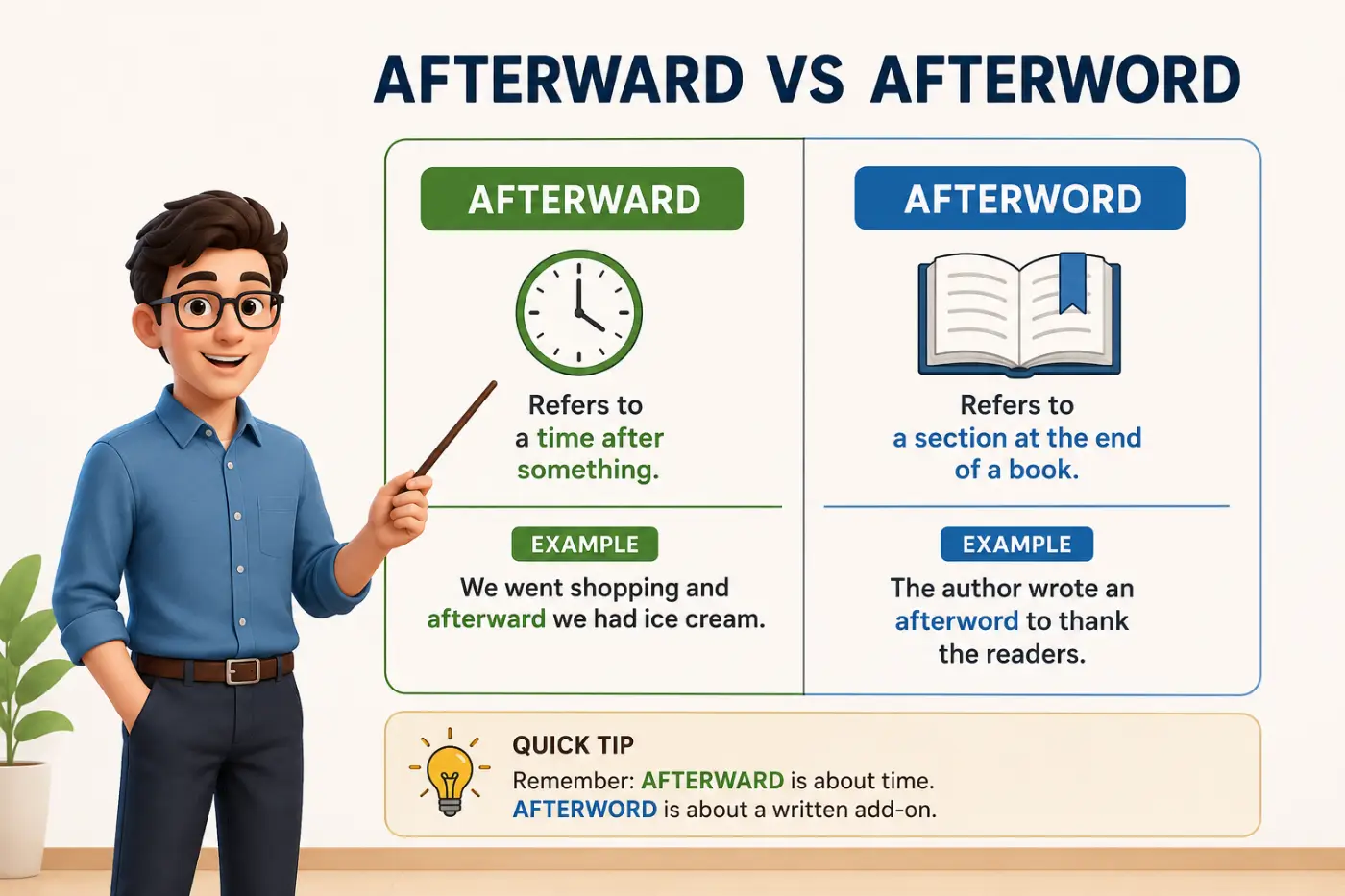
Many English learners get confused by afterward vs afterword because the two words look almost the same. They differ by only one letter, but they have different meanings and different jobs in a sentence. If you know the simple difference, you will never mix them up again.
The good news is that the answer is easy. One word talks about time. The other talks about a book. Once you connect each word with its meaning, choosing the right one becomes simple.
This guide explains in very easy US English. You will learn what each word means, why people confuse them, how to use them correctly, and how to remember the difference with simple tricks and real-life examples.
Still confused? Compare Nosey or Nosy: Which Spelling Is Correct (2026 Guide)?.
Simple Answer In One Look
Afterward means later or after something happens.
Afterword is a short section at the end of a book written by the author or another person.
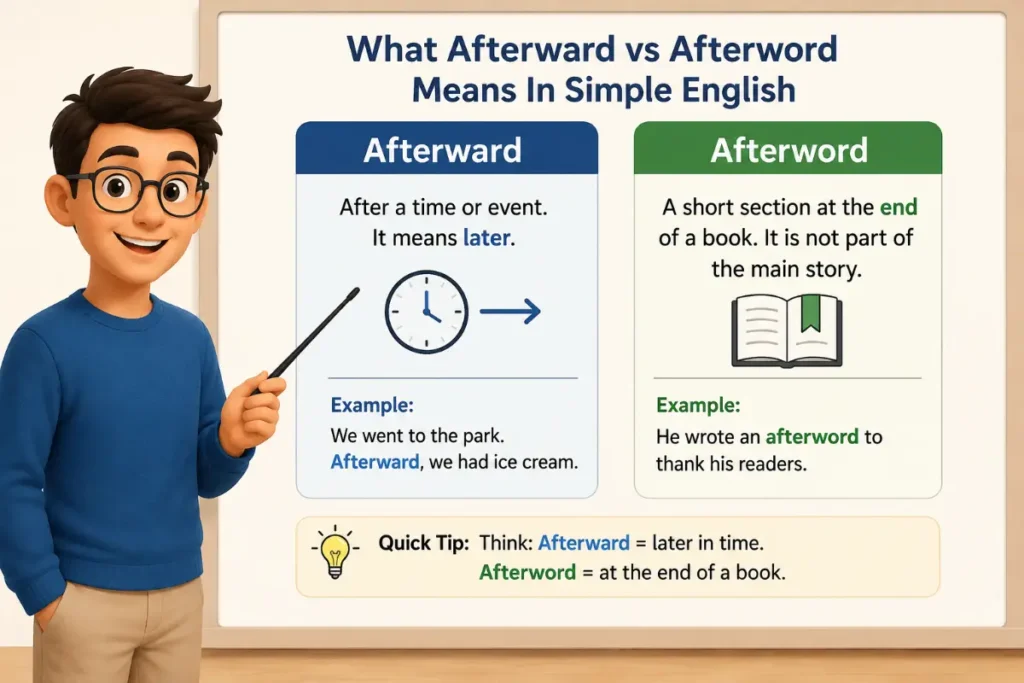
What Afterward vs Afterword Means In Simple English
The easiest way to remember afterward vs afterword is to think about what each word is talking about.
What Does Afterward Mean?
Afterward means later, after that, or at a later time.
It tells us when something happens.
Examples:
- We went home afterward.
- She called me afterward.
- We ate dinner and afterward watched a movie.
- Finish your homework. Afterward you can play.
- He felt much better afterward.
In all of these examples, afterward tells us that something happened later.
You can often replace afterward with these words:
- Later
- After that
- Then
- Following that
Example:
- We visited the museum. Afterward we had lunch.
- We visited the museum. Later we had lunch.
Both sentences have almost the same meaning.
What Does Afterword Mean?
Afterword is a short piece of writing placed at the end of a book.
It often gives extra thoughts, explains why the book was written, or shares what happened after the main story.
Examples:
- I enjoyed reading the afterword.
- The author wrote an interesting afterword.
- The afterword explained how the novel was created.
- Read the afterword for more details.
- Her afterword answered many questions.
Notice that every example talks about a book, not about time.
Why People Mix These Words Afterward or Afterword
Many people confuse words because they look almost identical.
There is only one letter that changes.
- Afterward
- Afterword
When people read quickly, they often miss that small difference.
Another reason is that both words begin with after.
That makes people think they must have similar meanings.
They do not.
One tells when something happens.
The other names a section of a book.
Here are some common mistakes.
Wrong:
- I read the book afterward.
Correct:
- I read the book afterward.
This sentence is correct because it means later.
Wrong:
- I liked the afterward of the book.
Correct:
- I liked the afterword of the book.
Here the sentence is talking about the ending section of a book, so afterword is correct.
Many learners also type the wrong word because spell check may not catch it. Both words are spelled correctly. Only the meaning is different.
Clear Difference Explained Simply
Here is a simple comparison.
| Afterward | Afterword |
|---|---|
| Means later | Means a section at the end of a book |
| Talks about time | Talks about books |
| Used in everyday conversations | Used when discussing books or writing |
| Answers the question “When?” | Answers the question “What part of the book?” |
| Cannot be part of a book | Is part of a book |
Think about these two sentences.
- We went shopping afterward.
- I enjoyed the afterword of the novel.
The first sentence is about time.
The second sentence is about a book.
That is the whole difference.
Which Form Should You Use?
When choosing between words, ask yourself one simple question.
Are you talking about time or about a book?
If you mean later, use afterward.
Examples:
- We talked afterward.
- She smiled afterward.
- He left afterward.
If you mean the ending section of a book, use afterword.
Examples:
- The afterword explained the author’s ideas.
- I skipped the afterword.
- Her favorite part was the afterword.
Here is a simple memory trick.
- Afterward ends with ward. Think of moving forward in time.
- Afterword ends with word. A book is made of words.
That small idea helps many students remember the difference.
Easy Real Life Sentences You Can Use Afterward and Afterword
Here are simple examples using afterward.
- We went for ice cream afterward.
- Call me afterward.
- I felt tired afterward.
- She laughed afterward.
- We cleaned the room afterward.
- They apologized afterward.
- He thanked everyone afterward.
- We relaxed afterward.
Now look at examples using afterword.
- The afterword made the story even better.
- I always read the afterword.
- The author signed the afterword.
- Her afterword shared personal memories.
- The afterword answered my questions.
- This book has a short afterword.
- I learned more from the afterword.
- The afterword explained the ending.
Notice how easy it is to tell them apart once you know the meaning.
Where This Word Expression Comes From Simple History
The history of these words also helps explain the difference.
Afterward has been part of English for hundreds of years. It comes from the idea of something happening after another event. Over time it became a common word meaning later or after that.
Afterword was created by joining two simple words.
- After
- Word
The name makes sense because it is a piece of writing that comes after the main words of the book.
That is why an afterword always appears near the end of a book.
Many books also have a foreword at the beginning.
A simple way to remember both is this.
- Foreword comes before the main text.
- Afterword comes after the main text.
The names tell you exactly where each section belongs.
As you can see is not a difficult choice once you understand their meanings. One word helps you talk about events that happen later, while the other belongs to the world of books and writing. In the next section, you will learn how these words appear in stories, publishing, everyday culture, common mistakes people make, related words, and easy memory tricks that will help you remember the correct choice every time.
How Afterward or Afterword Is Understood In Culture And Stories
Words often become part of the stories people tell. That is true as well. Even though these words have different meanings, each one appears in its own place in everyday life.
Afterward is common in conversations, movies, TV shows, and stories. It helps people explain what happened next. It moves a story forward in time.
For example:
- The family ate dinner. Afterward they watched a movie.
- She finished school. Afterward she started her first job.
- We visited the beach. Afterward it began to rain.
When people hear afterward, they naturally expect the next event in the story.
Afterword belongs to the world of books. Many novels, biographies, and history books include an afterword at the end. It gives readers one last message before they close the book.
Sometimes the author shares why the book was written.
Sometimes the afterword tells what happened after the real events ended.
Readers often enjoy the afterword because it feels like one final conversation with the writer.
Both words appear after something else, but they serve different purposes.
Afterward continues time.
Afterword continues the conversation.
You may also want to read Village vs Subdivision: Which Word Should You Use?.
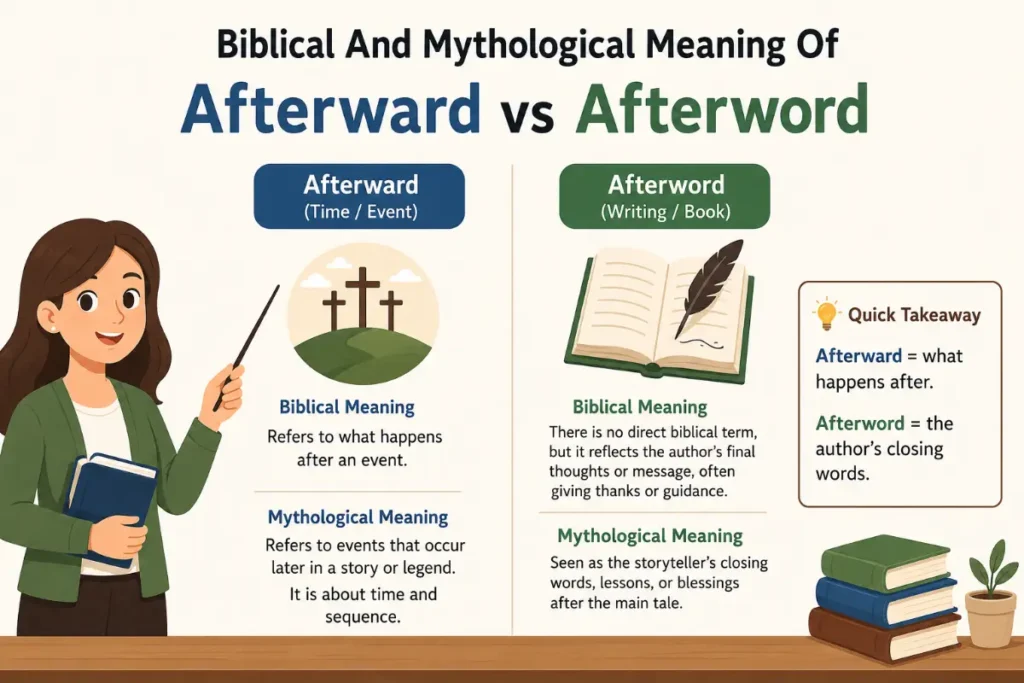
Biblical And Mythological Meaning Of Afterward vs Afterword
There is no special biblical meaning. The Bible uses words that mean later, after that, or following this. Modern English translations may sometimes use afterward because it sounds natural in today’s English.
Example:
- The people prayed. Afterward they celebrated.
Here, afterward simply means later.
The word afterword is not a biblical idea. It is a publishing term. Ancient books of the Bible were not written with modern afterwords like many books today.
The same is true in mythology. Stories from Greek, Roman, Egyptian, or Norse mythology may describe events that happen afterward, but they do not have a special symbolic meaning for the word itself. An afterword may appear in a modern book about mythology because the author wants to explain the stories or share extra information with readers.
So the meanings stay simple.
- Afterward means later.
- Afterword means extra writing at the end of a book.
Symbolism Explained In Simple Words
What Afterward Represents
Afterward often represents moving forward.
It reminds us that life keeps going after every event.
People may think about:
- New beginnings
- Learning from experience
- Hope after hard times
- Life continuing
- The next step
That is why stories often use afterward before showing a new part of someone’s journey.
What Afterword Represents
Afterword often represents reflection.
It gives people one last chance to think about what they have read.
An afterword may symbolize:
- Looking back
- Sharing wisdom
- Personal thoughts
- Closing a story
- A final goodbye
One word looks ahead.
The other looks back.
That simple picture makes much easier to remember.
Related Words You Should Know
Here are some related words that can also help you understand.
Later
Means at another time. It is one of the closest words to afterward.
After
Shows that one thing happens following another.
Then
Means the next event or action.
Next
Shows what comes after the current step.
Finally
Means the last event in a series.
Foreword
A short section at the beginning of a book. It comes before the main text.
Preface
An introduction written by the author before the book begins.
Epilogue
The final part of a story that tells readers what happens after the main events.
How Afterward and Afterword People Actually Use It In Daily English
Most people use afterward much more often than afterword because daily conversations usually talk about time.
Here are real-life examples.
- We finished dinner. Afterward we went for a walk.
- Please call me afterward.
- I felt much better afterward.
- Afterward we took some pictures.
- She apologized afterward.
- We laughed about it afterward.
- I always read the afterword before putting a book away.
- The afterword explained the real story behind the novel.
- My teacher asked us to read the afterword for homework.
- The author’s afterword answered many reader questions.
Notice something interesting.
The first six examples could happen in almost any conversation.
The last four examples only make sense when people are talking about books.
That is another easy way to remember the difference.
Common Mistakes People Make
Many learners make the same mistakes. The good news is that they are easy to fix.
Mistake One
Wrong:
I liked the afterward of the book.
Correct:
I liked the afterword of the book.
Reason:
A book ends with an afterword, not an afterward.
Mistake Two
Wrong:
We went home afterword.
Correct:
We went home afterward.
Reason:
The sentence talks about time, not a book.
Mistake Three
Wrong:
The author wrote an afterward.
Correct:
The author wrote an afterword.
Reason:
Authors write afterwords at the end of books.
Mistake Four
Wrong:
Read the afterward before Chapter One.
Correct:
Read the foreword before Chapter One.
Reason:
An afterword belongs at the end of a book.
Mistake Five
Thinking both words mean the same thing.
They do not.
Always ask yourself one question.
Am I talking about time or about a book?
If the answer is time, use afterward.
If the answer is a book, use afterword.
Final Teacher Explanation About Afterward or Afterword
Imagine you are sitting in an English classroom.
A student asks, “How can I remember forever?”
Here is the answer.
Think about the last letters.
Afterward ends with ward.
That can remind you of moving forward through time.
Something happens first.
Something happens afterward.
Now look at afterword.
It ends with word.
Books are made of words.
An afterword is made of words that appear after the main book.
That is the only difference you need to remember.
Do not worry that the spellings are similar.
Just ask one simple question.
Is this about time or about a book?
That question will lead you to the correct answer almost every time.
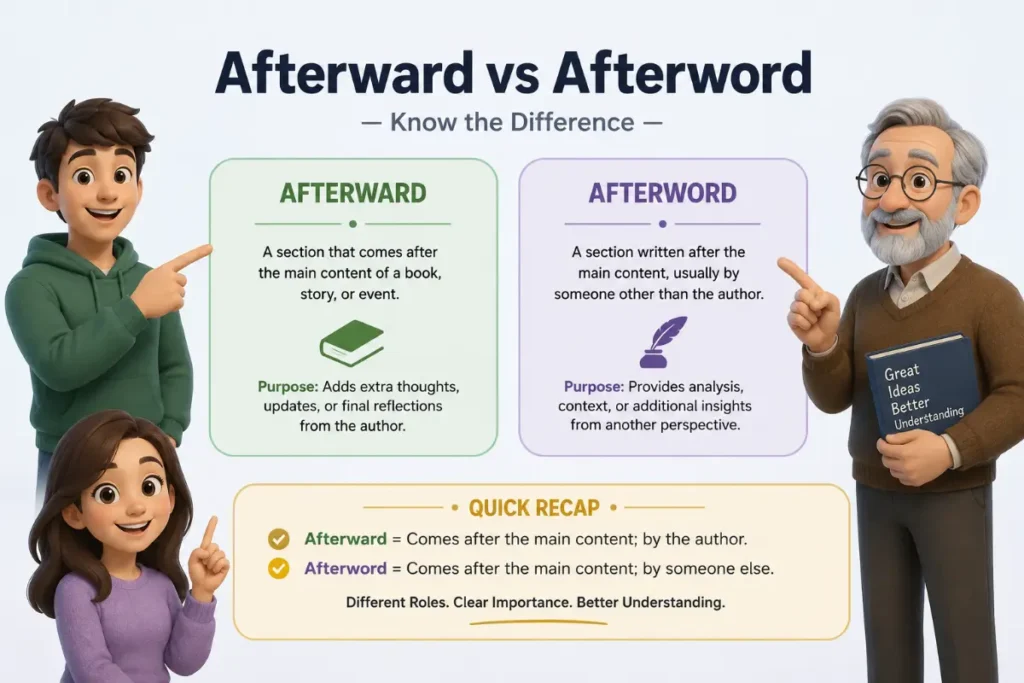
Final Answer About Afterward vs Afterword Quick Recap
The difference between words are simple once you know what each word means.
Afterward means later or after that. It tells us when something happens. People use it every day in conversations, emails, stories, and school writing.
Afterword is a special section at the end of a book. It gives readers extra thoughts, explanations, or final comments. You will mostly see it in books rather than everyday conversation.
Whenever you feel unsure, remember this easy trick.
Time means afterward. Book means afterword.
That small reminder is enough for most English learners.
Many readers also check Unregister vs Deregister: Which Word Should You Use (2026).
Conclusion
Learning is much easier than many people think. The words look almost the same, but they have completely different meanings. One talks about something that happens later. The other is a written section at the end of a book.
The best way to remember afterward vs afterword is to connect each word with one simple idea. Think of afterward as time. Think of afterword as books. Once you make that connection, choosing the correct word becomes easy.
Keep practicing with real sentences whenever you read or write English. The more you see these words in context, the more natural they will become. Remember this simple takeaway: Afterward means later. Afterword means the final words of a book.
Frequently Asked Questions FAQs
What does afterward mean in simple words?
Afterward means later or after that. It tells you when something happens.
What does afterword mean in simple words?
An afterword is a short section at the end of a book that gives extra information or final thoughts.
What is the difference?
Afterward is about time. Afterword is about books.
Which is correct afterward or afterword?
Both are correct. The right choice depends on what you mean.
Why do people confuse?
They look almost the same, and only one letter is different.
Can I use afterward in formal writing?
Yes. Afterward is correct in both formal and everyday English.
Is an afterword the same as a foreword?
No. A foreword comes before the main book. An afterword comes after the main book.
How can I remember?
Remember this simple trick. Afterward is about time. Afterword is about words in a book.
