
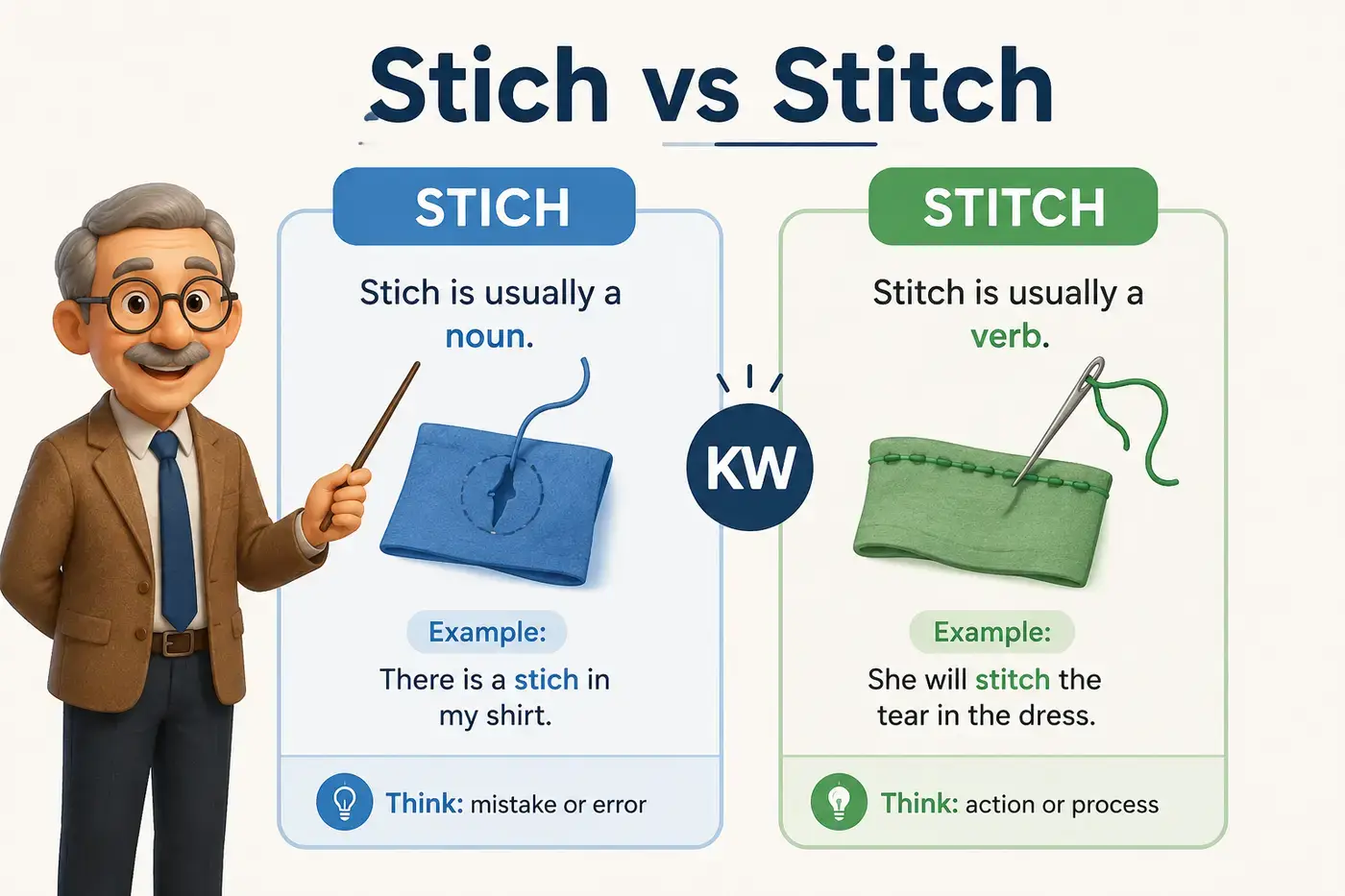
Many English learners get confused about stich vs stitch because the two words look very similar. When you see them side by side, it is easy to wonder which spelling is correct and which one should be used in writing.
The short answer is simple. Stitch is the correct English word. Stich is usually a spelling mistake. Most of the time, when people write “stich,” they actually mean “stitch.”
If you have ever wondered about stich vs stitch, this guide will help you understand the difference in a very simple way. By the end, you will know which spelling to use, why people mix them up, and how to remember the correct form.
Many readers also check Whiny vs Whiney: Which Spelling Is Correct and How to Use It?.
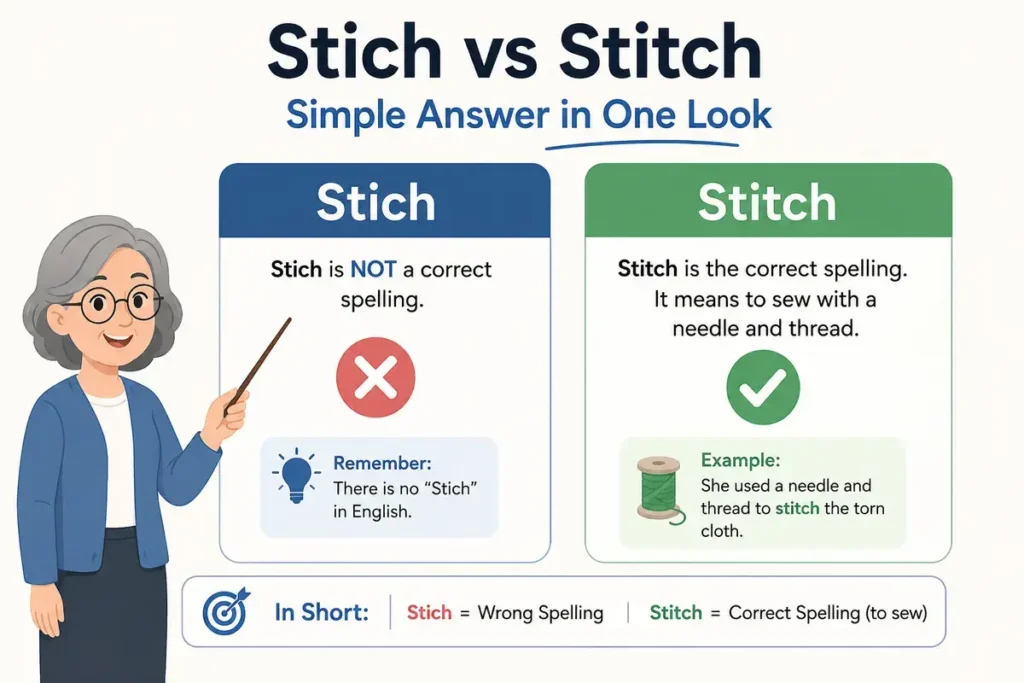
Stich vs Stitch: Simple Answer in One Look
Stitch is the correct spelling.
Stich is usually an incorrect spelling of the word stitch.
- Correct: “I need to stitch this hole in my shirt.”
- Incorrect: “I need to stich this hole in my shirt.”
What Stich vs Stitch Means in Simple English
A stitch is a small loop of thread used in sewing. The word can be used as a noun or a verb.
As a noun:
- “The stitch came loose.”
As a verb:
- “Can you stitch this button back on?”
When you stitch something, you join pieces of fabric together with thread and a needle. Doctors also use stitches to close a cut after an injury. In that case, the word still refers to small loops of thread used to hold skin together while it heals. Here are some easy examples:
- My grandmother taught me how to stitch.
- The dress needs one more stitch.
- The doctor put stitches in the cut.
- She stitched the torn pocket.
The spelling stich does not belong to standard English in these situations. It is usually just a missing “t.”
Why People Mix These Words Stich vs Stitch
The confusion between stich vs stitch happens for several simple reasons.
The Words Look Almost the Same
The only difference is one letter.
- Stich
- Stitch
When people type quickly, they may accidentally leave out the second “t.”
English Spelling Can Be Tricky
English has many words with unusual spelling patterns. For example:
- Rich
- Which
- Switch
- Stitch
Some learners are unsure about how many letters should appear in the middle of the word.
Typing Errors Are Common
Many spelling mistakes happen because people type fast. A person may know the correct spelling but still write “stich” by accident.
Pronunciation Does Not Always Help
When we say “stitch,” the extra “t” is not strongly stressed. Because of this, some people think the shorter spelling is correct.
New Learners Often Guess
Someone learning English may hear the word first and then try to spell it without checking a dictionary. That guess can lead to “stich” instead of “stitch.”
Stich vs Stitch: Clear Difference Explained Simply
When comparing stich vs stitch, the difference is very easy.
| Word | Correct? | Meaning |
|---|---|---|
| Stich | No (usually a spelling mistake) | Usually meant to be “stitch” |
| Stitch | Yes | A sewing loop or the act of sewing |
Think of it this way:
- If you are talking about sewing, fabric, thread, repairing clothes, or medical stitches, use stitch.
- Do not use stich in standard English writing.
Quick Memory Trick for Stich vs Stitch
Remember this sentence:
A stitch needs two t’s.
The word has two “t” letters right next to each other.
Whenever you write the word, check for the double “t.”
Stich vs Stitch: Which Form Should You Use?
You should use stitch in almost every situation. This is the accepted spelling in modern English. Use stitch when talking about:
Sewing
- Stitch a shirt
- Stitch a button
Knitting and Crafting
- A knitting stitch
- A crochet stitch
Medicine
- The doctor used stitches.
- The wound needed stitches.
Expressions and Idioms
English also uses the word in common expressions. For example:
- A stitch in time saves nine.
- Not a stitch of clothing.
In all these examples, the correct spelling is stitch.
What About “Stich”?
In everyday English, “stich” is usually considered a spelling error. If you are writing school work, business emails, articles, social media posts, or professional content, use stitch.
Easy Real-Life Sentences You Can Use for Stich vs Stitch
Here are some simple examples.
- I need to stitch a hole in my jacket.
- She stitched the torn bag yesterday.
- The doctor used stitches to close the cut.
- One stitch came loose from the sleeve.
- My mother taught me how to stitch by hand.
- The blanket has a beautiful stitch pattern.
- He carefully stitched the edges together.
- The shirt looks new after a few stitches.
Now look at these incorrect examples:
- I need to stich my jacket.
- She stiched the bag.
These should be:
- I need to stitch my jacket.
- She stitched the bag.
Where Stich vs Stitch Word Comes From (Simple History)
The word stitch has been part of English for hundreds of years. It comes from older Germanic languages that used similar words for sewing and fastening cloth with thread. Long before sewing machines existed, people stitched clothing by hand. Every piece of clothing needed many small stitches to hold it together. Over time, the word became common in everyday English. Today, people use it for:
- Sewing
- Knitting
- Embroidery
- Medicine
- Everyday expressions
The spelling has remained stitch for a very long time. That is why dictionaries, schools, publishers, and English teachers all use the same spelling.
Transition to Deeper Meaning
Now that you understand the basic difference between stich vs stitch, the next step is to look at how the word is used in culture, sayings, symbolism, and everyday communication. Understanding these deeper meanings will help you recognize the word more easily and use it with confidence in real life.
Need another quick comparison? Read Spicey vs Spicy: Which Spelling Is Correct Guide (2026).
How Stich vs Stitch Words Is Understood in Culture and Stories
The word stitch appears in many cultures, stories, and everyday traditions. For hundreds of years, people have used sewing to make clothes, repair fabric, and create beautiful handmade items. Because stitching takes time and care, many people connect the word with patience and hard work.
In stories, a character who stitches clothing is often shown as thoughtful, kind, or skilled. Sewing is sometimes used to show that a person can fix problems instead of throwing things away. Many cultures also pass sewing skills from one generation to the next. A grandmother may teach a child how to stitch a button. A parent may show a son or daughter how to repair a torn shirt.
This makes the word stitch feel connected to learning, family, and tradition. The spelling stich does not carry these meanings because it is usually just a misspelling. The cultural meaning belongs to the correct word, stitch. People also use stitch in stories to show healing. For example:
- A torn piece of cloth can be stitched together.
- A wound can be closed with stitches.
- A broken item can be repaired with careful stitching.
Because of this, stitch is often connected with fixing, repairing, and making something whole again.
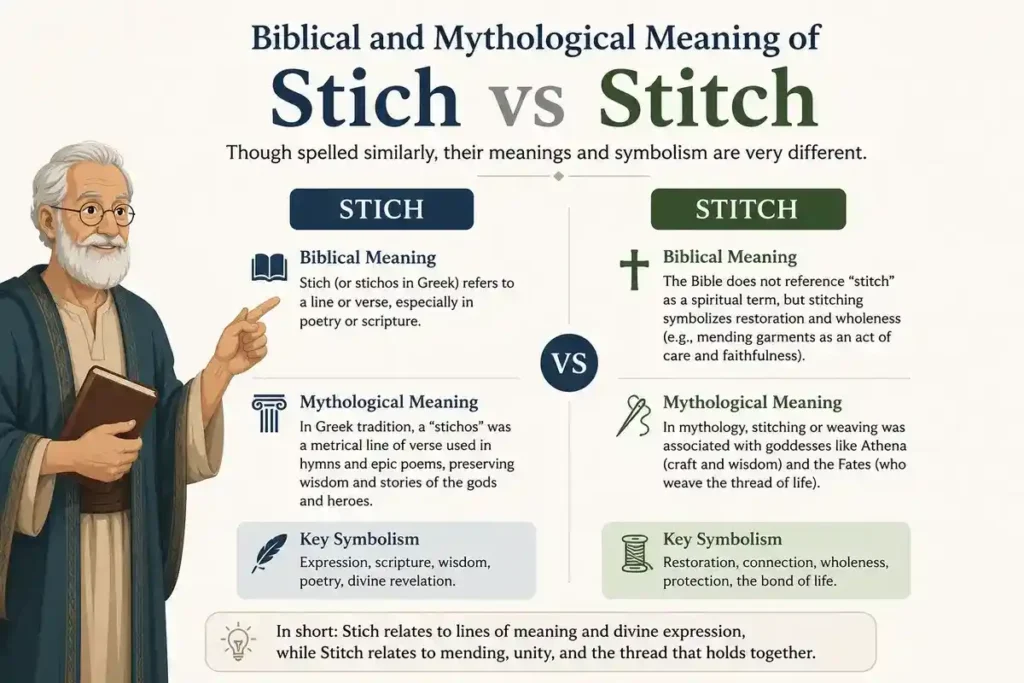
Biblical and Mythological Meaning of Stich vs Stitch (If Applicable)
The word stitch itself is not a major biblical term. However, sewing and clothing appear many times in the Bible. People in biblical times made clothing by hand. Sewing was a normal part of daily life. Because of this, stitching can remind people of:
- Care
- Work
- Responsibility
- Preparation
In some Bible stories, clothing represents protection or identity. Since clothing was often handmade, stitching was part of creating those garments. In mythology and ancient stories from different cultures, weaving and sewing are sometimes connected with skill and creativity. Many old stories include people who create clothing, cloth, or woven items using great talent and patience. The word stitch itself does not have a special religious meaning, but the act of stitching often suggests making, repairing, or caring for something valuable.
Stich vs Stitch: Symbolism Explained in Simple Words
What Stitch Represents
The word stitch often symbolizes positive ideas. Some common symbolic meanings include:
- Repairing something broken.
- Bringing pieces together.
- Patience and careful work.
- Healing after damage.
- Creating something useful.
Think about a torn shirt. A stitch helps bring the two sides together. Because of this, people sometimes use stitching as a symbol of fixing problems or rebuilding relationships. A stitch can also represent progress. One stitch may seem small, but many stitches together can create something strong and beautiful. That is why the word is sometimes linked with steady effort and hard work.
What Stich Represents
When comparing stich vs stitch, the spelling stich does not have a recognized symbolic meaning in normal English. Since it is usually a spelling mistake, it does not carry the cultural, emotional, or symbolic value that belongs to stitch. This creates a simple comparison:
| Word | Symbolic Meaning |
|---|---|
| Stich | Usually no recognized meaning in standard English |
| Stitch | Repair, healing, patience, connection, creation |
This is another reason why using the correct spelling matters. The correct word carries a clear meaning that readers immediately understand.
Related Words You Should Know Stich vs Stitch
Learning related words can make easier to remember.
Sewing
Using a needle and thread to join fabric together. Example:
- My aunt enjoys sewing clothes.
Needle
A small tool used to make stitches. Example:
- The needle is very sharp.
Thread
The thin material used when stitching. Example:
- The blue thread matches the shirt.
Seam
The place where two pieces of fabric are joined. Example:
- The seam came apart.
Embroidery
Decorative stitching used to create designs. Example:
- The flowers were made with embroidery.
Patch
A piece of fabric used to cover a hole. Example:
- He stitched a patch onto his jeans.
Mend
To repair something that is damaged. Example:
- I need to mend my jacket.
Weave
To create cloth by crossing threads together. Example:
- The basket was woven by hand.
Knit
To create fabric using yarn and knitting needles. Example:
- She likes to knit scarves.
Crochet
A craft that uses a hook to create fabric from yarn. Example:
- My grandmother crochets blankets.
How People Actually Use Stich vs Stitch in Daily English
The word stitch appears in many real-life situations. Here are common examples you may hear every day.
Talking About Clothing
- Can you stitch this button back on?
- My shirt needs a few stitches.
- She stitched the pocket closed.
Talking About Injuries
- The cut needed stitches.
- The doctor removed the stitches today.
- He got stitches after the accident.
About Crafts
- This stitch pattern looks beautiful.
- I learned a new stitch in sewing class.
- The blanket uses a simple stitch design.
About Fixing Things
- I’ll stitch the tear before it gets worse.
- We stitched the fabric together.
- The old bag was stitched by hand.
Common Expressions
You may also hear:
A stitch in time saves nine.
This means fixing a small problem now can prevent a bigger problem later. Example:
- I repaired the leak right away. A stitch in time saves nine.
Another expression is:
Not a stitch of clothing.
This means wearing no clothes at all. Example:
- The baby ran around with not a stitch of clothing on.
Common Mistakes People Make using Stich vs Stitch
Many mistakes happen when people compare stich vs stitch. Here are the most common ones.
Mistake 1: Leaving Out the Second T
Incorrect:
- I need to stich this shirt.
Correct:
- I need to stitch this shirt.
Always remember the double “t.”
Mistake 2: Thinking Both Spellings Are Correct
Some learners believe both versions are accepted. They are not. Standard English uses stitch.
Mistake 3: Typing Too Fast
Many people know the correct spelling but accidentally type “stich.” A quick spell-check can help catch this mistake.
Mistake 4: Using the Wrong Past Tense
Incorrect:
- She stiched the hole.
Correct:
- She stitched the hole.
Notice that stitched keeps the double “t.”
Mistake 5: Forgetting the Meaning
Sometimes learners focus only on spelling. Remembering the meaning can help. If you are talking about:
- Sewing
- Repairing fabric
- Medical stitches
The word should almost always be stitch.
Easy Memory Tip Stich vs Stitch
Think of this sentence:
Two t’s help hold the stitch together.
The double “t” can remind you of two pieces joined together.
Stich vs Stitch: Final Teacher Explanation (Very Important)
As your English teacher, I want you to remember one simple rule. When comparing stich vs stitch, the correct spelling is stitch. The word refers to a small loop of thread, the act of sewing, or the stitches used by doctors to close a wound. The spelling stich is usually just a mistake caused by typing too quickly or forgetting one of the “t” letters. You do not need to memorize complicated grammar rules. Just remember:
- Sewing a shirt = stitch.
- Repairing fabric = stitch.
- Closing a wound = stitch.
- Writing in school or at work = stitch.
The more you read and write the word correctly, the easier it becomes to remember. A simple memory trick is:
A stitch needs two t’s.
That one sentence can help you avoid the mistake every time.
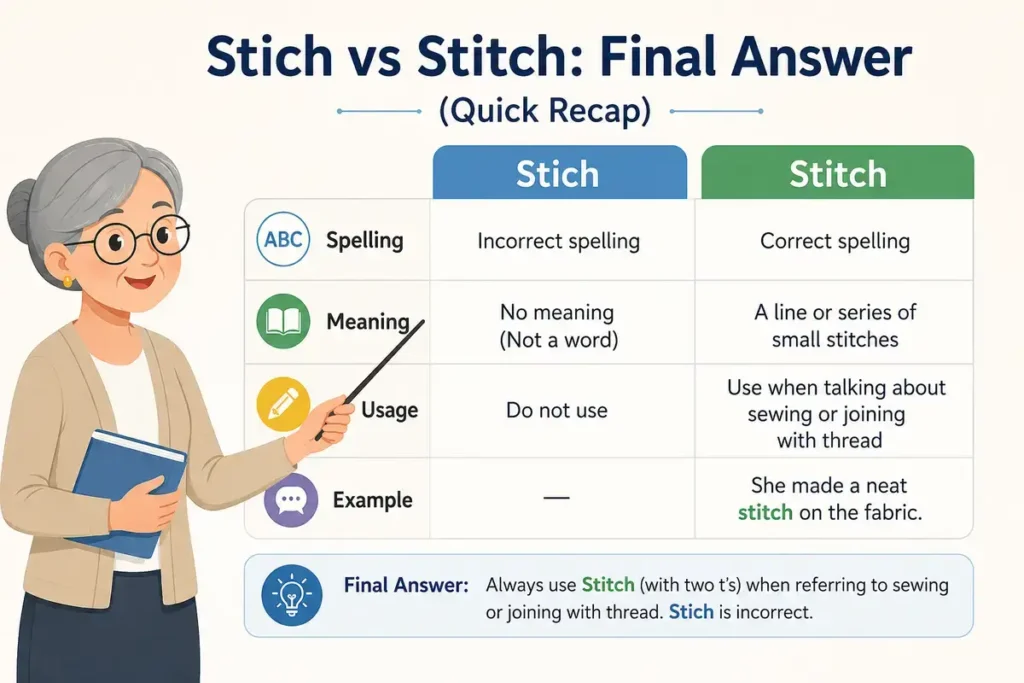
Stich vs Stitch: Final Answer (Quick Recap)
When comparing stich vs stitch, stitch is the correct English spelling. Use stitch when talking about sewing, repairing fabric, crafts, or medical stitches. Stich is usually a spelling mistake and should be avoided in standard English writing.
Still confused? Compare Hello world!.
Conclusion
Understanding stich vs stitch is actually very simple once you know the correct spelling. Stitch is the standard English word used for sewing, repairing fabric, creating crafts, and even closing wounds in medical situations. The spelling stich is usually just a typo or spelling mistake caused by leaving out one of the “t” letters.
A good way to remember the difference is to think of the phrase “A stitch needs two t’s.” Whenever you write the word, take a quick look to make sure both “t” letters are there. With a little practice, using the correct spelling will become natural. If you remember only one thing from this guide, remember this: stitch is correct, and stich is not used in standard English writing.
Frequently Asked Questions (FAQs)
Is correct?
Stitch is correct. Stich is usually a spelling mistake.
What does stitch mean in simple words?
A stitch is a loop of thread used in sewing or the act of sewing something together.
Why do people confuse?
The words look very similar, and people sometimes forget the second “t” when typing.
Can I use stich in formal writing?
No. Standard English uses stitch.
Is stitch a noun or a verb?
It can be both. A stitch can be a thing, and to stitch can be an action.
What is the past tense of stitch?
The past tense is stitched. Example:
- She stitched the torn pocket yesterday.
Does stitch have a symbolic meaning?
Yes. It often represents repair, healing, connection, patience, and careful work.
How can I remember the correct spelling?
Use this memory trick:
A stitch needs two t’s.
That will help you remember the correct spelling every time.
