
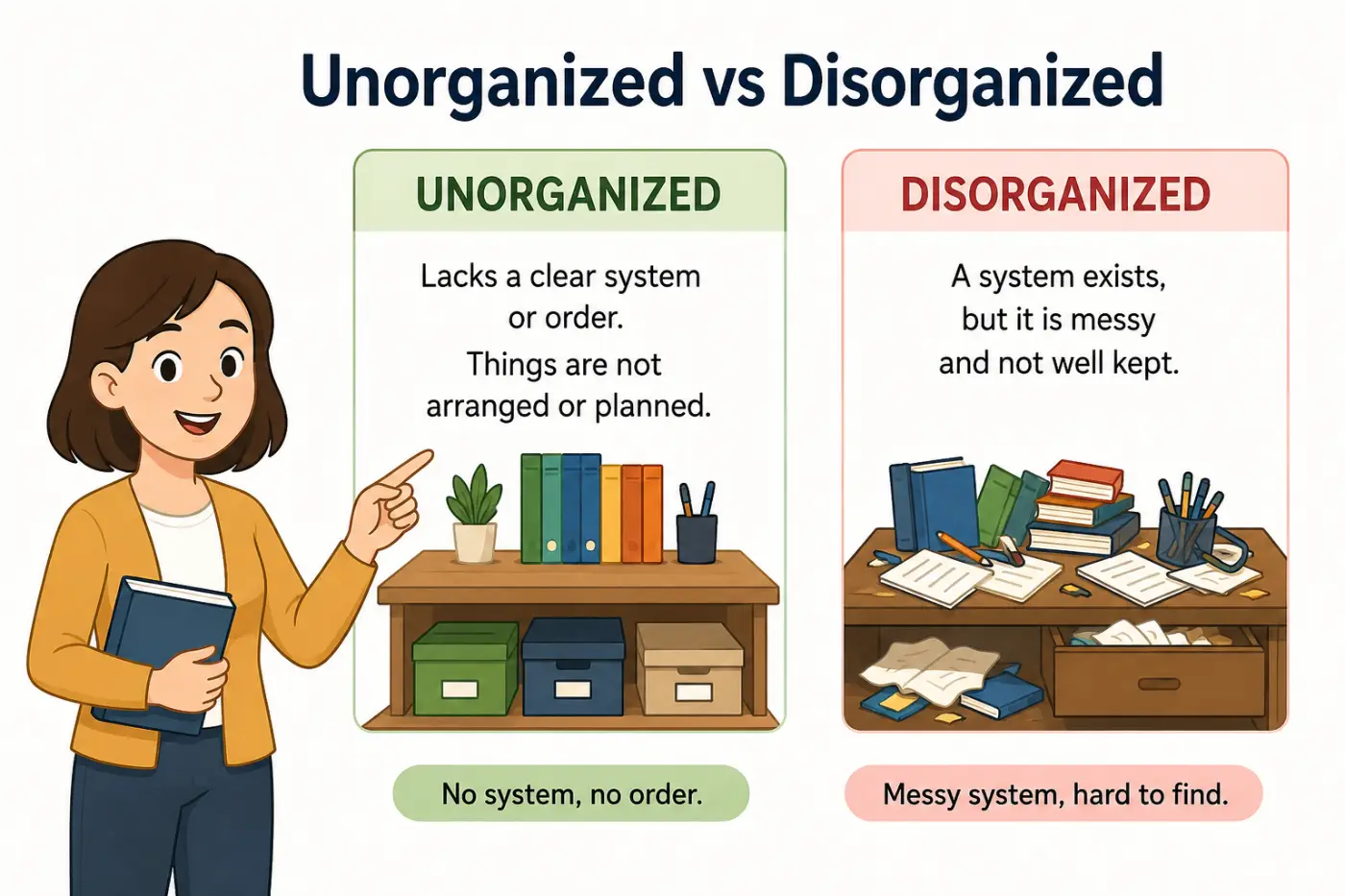
Many English learners get confuse about unorganized vs disorganized because both words describe something that is not in order. At first, they seem to mean the same thing. That is why many people use them in the wrong place.
The truth is that words are not about one word being right and the other being wrong. Both words are correct English. The difference is how they describe people, places, ideas, or things. One word often talks about something that has never been organized, while the other usually describes something that has lost its order.
If you understand the small difference between words, your writing and speaking will sound more natural. This guide explains everything in very simple English with easy examples that you can use every day.
A related grammar guide is Prescribe vs Proscribe: Common Mistake Explained 2026.
Simple Answer in One Look
Unorganized means something has not been organized yet.
Disorganized means something was organized before but is now messy, confused, or out of order.
Both words are correct. The best choice depends on the situation.
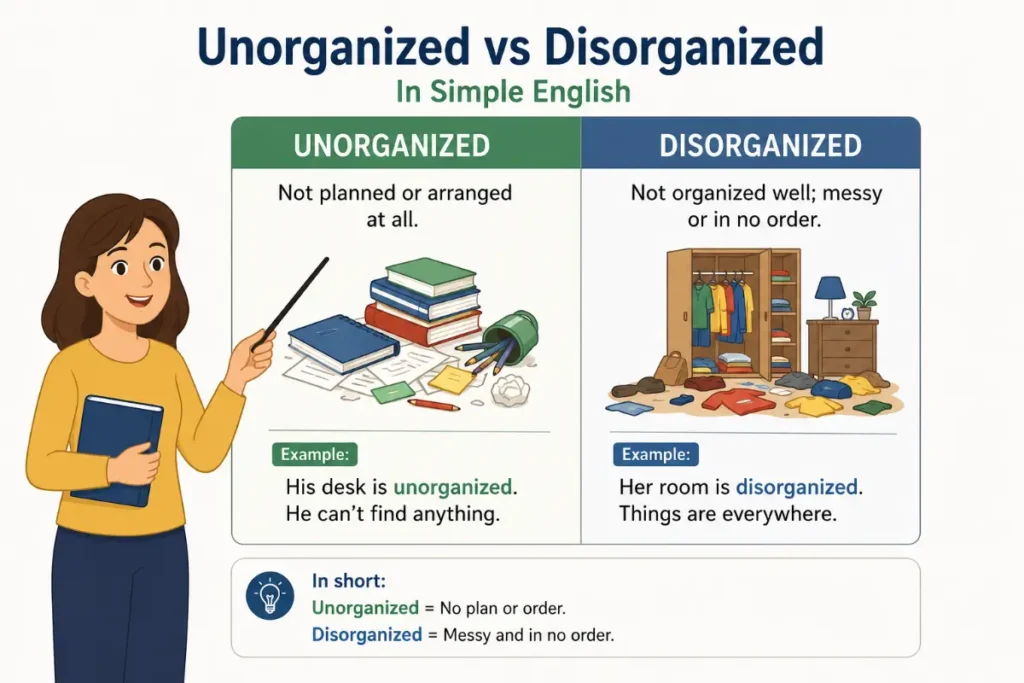
What Does Unorganized vs Disorganized Mean in Simple English?
Think about your bedroom. If you just moved into a new house and have not unpacked your boxes, your room is unorganized. Nothing has been arrange yet. Now imagine your room was clean yesterday. Today, clothes are on the floor, books are everywhere, and nothing is in its place. Your room is disorganize. That is the easiest way to remember these words.
A simple teacher’s rule is this:
- Unorganized = Not organized yet.
- Disorganized = Organized before, but now messy or confusing.
Sometimes people use these words as if they mean exactly the same thing. In casual conversations, that happens often. Even so, knowing the small difference helps you choose the better word. Here is another way to think about it.
Imagine a new notebook.
- If no notes have been arrange inside it, it is unorganized.
- If the notes were neat before but are now mix up, it is disorganized.
This small picture makes the meaning easy to remember.
Why Do People Mix These Words Unorganized vs Disorganized?
Many reasons cause confusion.
They both describe a lack of order.
When people see a messy desk, they may use either word because both suggest disorder. For example:
- My desk is unorganized.
- My desk is disorganized.
Many native speakers understand both sentences.
They look almost the same.
Both words begin with prefixes that mean “not.”
- Un- means “not.”
- Dis- often means “the opposite of” or “away from.”
Because both prefixes show something negative, learners often think the words are identical.
Dictionaries give similar definitions.
Many dictionaries explain both words using words like:
- messy
- unordered
- untidy
- confused
This makes the difference harder to notice.
Everyday speech is flexible.
People often choose whichever word comes to mind first.
For example:
“My closet is so unorganized.”
Most listeners understand both.
Still, careful writers usually choose the word that best matches the situation.
Clear Difference Explained Simply
Here is an easy comparison.
| Unorganized | Disorganized |
|---|---|
| Not arranged yet. | Lost its order. |
| Never properly organized. | Was organized before or should be organized. |
| Focuses on missing organization. | Focuses on confusion or disorder. |
| Often describes systems or collections. | Often describes people, rooms, plans, or thoughts. |
Here are more simple comparisons.
Unorganized
- Files have not been sort.
- Boxes are still pack.
- Ideas have not been arrange.
- Work has not started.
Disorganized
- Papers are scatter everywhere.
- The meeting became confusing.
- A person keeps forgetting things.
- The office is messy.
Notice the pattern.
Unorganized often talks about something that still needs organization.
Disorganized often talks about something that is already in a messy condition.
Which Form Should You Use?
Many students ask, “Which word is correct?”
The answer is simple.
Both are correct.
Choose unorganized when something has not been organize.
Examples:
- The new files are still unorganized.
- My study notes are unorganized.
- The books have not been sort yet.
Choose disorganized when something is messy, confused, or out of order.
Examples:
- My backpack is completely disorganized.
- The meeting became disorganized.
- His desk looks disorganized.
A quick memory trick
Ask yourself one question.
It was organize before?
If yes, disorganized is usually the better choice.
If no, unorganized often fits better.
This simple question helps you choose the right word most of the time.
Easy Real-Life Sentences You Can Use Unorganized vs Disorganized
Here are everyday examples.
- My desk is disorganize after a busy week.
- The new files are still unorganized.
- Her notes became disorganized during class.
- Our storage room is unorganized because we just moved.
- His schedule looks disorganized today.
- The project folders are still unorganized.
- My thoughts felt disorganized before the test.
- We need to organize these unorganized papers.
Notice how the meaning changes naturally depending on the situation.
Common Situations and the Best Word
Talking about a room
“The room is disorganize.”
This sounds natural because the room has become messy.
Talking about new documents
“The documents are unorganized.”
This means nobody has sorted them yet.
Talking about your thoughts
“My thoughts are disorganize.”
People often use disorganized because thoughts become confused.
Talking about a new collection
“The photos are still unorganized.”
This means they have not been place into albums or folders.
In School
Students hear these words often.
A teacher may say:
“Your notes are disorganize.”
This means the notes are messy and difficult to follow.
Another teacher might say:
“These worksheets are still unorganized.”
This means they have not been sort yet.
Both sentences are correct, but they describe different situations.
At Work
These words also appear in offices.
Imagine a company receives hundreds of papers.
If nobody has sorted them yet, they are unorganized.
After sorting, if people throw everything into random folders, the files become disorganized.
See the difference?
One happens before organization.
The other happens after order is lost.
For People
People can also be describ with these words.
Someone who never plans ahead may be called unorganized.
Someone who forgets appointments, loses papers, and cannot keep track of tasks is often described as disorganized.
For example:
- She is unorganized and needs a better study plan.
- He is disorganized and often misses deadlines.
In everyday English, many speakers use either word for people. Still, disorganized is slightly more common when talking about habits.
Common Synonyms
Here are words that have similar meanings.
For unorganized:
- Unsorted
- Unarranged
- Unplanned
- Unprepared
- Unstructured
For disorganized:
- Messy
- Chaotic
- Confused
- Disorderly
- Untidy
- Scattered
Each synonym has its own small difference, but all relate to a lack of order.
Many readers also check Nonresponsive vs Unresponsive: Easy Examples and Rules.
Common Mistakes
Here are mistakes learners often make.
Mistake 1
“My room is unorganized after the party.”
Better:
“My room is disorganize after the party.”
The room became messy.
Mistake 2
“The new files are disorganize because nobody sorted them.”
Better:
“The new files are unorganized because nobody sorted them.”
They have never been organize.
Mistake 3
Thinking one word is wrong.
This is false.
Both words are accept English words.
The key is choosing the one that fits the situation.
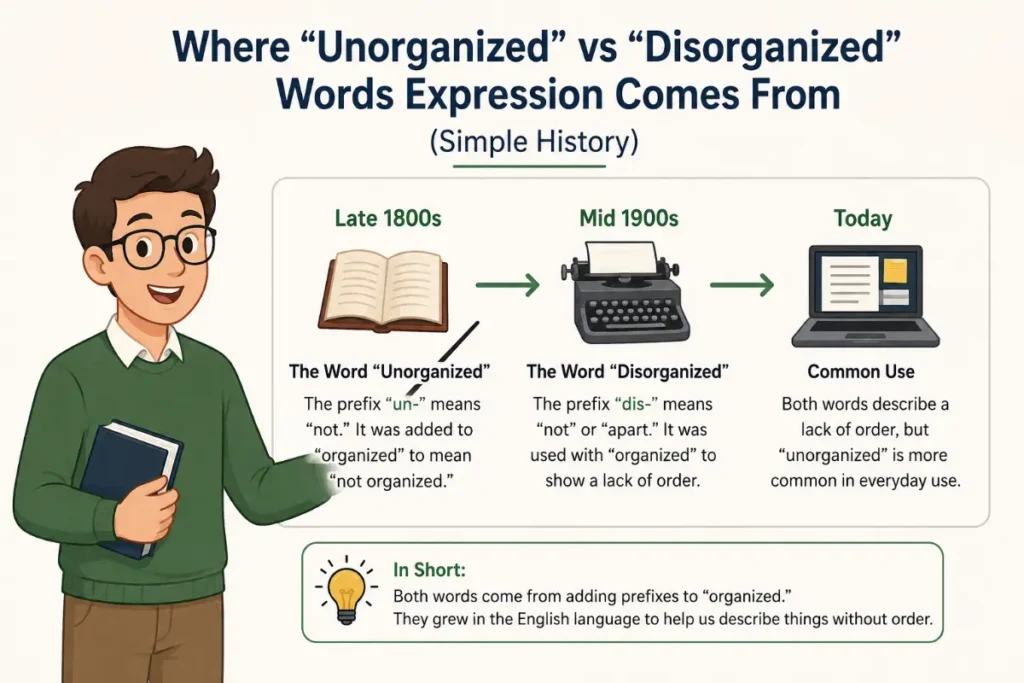
Where Unorganized vs Disorganized Words Expression Comes From (Simple History)
Both words come from the word organize. The word organize comes from a Greek word connected with tools or instruments. Over time, English speakers began using organize to mean arranging things into a clear order. Later, English added two common prefixes.
- Un- means “not.”
- Dis- often means “remove,” “reverse,” or “break apart.”
That is why unorganized usually means “not organized.”
Disorganized usually means “the organization has been broken or lost.” The meanings developed naturally over many years and are still used today. Understanding the history is not necessary for everyday speaking, but it makes the difference easier to remember.
As you can see, the difference between it is small but useful. Once you know when each word fits best, you’ll notice them more often in books, conversations, schoolwork, and daily life. In the next section, we’ll look at how these words are understood in culture, common expressions, symbolism, and everyday English, along with more practical examples that make choosing the right word even easier.
How Is Understood in Culture and Stories?
People have always connected order with peace and success. They often connect disorder with stress, confusion, or hard times. That is why both words can carry emotional meaning, even outside grammar.
In many stories, the main character begins with a messy room, a messy plan, or messy thoughts. As the story moves forward, the character learns, grows, and becomes more organized. This change often shows personal growth.
A teacher may tell students to keep their notebooks organized because it helps them learn better. Parents may ask children to organize their toys because it makes the house easier to enjoy. These simple lessons appear in many cultures around the world. People also use these words to describe teamwork. For example:
- An unorganized team may never have made a clear plan.
- A disorganized team may have started with a good plan but later lost direction.
That small difference helps people understand what kind of problem they are facing. Movies often show a detective working in a disorganized office filled with papers everywhere. Even though the office looks messy, the detective may still know where everything is. This reminds us that appearance does not always tell the whole story.
Children’s books often teach that organizing your things saves time and reduces stress. These stories help children build good habits while learning new words. So, in everyday culture is about much more than grammar. These words also describe habits, responsibility, planning, and personal growth.
Biblical and Mythological Meaning of Unorganized vs Disorganized
The Bible does not specifically compare as vocabulary words. However, it often speaks about order, wisdom, and careful planning. Many Bible stories show God bringing order out of chaos. Because of this, many readers connect organization with peace and purpose.
At the same time, disorder is sometimes connected with confusion or difficult situations. This does not mean every messy room is wrong. It simply shows that order often helps people live and work together more easily.
In Greek mythology, many stories begin with chaos before order is created. Heroes often face confusion before bringing peace to people. This idea is similar to how people understand these words today. These cultural ideas help explain why many people naturally think of organization as something positive.
Symbolism Explained in Simple Words
What Unorganized Represents
The word unorganized often represents a beginning.
It may suggest:
- A new project.
- A fresh start.
- Work that has not been arranged yet.
- Ideas waiting to be organized.
- Something unfinished.
This word is usually more neutral. It does not always suggest failure. Sometimes it simply means the work has not started yet.
For example:
A student receives new school supplies on the first day of class. Everything is still unorganized because nothing has been sorted.
That situation is completely normal.
What Disorganized Represents
The word disorganized often represents confusion.
It may suggest:
- Lost order.
- Stress.
- Busy schedules.
- Poor planning.
- Difficulty finding things.
People sometimes use this word to describe emotions as well.
For example:
“I felt disorganized before my big exam.”
This does not mean the person is lazy. It simply means their thoughts felt mixed up.
Looking at keyword this way makes the difference easier to remember.
Unorganized points to work that still needs organization.
Disorganized points to order that has been lost.
Related Words You Should Know
Learning similar words helps you understand English more naturally.
Organized
Everything is arrange clearly and easy to find. Example:
“Our classroom is organized.”
Orderly
Things are neat and follow a clear order. Example:
“The shelves are orderly.”
Messy
Things are untidy or scattered around. Example:
“My desk looks messy.”
Chaotic
Everything feels confusing and out of control. Example:
“The office became chaotic.”
Unsorted
Items have not been place into groups yet. Example:
“The emails are still unsorted.”
Unplanned
Something happened without preparation. Example:
“It was an unplanned trip.”
Structured
Something follows a clear plan or system. Example:
“The lesson is well structured.”
Confused
A person does not clearly understand something. Example:
“I feel confused about the homework.”
Disorderly
Something lacks proper order. Example:
“The room became disorderly.”
Scattered
Items are spread everywhere. Example:
“The papers are scatter across the table.”
These related words help you describe different kinds of order and disorder without repeating the same word every time.
How Do People Actually Use Unorganized vs Disorganized in Daily English?
Native speakers use these words in many everyday situations.
Here are some common examples.
- My desk is disorganized after a busy week.
- Our garage is still unorganized because we just moved.
- His thoughts became disorganized during the interview.
- The new files are unorganized and need labels.
- My backpack is always disorganized by Friday.
- We spent all afternoon organizing our unorganized storage room.
- The meeting became disorganized after everyone started talking at once.
- My photo collection is still unorganized.
- Her schedule feels disorganized this month.
- The classroom looked unorganized before the students arranged everything.
These examples show that both words are useful in everyday English. Choosing the better word depends on what happened before.
Common Mistakes People Make
Many learners make the same mistakes when using these words.
Mistake 1: Thinking One Word Is Wrong
Some learners believe only one word is correct.
Correction:
Both unorganized and disorganized are correct English words.
Mistake 2: Using Them as Exact Twins
Although people sometimes use them the same way, they do have a small difference.
Correction:
Use unorganized for something not arranged yet.
Use disorganized for something that has become messy.
Mistake 3: Forgetting the Situation
Many learners choose a word without thinking about what happened first.
Correction:
Ask yourself:
“This has been organized?”
If the answer is yes, disorganized is often the better choice.
Mistake 4: Calling Every Messy Thing Unorganized
Sometimes the better word is disorganized because the mess happened after everything was already arranged.
Example:
Incorrect:
“My office became unorganized after the meeting.”
Better:
“My office became disorganized after the meeting.”
Mistake 5: Avoiding One Word Completely
Some learners always use only one word.
Correction:
Learning both words gives you more natural English.
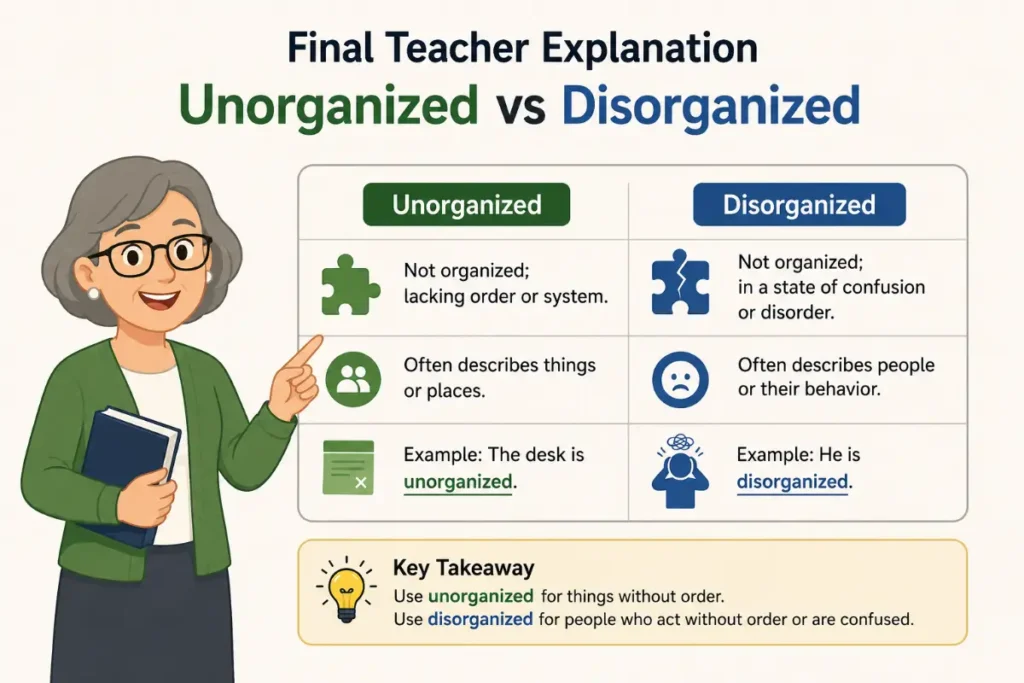
Final Teacher Explanation About Unorganized vs Disorganized
Imagine I am standing in front of a classroom. I would tell my students this simple rule. Do not worry if these words seem similar. Even native English speakers sometimes use them in similar ways. The easiest way to remember both words and it is to think about time. First comes unorganized.
Nothing has been arranged yet. Later, if something becomes messy after being arranged, it becomes disorganized. That one picture helps most students remember the difference for years. Also remember that language is flexible. In casual conversations, people may use either word, and most listeners will understand them. Still, choosing the more accurate word makes your English sound clearer and more natural.
Practice using both words in your own sentences. After a few days, the difference will start to feel easy.
Final Answer or Quick Recap
The answer is simple. Both words are correct. Neither one is wrong. Use unorganized when something has not been organized yet. Use disorganized when something was organized before or when it has become messy, confusing, or out of order.
A simple memory trick is to ask yourself one question:
“it was organized before?”
If yes, choose disorganized.
If no, choose unorganized.
That small question will help you choose the right word in most everyday situations.
A related grammar guide is Mentioned vs Mentionned: Easy Guide With Examples.
Conclusion
Understanding is easier than many people think. The words are closely related, but they are not always the same. Knowing the small difference helps you speak and write more clearly.
Remember that unorganized usually describes something that has not been arranged yet. Disorganized usually describes something that has lost its order or become messy. Keeping this idea in mind will make choosing the right word much easier.
The easiest takeaway is this: If it was never organized, use unorganized. If it became messy after being organized, use disorganized.
Frequently Asked Questions (FAQs)
What does mean in simple words?
Both words describe a lack of order. Unorganized means not arranged yet. Disorganized means messy or out of order.
Is it correct to use unorganized or disorganized?
Yes. Both words are correct English. The best choice depends on the situation.
When should I use unorganized?
Use unorganized when something has not been sorted, planned, or arranged yet.
When should I use disorganized?
Use disorganized when something has become messy, confusing, or lost its order.
Why do people get confused?
Both words have similar meanings, and many people use them in everyday conversations as if they mean the same thing.
Can I use both words in formal writing?
Yes. Both are accepted in formal and informal writing. Choose the word that matches the meaning you want.
Which word is more common for describing a person?
Disorganized is more common because it describes someone whose work, schedule, or thoughts are often messy or difficult to manage.
Is unorganized always wrong for a messy room?
No. However, disorganized is usually the more natural choice if the room was clean before and later became messy.
