
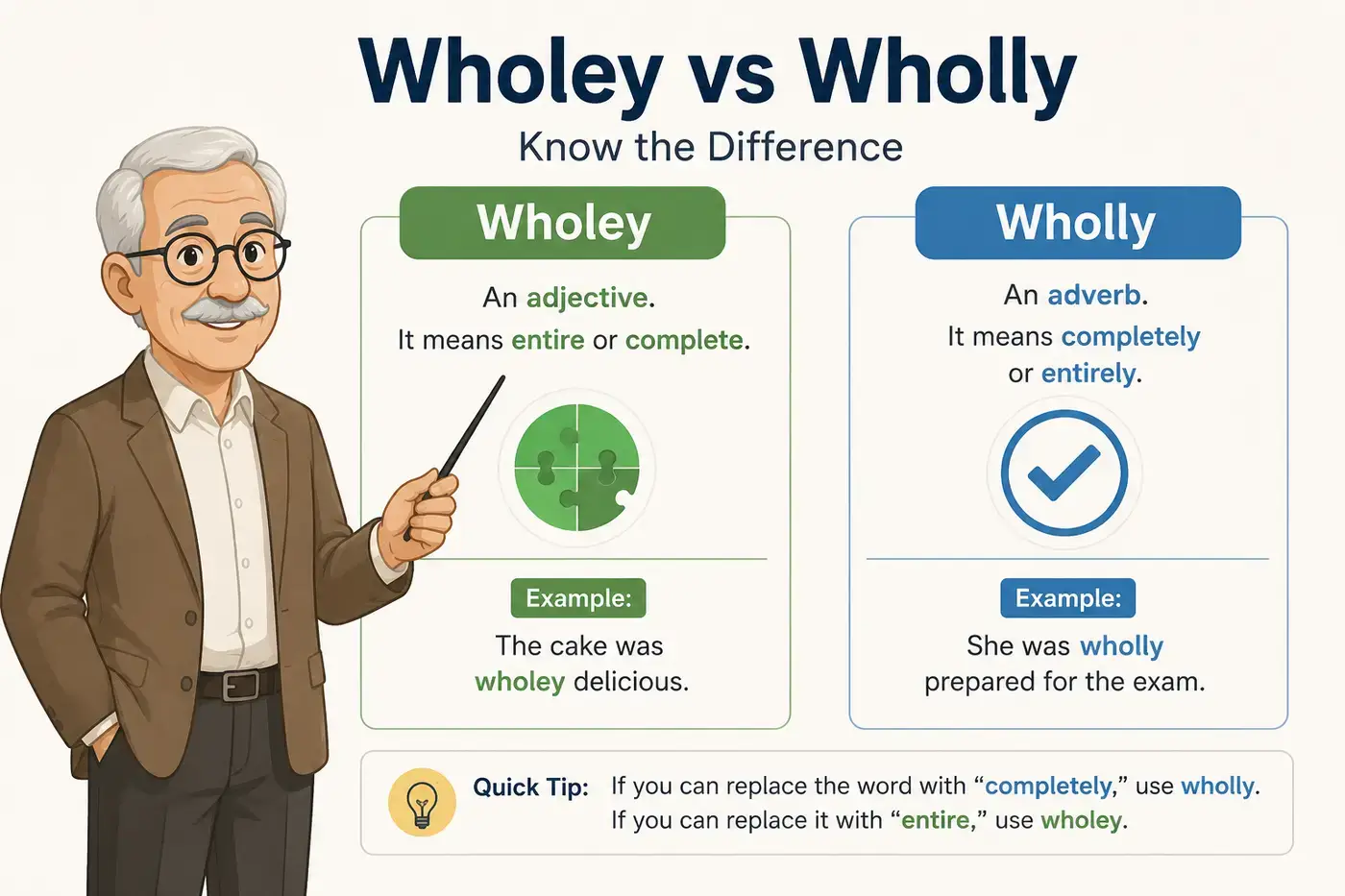
Many people get confused about wholey vs wholly because the two words look very similar. At first glance, it seems like they should mean the same thing. That is why many writers stop and wonder which spelling is correct.
If you have searched for wholey vs wholly, the short answer is simple. Wholly is the correct standard English word. Wholey is usually considered a misspelling unless it appears as part of a name, brand, or special title.
Knowing the difference can help you avoid writing mistakes. It can also make your writing look more professional and easier to understand.
For another common grammar confusion, see Chefs Or Cheves: Correct Answer Explained Clearly (2026).
Wholey vs Wholly: Simple Answer in One Look
Wholly is the correct word in standard English.
Wholey is usually a spelling mistake.
Use wholly when you mean completely, entirely, or fully.
What Does Wholey vs Wholly Mean in Simple English?
To understand you first need to know what wholly means. The word wholly means:
- Completely
- Entirely
- Fully
- Totally
It is used when something is done 100 percent. For example:
“The project was wholly successful.”
This means the project was completely successful. Another example:
“I wholly agree with your idea.”
This means I completely agree.
In everyday English, wholly helps show that something is full or complete.
What About Wholey?
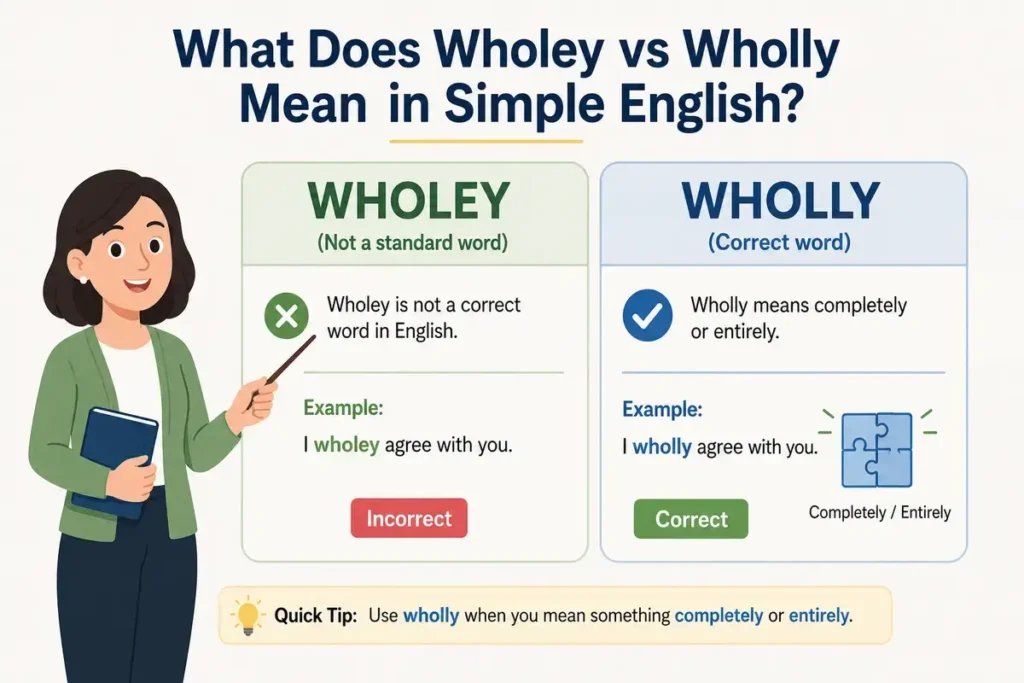
Most of the time, wholey is not a standard English word. People often write wholey when they actually mean wholly. For example:
❌ I wholey agree with you.
✔ I wholly agree with you.
The second sentence is correct.
Easy Way to Remember the Meaning of Wholey vs Wholly
Think of wholly as another way to say:
- Completely
- Totally
- Entirely
- Fully
If one of those words fits your sentence, wholly will probably fit too. Examples:
- I am wholly committed to the plan.
- She was wholly honest.
- The team was wholly prepared.
- We were wholly surprised.
In each sentence, wholly means completely.
Why Do People Mix Wholey vs Wholly?
The confusion in wholey vs wholly happens for a few simple reasons.
The Spellings Look Almost the Same
Look at these words:
- whole
- wholly
- wholey
Only one letter changes. Because they look so similar, many people accidentally choose the wrong spelling.
People See the Word “Whole”
Many writers know the word whole. Whole means complete or not broken. When they try to turn whole into another form, they naturally write wholey. It seems logical. But English does not follow that pattern here. The accepted spelling became wholly instead.
Spell Check Does Not Always Catch It
Sometimes people use names, brands, or usernames that contain the spelling wholey. Because of that, some writing tools may not immediately warn about it. This can make people think the word is correct in normal writing.
Fast Typing Creates Mistakes
Many spelling mistakes happen because people type quickly. For example:
- wholly → wholey
- definitely → definately
- separate → seperate
These mistakes are common because the words sound similar when spoken.
Wholey vs Wholly: Clear Difference Explained Simply
The difference is actually very easy.
| Word | Correct Standard English? | Meaning |
|---|---|---|
| Wholly | Yes | Completely, fully, entirely |
| Wholey | Usually No | Usually a misspelling of wholly |
Quick Visual Comparison of Wholey vs Wholly
Wholly = Correct
Wholey = Usually Incorrect
Examples:
✔ I wholly support the decision.
✔ She was wholly dedicated to her work.
❌ I wholey support the decision.
❌ She was wholey dedicated to her work.
What Makes Wholly Different?
The word wholly became the accepted spelling through the development of English over many years. Even though it comes from the idea of being whole, the spelling changed as the language evolved. That is why modern dictionaries list wholly as the correct form.
Wholey vs Wholly in Everyday Writing
You may see wholly in many types of writing.
In School Writing
Students often use wholly when discussing ideas or opinions. Examples:
- I wholly agree with the author.
- The experiment was wholly successful.
In Business Writing
Companies use wholly to describe ownership or complete responsibility. Examples:
- The company is wholly owned by its parent organization.
- The project is wholly funded by investors.
In News Articles
Reporters often use wholly when describing complete actions or situations. Examples:
- The plan was not wholly effective.
- The statement was wholly inaccurate.
In Everyday Conversation
People use wholly less often in casual speech, but it still appears. Examples:
- I wholly agree.
- We are wholly committed.
- She was wholly surprised.
Which Form Should You Use for Wholey vs Wholly?
When deciding use wholly. That is the standard spelling accepted by dictionaries, teachers, editors, and professional writers.
Use Wholly When You Mean “Completely”
Examples:
- I wholly understand.
- We wholly support the idea.
- They were wholly prepared.
- The team was wholly focused.
In each sentence, wholly means completely.
Avoid Wholey in Standard Writing
Do not use wholey in:
- Essays
- School assignments
- Business reports
- Professional emails
- Blog posts
- Articles
Most readers will see it as a spelling error.
The Simple Rule
Remember this:
Wholly = Correct.
Wholey = Usually Wrong.
This rule works almost every time.
Common Mistakes People Make using Wholey vs Wholly
Many learners make the same mistakes.
Mistake 1: Using Wholey Because It Looks Logical
People think:
Whole + y = Wholey
That seems reasonable. But English uses wholly instead.
Mistake 2: Confusing Whole With Wholly
These words are related, but they do different jobs. Whole describes something complete. Example:
“The whole cake was eaten.”
Wholly means completely. Example:
“The team was wholly prepared.”
Mistake 3: Copying Incorrect Online Examples
The internet contains many spelling errors. Sometimes people see wholey used incorrectly and assume it is accepted English. Always check a trusted dictionary when unsure.
Easy Real-Life Sentences You Can Use for Wholey vs Wholly
Here are simple examples with wholly.
- I wholly agree with your decision.
- She was wholly committed to her goals.
- We were wholly surprised by the news.
- The project was wholly successful.
- He was wholly responsible for the mistake.
- They were wholly prepared for the test.
- The company is wholly owned by investors.
- The team was wholly focused on winning.
Notice how wholly means completely in every sentence.
Practice Sentences
Try filling in the blank.
- I _____ support your idea.
- The group was _____ ready.
Answer:
- wholly
- wholly
Wholey vs Wholly and Similar Confusing Words
English has many word pairs that confuse writers. For example:
- altogether vs all together
- everyday vs every day
- awhile vs a while
- anyway vs any way
These pairs look similar but have different rules. The best way to learn them is through reading and practice.
A Helpful Memory Trick
Look at the word:
wholly
Notice the double “ll.”
Think:
“Wholly means fully.”
Both words have a strong complete feeling. This memory trick helps many learners remember the correct spelling.
Where Does Wholly Come From? (Simple History)
The history behind wholly is interesting. The word comes from the older English word whole, which means complete or entire. As English changed over time, people developed the adverb wholly to mean completely. The spelling slowly became standardized. Writers, printers, teachers, and dictionaries eventually settled on wholly as the accepted form. That spelling has remained the standard for many years.
Why Didn’t Wholey Become Standard?
Language often develops in unexpected ways. Some spellings become accepted while others do not. Although wholey looks like it could work, English settled on wholly instead. That is why modern dictionaries and style guides recommend wholly.
Why Learning Word History Helps
When you know where a word comes from, it becomes easier to remember.
Think of it this way:
- Whole = complete
- Wholly = completely
The connection becomes much clearer.
Is Wholly Common in Modern English?
Yes. You may not hear it every day in casual conversation, but it appears often in:
- Books
- News articles
- Business documents
- Academic writing
- Legal writing
- Professional communication
Because of this, learning the correct spelling is useful. Writers who use wholly correctly often appear more confident and polished.
Quick Review of Wholey vs Wholly
Before moving on, remember these key points:
- Wholly is the correct standard English spelling.
- Wholey is usually a misspelling.
- Wholly means completely, entirely, or fully.
- Use wholly in professional and everyday writing.
- If you are unsure, choose wholly.
Once you remember that simple rule, this spelling question becomes much easier.
For another common grammar confusion, see Naive vs Nieve Explained With Easy Examples.
Transition to Deeper Meaning and Usage
Now that you understand the basic difference between wholey vs wholly, the next section will look at deeper meanings, symbolism, cultural use, common expressions, and how people use the word in literature and everyday communication.
Wholey vs Wholly in Culture and Stories
When discussing wholey vs wholly, culture gives us an interesting way to understand the word wholly. People often use wholly when they want to show complete commitment, trust, love, or belief. Because of this, the word appears in stories, books, speeches, and everyday conversations. For example, a story might say:
“He was wholly devoted to helping others.”
This tells readers that the character was fully dedicated. In many stories, characters are admired when they give themselves wholly to a good cause. They do not do things halfway. They give their full effort. You may also see sentences like:
- She wholly trusted her friend.
- They wholly believed in their dream.
- He was wholly committed to the mission.
These examples create a feeling of strength and completeness. The incorrect form wholey usually does not carry any special cultural meaning because it is not recognized as a standard English word. That is why writers, teachers, and publishers almost always choose wholly.
Wholey vs Wholly in Biblical and Mythological Meaning
The word wholly appears in some religious and spiritual writing because it expresses the idea of being complete or fully devoted. For example, people may talk about:
- Wholly trusting God.
- Wholly following a belief.
- Wholly committing to a purpose.
In these situations, wholly means giving full faith, attention, or dedication. The word itself is not a special religious word. It simply helps express complete commitment.
Is Wholey Used in Religious Writing?
Usually no. Most religious books, articles, and translations use wholly because it is the accepted spelling. Wholey generally appears only as a spelling mistake or as part of a person’s name.
Mythological Connections
In myths and legends, heroes are often described as fully committed to their quests. A modern writer might say:
“The hero was wholly devoted to protecting his people.”
Here, wholly highlights complete dedication and courage. Again, wholey does not have a separate mythological meaning.
Wholey vs Wholly Symbolism Explained in Simple Words
Words often carry feelings beyond their dictionary meanings. The comparison can help show how language works.
What Wholey Represents
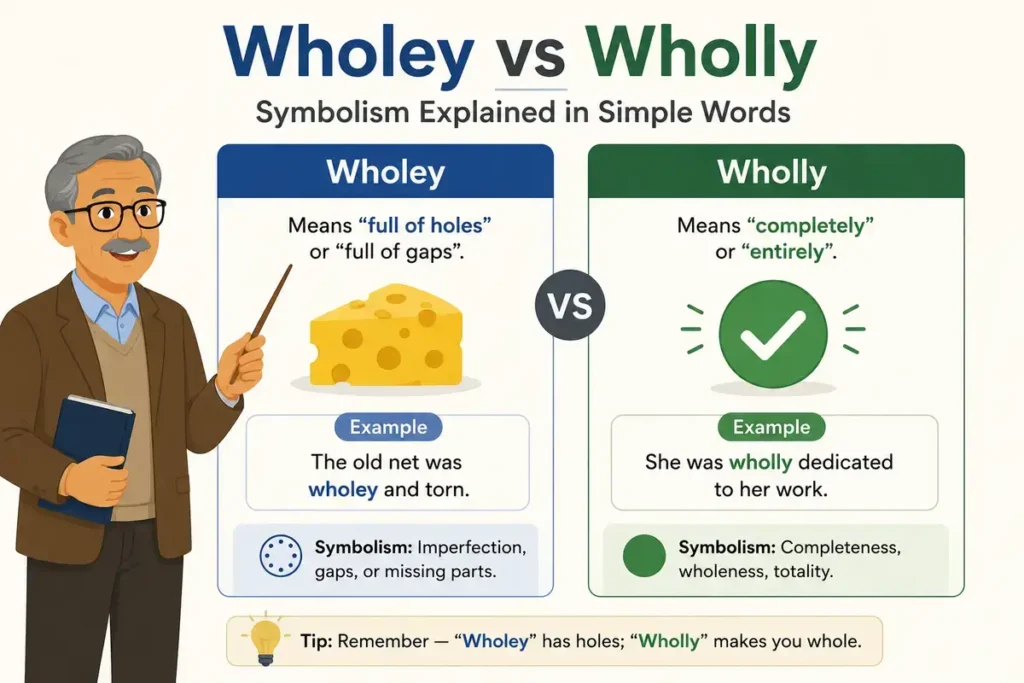
In standard English, wholey does not represent a recognized meaning. When readers see wholey, they often think:
- Typing mistake
- Spelling error
- Incorrect form of wholly
Because of this, it usually creates confusion rather than a clear message.
What Wholly Represents
Wholly often symbolizes:
- Completeness
- Total commitment
- Full effort
- Strong belief
- Full support
When someone says:
“I wholly agree.”
The sentence feels stronger than simply saying:
“I agree.”
The word adds a sense of completeness.
Simple Comparison of Wholey vs Wholly
Wholey:
- Usually seen as incorrect
- Can confuse readers
- Not standard English
Wholly:
- Standard English spelling
- Means completely
- Creates a clear message
- Widely accepted
This is one reason learning the correct spelling matters.
Related Words You Should Know When Learning Wholey vs Wholly
Several words are closely connected to wholly. Learning them can make your vocabulary stronger.
Completely
Means 100 percent. Example:
“I completely understand.”
Entirely
Means fully or totally. Example:
“The plan was entirely successful.”
Fully
Means to the fullest extent. Example:
“She was fully prepared.”
Totally
Means completely. Example:
“I totally agree.”
Whole
Means complete or all of something. Example:
“He ate the whole pizza.”
Entire
Means complete. Example:
“The entire class passed.”
Absolutely
Means without any doubt. Example:
“I absolutely support the idea.”
These words often work in similar situations as wholly.
How People Actually Use Wholey vs Wholly in Daily English
Most native speakers use wholly when they want to emphasize something. Here are common examples you might hear or read.
Agreement
“I wholly agree with you.”
Support
“We wholly support the project.”
Responsibility
“He was wholly responsible for the mistake.”
Commitment
“She is wholly dedicated to her work.”
Trust
“They wholly trusted their leader.”
Success
“The event was wholly successful.”
Focus
“The team was wholly focused on winning.”
Honesty
“She was wholly honest about the problem.”
Surprise
“We were wholly surprised by the result.”
Confidence
“I am wholly confident in the plan.”
These examples show how naturally wholly fits into everyday English.
Common Phrases Using Wholly
You may often see wholly used in fixed expressions. Examples include:
- Wholly owned company
- Wholly responsible
- Wholly committed
- Wholly successful
- Wholly dependent
- Wholly accurate
- Wholly unacceptable
- Wholly devoted
These phrases appear frequently in business, education, and professional writing.
Common Mistakes People Make With Wholey vs Wholly
Many learners make the same errors. The good news is that they are easy to fix.
Mistake 1: Writing Wholey Instead of Wholly
Incorrect:
“I wholey support your decision.”
Correct:
“I wholly support your decision.”
Always remember that wholly is the accepted spelling.
Mistake 2: Using Whole Instead of Wholly
Incorrect:
“I whole agree.”
Correct:
“I wholly agree.”
Whole and wholly have different jobs in a sentence.
Mistake 3: Thinking Both Are Equally Correct
Some people assume wholey and wholly are standard alternatives. They are not. Wholly is the standard English form.
Mistake 4: Avoiding the Word Completely
Some writers stop using wholly because they are unsure about the spelling. Instead, learn the correct form and use it confidently.
Mistake 5: Mixing Up Meaning
Remember:
Whole = complete thing.
Wholly = completely.
Example:
“The whole class arrived.”
“The class was wholly prepared.”
Why Learning Wholey vs Wholly Matters
You may wonder why one small spelling difference matters. The answer is simple Correct spelling helps readers trust your writing.
When readers see wholly, they immediately understand your meaning.
When readers see wholey, they may pause and wonder if it is a mistake.
Small spelling improvements can make:
- School assignments stronger
- Blog posts clearer
- Emails more professional
- Reports easier to read
That is why learning these word pairs is useful.
Final Teacher Explanation of Wholey vs Wholly
Imagine you are sitting in a classroom and asking:
“Teacher, which word should I use: wholey or wholly?”
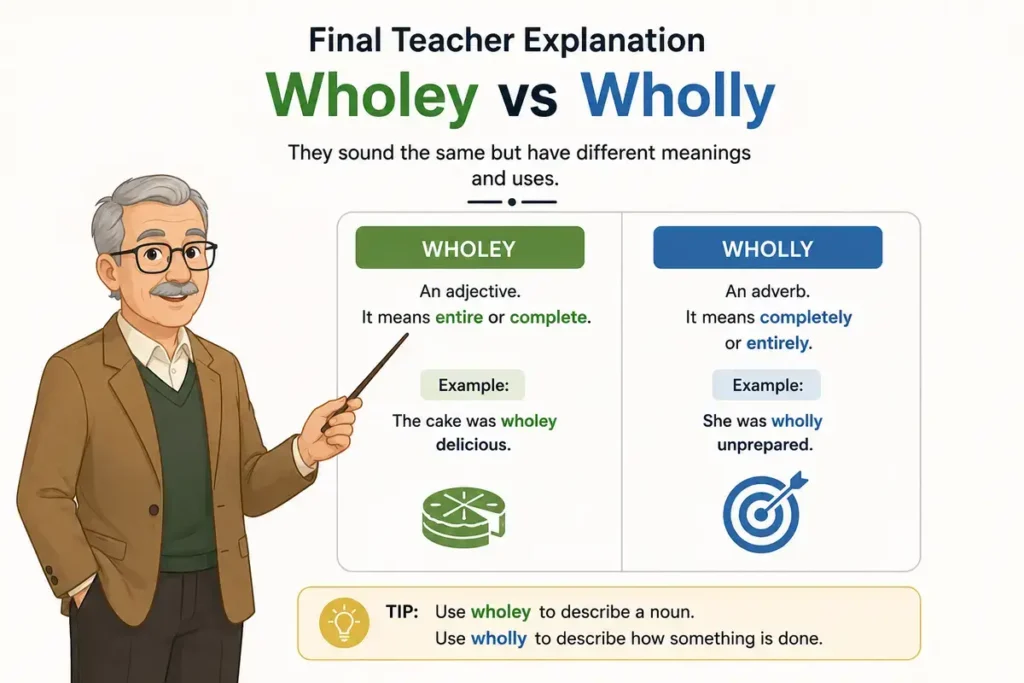
My answer would be simple. Use wholly. It is the correct spelling found in standard English dictionaries. It means completely, entirely, fully, or totally. The spelling wholey usually appears because people think it follows the spelling of whole. That idea makes sense, but English chose wholly as the accepted form. Whenever you want to express complete agreement, complete commitment, or complete support, use wholly. Remember this classroom rule:
Whole = complete thing.
Wholly = completely.
If you remember that one rule, you will rarely make a mistake.
Final Answer: Wholey vs Wholly Quick Recap
When comparing wholey vs wholly, wholly is the correct standard English spelling.
Wholly means completely, entirely, fully, or totally.
Wholey is usually considered a spelling mistake unless it is part of a name or special title.
If you are unsure which form to choose, use wholly.
Many readers also check Using or Useing: Which Spelling Is Correct?.
Conclusion
The confusion between wholey vs wholly is very common because the two spellings look almost identical. However, the answer is simple. Wholly is the correct word in standard English, while wholey is usually a misspelling.
Whenever you want to say completely, entirely, fully, or totally, choose wholly. It is accepted by dictionaries, teachers, editors, and professional writers. Learning this small difference can make your writing clearer and more confident. The easiest rule to remember is this: use wholly for complete agreement, complete commitment, and complete support. If you follow that rule, you will almost always be correct.
Frequently Asked Questions (FAQs)
What does wholly mean in simple words?
Wholly means completely, entirely, or fully.
Is wholly a real English word?
Yes. Wholly is a standard English word used in formal and everyday writing.
Is wholey correct?
Usually no. Wholey is generally considered a spelling mistake unless it is part of a name.
Which is correct?
Wholly is the correct spelling in standard English.
Why do people confuse?
People see the word whole and assume wholey should be correct. English uses wholly instead.
Can I use wholly in professional writing?
Yes. Wholly is commonly used in business, academic, and professional writing.
What is a synonym for wholly?
Common synonyms include completely, entirely, fully, and totally.
How can I remember the correct spelling?
Remember this simple rule: wholly means completely. Use wholly whenever you mean fully or entirely.
