
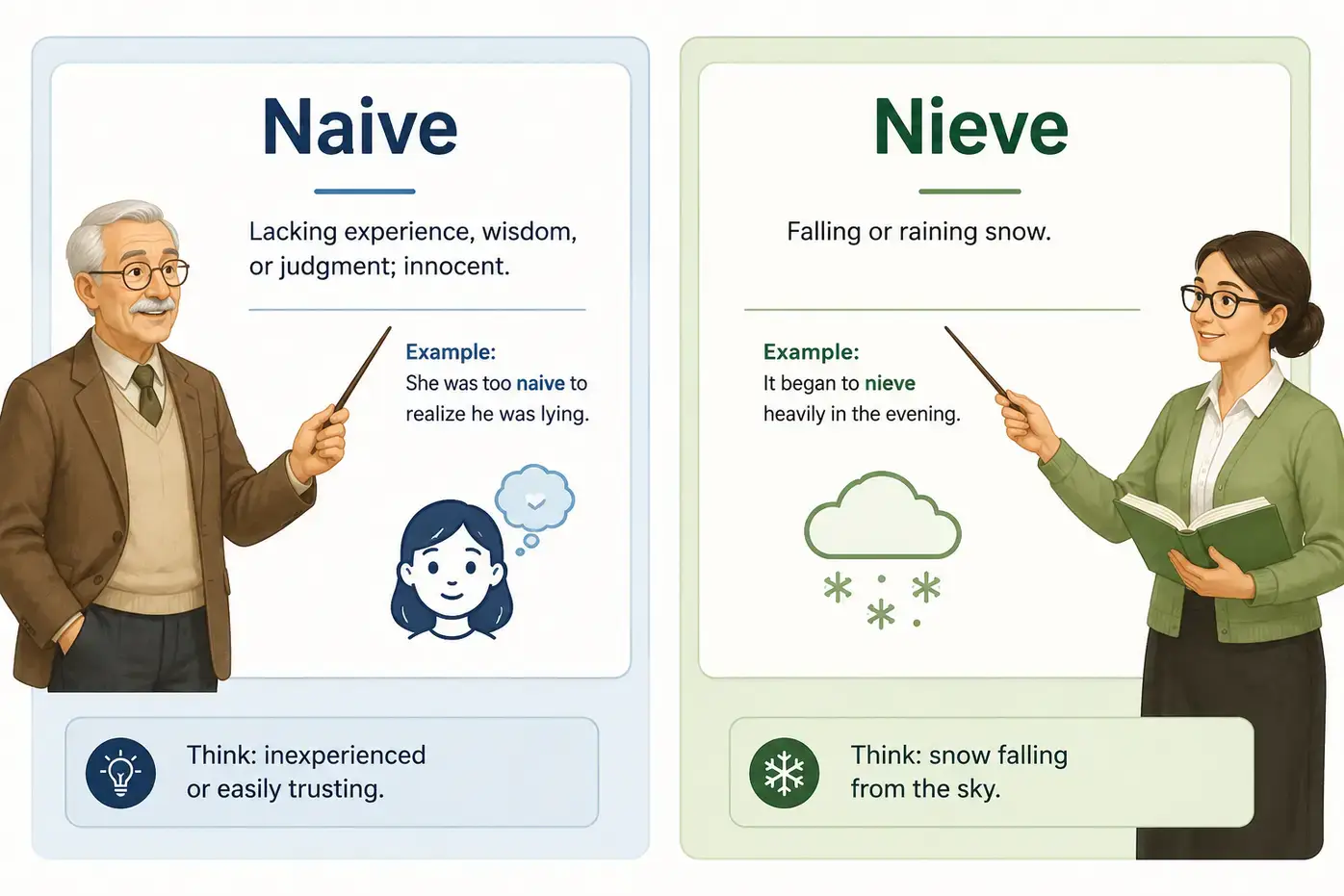
Many English learners get confused about naive vs nieve because the two words look very similar. At first glance, they seem like different spellings of the same word. That makes people wonder which one is correct.
The short answer is simple. In standard English, naive is the correct word. Nieve is usually a misspelling. This mistake happens often because the letters are arranged in a similar way.
If you have ever searched for naive vs nieve, you are not alone. Thousands of people make this spelling mistake. In this guide, you will learn the meaning, spelling, usage, and difference in very simple English.
For another common grammar confusion, see Whiny vs Whiney: Which Spelling Is Correct and How to Use It?.
Naive vs Nieve: Simple Answer in One Look
Naive is the correct English word.
Nieve is usually a spelling mistake.
- Naive = innocent, trusting, or lacking experience
- Nieve = not a standard English spelling of the word
If you are writing in English, use naive.
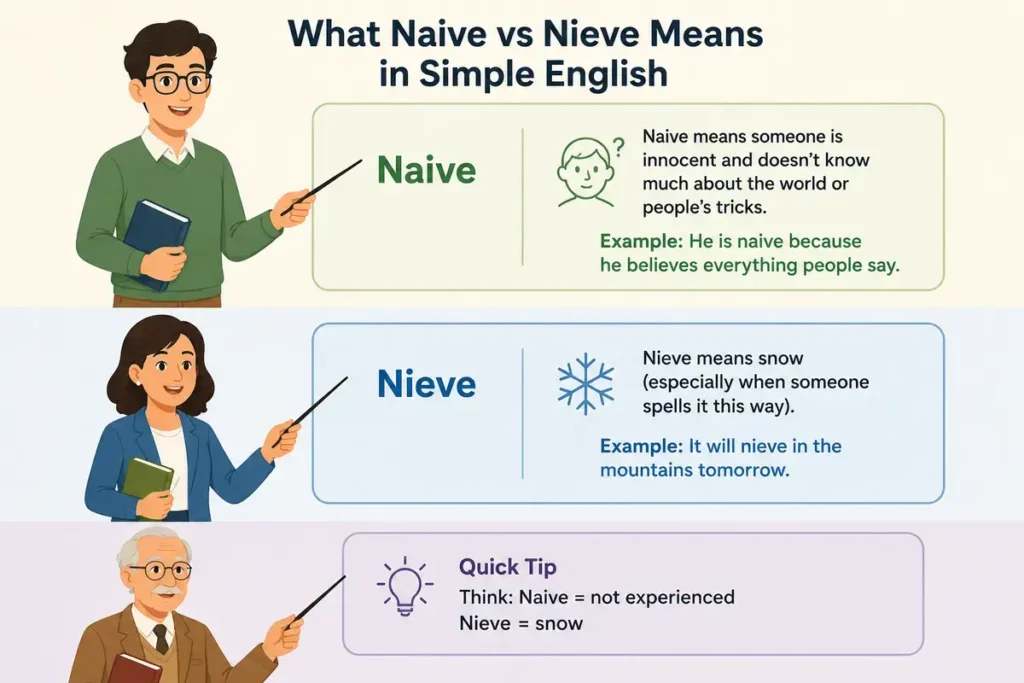
What Naive vs Nieve Means in Simple English
The word naive describes a person who is very trusting or does not have much experience with how the world works. A naive person often believes what others say without questioning it. This does not always mean the person is unintelligent. It usually means they are innocent, inexperienced, or too trusting.
For example: “He was naive enough to believe the scam message.” In this sentence, the person trusted something that was not true. Think of a young child. Children often believe what adults tell them because they have not yet learned that some people may lie or trick others. That is one example of being naive.
Naive vs Nieve Meaning
When comparing naive vs nieve, only naive has this meaning in English. The spelling nieve does not carry the same accepted meaning in English dictionaries.
Why People Mix Naive vs Nieve
People mix up naive vs nieve because the spellings look very close. English spelling can be tricky. Sometimes letters change places when people type quickly. For example:
- receive → recieve
- friend → freind
- naive → nieve
The mistake often happens because people remember the sounds but not the exact order of the letters. Another reason is that some languages have words that look similar to nieve. This can make learners think the spelling is correct in English too.
Common Typing Mistake
When someone hears the word naive, they may write:
- nieve
- naiv
- nave
- naeve
Among these, nieve is one of the most common misspellings.
Clear Difference Explained Simply
Understanding naive vs nieve is actually very easy.
Naive
- Correct English word
- Found in dictionaries
- Used in writing and speaking
- Means innocent or inexperienced
Nieve
- Usually a misspelling
- Not the standard English word
- Should not be used instead of naive
Naive vs Nieve Comparison Table
| Word | Correct English? | Meaning |
|---|---|---|
| Naive | Yes | Innocent, trusting, inexperienced |
| Nieve | No | Usually a spelling mistake |
Easy Way to Remember
Look at the beginning of the word:
NAIVE = NAI + VE
Remember that the word starts with NAI. If you write nieve, the letters are in the wrong order.
Which Form Should You Use?
You should always use naive when writing English. This applies to:
- School assignments
- Emails
- Blog posts
- Social media posts
- Business writing
- Everyday conversations
Correct Examples
- She was naive about online scams.
- I was naive when I started my first job.
- It would be naive to think every rumor is true.
- His naive attitude caused problems.
Incorrect Examples
- She was nieve about online scams.
- I was nieve when I started my first job.
- His nieve attitude caused problems.
The second group contains spelling mistakes.
Is Naïve Also Correct?
Yes. Sometimes you may see the word written as naïve with two dots above the i. Both forms are accepted.
- naive
- naïve
The version without the dots is more common in everyday English writing.
Easy Real-Life Sentences You Can Use for Naive vs Nieve
Here are some simple examples that show how to use naive correctly.
- I was naive when I bought my first car.
- She seemed naive about the dangers of the internet.
- It was naive to trust a stranger with personal information.
- The young student was naive but eager to learn.
- He made a naive mistake because he lacked experience.
- They were naive enough to believe the fake story.
- Her naive view changed after she gained more experience.
- Being naive is common when you are learning something new.
Everyday Conversation Examples
Friend 1: Why did he give money to the scammer?
Friend 2: He was a little naive and believed the message.
Parent: Don’t trust every website you see.
Child: Okay, I guess I was being naive.
Teacher: Why did you believe that rumor?
Student: I was naive and thought it was true.
These examples sound natural and are easy to use in daily life.
Where Naive vs Nieve Comes From (Simple History)
The word naive has been around for a long time. It came into English through the French language. In French, it described someone who was natural, innocent, or simple in behavior. Over time, English speakers started using the word too. The meaning slowly developed into the idea of someone who lacks experience or trusts people too easily. Even though the word is old, people still use it every day.
Why the Spelling Looks Different
Many English words came from other languages. Because of that, some spellings do not follow simple English patterns. That is one reason learners sometimes write nieve instead of naive. The correct spelling stayed close to its original form.
Is Nieve Ever a Real Word?
This is an interesting question. In discussions about naive vs nieve, some people wonder if nieve is ever correct. Outside standard English, Nieve can appear as a personal name or surname in some cultures. However, when you want the English word meaning innocent or inexperienced, you should use naive. So remember:
- As an English vocabulary word, use naive.
- As a person’s name, Nieve may exist.
The two uses are different.
Common Mistakes People Make using Naive vs Nieve
Here are mistakes learners often make when dealing with naive vs nieve.
Mistake 1: Switching the Letters
Incorrect:
- nieve
Correct:
- naive
Mistake 2: Assuming Both Spellings Work
Some people think both spellings are accepted. They are not interchangeable in English writing.
Mistake 3: Using Spell Check Too Late
Many writers type quickly and do not notice the error. Always proofread your work before publishing or submitting it.
Words Similar to Naive
Learning similar words can help you understand the meaning better. Some common synonyms include:
- Innocent
- Trusting
- Gullible
- Unsuspecting
- Inexperienced
- Unaware
Each word has a slightly different meaning, but all share the idea of lacking experience or caution.
Example
Naive:
“She was naive about business deals.”
Inexperienced:
“She was inexperienced in business deals.”
The meaning is similar, though not exactly the same.
Opposites of Naive
The opposite of naive is someone who has experience and understands how situations work. Common opposites include:
- Experienced
- Wise
- Knowledgeable
- Realistic
- Practical
- Skeptical
Example: “He was no longer naive after years of experience.” Experience often helps people become less naive over time.
Many readers also check Passtime or Pastime Which Word Is Correct and Why.
Naive vs Nieve: Why Correct Spelling Matters
Correct spelling helps people understand your writing clearly. If you write nieve instead of naive, readers may think:
- It is a typo.
- You made a spelling mistake.
- You meant something else.
Good spelling makes your writing look more professional and trustworthy. Even small spelling mistakes can change how readers view your work.
Quick Memory Trick for Naive vs Nieve
Try this simple trick.
Think of the word:
NAIVE
Notice the first three letters:
NAI
Keep them together. Whenever you write the word, remember: NAI comes before VE. If you switch the letters and write nieve, you have made a spelling mistake. This small memory trick helps many learners remember the correct form.
Transition to Deeper Meaning
Now you know the basic difference between naive vs nieve. The spelling question is simple: naive is correct, and nieve is usually a mistake. In the next section, we will look at deeper meanings, symbolism, cultural ideas, and how people understand this word in stories and everyday life.
How Naive vs Nieve Is Understood in Culture and Stories
When people hear the word naive, they often think about someone who has a good heart but does not have much life experience. In movies, books, and stories, a naive character is usually kind, honest, and trusting. They often believe the best about other people. Sometimes this makes the character easy to like.
For example, a young hero may trust everyone they meet. Because of that trust, they may get into trouble. As the story continues, they learn important lessons and become wiser. This type of character appears in many cultures around the world. A naive person in a story is often:
- Honest
- Friendly
- Hopeful
- Trusting
- Innocent
These qualities are usually seen as positive. The problem comes when trust is given to the wrong person. When discussing naive vs nieve, only naive carries these meanings in English stories and culture. The spelling nieve does not have this cultural meaning because it is usually a misspelling.
Naive vs Nieve in Everyday Culture
People sometimes use the word “naive” when talking about:
- New workers
- Young students
- First-time travelers
- Beginners in business
- People who trust too easily
The word is not always meant as an insult. Sometimes it simply means a person has not had enough experience yet.
Naive vs Nieve Biblical and Mythological Meaning
The word naive does not have a special Biblical meaning. You will not usually find the exact word used as an important religious term. However, many religious stories include people who show qualities that seem naive. For example:
- Trusting others easily
- Believing promises without question
- Having innocent faith
- Seeing the good in people
These traits can sometimes lead to blessings and sometimes lead to problems. In mythology, young heroes are often shown as innocent before they begin their journey. They learn lessons, face challenges, and become wiser.
So while naive itself is not a major Biblical or mythological symbol, the idea of innocence appears in many stories. Again, in the comparison of naive vs nieve, only naive connects to these ideas because it is the real English word.
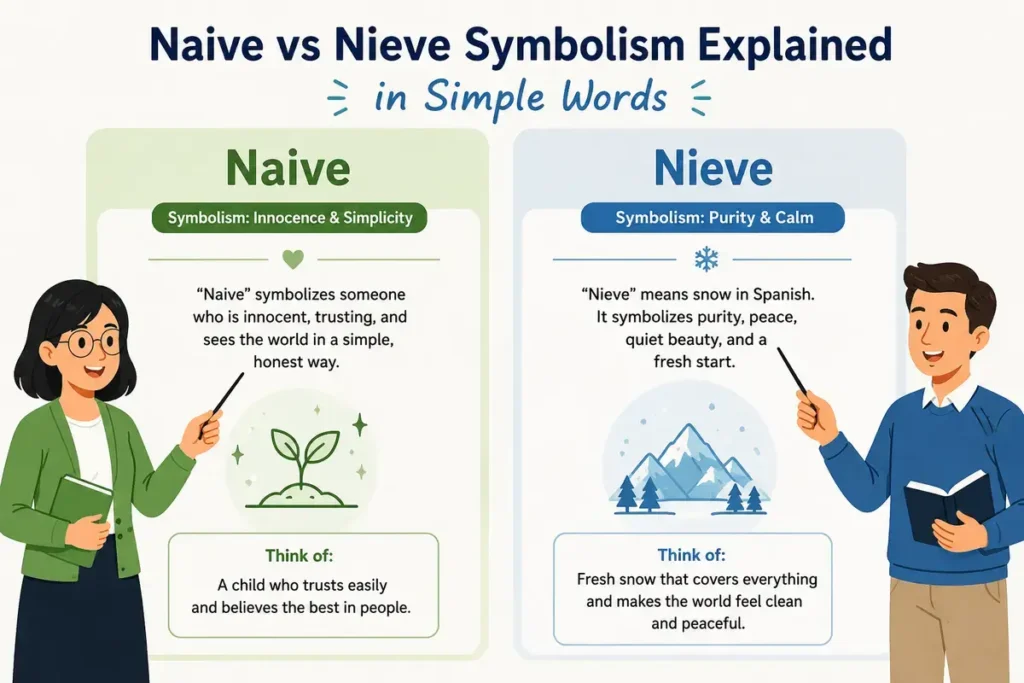
Naive vs Nieve Symbolism Explained in Simple Words
Words often carry feelings beyond their dictionary meanings. The discussion of naive vs nieve is mostly about correct spelling, but the word naive can also symbolize certain human qualities.
What Naive Represents
The word naive often represents:
- Innocence
- Trust
- Hope
- Youth
- Fresh beginnings
- Lack of experience
A naive person may believe that people are naturally good. They may look at the world with optimism. That can be beautiful because it shows kindness and hope. At the same time, it can create problems if someone takes advantage of that trust. Because of this, naive often symbolizes the early stage of learning before experience teaches important lessons.
What Nieve Represents
In standard English, nieve does not represent a separate meaning.It is usually a spelling mistake of naive. Because it is not the accepted English word, it does not have its own symbolic meaning in English writing. So the comparison is simple:
| Word | Symbolic Meaning |
|---|---|
| Naive | Innocence, trust, lack of experience |
| Nieve | Usually a misspelling with no separate English meaning |
This is another reason why using the correct spelling matters.
Related Words You Should Know about Naive vs Nieve
Learning related words can make your vocabulary stronger.
Innocent
Someone who has done nothing wrong or does not know about bad things.
Trusting
A person who easily believes other people.
Gullible
Someone who is easily fooled.
This word is usually more negative than naive.
Inexperienced
A person who has not done something enough to gain knowledge.
Unsuspecting
Not expecting danger or problems.
Idealistic
Believing that things should be perfect or better than they really are.
Wise
A person with good judgment gained from experience. This is often considered the opposite of naive.
Skeptical
Someone who asks questions before believing something. A skeptical person is usually less naive.
How People Actually Use Naive vs Nieve in Daily English
Most English speakers use naive in natural conversations. They almost never use nieve unless they accidentally misspell the word. Here are some common real-life examples.
At Work
“I was naive when I started my first job.”
About Money
“It was naive to think making money would be that easy.”
About Online Scams
“Many people are naive when they first use the internet.”
About Relationships
“He was naive and believed every excuse.”
About School
“I felt naive when I entered college.”
About Travel
“We were naive travelers and got lost several times.”
About Business
“She was naive about how business deals work.”
About Social Media
“It is naive to believe everything you read online.”
About Life Experience
“When I was younger, I was much more naive.”
Friendly Conversation
“Don’t feel bad. Everyone is a little naive sometimes.” These examples show how common the word is in everyday English.
Common Mistakes People Make With Naive vs Nieve
Many learners make the same mistakes. The good news is that they are easy to fix.
Mistake 1: Writing Nieve Instead of Naive
Incorrect:
- She was nieve.
Correct:
- She was naive.
This is the most common mistake.
Mistake 2: Thinking Both Spellings Are Correct
Some people assume that both words are accepted. In standard English, only naive is correct.
Mistake 3: Confusing Naive With Gullible
These words are similar but not exactly the same. A naive person lacks experience. A gullible person is easily fooled. Sometimes a person can be both, but the meanings are different.
Mistake 4: Using Naive as a Harsh Insult
The word is often softer than people think. It can simply mean inexperienced. It does not always mean foolish.
Mistake 5: Forgetting the Correct Letter Order
Many writers accidentally switch the letters. Remember:
- Correct = naive
- Incorrect = nieve
A quick spell check can prevent this mistake.
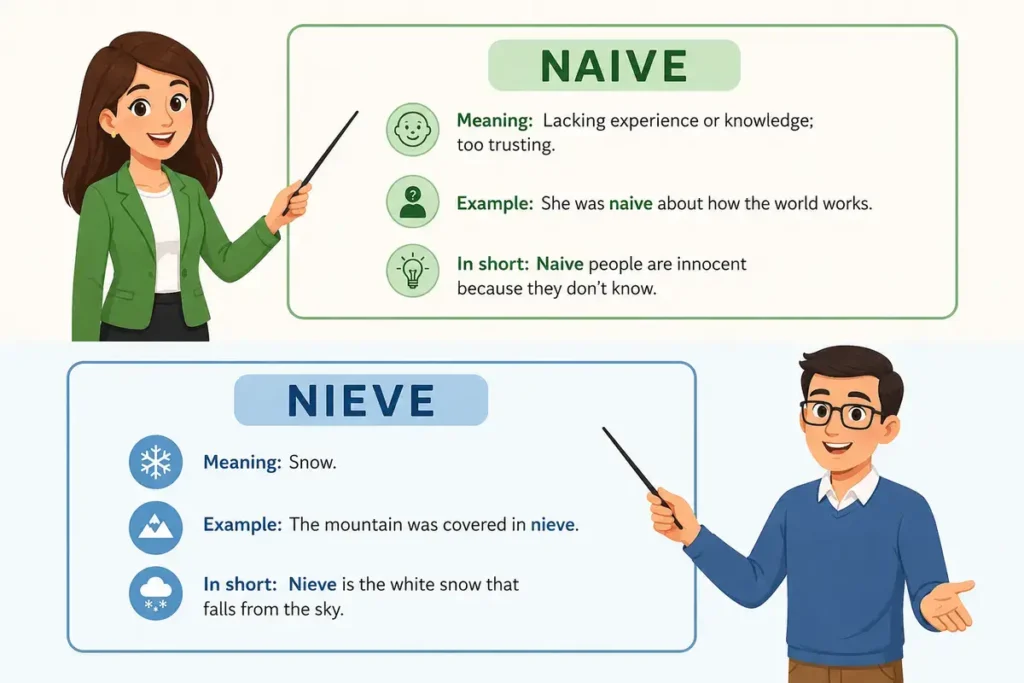
Final Teacher Explanation of Naive vs Nieve
Imagine you are sitting in a classroom and a student asks: “Teacher, which is correct: naive or nieve?” The answer is very simple. Use naive. That is the correct English word. It means someone who is innocent, trusting, or lacking experience.
Use it when talking about a person who believes things easily or has not learned certain life lessons yet. Do not use nieve when you mean the English word “naive.” Most of the time, nieve is simply a spelling mistake. A helpful way to remember this is to focus on the first three letters: NAI
If you remember those letters, you will usually spell the word correctly. Also remember that being naive is not always a bad thing. Many kind, honest, and hopeful people can seem naive at times. Life experience often helps people become wiser while keeping those positive qualities.
Conclusion
Naive is the correct English spelling. It means innocent, trusting, or inexperienced.
Nieve is usually a misspelling and should not be used when writing standard English.
If you remember that naive starts with “NAI,” you can avoid the mistake and write with confidence. The next time you will know exactly which word belongs in your sentence.
Need another quick comparison? Read Bailer or Baler: Difference Explained Simply 2026 Guide.
Naive vs Nieve: Final Answer (Quick Recap)
Naive is the correct English word.
It means innocent, trusting, or lacking experience.
Nieve is usually a spelling mistake and should not replace naive in English writing.
Remember: naive = correct, nieve = incorrect.
Frequently Asked Questions (FAQs)
What does naive mean in simple words?
It means someone who is very trusting or does not have much experience.
Is correct?
Naive is correct. Nieve is usually a spelling mistake.
Why do people confuse?
The spellings look very similar, and people often switch the letters by accident.
Can I use nieve in formal writing?
No. Use naive instead.
Is naïve different from naive?
No. They have the same meaning. Both spellings are accepted.
Is being naive always a bad thing?
No. It can also describe someone who is innocent, honest, and trusting.
What is the opposite of naive?
Common opposites include wise, experienced, realistic, and skeptical.
How can I remember the correct spelling?
Remember that the word starts with NAI. The correct spelling is naive.
