
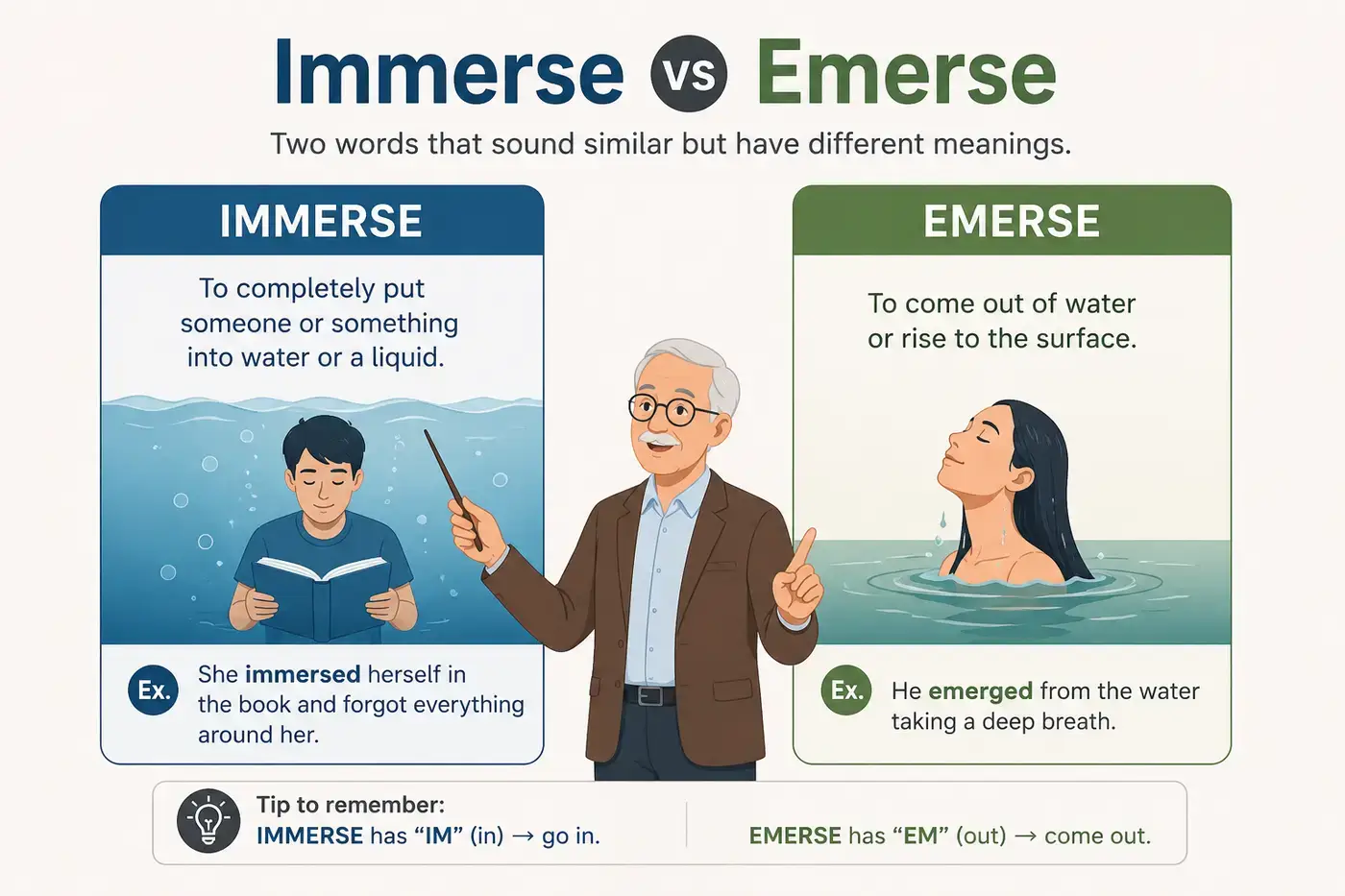
Many people search for the difference between immerse vs emerse because the two words look very similar. They share some of the same letters, and both are connected to the idea of being in or out of something. That makes them easy to confuse.
If you have ever wondered about immerse vs emerse, you are not alone. One word is common in everyday English, while the other is much less common. Because of this, many writers are unsure which one is correct in a sentence.
The good news is that both words are real English words. However, they have opposite meanings. Once you understand the basic idea behind each word, choosing the right one becomes much easier.
Learn the difference in Holistic or Wholistic: Difference Explained Simply(2026).
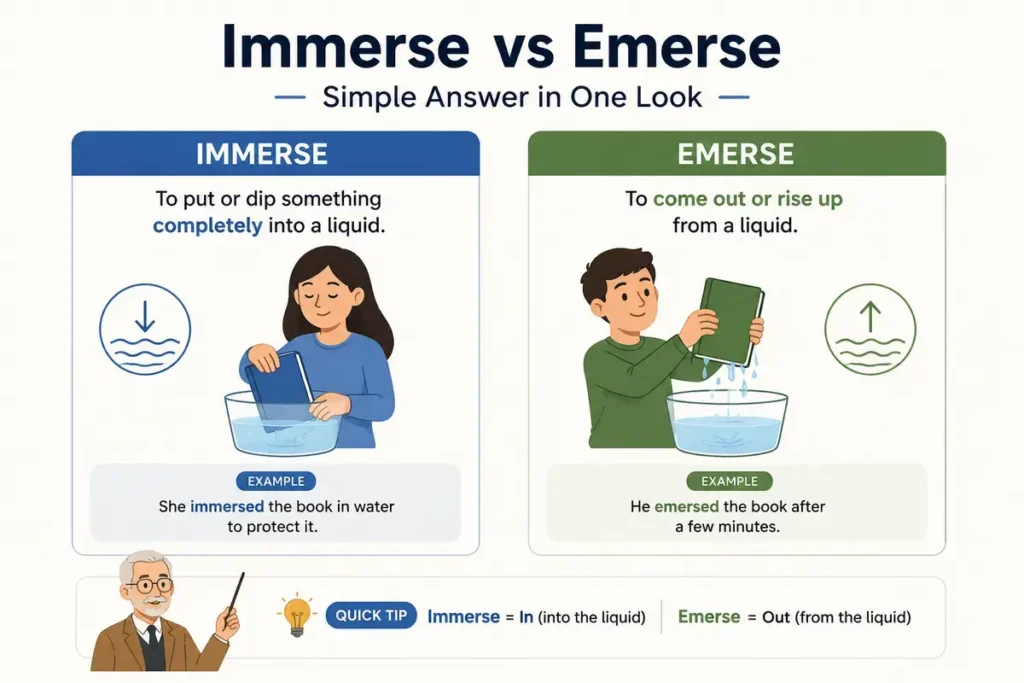
Immerse vs Emerse: Simple Answer in One Look
In the comparison of immerse vs emerse, immerse means “to go into something,” while emerse means “to come out of something.” They are opposite in meaning.
What Does Immerse vs Emerse Mean in Simple English?
To understand immerse vs emerse, imagine a person standing beside a swimming pool. If the person jumps into the water, that is the idea of immerse. If the person comes out of the water, that is the idea of emerse. The two words describe movement in opposite directions.
What Does Immerse Mean?
Immerse means to put something into a liquid or to become deeply involved in something. You may hear people use it when talking about water. Examples:
- Immerse the cup in water.
- Immerse the cloth in the bucket.
- The diver immersed himself in the lake.
But immerse is also used in a figurative way. Examples:
- She immersed herself in the book.
- He immersed himself in learning English.
- They immersed themselves in the project.
In these examples, nobody is going into water. Instead, they are giving their full attention to something.
What Does Emerse Mean?
Emerse means to rise out of a liquid or come out from being covered. This word is much less common. Examples:
- The plant became emerse after the water level dropped.
- The object emersed from the lake.
- The leaves remained emerse above the water.
Most people rarely use this word in daily conversation. You are more likely to see it in science, biology, or nature writing.
A Simple Way to Remember Immerse vs Emerse
Think of these two actions:
- Immerse = go in.
- Emerse = come out.
That simple idea helps you remember the difference quickly.
Why Do People Mix These Words Immerse vs Emerse?
There are several reasons people confuse.
They Look Almost the Same
The words differ by only one letter. Compare them:
- Immerse
- Emerse
When reading quickly, many people do not notice the difference. That can lead to spelling mistakes.
They Are Related in Meaning
Both words describe movement involving water or another substance. Because they belong to a similar idea group, people sometimes assume they mean the same thing. They do not. They are opposites.
One Word Is Far More Common
Most English speakers know the word immerse. Many have never heard the word emerse. When people see emerse, they sometimes think it is a spelling mistake. In reality, it is a real word, but it is used much less often.
Similar Sound Creates Confusion
The pronunciation is somewhat similar. When spoken quickly, listeners may not immediately know which word is being used. That is another reason learners often search for the difference.
Immerse vs Emerse: Clear Difference Explained Simply
The easiest way to understand immerse vs emerse is through a simple comparison.
| Immerse | Emerse |
|---|---|
| Go into something | Come out of something |
| Move downward into water | Rise upward from water |
| Very common word | Less common word |
| Used in everyday English | Mostly used in science and nature |
| Can mean deep focus | Usually refers to physical emergence |
Visual Picture
Imagine a duck in a pond. When the duck dives below the water, think:
Immerse.
When the duck comes back above the water, think:
Emerse.
The movement direction changes.
That is the key difference.
Quick Memory Trick for Immerse vs Emerse
The beginning of immerse can remind you of “in.”
Immerse = in.
The beginning of emerse can remind you of “exit.”
Emerse = out.
This is not a dictionary rule, but it helps many students remember the meanings.
Immerse vs Emerse: Which Form Should You Use?
The answer depends on what you want to say.
Use Immerse When Talking About Going Into Something
Choose immerse when describing:
- Entering water.
- Putting something into liquid.
- Becoming deeply involved.
- Giving full attention.
Examples:
- Immerse the vegetables in cold water.
- I want to immerse myself in the culture.
- She immersed herself in music.
These are common and natural uses.
Use Emerse When Talking About Coming Out
Choose emerse when describing:
- Rising from water.
- Appearing above a surface.
- Coming out of a covering substance.
Examples:
- The plant became emerse.
- The rocks emersed as the water moved away.
This use is much less common in everyday English.
Which Word Will Most People Use?
Most people use immerse regularly. Many native English speakers never use emerse in normal conversation. Because of that, immerse appears much more often in books, articles, and daily speech.
Which Word Is More Useful to Learn First?
Learn immerse first. You will hear it often. You can use it in school, work, travel, reading, and conversation. After that, learn emerse as a special vocabulary word.
Common Situations Where People Use Immerse
The word immerse appears in many parts of daily life.
Reading
People often say:
- I immersed myself in the novel.
- She became immersed in the story.
This means they were completely focused.
Learning
Teachers may encourage students to immerse themselves in a language. Example:
- Immerse yourself in English every day.
This means listening, reading, speaking, and practicing often.
Travel
Travelers may want to immerse themselves in a culture. Example:
- We immersed ourselves in local traditions.
This means they experienced the culture deeply.
Hobbies
People use immerse when discussing activities they enjoy. Examples:
- He immersed himself in painting.
- She immersed herself in gardening.
The meaning is complete involvement.
Common Situations Where People Use Emerse
The word emerse is more specialized.
Science
Scientists may describe plants as submerged or emerse. Example:
- The leaves became emerse above the water.
Nature Studies
Nature writers sometimes use emerse when discussing lakes, ponds, and wetlands. Example:
- The stems remained emerse during the dry season.
Water Environments
The word can describe objects rising above water. Example:
- Several rocks emersed as the tide moved away.
These situations are much less common than the everyday uses of immerse.
Easy Real-Life Sentences You Can Use for Immerse vs Emerse
Here are simple examples with immerse.
- Please immerse the shirt in warm water.
- I want to immerse myself in the new language.
- She immersed herself in her studies.
- We immersed ourselves in the local culture.
- He immersed the brush in paint.
- The children immersed themselves in the game.
- The diver immersed himself in the ocean.
- They immersed themselves in the project.
Now look at examples with emerse.
- The plant became emerse after the water dropped.
- The rock emersed from the lake.
- Several stems remained emerse above the water.
- The object slowly emersed from the pond.
- The roots stayed underwater while the leaves were emerse.
Notice how immerse is useful in many situations, while emerse usually relates to water and nature.
Common Mistakes People Make using Immerse vs Emerse
When learning students often make a few simple mistakes.
Mistake 1: Thinking They Mean the Same Thing
Wrong idea:
- Immerse = Emerse
Correct idea:
- Immerse = go in.
- Emerse = come out.
Mistake 2: Using Emerse for Deep Focus
Wrong:
- I emersed myself in the book.
Correct:
- I immersed myself in the book.
When talking about attention or focus, immerse is the correct choice.
Mistake 3: Assuming Emerse Is a Misspelling
Some learners think emerse is not a real word. It is a real English word. It is simply less common.
Where Does Immerse vs Emerse Words Come From? (Simple History)
The history helps explain why the meanings are opposite. Both words come from Latin. The older roots were connected to movement. One root carried the idea of putting something into a liquid. The other carried the idea of coming out. Over time, English adopted both words.
How Immerse Developed
Immerse became widely used because people needed a word for placing something into water. Later, writers started using it in a figurative way. That is why we now say things like:
- Immerse yourself in learning.
- Immerse yourself in history.
- Immerse yourself in music.
The meaning expanded beyond water.
How Emerse Developed
Emerse kept a more specialized meaning. It stayed closely connected to water, plants, and natural environments. Because of this narrow use, it never became as common as immerse. Today, it is mostly found in scientific and environmental writing.
Many readers also check Reins vs Reigns Explained Simply With Easy Examples.
Why Knowing the Difference Matters about Immerse vs Emerse
Knowing the difference between immerse vs emerse helps you choose the right word quickly. It also prevents confusion when reading books, articles, or educational materials. The meanings are simple once you remember the direction of movement.
- Immerse means moving in.
- Emerse means moving out.
That one idea explains almost everything about these two words.
Transition to Deeper Meaning and Cultural Understanding
Now that you understand the basic difference between immerse vs emerse, the next section will look at deeper meanings, symbolism, cultural uses, and how these words are understood in stories, learning, personal growth, and everyday communication.
How Is Immerse vs Emerse Understood in Culture and Stories?
When people hear the word immerse, they often think about becoming fully involved in something. In stories, movies, and books, characters often immerse themselves in a new adventure, a challenge, or a dream. For example:
- A young hero may immerse himself in learning magic.
- A traveler may immerse herself in a new culture.
- A musician may immerse herself in practice.
The word suggests focus, effort, and commitment. The word emerse appears much less often in stories. When it does appear, it usually describes something rising from water or becoming visible. For example:
- An island may emerse from the sea.
- A hidden object may emerse from a lake.
- A water plant may become emerse during a dry season.
Because of this, immerse is connected with participation, while emerse is connected with appearance or emergence.
Immerse vs Emerse in Storytelling
Writers often use immerse when they want readers to imagine deep involvement. Examples:
- Immersed in thought.
- Immersed in study.
- Immersed in adventure.
The word helps create a picture of someone being fully engaged. Emerse creates a different picture. It often suggests something becoming visible after being hidden That can symbolize discovery, change, or a new beginning.
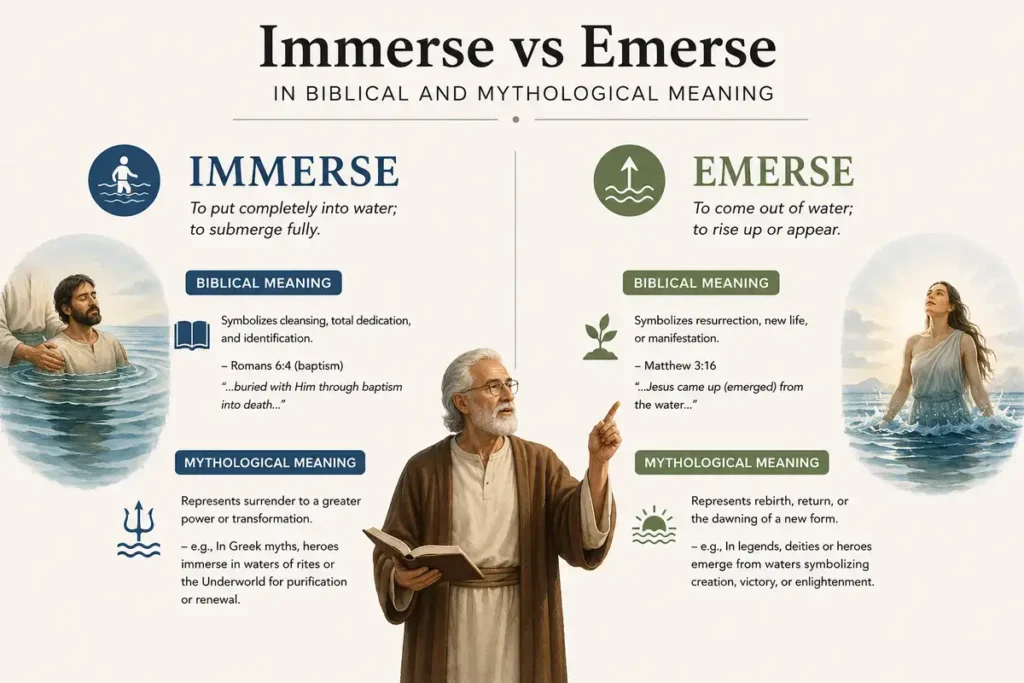
Immerse vs Emerse in Biblical and Mythological Meaning
Neither immerse nor emerse is a major biblical word, but their ideas appear in many religious and mythological stories.
Immerse in Religious Contexts
The idea of immersion often appears in water-related ceremonies. Water is sometimes connected with:
- Cleansing
- Renewal
- Change
- New beginnings
Because of this, immerse can carry a meaning of transformation. A person enters one state and comes out changed.
Emerse in Religious Contexts
The idea behind emerse can be seen when something rises from water or darkness into light. This can symbolize:
- Hope
- Growth
- Revelation
- New life
The word itself is rarely used in religious texts, but the idea behind it appears often.
Mythological Connections
Many myths include characters entering unknown places and later returning. The journey often follows this pattern:
- Immerse into a challenge.
- Learn something important.
- Emerse with new knowledge.
This simple pattern appears in stories from many cultures.
Symbolism Immerse vs Emerse Explained in Simple Words
The comparison becomes even more interesting when we look at symbolism.
What Immerse Represents
Immerse often symbolizes:
- Deep learning
- Commitment
- Focus
- Curiosity
- Personal growth
When someone immerses themselves in a subject, they are giving it their full attention. Examples:
- Immersing yourself in a language.
- Immersing yourself in a hobby.
- Immersing yourself in a culture.
Symbolically, immerse means going deeper. It suggests entering an experience completely.
What Emerse Represents
Emerse often symbolizes:
- Discovery
- Progress
- Success
- Visibility
- New beginnings
Something that emerses becomes easier to see. It moves from hidden to visible. Examples:
- Ideas emersing after careful thought.
- Solutions emersing after a problem.
- Growth emersing after hard work.
Symbolically, emerse means coming forward or appearing.
Immerse vs Emerse Symbolism Comparison
| Immerse | Emerse |
|---|---|
| Going deeper | Coming out |
| Learning | Revealing |
| Entering | Appearing |
| Focus | Discovery |
| Participation | Visibility |
| Growth process | Growth result |
This comparison helps many learners remember the difference.
Related Words You Should Know About Immerse vs Emerse
Learning related words makes understanding easier.
Immersion
The state of being immersed. Example:
“Language immersion helps people learn faster.”
Immersed
The past form of immerse. Example:
“She was immersed in her work.”
Immersive
Something that feels very engaging. Example:
“The game was immersive.”
Emerge
To come out or become visible. Example:
“New ideas emerged during the meeting.”
Many people know emerge better than emerse.
Emergence
The act of appearing or becoming known. Example:
“The emergence of new technology changed the industry.”
Submerge
To place completely under water. Example:
“The boat began to submerge.”
Surface
To rise to the top. Example:
“The fish surfaced near the shore.”
These related words help build a stronger understanding.
How Do People Actually Use Immerse vs Emerse in Daily English?
In everyday conversation, immerse appears much more often. Here are common examples.
Everyday Examples with Immerse
- I want to immerse myself in Spanish.
- She immersed herself in her studies.
- We immersed ourselves in local traditions.
- He immersed himself in the project.
- The kids were immersed in the game.
- I immersed the cup in warm water.
- They immersed themselves in learning.
- She became immersed in the story.
These sentences sound natural in modern English.
Everyday Examples Related to Emerse
The word emerse is less common in conversation. People often use emerge instead. Still, you may see sentences like:
- The plant became emerse above the water.
- Several leaves remained emerse.
- The rocks emersed after the tide moved away.
- The stems stayed emerse during the dry season.
These examples mostly appear in scientific or environmental writing.
What Native Speakers Usually Say
Most native speakers use:
- Immerse
- Immersed
- Immersion
- Immersive
- Emerge
They rarely use emerse in casual speech. That is why immerse is usually the more useful word to learn first.
Common Mistakes People Make With Immerse vs Emerse
Many learners make the same mistakes. The good news is that they are easy to fix.
Mistake 1: Using the Words as Synonyms
Wrong:
- The diver emersed himself into the pool.
Correct:
- The diver immersed himself into the pool.
Remember:
Immerse means go in.
Mistake 2: Using Immerse When Something Comes Out
Wrong:
- The rocks immersed from the water.
Correct:
- The rocks emersed from the water.
The movement is outward, not inward.
Mistake 3: Thinking Emerse Is a Misspelling
Some people assume emerse is incorrect. It is a real word. It is simply uncommon.
Mistake 4: Confusing Emerse and Emerge
These words are related but not always identical. Many writers use emerge more often. Because emerge is common, people sometimes forget that emerse also exists.
Mistake 5: Forgetting the Direction
The easiest mistake is forgetting which way the movement goes. Quick reminder:
- Immerse = move in.
- Emerse = move out.
If you remember the direction, you will usually choose the correct word.
Final Teacher Explanation of Immerse vs Emerse
Imagine I am standing in front of a classroom with a glass bowl of water. If I place a stone into the water, I can say I immerse it. The stone moves into the water. Now imagine the water level drops and the stone becomes visible again. The stone emerses. It comes out from being covered. That simple picture explains the entire difference between immerse vs emerse.
Most of the time, you will use immerse because it appears in everyday English. People immerse themselves in books, hobbies, cultures, studies, and experiences. The word emerse is real, but it is mostly used in science and nature topics. So if you remember one thing, remember this:
Immerse means going in.
Emerse means coming out.
Everything else builds from that simple idea.
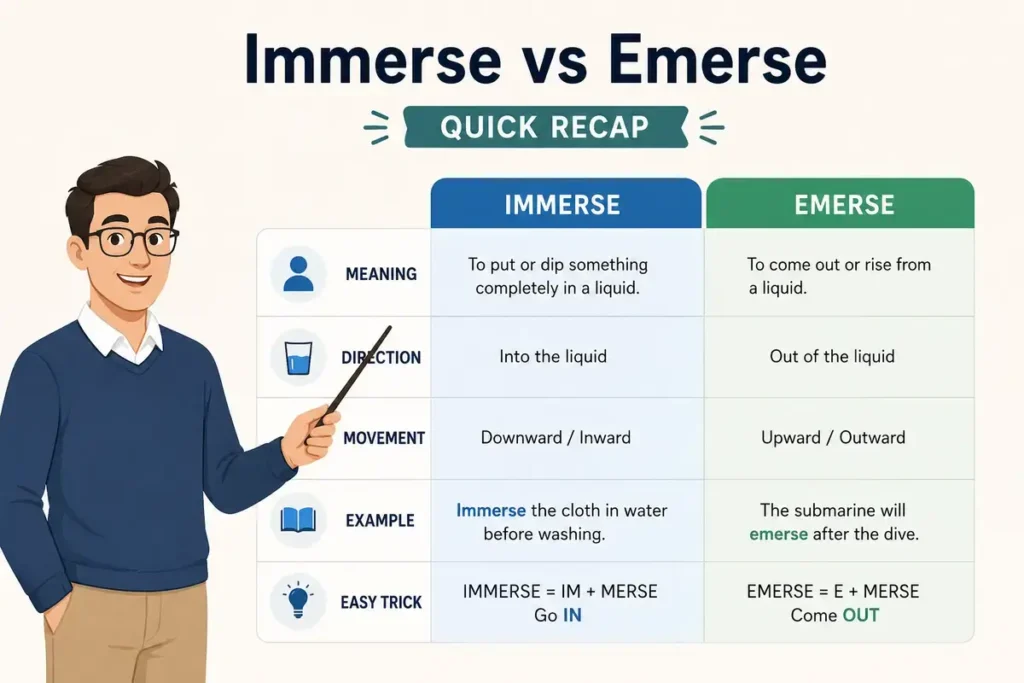
Final Answer: Immerse vs Emerse Quick Recap
In the comparison of immerse vs emerse, both words are correct but they have opposite meanings. Immerse means to go into something or become deeply involved. Emerse means to come out of something, especially water. For most everyday situations, immerse is the word you will use most often.
Many readers also check Busyness vs Business: Which One Should You Use?.
Conclusion
Understanding immerse vs emerse is easier than it first appears. These words may look similar, but their meanings move in opposite directions. Immerse means entering, sinking into, or becoming deeply involved. Emerse means rising out, appearing, or becoming uncovered.
Most English learners will encounter immerse far more often because it is common in daily speech, education, travel, books, and personal development. The word emerse is mainly used in scientific, environmental, and nature-related writing. A simple memory trick can help you forever:
- Immerse = go in.
- Emerse = come out.
Once you remember that direction, choosing the correct word becomes simple.
Frequently Asked Questions (FAQs)
What does immerse mean in simple words?
Immerse means to put something into a liquid or become deeply involved in an activity, subject, or experience.
What does emerse mean in simple words?
Emerse means to come out of water or become visible after being covered.
Is more common?
Immerse is much more common in everyday English. Emerse is mostly used in science and nature writing.
Can I use immerse and emerse interchangeably?
No. They have opposite meanings, so they cannot replace each other.
Why do people confuse?
The words look very similar and are connected to water, which makes them easy to mix up.
Is emerse a real English word?
Yes. Emerse is a correct English word, although it is much less common than immerse.
When should I use immerse?
Use immerse when talking about going into something or becoming fully involved in an activity.
What is the easiest way to remember?
Remember this simple rule:
Immerse = go in.
Emerse = come out.
