
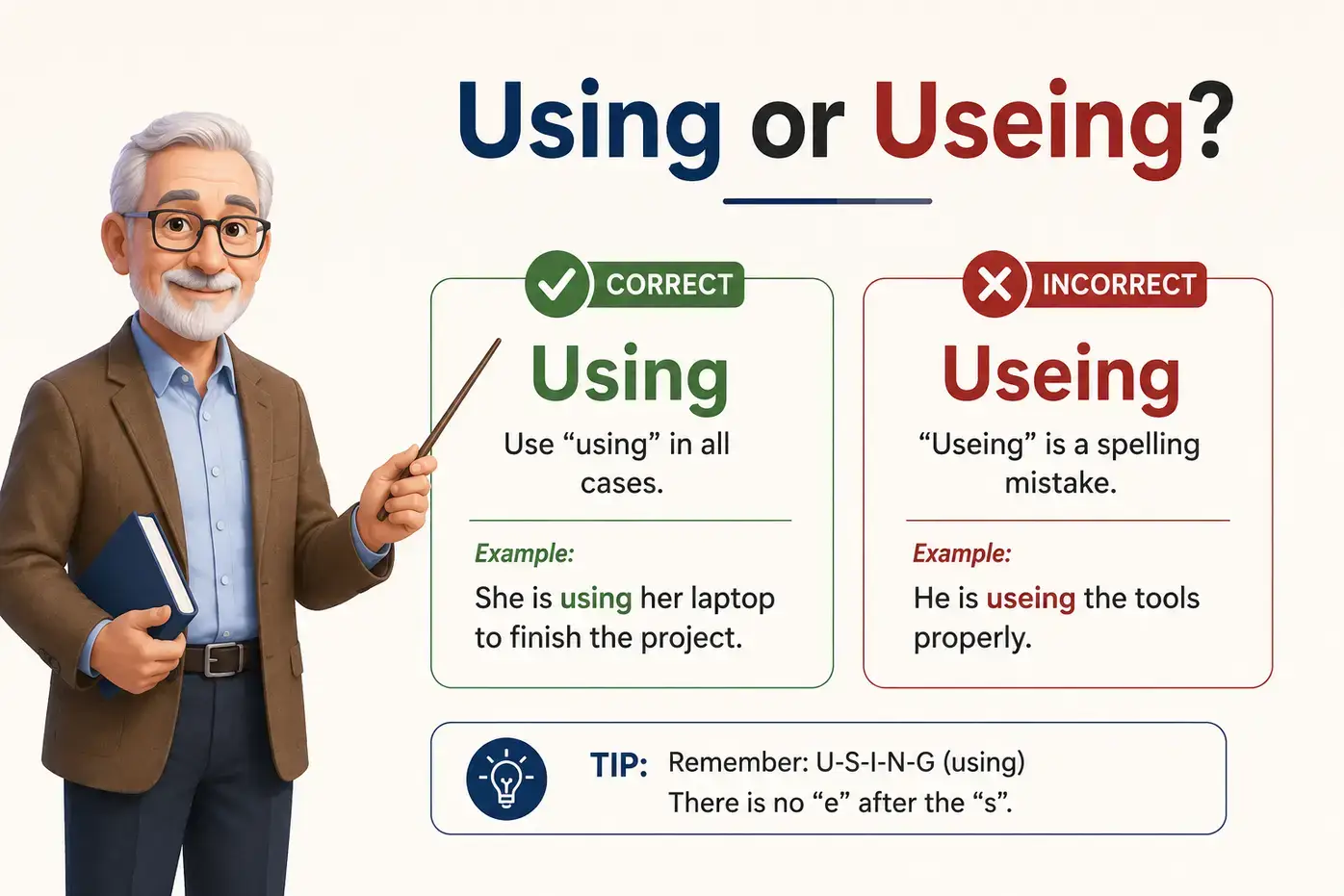
Many English learners get confused about using or useing because both spellings seem possible at first glance. When you add -ing to the word use, the spelling changes in a way that can feel surprising.
If you have ever wondered the good news is that the answer is simple. One spelling follows standard English rules, while the other is considered a mistake.
In this guide, you will learn the difference and why people mix them up, which form is correct, and how to remember the right spelling every time.
You may also want to read Offered vs Offerred: Which Is Correct and How to Use It?.
Using or Useing: Simple Answer in One Look
Using is the correct spelling.
Useing is incorrect in standard English.
Example:
- I am using my laptop.
- She is using a new phone.
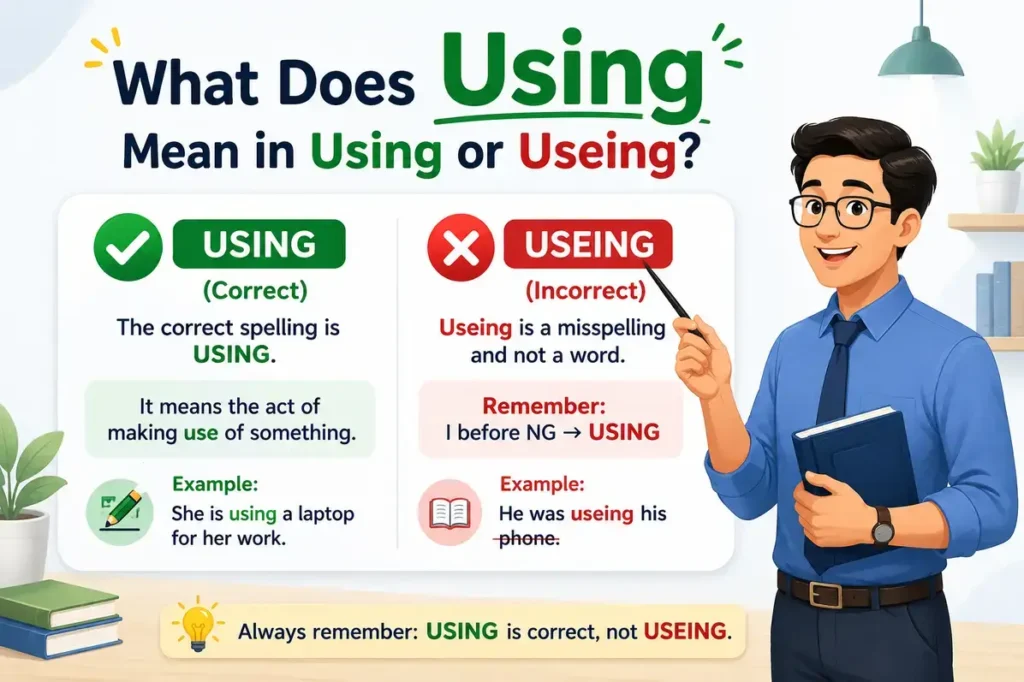
What Does Using Mean in Using or Useing?
The word using means employing, operating, applying, or making use of something. It describes an action that is happening now or around the present time. Examples:
- I am using a pencil.
- She is using the computer.
- They are using a map.
In simple English, using means that someone is working with something or making it serve a purpose.
Simple Examples of Using
- He is using a flashlight.
- We are using clean water.
- The teacher is using a whiteboard.
- They are using new ideas.
Each sentence shows a person actively working with something.
Why Do People Mix Up?
The confusion usually happens because of spelling patterns. People see the base word use and think they should simply add ing. That leads to:
- use + ing = useing
At first, that looks logical. However, English has a spelling rule for many words ending in a silent e. Before adding -ing, the final silent e is often removed. So:
- use → using
- make → making
- take → taking
- write → writing
Because learners focus on the original word use, they sometimes forget to remove the silent e.
Everyday Situations Where Mistakes Happen
Fast Typing
People type quickly and accidentally write useing.
School Assignments
Students may not remember the silent e rule.
Social Media Posts
Informal writing often contains spelling mistakes.
English Learners
People learning English naturally try to spell words exactly as they sound.
Since “using” sounds like it contains the full word “use,” some writers add the extra e.
Using or Useing: Clear Difference Explained Simply
The difference is very small in spelling but very important in correct English.
| Word | Correct? | Meaning |
|---|---|---|
| Using | ✅ Yes | Making use of something |
| Useing | ❌ No | Incorrect spelling |
Quick Comparison of Using or Useing
Using
- Correct spelling
- Accepted everywhere
- Used in schools, books, and professional writing
Example:
- She is using a calculator.
Useing
- Incorrect spelling
- Not accepted in standard English
- Should be corrected to using
Incorrect:
- She is useing a calculator.
Correct:
- She is using a calculator.
Easy Memory Trick
Remember this simple pattern:
- Make → Making
- Take → Taking
- Use → Using
- Write → Writing
The silent e disappears before -ing is added. If you remember making, you can also remember using.
Which Form Should You Use in Using or Useing?
The Simple Rule
Step 1:
Start with the word use.
Step 2:
Remove the final silent e.
Step 3:
Add ing.
Result:
Using
More Examples of the Same Rule
- Hope → Hoping
- Move → Moving
- Live → Living
- Bake → Baking
- Use → Using
These words follow the same spelling pattern.
When Writing
Use using in:
- Essays
- Emails
- Text messages
- Blog posts
- Reports
- Social media updates
The spelling remains the same in all situations.
Easy Real-Life Sentences Using Using
Here are some everyday examples.
- I am using my phone right now.
- She is using a new notebook.
- We are using the kitchen table.
- They are using an online dictionary.
- The teacher is using a projector.
- He is using a ladder to reach the roof.
- The children are using crayons.
- My friend is using a different route home.
More Natural Examples
- Are you using this chair?
- I am using my favorite pen.
- We are using fresh ingredients.
- She enjoys using creative ideas.
These examples show how common the word using is in daily English.
Where Does Using Come From? (Simple History)
The word use comes from very old languages that influenced English many centuries ago. Over time, English speakers created forms such as:
- Use
- Used
- Useful
- Using
The spelling rule that removes a silent e before adding -ing became common across many English words. That is why modern English uses:
- Using
instead of:
- Useing
This pattern has been part of English spelling for a long time.
Other Words That Follow the Same Pattern
- Dance → Dancing
- Smile → Smiling
- Move → Moving
- Bake → Baking
- Use → Using
When you see these examples together, the pattern becomes easier to remember.
Common Word Forms Related
Understanding related forms can help you avoid mistakes.
Use
The basic form. Example:
- I use a computer every day.
Used
The past form. Example:
- I used that computer yesterday.
Using
The action happening now. Example:
- I am using the computer.
Useful
Something that helps or has value. Example:
- This guide is useful.
User
A person who uses something. Example:
- Every user needs a password.
Learning these related forms makes the difference even clearer.
Quick Practice
Choose the correct answer.
- I am ___ a new backpack.
- She is ___ her tablet.
- We are ___ a different plan.
- The students are ___ dictionaries.
If you selected using every time, you got them all correct.
A Helpful Teacher Tip for Remembering Using or Useing
Imagine the letter e stepping out of the way before ing arrives.
Use → Using
Make → Making
Bake → Baking
The silent e leaves, and ing takes its place.
Many students remember the rule this way because it creates a simple picture in their minds.
Many readers also check Cheff or Chef: Easy Guide With Examples (2026).
Transition to Deeper Understanding
Now that you understand the basic difference and the next step is looking at how the word using appears in everyday communication, culture, common expressions, symbolism, and real-life English usage. This deeper understanding helps you use the word naturally and confidently in both speaking and writing.
How Using or Useing Is Understood in Culture and Stories
The word using appears everywhere in daily life. People use it when talking about tools, ideas, skills, technology, and even relationships. In stories, characters are often described as using something to solve a problem. For example:
- A hero may be using a map to find a hidden place.
- A student may be using knowledge to pass a test.
- A scientist may be using a new invention.
The word helps show action. It tells readers that someone is actively doing something with a person, object, or idea. Because of this, using often represents action, effort, and purpose.
The spelling useing does not appear in proper books, educational materials, or professional writing because it is not the correct English form. When readers see using, they immediately recognize it as standard English. Understanding helps your writing look more natural and polished.
Using or Useing in Biblical and Mythological Meaning
The words using and use are not usually symbols by themselves in the Bible or mythology. However, many religious and traditional stories involve people using wisdom, faith, courage, or tools to complete important tasks. For example, the story of Noah involves using skills and obedience to build the ark.
The story of David and Goliath includes David using a sling to defeat a stronger opponent. In myths from different cultures, heroes often succeed by using intelligence instead of strength. These examples show the idea of using something wisely. The spelling rule remains the same:
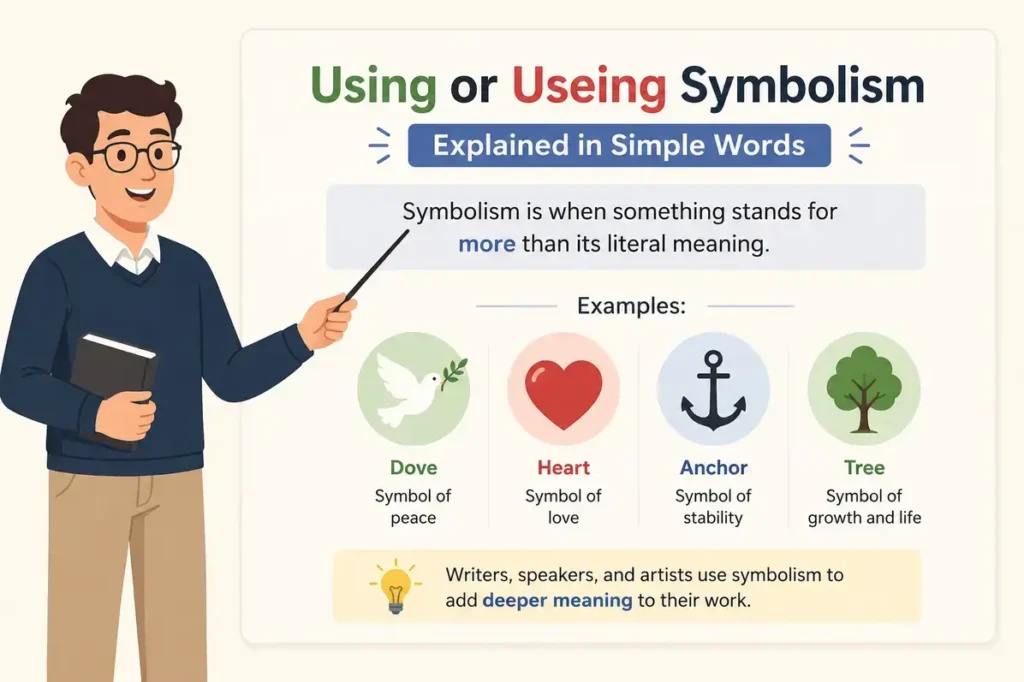
Using or Useing Symbolism Explained in Simple Words
Words often carry ideas beyond their dictionary meanings. Looking from a symbolic point of view can make the difference easier to remember.
What Using Represents in Using or Useing
The word using often represents:
- Action
- Purpose
- Learning
- Problem-solving
- Creativity
- Progress
Examples:
- Using knowledge to help others.
- Using tools to build something.
- Using experience to make better choices.
In many situations, using suggests that a person is taking action and making something useful.
Because using is the correct spelling, it represents clear and effective communication.
What Useing Represents in Using or Useing
It is simply a spelling mistake.
People usually write it because they forget to remove the silent e before adding ing.
Unlike using, it carries no special cultural or emotional meaning.
The comparison is simple:
| Word | Meaning |
|---|---|
| Using | Correct spelling |
| Useing | Incorrect spelling |
This is why the discussion is mainly about correct spelling, not different meanings.
Related Words You Should Know About Using or Useing
Learning related words helps you understand English patterns more easily.
Use
The basic form of the word. Example:
- I use a notebook every day.
Used
The past form. Example:
- She used a different computer yesterday.
Useful
Something that helps or has value. Example:
- This guide is very useful.
User
A person who uses something. Example:
- Every user needs an account.
Usage
The way a word or thing is used. Example:
- Correct usage improves writing.
Reuse
To use something again. Example:
- We reuse old boxes for storage.
Misuse
To use something incorrectly. Example:
- Misuse of equipment can cause problems.
Utilizing
A more formal word that means using. Example:
- The company is utilizing new technology.
These related words can make the difference easier to remember.
How People Actually Use Using or Useing in Daily English
Native speakers use using every day. Here are some natural examples.
- I am using my phone right now.
- She is using a new app.
- We are using the kitchen table for homework.
- They are using online tools to learn English.
- He is using a ladder to fix the roof.
- The teacher is using examples to explain the lesson.
- My friend is using a different route home.
- We are using fresh ingredients for dinner.
- The students are using dictionaries.
- She enjoys using creative ideas in her projects.
Common Spoken Examples
You may hear sentences like:
- “Are you using this chair?”
- “I’m using my laptop.”
- “She’s using a new camera.”
- “We’re using a better system now.”
These examples show how common the word using is in everyday English.
Common Mistakes People Make
Many learners make similar mistakes when adding ing to words.
Mistake 1: Writing Useing
Incorrect:
- I am useing a calculator.
Correct:
- I am using a calculator.
Mistake 2: Forgetting the Silent E Rule
Many people remember the base word use but forget to remove the final e.
Incorrect:
- useing
Correct:
- using
Mistake 3: Applying Sound Instead of Spelling Rules
Some writers spell words exactly how they think they sound.
Since using sounds similar to the word use, they mistakenly keep the e.
Mistake 4: Copying Incorrect Online Writing
Not everything online is written correctly.
Always check trusted dictionaries and grammar sources if you are unsure.
Easy Correction Trick
Remember this simple pattern:
- Make → Making
- Take → Taking
- Move → Moving
- Use → Using
The silent e leaves before ing arrives.
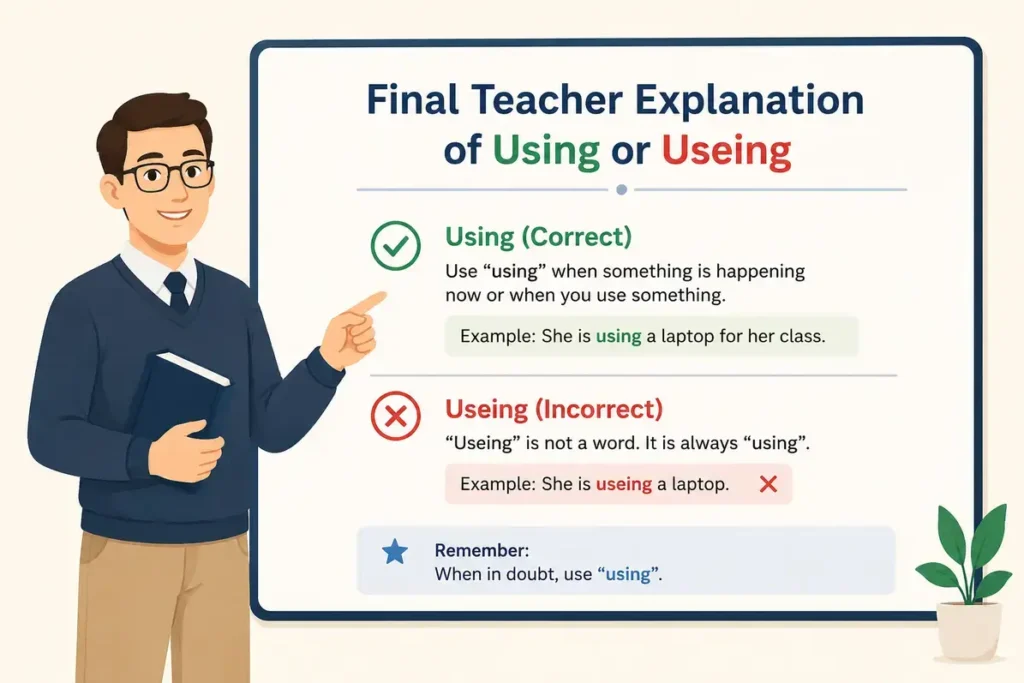
Final Teacher Explanation of Using or Useing
Imagine you are in class and a student asks: “Which spelling is correct?” The answer is simple.
The correct spelling is using.
The spelling useing is incorrect.
Why? Because the word use ends with a silent e. When we add ing, we remove that silent e first. So the process looks like this:
- Use
- Remove the e
- Add ing
- Using
This same rule appears in many common English words.
- Bake → Baking
- Move → Moving
- Hope → Hoping
- Use → Using
Once you understand this pattern, the correct spelling becomes easy to remember. Whenever you need the action form of use, write using.
Using or Useing: Final Answer (Quick Recap)
If you are choosing always choose using.
Using is the correct spelling in standard English.
Useing is a spelling mistake and should be avoided in school, business, and everyday writing.
Remember:
Use → Using
Learn the difference in How the Turntables Meaning: How to Use It Correctly.
Conclusion
The confusion between using or useing comes from a common spelling mistake. Many people assume they should simply add ing to the word use, but English follows a different pattern. The final silent e is removed before ing is added.
A helpful way to remember this rule is to compare it with similar words such as making, moving, and hoping. They all follow the same spelling pattern. Once you learn this simple rule, you can confidently use using in emails, essays, conversations, and professional writing.
Frequently Asked Questions (FAQs)
Is correct?
Using is correct. Useing is a spelling mistake.
Why is incorrect?
Because the silent e is removed before adding ing.
What does using mean?
Using means making use of something or working with it.
Can I use in formal writing?
No. Standard English uses using.
Why do people confuse?
Many people forget the silent e rule when adding ing.
How can I remember the correct spelling?
Think of similar words like making, hoping, and moving.
Is using a verb?
Yes. It is a form of the verb use.
When should I use using?
Use it when talking about an action that is happening now or around the present time.
