
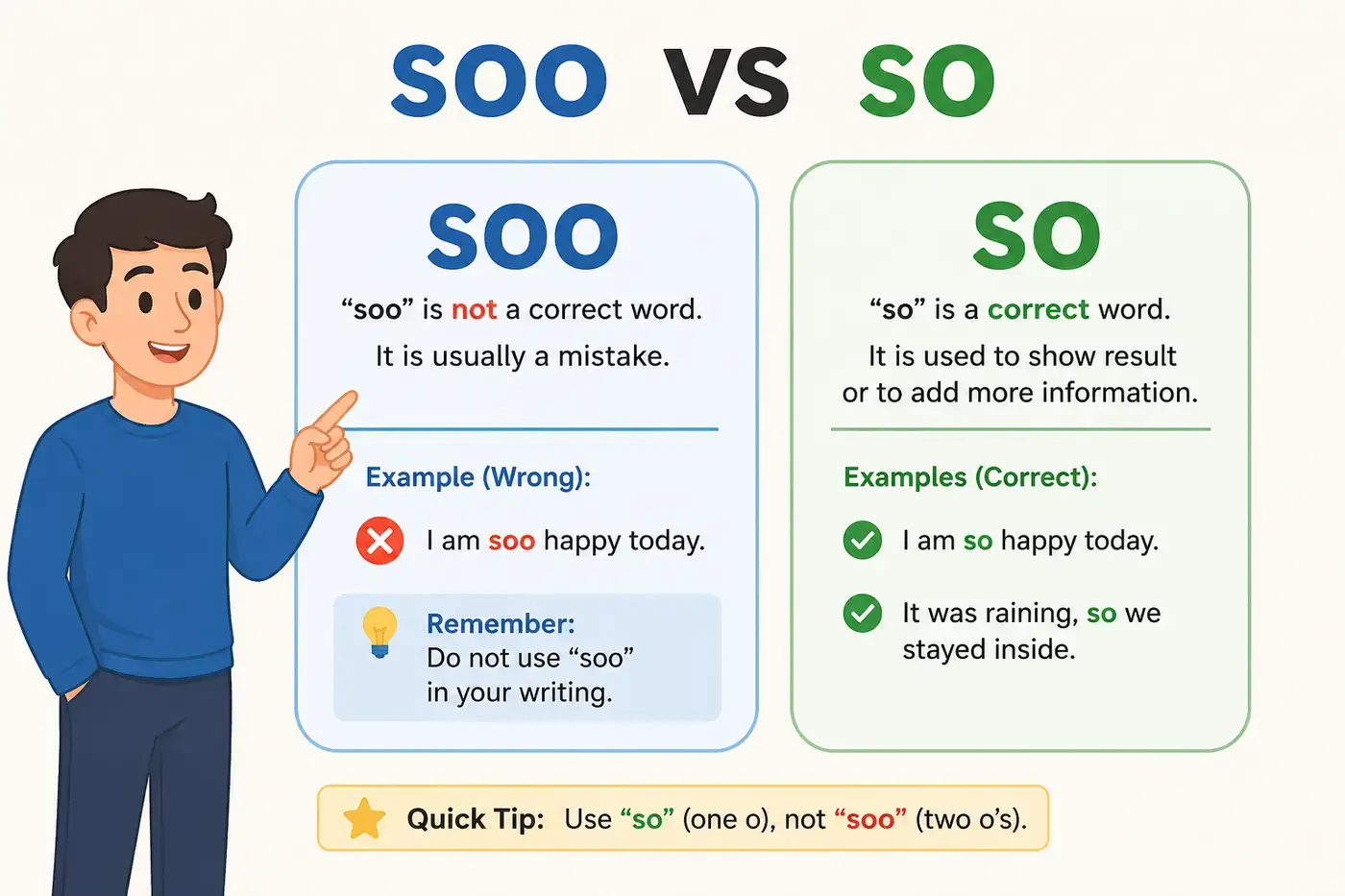
Many English learners search for the difference between soo vs so because these two forms look almost the same. They sound similar when people speak quickly, but they do not have the same use. In most normal English writing, so is the correct word to use.
The word so is a common English word with many uses. It can show a result, add emphasis, or describe a level of something. The word soo is not usually a standard English word. People often type it online to show a long sound or extra emotion.
Learning is simple when you understand where each form belongs. This guide explains the meaning, correct use, and common mistakes in easy English.
Need another quick comparison? Read Loot vs Lute: Ultimate Difference Guide 2026.
Simple Answer in One Look about Soo vs So
So is the correct English word. Soo is usually an informal spelling used online to show extra feeling or a longer sound.
What This Means in Simple English
The word so is used every day by English speakers. It helps connect ideas and explain feelings. It can mean “very,” “therefore,” or “in this way,” depending on the sentence. For example:
“I was tired, so I went to bed.”
Here, so connects two ideas. The first idea gives a reason, and the second idea shows the result.
Another example:
“She is so happy today.”
In this sentence, so means “very.” It makes the feeling stronger.
The spelling soo is different. Most of the time, it is not used in formal English writing. People may write soo in text messages, comments, or social media posts to show a strong emotion.
For example:
“That movie was soo good!”
The person is trying to show extra excitement. They are stretching the word “so” to make their feeling stronger. However, this spelling is not correct for school writing, work emails, or formal communication.
Think of it like this:
So belongs in normal English.
Soo belongs mostly in casual online conversations.
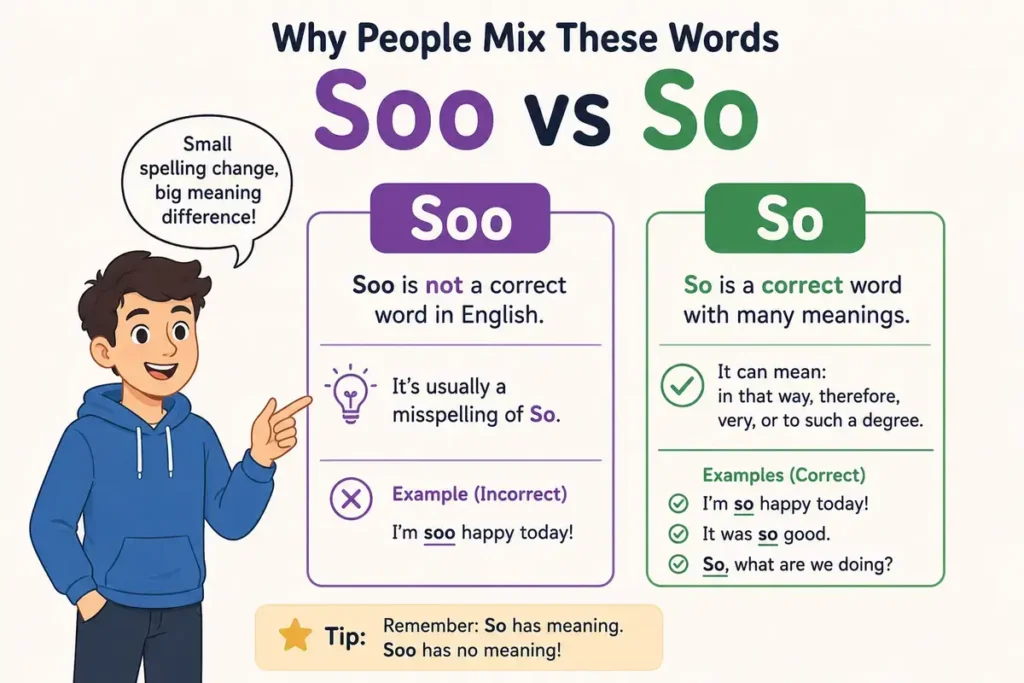
Why People Mix These Words Soo vs So
Many people confuse because they look and sound almost identical. When people speak, they may stretch the sound of “so” for emotion. The listener still understands the meaning, but the written form can become confusing. For example, a person might say:
“That was so amazing!”
They may say “so” with a long sound:
“That was sooo amazing!”
When they type this feeling, some people write:
“That was soo amazing!”
This creates the confusion.
Another reason is social media. Online writing is often more relaxed. People change spellings to show emotions, excitement, surprise, or humor.
You may see examples like:
“I am sooo happy!”
“I miss you soo much!”
“This cake is soo delicious!”
These examples show emotion, but they are not standard English spelling. The problem happens when people use the same style in formal situations. A teacher, employer, or professional reader expects standard English. Writing soo in an essay or official message can look like a spelling mistake.
A simple way to remember it:
If you are writing for school, work, or a formal purpose, use so.
If you are chatting with friends online, you may see soo used for extra emotion.
Clear Difference Explained Simply
The difference between is mainly about spelling and purpose.
| Word | Meaning | Correct Use | Example |
|---|---|---|---|
| So | A real English word | Normal speaking and writing | I was hungry, so I made food. |
| Soo | Informal stretched spelling | Casual messages and online posts | That was soo funny! |
Here are the main differences:
- So is a standard English word
The word so appears in dictionaries and is used in all types of communication. Examples:
“He was so kind.”
“I think so.”
“So, what happens next?”
- Soo is not standard English
The word soo is usually an internet spelling. It shows that someone is making the sound longer. Example:
“That puppy is soo cute!”
The writer does not mean a different word. They are adding emotion.
- So works in formal writing
You can use so in:
School essays.
Business emails.
Reports.
Articles.
Professional messages.
- Soo is mainly for casual expression
You may see soo in:
Text messages.
Social media comments.
Personal chats.
Funny posts.
It helps show excitement, but it should not replace the correct word.
Which Form Should You Use
The correct choice is usually so.
Use so when you want to write proper English. It works in almost every situation.
Examples:
“I was late, so I called my friend.”
“The test was so easy.”
“So, what do you want to do today?”
Use soo only when you are copying a casual style or showing strong emotion in an informal conversation.
Example:
“That song was soo beautiful!”
Even in this example, the standard spelling is:
“That song was so beautiful!”
The meaning stays the same. The extra “o” only changes the feeling.
A helpful rule:
Use one “o” for correct English.
Use extra letters only for informal emotion.
This rule also works with other words. People sometimes write:
“Nooo!”
“Yesss!”
“Pleeease!”
These spellings show feelings, but they are not the normal written forms.
Easy Real Life Sentences You Can Use Soo vs So
Here are simple examples using so correctly:
- I was so tired after work.
- She is so kind to everyone.
- The weather was so nice today.
- I forgot my keys, so I came back home.
- He studied hard, so he passed the exam.
- So, what are we doing tomorrow?
- This book is so interesting.
- I think so.
Now look at informal examples with soo:
- This puppy is soo cute!
- That game was soo fun!
- I am soo excited for the trip!
- The food was soo good!
These examples are common online, but remember that soo is a style choice, not the normal English spelling.
Where This Word Comes From Simple History
The word so has been part of the English language for a very long time. It came from older forms of English and other related languages. Over many years, English speakers kept using it because it is useful in many different situations. The word became common because people use it to connect ideas and express feelings.
The extra spelling soo developed much later through casual writing. As people started using text messages and social media, they began changing spellings to show emotions. Adding extra letters became a simple way to show excitement or strong feelings. For example:
“I am so happy.”
shows a normal feeling.
“I am sooo happy.”
shows a stronger feeling.
The meaning is similar, but the second version adds emotion through spelling. Understanding this small difference helps you write clearer English. Knowing when to use standard spelling and when people are simply showing emotion can make your reading and writing skills stronger.
The difference between is not difficult. The main thing to remember is that so is the correct English word, while soo is mostly an informal way to show extra feeling. Now that the basic difference is clear, we can look deeper at how this word appears in culture, stories, emotions, and everyday communication.
How Soo vs So Word Is Understood in Culture and Stories
The word so is very common in English-speaking cultures. People use it every day when they talk, write, tell stories, and share feelings. It is a small word, but it can change the meaning of a sentence.
In conversations, so often helps people move from one idea to another. A person may say, “So, what happened next?” when they want to hear more of a story. It helps keep conversations natural and friendly.
In books, movies, and everyday stories, so can show a connection between events. For example:
“He was scared, so he ran away.”
The word shows that one thing caused another thing to happen.
People also use so to show strong feelings. When someone says:
“That was so beautiful.”
They are not only describing something. They are showing their emotion about it.
The spelling soo appears mostly in modern online culture. Social media users often add extra letters to show excitement, surprise, happiness, or strong feelings.
For example:
“That picture is soo amazing!”
The extra letters create a more emotional style. It feels more personal and expressive, but it is not the standard spelling used in formal English.
Need another quick comparison? Read Arised or Arose: Which One Is Correct Simple Answer (2026).
Biblical and Mythological Meaning
The word so does not have a special biblical or mythological meaning by itself. It is mainly an everyday English word used to connect ideas and describe feelings. In religious stories and ancient writings, small connecting words like so help explain events. They can show cause and effect.
For example:
“People worked together, so they achieved their goal.”
The word helps explain how one action leads to another. The informal spelling soo also does not have a special meaning in religious or mythological stories. It is a modern writing style used mostly in casual communication. The main meaning of both forms comes from how people use them today. So carries the real meaning, while soo mostly adds emotion.
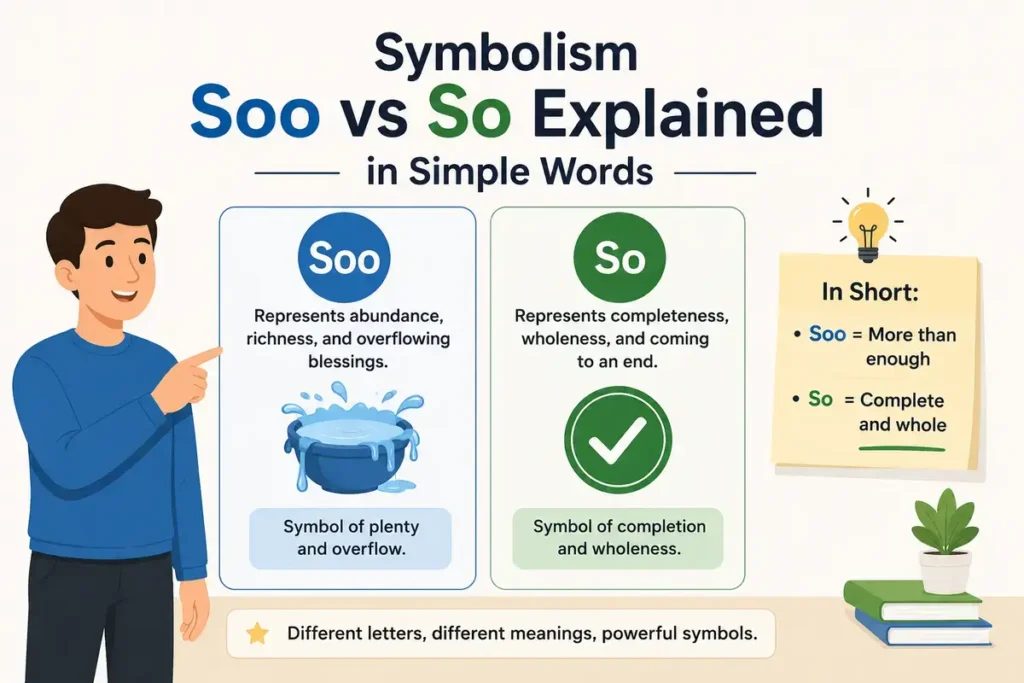
Symbolism Soo vs So Explained in Simple Words
Words can sometimes carry feelings beyond their dictionary meaning. The way people write a word can show their emotions and personality.
The difference between words is a good example. One form represents normal communication, while the other represents extra emotion.
What One Version Represents
The word so represents clarity, balance, and normal communication.
It is the trusted form used in everyday English. It helps people explain ideas clearly.
For example:
“She was tired, so she rested.”
Here, so represents a connection between two thoughts.
It can also represent strong feelings:
“He was so proud.”
In this sentence, so shows the level of emotion.
Because people use so in many situations, it represents simple and clear expression.
What the Other Version Represents
The spelling soo represents excitement, playfulness, and informal expression.
When someone writes:
“I am soo happy!”
They are trying to make the emotion feel stronger.
The extra letters can show:
- Excitement.
- Surprise.
- Humor.
- Strong personal feelings.
However, soo does not represent a new meaning. It is only a creative spelling style.
A simple comparison:
So = normal and correct English.
Soo = emotional and casual online style.
Related Words You Should Know
Understanding related words can make the difference between easier.
- Very
“Very” means something has a high level.
Example:
“She is very smart.”
It is similar to so when showing a strong amount.
- Too
“Too” means more than needed or also.
Example:
“This bag is too heavy.”
It has a different meaning from so.
- Such
“Such” is used to describe a strong quality.
Example:
“He is such a nice person.”
- Therefore
“Therefore” shows a result, similar to one use of so.
Example:
“It was raining; therefore, we stayed home.”
- Because
“Because” explains a reason.
Example:
“I stayed home because I was sick.”
- Really
“Really” adds strength to an idea.
Example:
“That movie was really good.”
- So much
“So much” shows a large amount.
Example:
“I miss you so much.”
- So excited
This phrase shows a strong feeling.
Example:
“I am so excited for the weekend.”
These words may look similar in meaning, but each one has its own purpose.
How People Actually Use Soo vs So in Daily English
People use so constantly in normal conversations. It appears in simple sentences, questions, stories, and explanations.
Here are real-life examples:
- “I was hungry, so I made a sandwich.”
Meaning: The hunger caused the action.
- “This coffee is so good.”
Meaning: The coffee is very good.
- “So, what are your plans today?”
Meaning: The speaker is starting a conversation.
- “I think so.”
Meaning: The speaker agrees or believes something is true.
- “She is so kind to everyone.”
Meaning: She has a high level of kindness.
- “The movie was so funny.”
Meaning: The movie was very funny.
- “I was late, so I called my friend.”
Meaning: Being late caused the phone call.
- “So that’s the reason.”
Meaning: The speaker is explaining or confirming something.
Now look at informal examples where people use soo:
- “This dress is soo beautiful!”
- “I am soo tired today!”
- “That puppy is soo cute!”
- “The concert was soo amazing!”
These examples are common in messages and comments. They show emotion, but they are not the best choice for formal writing.
Common Mistakes People Make
Many learners make small mistakes when they use both words. These mistakes are easy to fix.
Mistake 1: Using Soo in Formal Writing
Incorrect:
“My teacher was soo helpful.”
Better:
“My teacher was so helpful.”
The correct spelling for school and professional writing is so.
Mistake 2: Thinking Soo Has a Different Meaning
Some people think soo is a different English word.
It is not. Most of the time, it is only an emotional spelling of so.
Mistake 3: Using Extra Letters Everywhere
People may write:
“I am sooo happy.”
This is fine in casual chats, but it should not appear in formal documents.
Mistake 4: Confusing So With Similar Words
Some learners confuse:
So.
Very.
Too.
Such.
Because.
Each word has a different purpose.
Example:
“She is so kind.”
“She is very kind.”
Both can work, but the feeling and structure may be slightly different.
Mistake 5: Forgetting Context
The right spelling depends on where you are writing.
A text message and a job application do not follow the same writing style.
Always think about your reader.
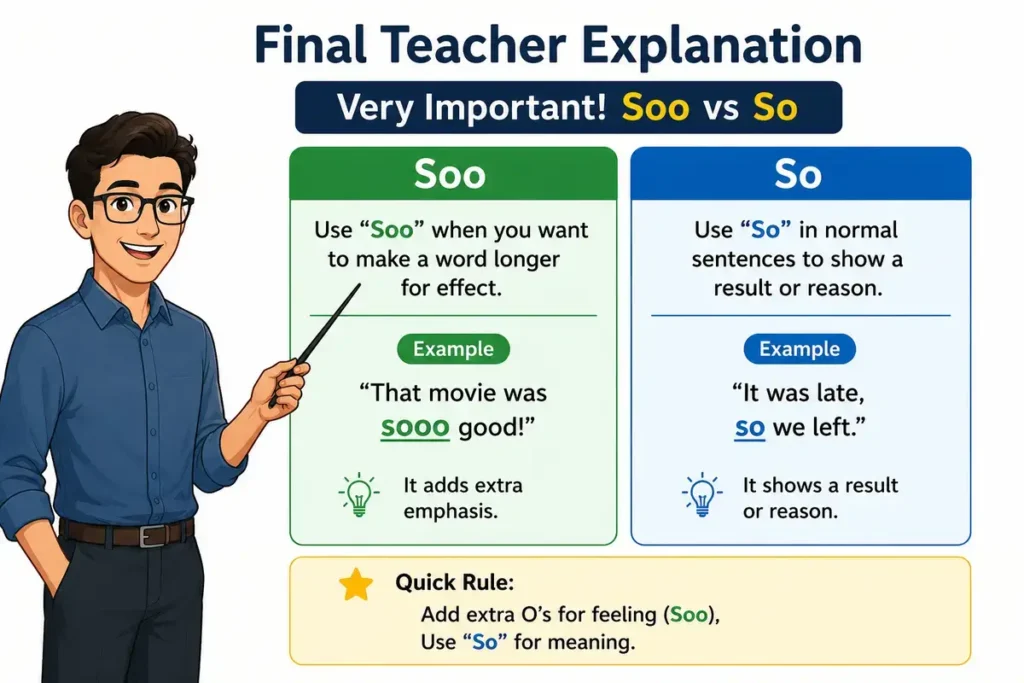
Final Teacher Explanation Very Important Soo vs So
If I was explaining both words in a classroom, I would say this:
“Students, remember one simple thing. The word so is the real English word. You can use it in speaking and writing. It helps you explain results, show feelings, and connect ideas.”
“The spelling soo is something people create online when they want to stretch the sound and show more emotion. It is like saying a word louder or with more feeling.”
Think about how you speak.
If you say:
“I am so happy.”
You may naturally make the sound longer:
“I am sooo happy!”
That is normal when speaking. But when you write, the standard spelling stays the same.
The easiest memory trick is:
One normal word = so.
Extra letters for feelings = soo.
When you learn this small difference, your English writing becomes cleaner and more natural.
Final Answer Quick Recap
The difference between is simple. So is the correct English word used in normal speaking and writing. It can mean “very,” show a result, or connect ideas.
Soo is usually an informal spelling used online to show extra emotion. It can make a message feel more excited, but it is not standard English.
For school, work, and formal writing, always choose so.
Many readers also check Passtime or Pastime Which Word Is Correct and Why.
Conclusion
The difference between words become easy when you understand how people use these forms. So is the correct English word, while soo is mostly a casual way to show stronger feelings.
You can use so in every type of writing. It works in conversations, essays, emails, and professional messages. The spelling soo is only useful when you want to show emotion in informal chats.
Remember this simple rule: Use so for correct English and use extra letters only for casual feelings.
Frequently Asked Questions FAQs
What is the difference?
So is the correct English word. Soo is an informal spelling used to show extra emotion.
Is soo a real English word?
No. Soo is not normally a standard English word. People use it casually online.
Which is correct so or soo?
So is correct for normal English writing.
Can I use soo in an essay?
No. Use so in essays, school work, and formal writing.
Why do people write soo?
People write soo to show excitement, strong feelings, or a longer sound.
Is so used in daily English?
Yes. So is one of the most common words in everyday English.
Can so mean very?
Yes. In sentences like “She is so kind,” so means “very.”
Should I replace soo with so?
Yes, in formal writing you should replace soo with so.
