
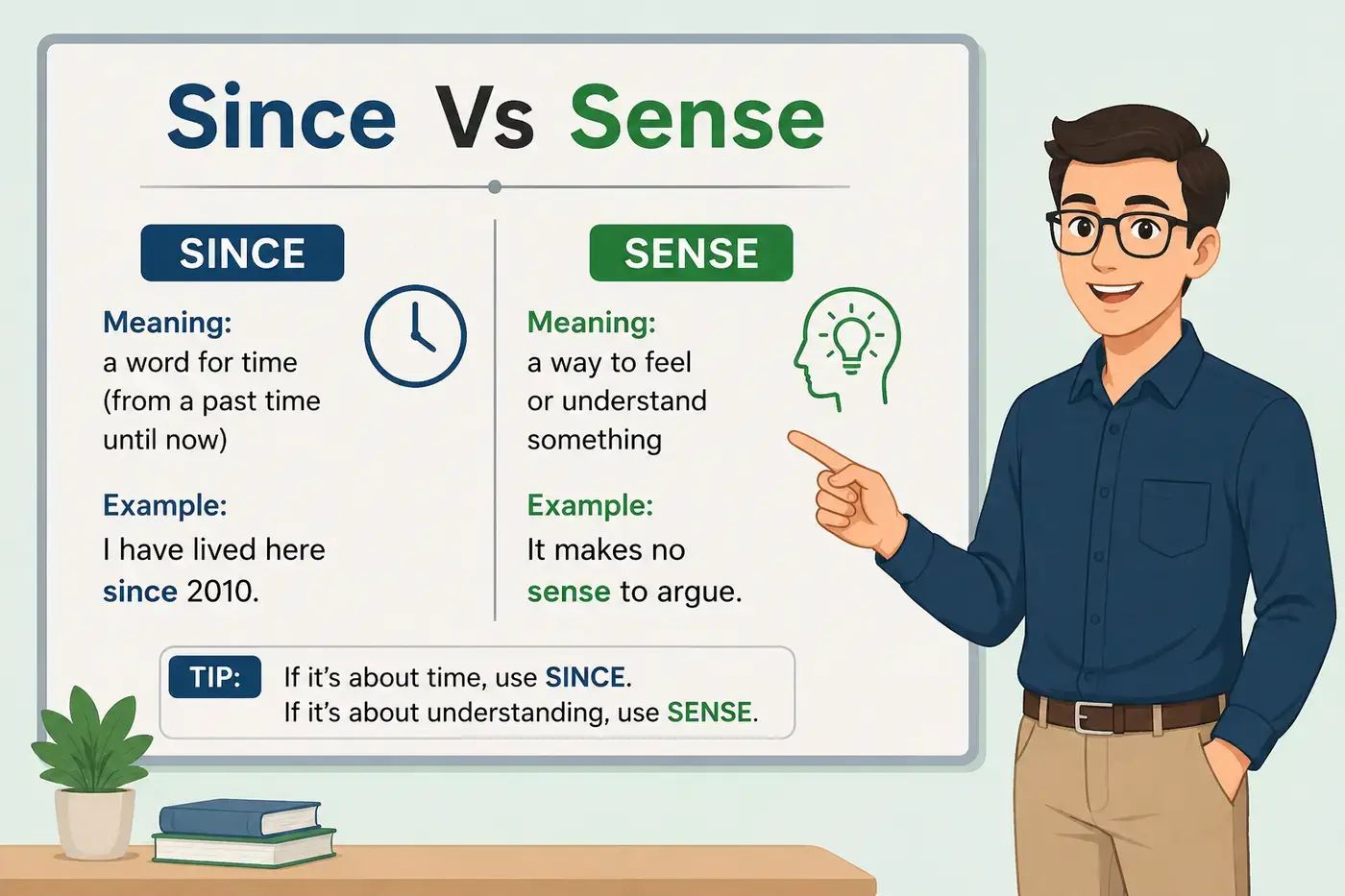
Many English learners confuse since vs sense because these words sound similar when spoken, but they have completely different meanings. One word talks about time, while the other talks about understanding, feelings, or ideas. Knowing the difference between since and sense helps you write clearer sentences and avoid common English mistakes.
The good news is that these two words are easy to separate. Once you understand what each word means and how people use it in daily conversations, you will quickly know which one fits your sentence.
This simple guide explains with clear examples, easy rules, and real-life sentences that make learning easier.
Need another quick comparison? Read Noteable or Notable: Complete Usage Guide(2026).
Simple Answer in One Look
Since is used for time or a reason.
Sense means understanding, meaning, or one of the five ways we experience the world.
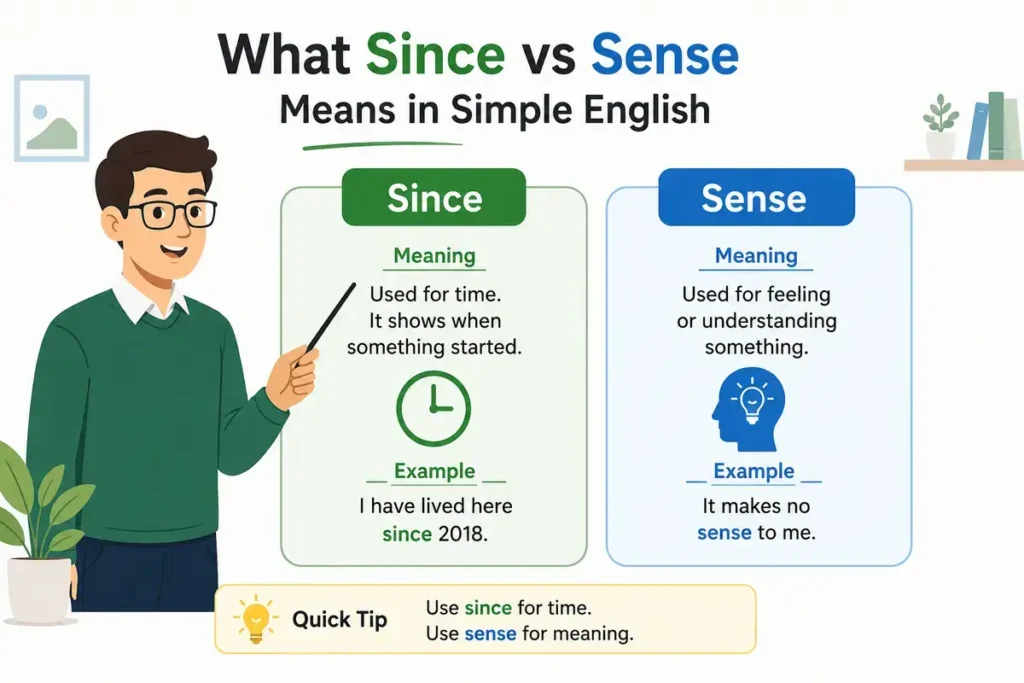
What Since vs Sense Means in Simple English
Let’s look at these two words one at a time.
What Does Since Mean?
The word since usually talks about a starting point in time. It tells us when something began and continues until now or another time.
For example:
“I have lived here since 2020.”
This means the person started living there in 2020 and still lives there now.
We often use since with:
- A year.
- A date.
- A specific time.
- A past event.
Examples:
“She has worked at the company since January.”
“He has been learning English since last summer.”
“They have known each other since childhood.”
In these sentences, since connects the past with the present.
But since can also show a reason. In this use, it means something like “because.”
Example:
“Since it was raining, we stayed home.”
This means:
“Because it was raining, we stayed home.”
So, since has two common meanings:
- A point in time.
- A reason or cause.
What Does Sense Mean?
The word sense means understanding, awareness, or a feeling.
We use sense when we talk about the five senses:
- Sight.
- Hearing.
- Smell.
- Taste.
- Touch.
Examples:
“My sense of smell is very strong.”
“Dogs have a great sense of hearing.”
The word sense can also mean understanding something. Example:
“That makes sense.”
This means:
“That is clear or easy to understand.”
Another example:
“I sense something is wrong.”
Here, sense means feeling or noticing something.
So, sense can describe:
- Your ability to experience things.
- Your understanding of an idea.
- A feeling that something is true.
Why People Mix These Words Since Vs Sense
The reason people confuse is simple. They sound almost the same when spoken. In English, many words have similar sounds but different meanings. These words are called homophones or near homophones. You hear the same or almost the same sound, but the spelling and meaning are different. For example:
“I have been here since Monday.”
“I can sense something strange.”
When someone says these sentences quickly, since and sense can sound very close. Another reason is that both words are common in everyday English. People hear them often but may not always remember their meanings.
A student may write:
“It makes since.”
But the correct sentence is:
“It makes sense.”
Why?
Because the sentence talks about understanding, not time.
Another common mistake is:
“I have lived here sense 2015.”
The correct sentence is:
“I have lived here since 2015.”
The sentence talks about a starting time, so since is correct.
A simple trick can help:
Ask yourself:
“Am I talking about time or understanding?”
If you mean time, use since.
If you mean understanding, feelings, or awareness, use sense.
Clear Difference Explained Simply
The difference between words becomes easy when you compare their meanings.
| Word | Meaning | Example |
|---|---|---|
| Since | A starting time | I have studied here since 2022. |
| Since | A reason | Since I was tired, I went home. |
| Sense | Understanding | That idea makes sense. |
| Sense | Feeling or awareness | I sense danger. |
| Sense | A body ability | My sense of taste changed. |
Here is another simple way to remember:
Since = When or why.
Sense = Think, feel, or understand.
Since Examples
“She has been happy since her birthday.”
The word since tells the starting time.
“I stayed inside since I was sick.”
The word since gives a reason.
Sense Examples
“You have a good sense of humor.”
The word sense means a quality or ability.
“Does this sentence make sense?”
The word sense means meaning or understanding.
“I sense that something is different.”
The word sense means noticing or feeling.
Which Form Should You Use Since Vs Sense?
Choosing between words depends on the meaning of your sentence.
Use since when you are talking about:
- A beginning time.
Example:
“I have had this phone since 2024.”
- A reason.
Example:
“Since you are here, we can start the meeting.”
Use sense when you are talking about:
- Understanding something.
Example:
“This explanation makes sense.”
- A feeling or awareness.
Example:
“I sense that he is worried.”
- A body ability.
Example:
“Her sense of hearing is excellent.”
A quick memory rule:
Since has to do with time.
Sense has to do with the mind, body, or feelings.
If your sentence includes a date, year, day, or moment, since is usually the correct choice.
If your sentence talks about knowing, feeling, meaning, or understanding, sense is usually correct.
Easy Real Life Sentences You Can Use
Here are simple examples that show the difference between words.
- I have lived in this city since 2018.
- She has been busy since Monday.
- Since you finished your work, you can relax.
- That answer makes sense to me.
- I sense that something is wrong.
- He has a great sense of humor.
- My sense of direction is not very good.
- We have been friends since school.
These examples show how people use both words in normal conversations. You do not need a complicated rule to remember them. Just focus on the meaning.
Where Since Vs Sense Word Or Expression Comes From Simple History
The words since and sense come from different language backgrounds, even though they sound similar today. The word since comes from an old English expression connected to the idea of “from that time.” Over many years, it developed into the modern word we use for time and reasons.
The word sense comes from Latin. It is connected to ideas about feeling, noticing, and understanding. Many English words related to thinking and feeling come from the same root. For example:
- Sensible means showing good judgment.
- Sensitive means able to feel or notice things.
- Sensation means a feeling or experience.
All of these words connect to the idea of awareness or feeling. Understanding the simple history helps us see why these words have different meanings even though they sound alike.
Bridge To A Deeper Understanding Of Since Vs Sense
Now that the basic difference between is clear, it becomes easier to understand how these words appear in culture, stories, expressions, and everyday communication.
The meaning of these words goes beyond spelling. Since connects our thoughts to time and memories, while sense connects our thoughts to feelings, choices, and understanding. In the next section, we will look deeper at how people use these words and why they matter in real English conversations.
Need another quick comparison? Read Baloney vs Bologna: Simple Meaning and Usage Explained.
How This Word Is Understood in Culture and Stories
The words appear in many everyday conversations, stories, and expressions. People often use these words when they talk about time, memories, feelings, and understanding. The word since is often connected with personal experiences. When someone says, “I have known her since childhood,” they are sharing a part of their life story. The word connects a past moment with the present.
The word sense is often connected with how people understand the world. It appears in stories when characters follow their feelings, use good judgment, or discover the meaning of something.
In normal conversations, both words help people explain their experiences. Since helps us talk about where something started. Sense helps us talk about what something means or how we feel about it. For example:
“I have loved reading since I was young.”
This sentence shares a personal timeline.
“I have a sense that something good will happen.”
This sentence shares a feeling or belief.
Both words are simple, but they help people express important parts of life.
Biblical and Mythological Meaning
The words do not have a special direct meaning in most biblical or mythological stories. However, the ideas behind these words appear often in religious and traditional stories. The idea of since connects with time, history, and the journey of life. Many stories talk about events that happened long ago and how those events shaped the present.
For example, a story may explain how a person changed “since” a major event in their life. This shows growth, experience, and learning.
The idea of sense appears often in stories about wisdom and understanding. Many traditional stories teach people to use good judgment and understand the world around them. A wise character may have a strong “sense” of what is right or wrong. They may listen to their inner feelings or understand hidden meanings.
In simple words:
Since connects with the idea of time passing.
Sense connects with the idea of understanding and awareness.
These ideas are common in many cultures because people often think about their past, their choices, and what they learn from life.
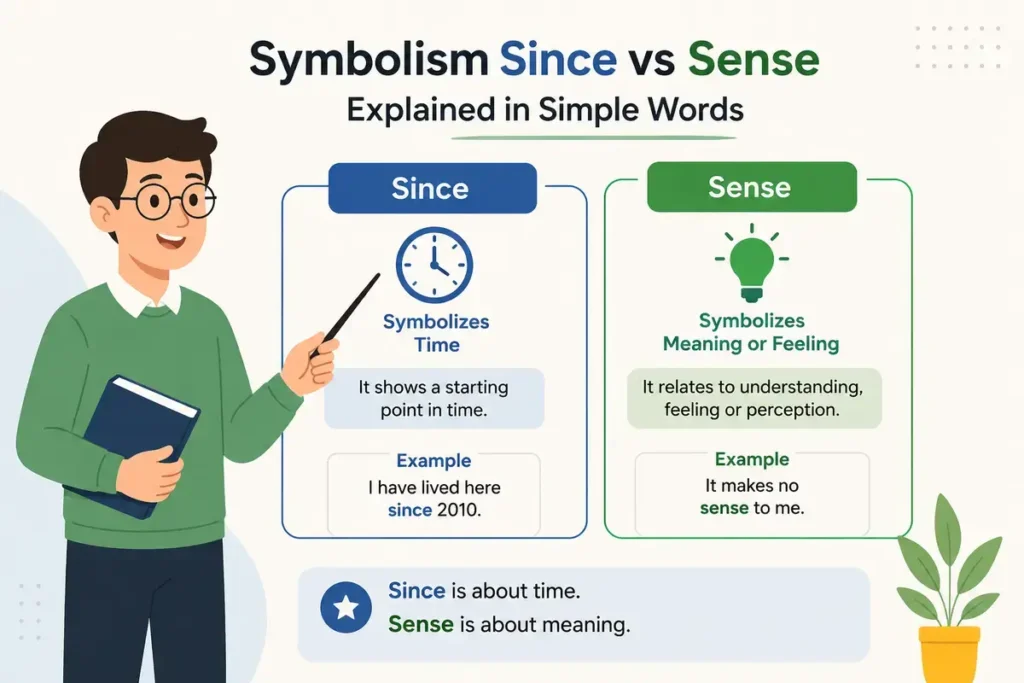
Symbolism Since vs Sense Explained in Simple Words
Words can carry deeper meanings beyond their dictionary definitions. The ideas behind both words can also represent different parts of human experience.
What One Version Represents
The word since represents time, memories, and beginnings.
It reminds us that every story has a starting point. People often use since when they talk about important moments in their lives.
Examples:
“I have loved music since I was a child.”
“I have lived here since 2010.”
These sentences show a connection between the past and the present.
Symbolically, since can represent:
- Personal growth.
- Life experiences.
- Memories.
- The passage of time.
It reminds us that our past helps shape who we are today.
What the Other Version Represents
The word sense represents understanding, feelings, and awareness.
It connects with how people experience life. We use our senses to see, hear, smell, taste, and touch the world around us.
We also use sense when we understand ideas.
Examples:
“That makes sense.”
“I sense something is wrong.”
Symbolically, sense can represent:
- Wisdom.
- Awareness.
- Understanding.
- Human feelings.
It reminds us that people do not only live through events. They also understand and feel those events.
The simple comparison is:
Since looks back at time.
Sense looks at understanding.
Related Words You Should Know
Learning related words makes the difference between easier to remember.
Sensible
Sensible means showing good judgment or making a smart choice. Example:
“It was sensible to bring an umbrella because it was raining.”
Sensitive
Sensitive means able to notice or feel things easily. Example:
“She is sensitive to other people’s feelings.”
Sensation
Sensation means a feeling or experience.
Example:
“The warm sunlight gave me a relaxing sensation.”
Sense Of Humor
Sense of humor means the ability to understand and enjoy jokes. Example:
“He has a great sense of humor.”
Sense Of Direction
Sense of direction means the ability to know where you are going. Example:
“My sense of direction is not very good.”
Since Then
Since then means from that time until now. Example:
“I moved here five years ago, and I have been happy since then.”
Ever Since
Ever since means continuously from a certain time. Example:
“I have loved this song ever since I heard it.”
Make Sense
Make sense means to be clear or understandable. Example:
“Your explanation makes sense.”
How People Actually Use Since Vs Sense in Daily English
People use every day in simple conversations. The meaning depends on the situation.
Here are real-life examples.
- “I have been waiting here since 9 a.m.”
The speaker talks about a starting time.
- “She has been my friend since school.”
The speaker talks about when the friendship started.
- “Since you are already here, we can begin.”
The word since gives a reason.
- “That movie did not make sense.”
The speaker means the movie was confusing.
- “I sense that he is upset.”
The speaker feels or notices something.
- “My sense of smell is stronger than my brother’s.”
The speaker talks about a body ability.
- “I have felt happy since I started this job.”
The speaker connects a feeling with a time.
- “Your answer makes sense.”
The speaker understands the answer.
- “I sense trouble coming.”
The speaker has a feeling that something may happen.
- “We have known each other since childhood.”
The speaker talks about a long connection over time.
These examples show that the two words may sound similar, but they work in completely different situations.
Common Mistakes People Make
Many English learners make small mistakes with words because the words sound alike. Here are some common mistakes and corrections.
Mistake 1
Incorrect:
“It makes since.”
Correct:
“It makes sense.”
Why?
The sentence talks about understanding, not time.
Mistake 2
Incorrect:
“I have lived here sense 2020.”
Correct:
“I have lived here since 2020.”
Why?
The sentence talks about a starting point in time.
Mistake 3
Incorrect:
“I sense Monday.”
Correct:
“I since Monday.”
Why?
The sentence needs a word that shows time. Since is correct only when connected to an action or situation.
Better:
“I have been here since Monday.”
Mistake 4
Incorrect:
“Since of humor.”
Correct:
“Sense of humor.”
Why?
Humor is connected to understanding and personality, so sense is the correct word.
Mistake 5
Incorrect:
“Since tells how you feel.”
Correct:
“Sense tells how you feel.”
Why?
Feelings and awareness connect with sense.
A simple way to avoid mistakes:
Ask yourself one question.
“Am I talking about time or understanding?”
Time means since.
Understanding or feeling means sense.
Final Teacher Explanation
As your English teacher, here is the easiest way to remember both words. The word since answers questions about time.
Ask:
“When did it start?”
Example:
“I have studied English since 2022.”
The word sense answers questions about understanding or feelings.
Ask:
“What does it mean?”
or
“What do I feel or notice?”
Example:
“That sentence makes sense.”
Example:
“I sense something different.”
Remember this small classroom rule:
Since tells when.
Sense tells what you understand or feel.
Once you learn this difference, you will avoid one of the most common spelling mistakes in English.
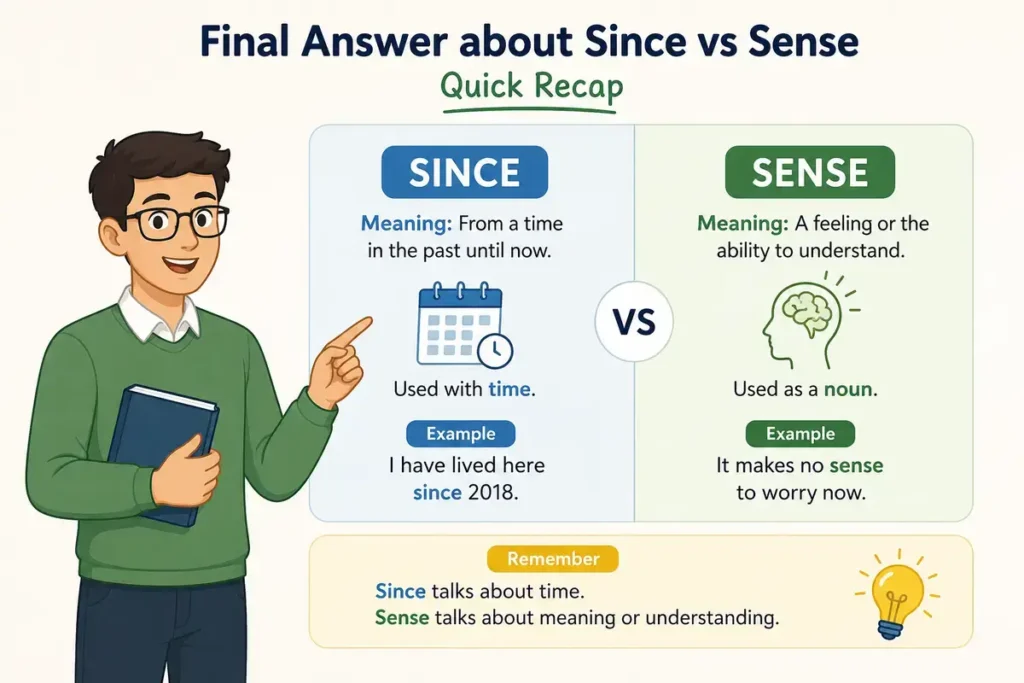
Final Answer about Since vs Sense Quick Recap
The difference between is simple.
Since is used for time and reasons. It tells when something started or explains why something happened.
Sense means understanding, feeling, awareness, or one of the five ways we experience the world.
If you are talking about a year, date, or starting point, choose since.
If you are talking about meaning, feelings, or awareness, choose sense.
You may also want to read Chefs Or Cheves: Correct Answer Explained Clearly (2026).
Conclusion
Understanding word helps you write and speak English more clearly. These words may sound similar, but their meanings are completely different.
Since connects ideas with time. Sense connects ideas with understanding and feelings. Learning this simple difference can help you avoid common English mistakes.
The easiest takeaway is: Since tells when. Sense tells what you understand or feel.
Frequently Asked Questions
What is the difference between since and sense?
Since talks about time or reasons. Sense talks about understanding, feelings, or awareness.
Is it correct to say it makes since?
No. The correct phrase is “It makes sense” because it means something is understandable.
When should I use since?
Use since when you talk about a starting time or explain a reason.
When should I use sense?
Use sense when you talk about meaning, feelings, awareness, or your five senses.
Why do people confuse since and sense?
People confuse them because they sound very similar when spoken.
Can I use since and sense in the same sentence?
Yes, but they will have different meanings.
Example:
“Since yesterday, I sense something has changed.”
Is since only used for time?
No. Since can also mean because when explaining a reason.
How can I remember?
Remember this simple rule:
Since means time.
Sense means understanding.
