
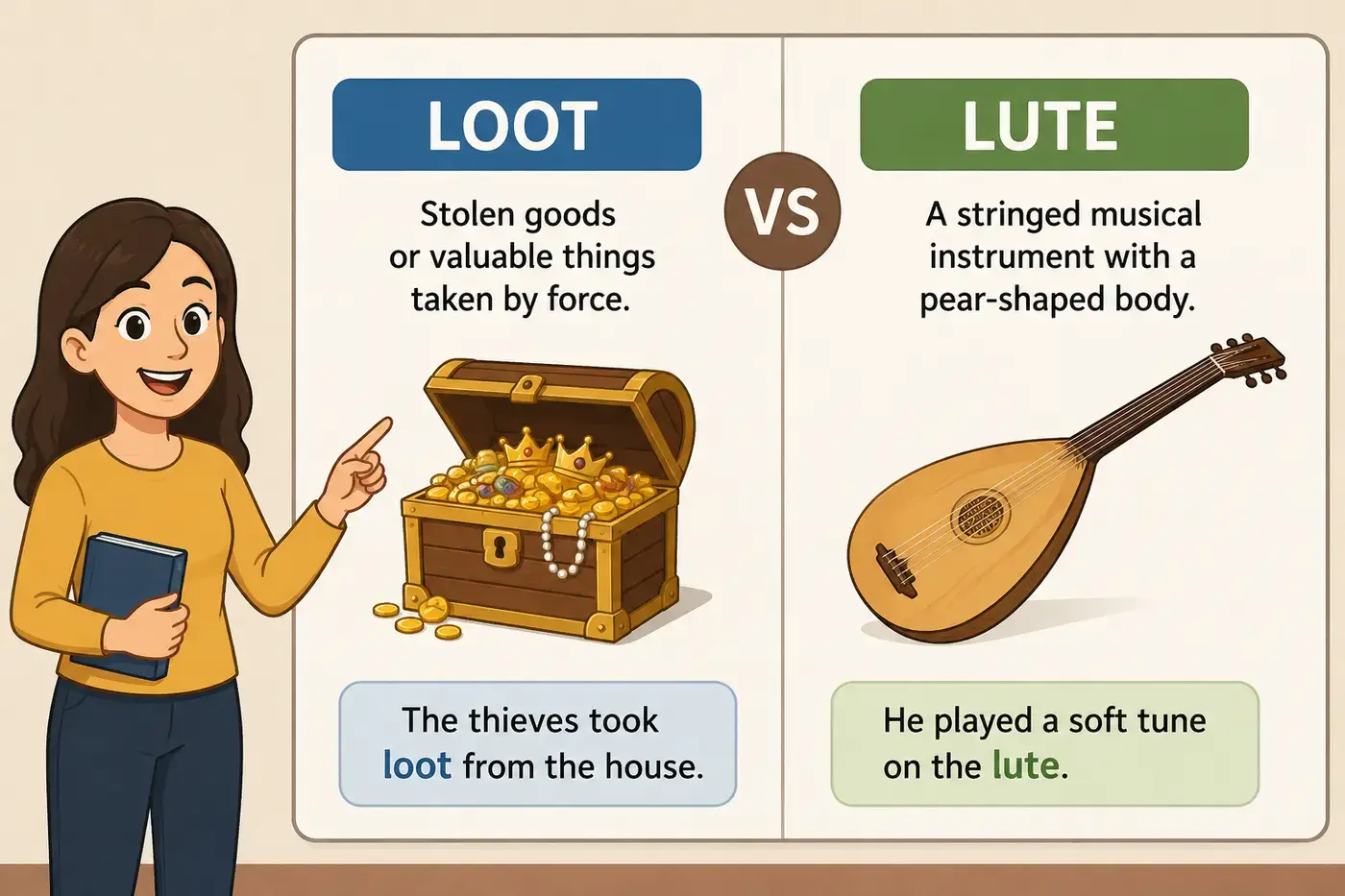
Many English learners get confused about loot vs lute because the two words look similar and sound almost the same. Even though they share a few letters, they have completely different meanings. One word is about stealing or valuable things taken during war or crime. The other is the name of a musical instrument.
If you have ever stopped while writing because you were not sure if you should use and you are not alone. This is a common mix-up for students, writers, and even native English speakers. The good news is that the difference is very easy to learn once you see each word in real sentences.
This guide explains in simple US English. You will learn what each word means, why people confuse them, how to remember the difference, and which one is correct in different situations.
For another common grammar confusion, see Channel vs Chanel: Easy Grammar Guide Explained.
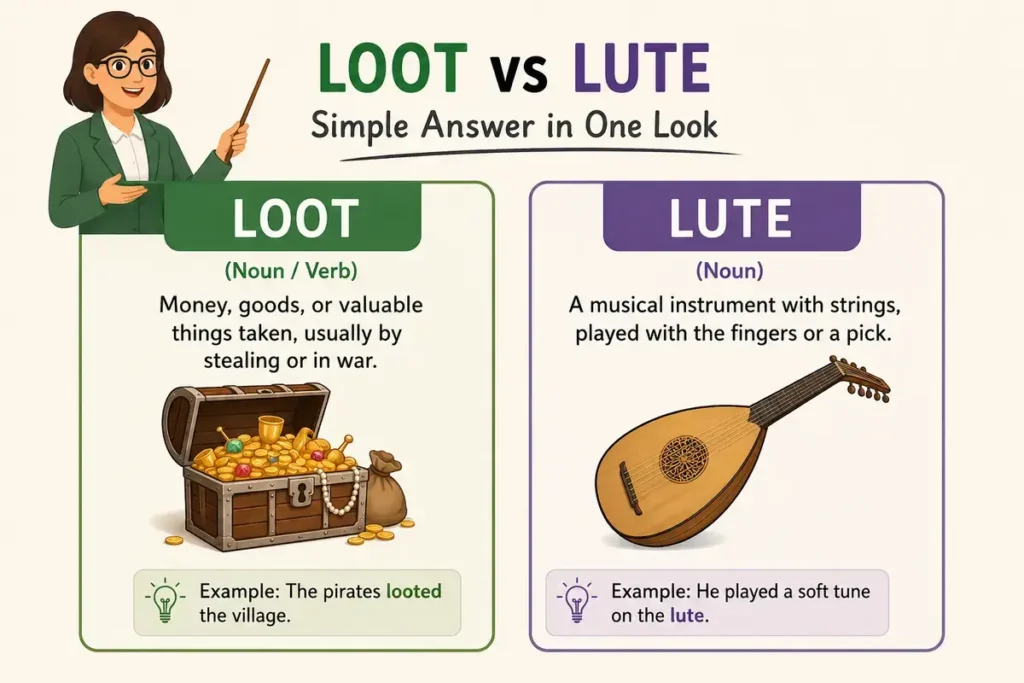
Simple Answer in One Look Loot vs Lute
Loot means stolen money, goods, or other valuable things.
Lute is a string musical instrument that was popular hundreds of years ago.
They are never interchangeable because they have different meanings.
What does Means in Simple English
The easiest way to understand these words is to connect each one with a simple picture in your mind.
What Does Loot Mean?
Loot means things that are stolen. It can also mean the act of stealing valuable things during a war, a robbery, or a disaster. Examples include:
- Money taken from a bank.
- Jewelry stolen from a store.
- Valuable items carried away after a robbery.
Sometimes people also use loot in a fun or playful way. For example:
- The kids came home with lots of Halloween loot.
- The gamer found amazing loot after beating the monster.
In games, loot usually means rewards, treasure, weapons, or useful items.
What Does Lute Mean?
A lute is a musical instrument. It has strings that people pluck with their fingers. It was very popular in Europe many hundreds of years ago. A lute has:
- A round back.
- A short neck.
- Many strings.
- A soft and gentle sound.
Today, you mostly see lutes in museums, concerts, history books, or movies about the past.
The Main Idea
Remember this simple rule.
- Loot equals stolen treasure or valuable rewards.
- Lute equals a musical instrument.
Once you remember this, the confusion almost disappears.
Why People Mix These Words Loot vs Lute
Many people confuse because they look alike. Only one letter changes. Look carefully.
- Loot
- Lute
The words also sound similar. When people hear them quickly in a conversation, they may think they heard the other word. Another reason is that both words are short. Short words are often easier to confuse than longer ones. Some people also see both words in video games. For example: Players collect loot after winning battles.
Some fantasy games also include musicians who play a lute. If someone is reading quickly, they may accidentally switch the words. Here are some common mistakes.
Incorrect:
- The king played the loot.
Correct:
- The king played the lute.
Incorrect:
- Pirates searched for hidden lute.
Correct:
- Pirates searched for hidden loot.
The sentence usually tells you which word makes sense.
If the sentence talks about music, use lute.
If it talks about treasure or stolen valuables, use loot.
Clear Difference Explained Simply
Here is an easy comparison.
| Loot | Lute |
|---|---|
| Means stolen valuables or treasure. | Means a string musical instrument. |
| Connected with crime, war, treasure, or games. | Connected with music and history. |
| Can be a noun or a verb. | Usually used as a noun. |
| Often seen in action stories and games. | Often seen in history books and music. |
You can also remember it this way.
Loot
Think about:
- Treasure.
- Gold.
- Money.
- Rewards.
- Stolen goods.
Example:
The thieves escaped with the loot.
Lute
Think about:
- Music.
- Songs.
- Strings.
- Musicians.
- Old instruments.
Example:
The musician played the lute beautifully.
Quick Memory Trick
The word lute has the letter U.
Think of U for music.
The word loot has two O letters.
Imagine those two O letters as two gold coins.
Gold coins remind you of treasure and stolen valuables.
Which Form Should You Use Loot vs Lute?
Ask yourself one simple question. Is the sentence talking about treasure or music? If it talks about treasure, money, rewards, or stolen valuables, choose loot. Examples:
- The police recovered the loot.
- The pirates buried their loot.
- The players shared the loot after the battle.
If it talks about music or instruments, choose lute. Examples:
- She learned to play the lute.
- The old painting showed a man holding a lute.
- We listened to beautiful lute music.
Here is a quick test.
Sentence:
The band played the ______.
Correct answer:
Lute.
Sentence:
The robbers hid the ______.
Correct answer:
Loot.
You can also look for nearby words.
Words that often appear with loot:
- steal
- robbery
- treasure
- gold
- reward
- pirate
- valuables
- police
Words that often appear with lute:
- music
- song
- musician
- concert
- strings
- instrument
- performance
- melody
These nearby words make choosing much easier.
Easy Real Life Sentences You Can Use
These examples show how people naturally use each word.
- The robbers escaped with the loot.
- The pirate captain buried the loot on an island.
- We found rare loot after finishing the game.
- The museum displayed an old lute.
- My history teacher showed us a picture of a lute.
- The musician played the lute during the concert.
- The police found most of the stolen loot.
- The actor carried a lute in the historical movie.
Now compare these.
Correct:
The treasure chest was full of loot.
Incorrect:
The treasure chest was full of lute.
Correct:
She practiced the lute every afternoon.
Incorrect:
She practiced the loot every afternoon.
Reading examples like these helps your brain remember the correct word naturally.
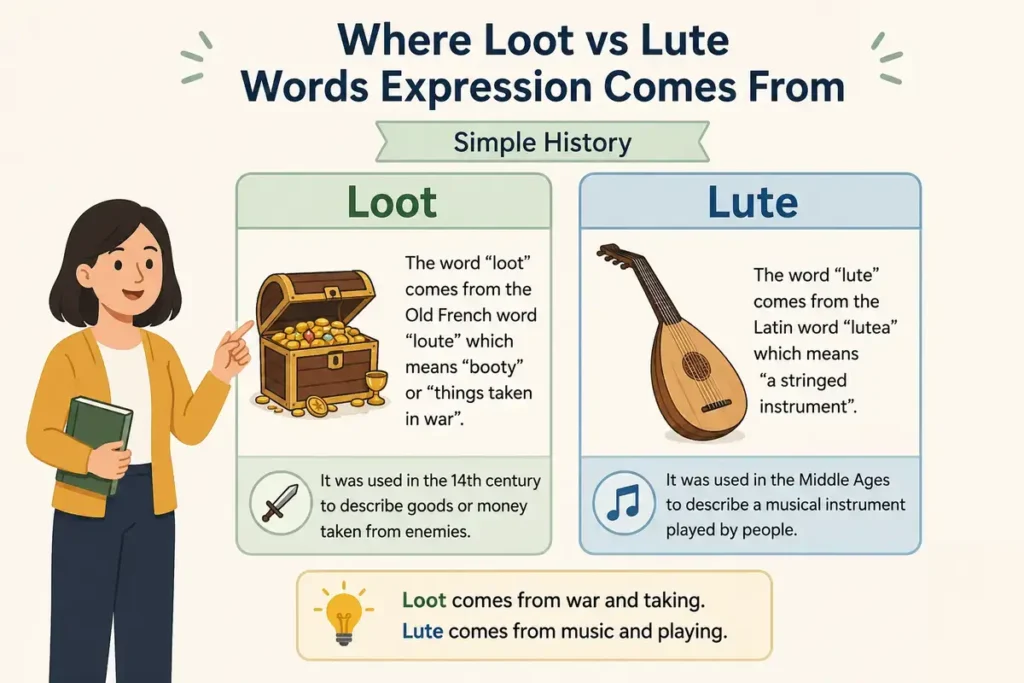
Where Loot vs Lute Words Expression Comes From Simple History
The two words have very different histories.
The History of Loot
The word loot came into English from Hindi during the time of British rule in India. It originally meant goods taken by force or stolen property. Over time, English speakers started using it for stolen valuables, treasure, and later even rewards in games. Today, gamers often use loot every day. You may hear phrases like:
- rare loot
- epic loot
- bonus loot
- hidden loot
The meaning has become much broader than it was hundreds of years ago.
The History of Lute
The word lute has a much older history. It came into English through several languages from an old Arabic word for the instrument. The lute became one of the most popular musical instruments in Europe during the Middle Ages and the Renaissance. Before modern guitars became common, many musicians performed with the lute. Although it is not used as often today, people still play it in traditional music and historical performances.
Why Their Histories Matter
Even though loot and lute sound similar, they come from completely different places and developed for different reasons. One word became connected with treasure, valuables, and rewards. The other became connected with music, art, and history. Their stories are different from the very beginning, which makes it easier to remember that they should never replace each other.
As you continue learning about you will also see how these words appear in stories, history, culture, games, and everyday conversations. Understanding those real-life uses makes the difference even clearer and helps you remember the correct word without stopping to think.
How Is Understood in Culture and Stories
When people hear both words, they usually think of two very different worlds. The word loot often appears in adventure stories, pirate tales, action movies, and video games. It makes people think about treasure, gold, secret maps, and valuable rewards. In many stories, heroes search for loot after defeating enemies, while villains try to steal it.
Pirate stories are full of loot. A pirate captain may hide loot on a small island. Explorers may spend years searching for that treasure. These stories make loot feel exciting, even though stealing is wrong in real life. Today, gamers also use the word every day. After winning a battle, players collect loot such as coins, weapons, armor, or special items. In games, loot usually means rewards instead of stolen goods.
The word lute brings a completely different picture to our minds. It reminds people of music, kings, queens, castles, artists, and peaceful times. In old stories, travelers, musicians, and singers often carried a lute. They played music to entertain people during festivals and family gatherings.
Many fairy tales and historical movies show someone sitting beside a fire while softly playing a lute. The gentle music creates a calm and happy feeling. This is one of the easiest ways to remember. Loot belongs to adventures and treasure. Lute belongs to music and peaceful performances.
You may also want to read Attornies or Attorneys: Which Spelling Is Correct?.
Biblical and Mythological Meaning of Loot vs Lute
The Bible uses ideas that are close to the meaning of loot, although different English translations may choose words like “plunder,” “spoils,” or “treasure.” These words describe valuable things taken after battles. Some stories show people collecting spoils after victory. Other stories warn against stealing or taking things dishonestly. The main lesson is that honesty is always better than greed.
The word lute does not usually appear by that exact name in most English Bible translations. Instead, the Bible mentions other musical instruments such as harps, lyres, trumpets, and cymbals. Since the lute is also a string instrument, people sometimes connect it with joyful music, praise, and celebration, but it is not a main biblical instrument.
In mythology and old legends, musicians often play instruments similar to the lute during celebrations, weddings, or royal events. Music usually represents peace, beauty, and happiness. So, the cultural meanings stay very different. Loot is linked with treasure, battles, or rewards. Lute is linked with music, celebration, and art.
Symbolism Explained in Simple Words
What Loot Represents
In stories and everyday language, loot can represent different ideas. Sometimes it represents greed because people steal things they do not own. Sometimes it represents success after hard work, especially in video games where players earn loot by completing difficult missions. In adventure stories, loot often represents hidden treasure waiting to be discovered. It can also remind people that easy money is not always earned honestly.
What Lute Represents
A lute usually represents peace, creativity, and beauty. People often connect it with music, learning, and culture. A person playing a lute may symbolize kindness, wisdom, or a love of art. In paintings and old stories, the lute often creates a quiet and peaceful feeling.
Symbolism
The comparison is very easy. Loot represents reward, treasure, wealth, or stolen valuables. Lute represents music, creativity, harmony, and peaceful expression. One word is about valuable objects. The other is about beautiful music.
Related Words You Should Know
Learning related words makes much easier to remember.
Treasure
Valuable gold, money, or jewels that people collect or discover.
Plunder
Things taken by force during war or attacks. It is very close to the meaning of loot.
Spoils
Property or valuable items taken after winning a battle.
Robbery
The crime of stealing money or valuable things from someone.
Theft
Taking something that belongs to another person without permission.
Instrument
An object used to make music, such as a guitar, piano, violin, or lute.
Guitar
A popular string instrument that many people know today. It is easier to recognize than a lute.
Harp
A large string instrument often seen in orchestras and old artwork.
Lyre
An ancient string instrument that looks different from a lute but belongs to the same musical family.
Musician
A person who plays musical instruments like the lute.
Knowing these related words helps you understand the meaning from the sentence around it.
How People Actually Use Loot vs Lute in Daily English
Here are examples of how people naturally use these words.
- The police recovered all the stolen loot.
- The pirates buried their loot near the beach.
- I found rare loot after finishing the game.
- The children showed everyone their Halloween loot.
- The museum has a beautiful old lute.
- She learned to play the lute in a music class.
- The actor carried a lute in the historical play.
- That song sounds better on a lute than on a guitar.
- We collected plenty of loot during the game.
- The old painting shows a woman holding a lute.
Notice how every sentence clearly points to treasure or music. That simple clue tells you which word is correct.
Common Mistakes People Make
Many learners make the same mistakes.
Mistake One
Incorrect:
The king played the loot.
Correct:
The king played the lute.
A musical instrument is a lute.
Mistake Two
Incorrect:
The robbers escaped with the lute.
Correct:
The robbers escaped with the loot.
Robbers steal loot, not musical instruments.
Mistake Three
Incorrect:
The treasure chest held an old lute.
Correct:
The treasure chest held old loot.
Treasure is loot.
A lute is an instrument.
Mistake Four
Incorrect:
She practiced her loot every day.
Correct:
She practiced her lute every day.
You practice an instrument.
Mistake Five
Incorrect:
We found magical lute after defeating the dragon.
Correct:
We found magical loot after defeating the dragon.
Games usually reward players with loot.
Easy Memory Trick
Think about the double O in loot. Those two O letters look like two gold coins. Gold coins remind you of treasure. Think about the U in lute. Imagine the U as the curved body of a musical instrument. This small picture can help you remember the correct spelling every time.
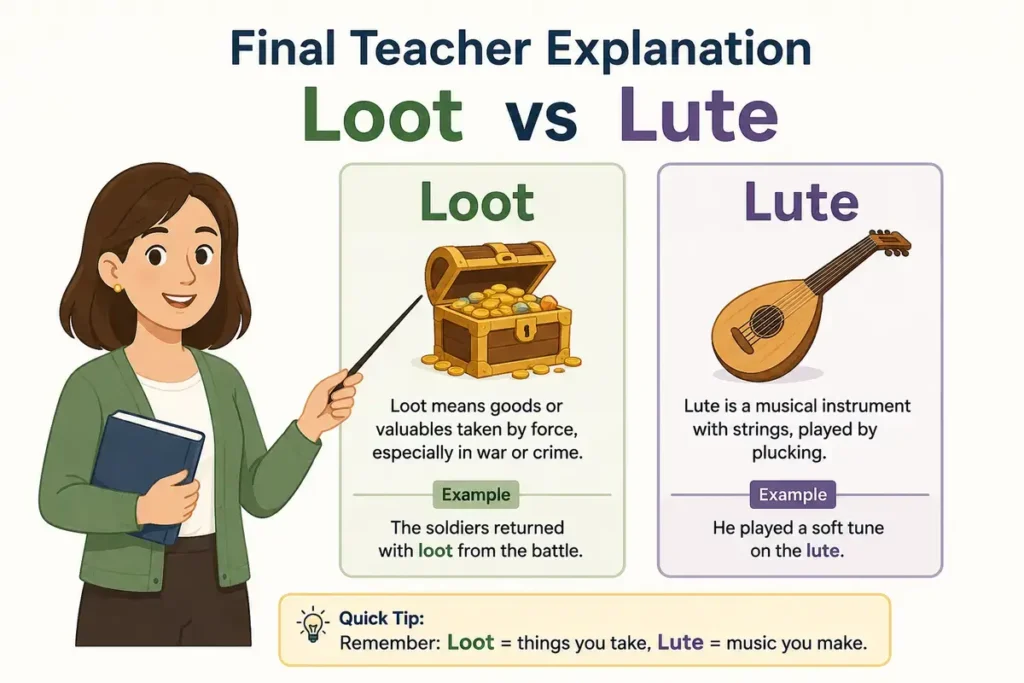
Final Teacher Explanation of Loot vs Lute
Now you know the complete difference. These words may look alike, but they belong to different parts of English. Use loot when talking about stolen valuables, treasure, rewards, or valuable items collected in games. Use lute when talking about the old string musical instrument. Whenever you feel unsure, ask yourself one simple question. Am I talking about treasure or music?
If the answer is treasure, choose loot. If the answer is music, choose lute. That simple question will help you choose the correct word almost every time. The more books you read and the more English you hear, the easier this choice becomes. Soon you will recognize the correct word without even thinking about it.
Final Answer About
The difference between boht words are simple.
Loot means stolen valuables, treasure, or game rewards.
Lute is a string musical instrument.
If you remember “treasure equals loot” and “music equals lute,” you will almost never confuse these words again.
Many readers also check Tear vs Tare: Powerful Grammar Tips for (Guide 2026).
Conclusion
Understanding loot vs lute is easier than it first seems. Although the words look and sound similar, they have completely different meanings. Loot refers to stolen valuables, treasure, or rewards in games. Lute refers to a traditional string musical instrument. Once you connect loot with treasure and lute with music, choosing the correct word becomes simple. With regular reading and practice, you will use both words correctly and confidently.
Frequently Asked Questions
What does loot mean in simple words?
Loot means stolen valuables, treasure, or rewards collected in games.
What does lute mean in simple words?
A lute is an old musical instrument with strings that people play using their fingers.
Is loot or lute correct?
Both are correct, but they have different meanings. Use the one that matches your sentence.
Why do people confuse?
They look similar and sound almost alike, but they refer to completely different things.
Can I use loot and lute in the same sentence?
Yes. For example: “The pirate found loot while the musician played the lute.”
Is loot only used for stealing?
No. In modern English, gamers often use loot to mean rewards earned during a game.
Is a lute the same as a guitar?
No. They are both string instruments, but they have different shapes, sounds, and histories.
Which is easier to remember?
Remember this simple rule: loot is treasure, and lute is music.
