
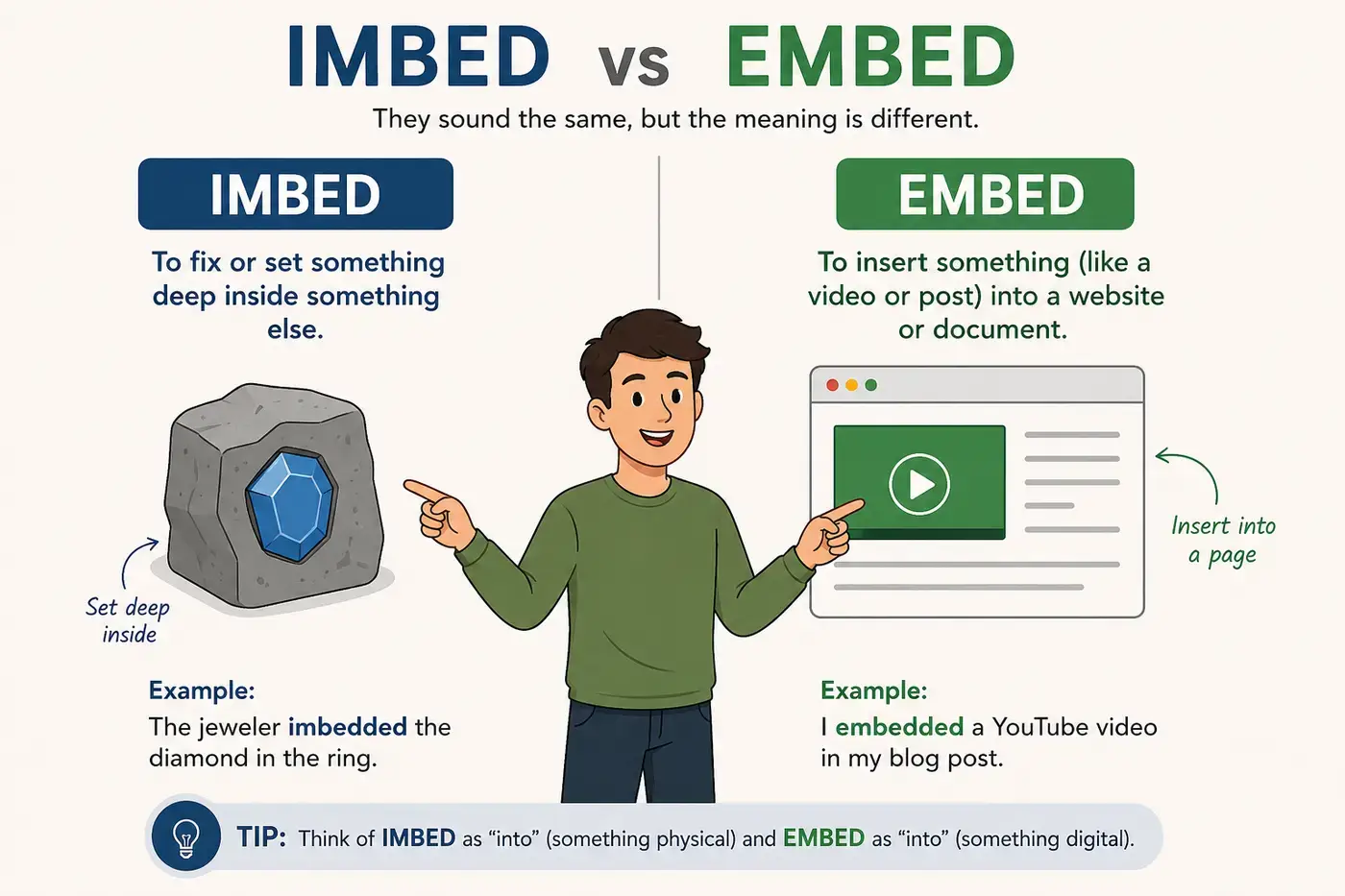
Many people search for imbed vs embed because both words appear in books, websites, and software guides. At first glance, they look almost the same. That makes many English learners wonder if one is wrong or if both are correct.
The simple answer is that embed is the standard spelling in modern English. Imbed is an older spelling that still appears sometimes, but it is much less common. In most writing, schools, workplaces, and online content, embed is the better choice.
If you have ever wondered about words, this guide will explain everything in simple words. You will learn the meaning, the difference, when to use each spelling, and how to avoid common mistakes.
For another common grammar confusion, see Laser or Lazer Meaning, Usage, and Correct Spelling Guide.
Simple Answer in One Look
When comparing both words, embed is the correct and preferred spelling for almost all modern writing. Imbed is an accepted older spelling, but it is rarely used today.
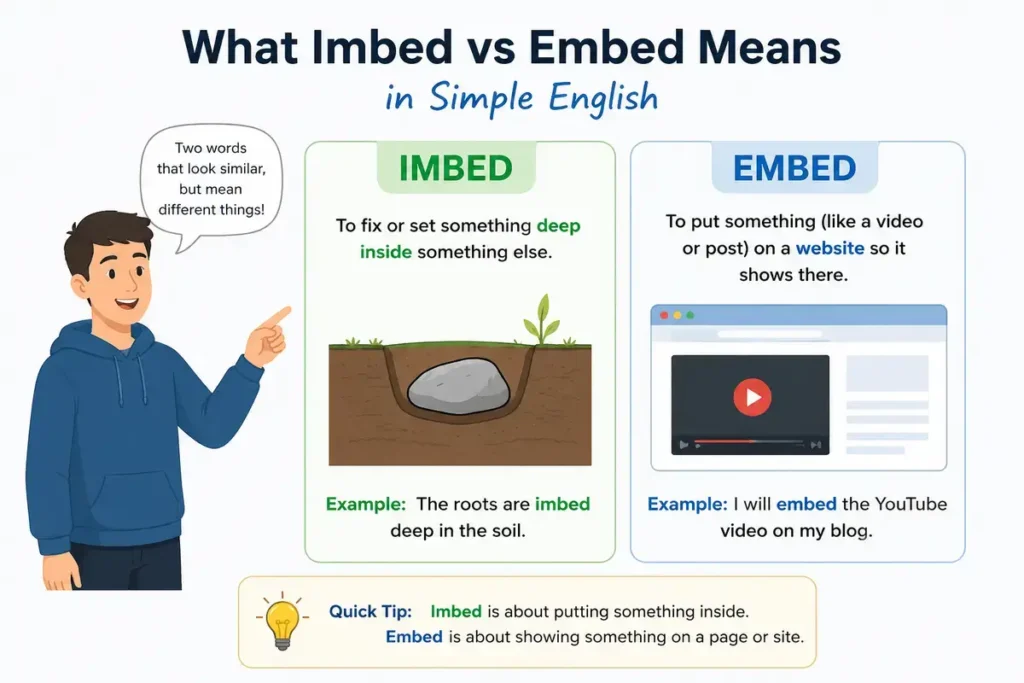
What Imbed vs Embed Means in Simple English
Think about putting something firmly inside something else.
That is what embed means.
You can embed a video on a website.
You can embed a picture in a document.
A rock can become embedded in the ground.
A small piece of glass can become embedded in your skin.
In every case, the idea is the same.
Something is placed deeply or firmly inside something else.
The spelling imbed has exactly the same meaning.
The only real difference is the spelling.
Today, most teachers, editors, dictionaries, businesses, and websites prefer embed.
That is why you should learn and use embed in your own writing.
Simple Definition of Embed
Embed means to place something firmly inside something else.
It can describe physical objects.
It can also describe digital items.
For example:
A photo can be embedded in a report.
A video can be embedded on a webpage.
A seed can become embedded in the soil.
Simple Definition of Imbed
Imbed means exactly the same thing.
It is simply an older spelling.
You may still see it in older books or older documents.
Modern English almost always chooses embed instead.
Why People Mix These Words Imbed vs Embed
Many people become confused because both spellings appear in dictionaries. When a dictionary lists two spellings, learners often think they are used equally. That is not true here. The spelling embed has become much more common. Another reason for the confusion is pronunciation. People pronounce both words exactly the same way. You cannot hear the spelling when someone speaks.
That means listening will not help you decide which spelling to write. People also find both spellings while searching online. Some old articles use imbed. Most new articles use embed. Seeing both versions makes people wonder which one is correct. The answer is simple. Both are accepted. Only one is widely preferred. That preferred spelling is embed.
Everyday Situations That Cause Confusion
A student writes a school paper. They see both spellings online. They do not know which one to choose. A website owner wants to add a YouTube video. One tutorial says “embed the video.” Another old guide says “imbed the video.” The different spellings create doubt. A writer edits an old document.
The document contains the word imbed. The writer wonders if it should stay the same or be updated. Most editors would change it to embed unless there is a special reason to keep the older spelling.
Clear Difference Explained Simply
The meaning is the same.
The spelling is different.
The modern choice is clear.
Here is the easiest way to remember it.
| Embed | Imbed |
|---|---|
| Modern spelling | Older spelling |
| Used almost everywhere today | Rarely used today |
| Preferred by teachers and editors | Mostly found in older writing |
| Best for school and business writing | Usually not the first choice |
| Recommended for websites and technology | Sometimes appears in historical texts |
Here is another simple comparison.
Choose embed when:
- You write emails.
- You write school papers.
- You publish blog posts.
- You create websites.
- You write business documents.
- You write social media posts.
You may see imbed when:
- Reading older books.
- Looking at historical documents.
- Reading older dictionary examples.
- Viewing older newspaper articles.
The safest choice is always embed.
Which Form Should You Use Imbed vs Embed?
If you are writing English today, use embed.
This simple rule works almost every time.
Imagine you are writing for your teacher.
Use embed.
Imagine you are writing for work.
Use embed.
Imagine you are creating a website.
Use embed.
Imagine you are writing a report.
Use embed.
Most people will expect this spelling.
It looks natural to modern readers.
It matches common computer terms.
For example, people say:
Embed a video.
Embed a map.
These are the phrases you will see every day.
Easy Rule to Remember
If you are unsure, choose embed.
You almost never need to choose imbed.
That one simple rule will help you avoid mistakes.
Is Imbed Wrong?
No.
It is not wrong.
It is simply uncommon.
English changes over time.
Some spellings slowly become less popular.
That is exactly what happened here.
The spelling embed became the favorite.
Today it is the spelling that most people expect.
Easy Real Life Sentences You Can Use
Here are simple examples you can copy into your own writing.
- Please embed the video in the article.
- I embedded the picture in my school report.
- The website lets you embed maps for free.
- A tiny stone became embedded in my shoe.
- The doctor removed the glass embedded in his hand.
- She embedded a chart in the presentation.
- We can embed the audio on our webpage.
- Good habits become embedded over time.
Notice that every example uses embed.
That is how modern English is usually written.
Sentences With Imbed
These examples are also correct, but they sound older.
The picture was imbedded in the book cover.
The nail was imbedded in the wall.
The stone became imbedded in the ground.
Many editors would update these sentences by changing imbedded to embedded.
Where This Word Expression Comes From Simple History
The word embed has been part of English for a very long time. It developed from older forms that meant to place something into a bed or a resting place. Over many years, the meaning grew wider. People started using it for objects placed firmly inside other objects. Later, technology gave the word an entirely new job. Now people use embed every day when talking about websites, documents, videos, music, computer code, and digital media.
The spelling imbed also appeared in English many years ago. For a time, both spellings were used by different writers. As English became more standardized, embed slowly became the preferred spelling. Today, it is the version taught in schools and used by most publishers. That is why modern dictionaries usually list embed first.
They may also include imbed, but they often label it as a less common variant. This change is not unusual. English has many words that once had two accepted spellings before one became much more popular. In this case, embed won that place. As a result, most readers now expect to see embed whenever they read books, articles, websites, or software instructions. Understanding this simple history makes the choice much easier.
You are not learning two different words. You are learning one word with two spellings, and one spelling is now the standard. As English continues to grow, modern spelling choices help writing stay clear and consistent for readers everywhere.
The basic difference between both word is now easy to remember. In the next part of this guide, we will go beyond spelling and look at cultural use, symbolism, related words, common mistakes, daily conversations, expert writing tips, and practical examples that help you use embed naturally in every situation.
How Imbed vs Embed Is Understood in Culture and Stories
When people compare both words, they are usually thinking about spelling. In stories and everyday language, though, the idea behind the word is more important than the spelling. The word embed often means something becomes a lasting part of something else. A lesson can become embedded in your mind. A good habit can become embedded in your daily life. People also use the word when talking about values.
For example, someone might say that kindness is embedded in their family.
This means kindness is a strong and lasting part of who they are. In movies and books, writers use embed to show that something stays deeply connected. A memory can stay embedded in a person’s heart. A symbol can become embedded in a culture over many years. The spelling imbed carries the same meaning. It simply appears less often because modern English prefers embed.
For another common grammar confusion, see Suit vs Suite: What Is the Difference?.
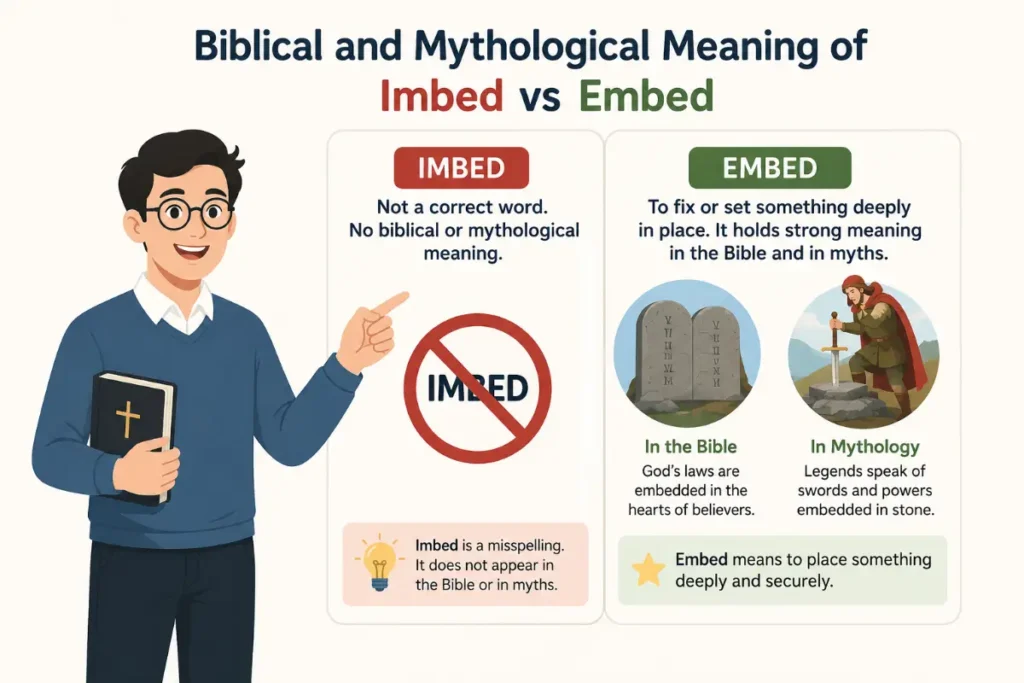
Biblical and Mythological Meaning of Imbed vs Embed
The words embed and imbed do not have a special Biblical meaning. You will not usually find them as important religious words. Still, the idea behind embed can appear in many religious and historical writings. For example, people may say that faith is embedded in a person’s life.
They may say that love is embedded in a community. These examples describe something that becomes a deep and lasting part of someone. In mythology, the word is sometimes used in modern retellings. A magical stone may be embedded in a sword. A special jewel may be embedded in a crown. Here, embed simply means that one object is firmly placed inside another. The spelling does not change the meaning.
Symbolism Explained in Simple Words
What Embed Represents
In the discussion of our keyword, embed often represents strength and permanence.
It suggests that something belongs where it is.
It stays there for a long time.
People also connect embed with learning.
Teachers hope good lessons become embedded in students’ minds.
Parents hope good manners become embedded in their children.
Companies want their values embedded in their work.
The word gives the feeling of something lasting and meaningful.
What Imbed Represents
The word imbed represents the same idea.
It still means placing something firmly inside something else.
The only difference is that it feels older.
Some readers may notice it in older books or documents.
Modern readers usually expect embed instead.
So, when thinking about both words, remember that the meaning stays the same while the preferred spelling changes.
Related Words You Should Know
Learning related words makes much easier to remember.
Embedded
This means something already been placed firmly inside something else.
Example: The photo embedded in the report.
Embedding
This is the action of placing something inside something else.
Example: She is embedding a video into the webpage.
Embedment
This means the state of being firmly fixed inside something.
It is less common in everyday English.
Embeddedness
This word describes something that has become deeply connected or established.
It is mostly used in formal writing.
Insert
Insert means to put something into another thing.
It does not always mean firmly or permanently.
Place
Place simply means to put something somewhere.
It is more general than embed.
Fix
Fix means to attach something so it stays in place.
Sometimes it has a meaning close to embed.
Install
Install usually means setting up equipment or software.
It is different from embed, but people sometimes confuse the two.
How People Actually Use Imbed vs Embed in Daily English
Most people naturally use embed every day without thinking about the older spelling.
Here are common examples.
“Please embed the video in the article.”
“I embedded the chart into my report.”
“The image is embedded in the document.”
“Can you embed this map on the website?”
“That lesson stayed embedded in my memory.”
“Family values embedded in our traditions.”
“The stone became embedded in the road.”
“The company logo is embedded in every page.”
“Good habits become embedded over time.”
These are the kinds of sentences you hear in schools, offices, and daily conversations.
The spelling imbed is much less common in modern speech and writing.
Common Mistakes People Make
Many learners make small mistakes when writing.
Here are the most common ones.
Mistake One
Using imbed in new school or work writing.
Correct:
Use embed.
Mistake Two
Thinking the words have different meanings.
Correct:
Both words mean the same thing.
Mistake Three
Believing imbed is always wrong.
Correct:
It is still accepted, but it is uncommon.
Mistake Four
Changing the meaning because of the spelling.
Correct:
Only the spelling changes.
The meaning stays the same.
Mistake Five
Using another word when embed fits better.
Correct:
If something is placed firmly inside something else, embed is usually the best choice.
Easy Memory Tip
Remember this simple sentence.
“Modern English chooses embed.”
That one sentence will help you every time.
Final Teacher Explanation of Imbed vs Embed
Imagine you are sitting in an English classroom. A student asks, “Which one should I write, imbed or embed?” The answer is simple.
Write embed.
It is the spelling that teachers, editors, publishers, businesses, and websites use today. The word means to place something firmly inside something else. That meaning never changes.
The spelling imbed is older.
It is accepted by many dictionaries. However, you will not see it very often in modern writing. If you always choose embed, your writing will look natural and correct. That is the easiest rule to remember.
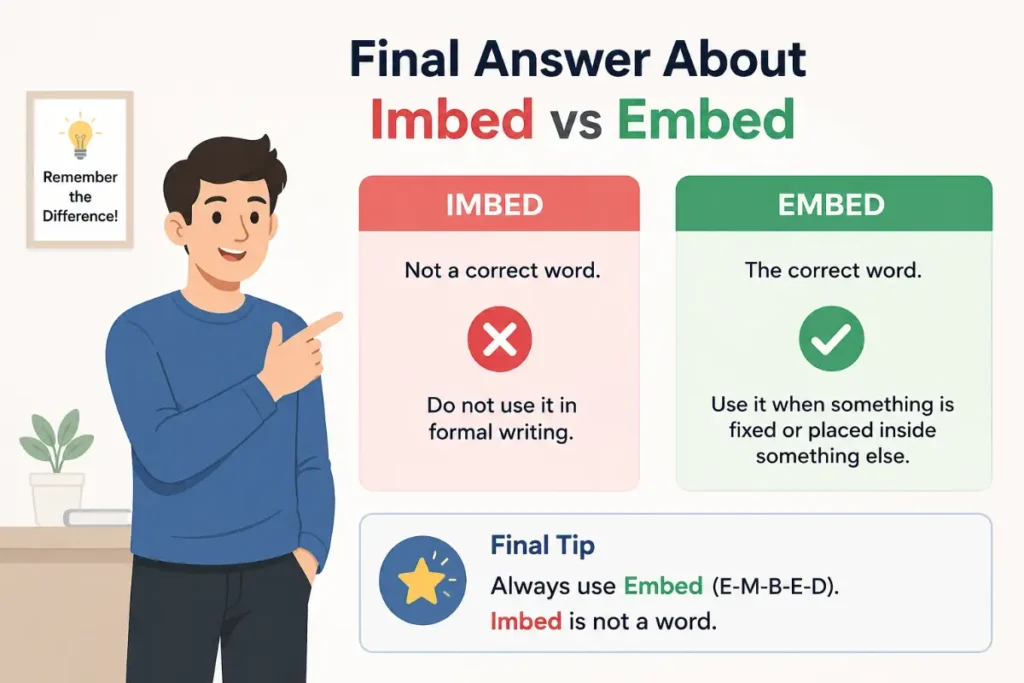
Final Answer About Imbed vs Embed
The question about keyword has a very simple answer. Both spellings have the same meaning. They both describe placing something firmly inside something else. The difference is that embed is the modern standard spelling. The form used in schools, books, websites, newspapers, and business writing.
You may still find imbed in older books or older documents, but it is much less common today. If you are ever unsure, choose embed. It is the spelling that modern readers expect to see.
A related grammar guide is Unphased or Unfazed: Which Is Correct and How to Use (2026)?.
Conclusion
The difference between is easy once you know the simple rule. Both words mean the same thing, but embed is the spelling used in modern English. You can confidently use embed in school assignments, emails, reports, blog posts, websites, and everyday writing. Most readers will recognize it right away.
The easiest takeaway is this. When you think about imbed vs embed, remember one simple rule. Always choose embed for modern English.
Frequently Asked Questions
What does embed mean in simple words?
Embed means to place something firmly inside something else.
Is embed or imbed correct?
Both are correct, but embed is the standard spelling used in modern English.
Why do people confuse?
People get confused because both spellings appear in dictionaries and older books.
Can I use imbed in my school writing?
You can, but embed is the better choice because it is the modern standard.
Which spelling do teachers prefer?
Most teachers and editors prefer embed.
Does imbed have a different meaning from embed?
No. Both words have the same meaning.
When should I use embed?
Embed is use when something placed firmly inside another thing or when adding videos, images, files, or maps to digital content.
Is embed used in technology?
Yes. It is the standard word for adding videos, images, fonts, maps, and other content to websites or documents.
