
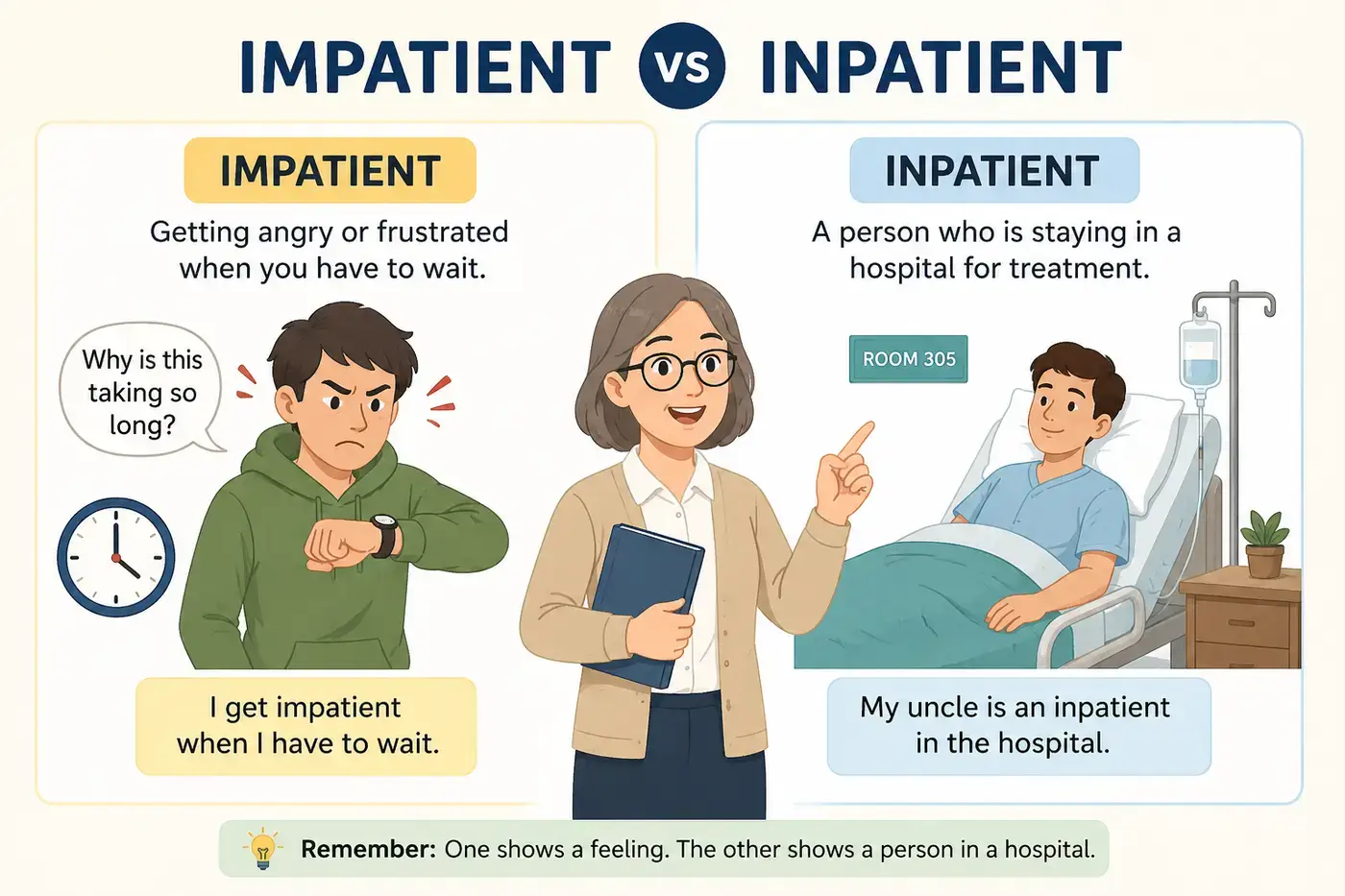
Many people get confused about impatient vs inpatient because the two words look almost the same. They differ by only one letter, but their meanings are completely different. One word describes a person’s feelings, while the other describes a type of hospital patient.
If you have ever stopped while writing because you were unsure about words, you are not alone. This is one of the most common English word mix-ups. The good news is that it is very easy to remember once you understand what each word means.
In this guide, you will learn the difference between when to use each word, and simple tricks that help you remember the correct spelling. Everything is explained in clear, everyday US English.
Need another quick comparison? Read Laid or Layed: Which One Is Correct and Why (2026)?.
Simple Answer in One Look
Impatient means you cannot wait because you feel annoyed or restless.
Inpatient means a person who stays in a hospital for treatment.
That is the whole difference.
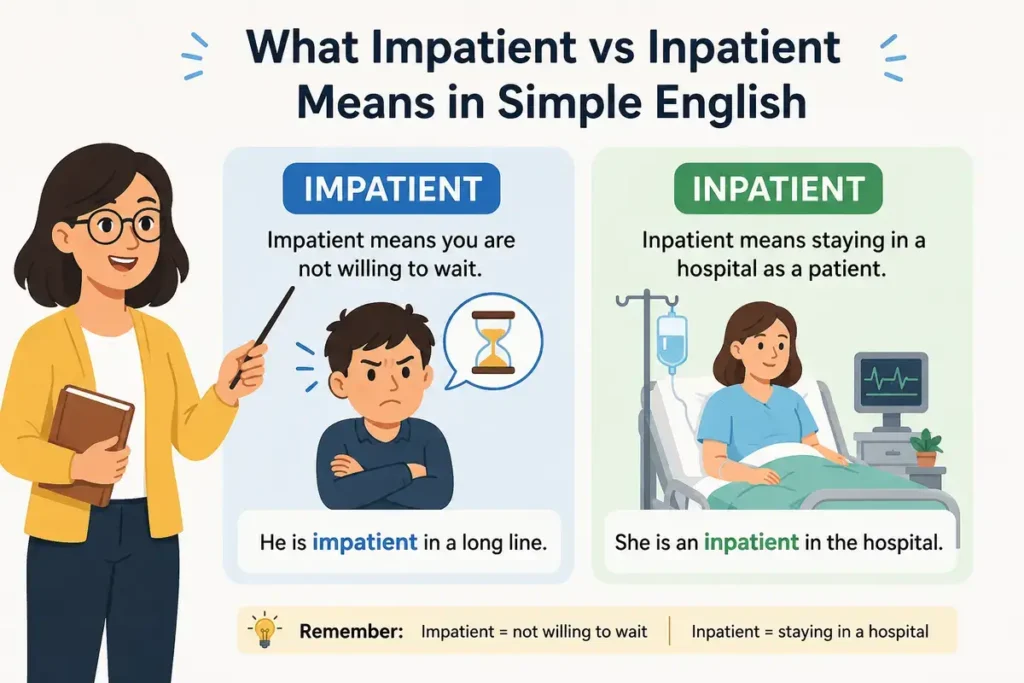
What Impatient vs Inpatient Means in Simple English
The easiest way to understand these words is to think about what they describe.
What Does Impatient Mean?
The word impatient describes a feeling. An impatient person does not like waiting. They want something to happen right away.
Someone may become impatient when:
- They are standing in a long line.
- A friend is very late.
- The internet is slow.
- They are waiting for test results.
- Traffic is moving very slowly.
Being impatient is a normal human feeling. Everyone feels impatient sometimes. For example:
- I became impatient while waiting for the bus.
- She is impatient because dinner is taking too long.
- The children grew impatient before the movie started.
Notice that impatient talks about emotions and behavior.
What Does Inpatient Mean?
The word inpatient has nothing to do with emotions. An inpatient is someone who stays in a hospital or another healthcare center for one or more nights while receiving medical care. Doctors decide that someone should become an inpatient when they need close medical attention. Examples include:
- The doctor admitted him as an inpatient.
- She remained an inpatient after surgery.
- Every inpatient receives regular medical care.
Here, inpatient always refers to a hospital patient.
The Main Idea
Remember this simple rule.
- Impatient = a feeling
- Inpatient = a hospital patient
That single idea helps solve most mistakes.
Why People Mix These Words
Many English learners and even native speakers confuse these words.
There are several simple reasons.
They Look Nearly the Same
Only one extra letter separates them.
- impatient
- inpatient
When reading quickly, your eyes may skip that small difference.
They Sound Similar
Both words begin with “in.”
Their pronunciation is also close enough that people sometimes mishear them.
Both Are Common Words
You may see impatient in everyday conversations.
You may see inpatient in hospitals, health articles, or medical forms.
Since both appear often, people sometimes remember the wrong one.
Spell Check Does Not Always Help
Both words are correctly spelled English words.
Because of that, spell check usually does not catch the mistake.
For example:
Incorrect:
- The nurse said I was impatient after surgery.
The computer may accept this sentence because impatient is a real word.
But the correct sentence is:
- The nurse said I was an inpatient after surgery.
Fast Typing Causes Mistakes
Many people accidentally leave out the second “n.”
Instead of writing:
- inpatient
they type:
- impatient
This happens often on phones and keyboards.
Clear Difference Explained Simply
Here is a quick comparison.
| Impatient | Inpatient |
|---|---|
| Describes a feeling | Describes a hospital patient |
| Means unable to wait | Means staying in a hospital |
| Used in everyday conversation | Used in healthcare |
| Talks about emotions | Talks about medical care |
| Can describe anyone | Describes only patients admitted to a hospital |
Think of it this way.
If the sentence talks about feelings, choose impatient.
If the sentence talks about hospitals, choose inpatient.
Quick Memory Trick
Imagine these two pictures.
Impatient
A child keeps asking:
“Are we there yet?”
The child cannot wait.
That is impatient.
Inpatient
A person is resting in a hospital bed while doctors care for them.
That is an inpatient.
The pictures are completely different, making the words easier to remember.
Which Form Should You Use Impatient vs Inpatient?
The correct word depends on what you want to say.
Choose impatient when talking about waiting or feelings.
Examples:
- I became impatient.
- We were impatient for the game to begin.
- My brother gets impatient easily.
Choose inpatient when talking about someone receiving hospital care.
Examples:
- He became an inpatient yesterday.
- The hospital admitted several inpatients.
- The inpatient recovered well.
Ask yourself one simple question.
Am I talking about feelings or hospitals?
If the answer is feelings, use impatient.
If the answer is hospitals, use inpatient.
That simple question works almost every time.
Easy Way to Remember
Notice the middle of the word.
Impatient
Contains “patient,” but it describes someone who is not acting patiently.
Inpatient
Starts with “in.”
Think:
In the hospital.
If someone is in the hospital overnight, they are an inpatient.
That small memory trick helps many students.
Easy Real Life Sentences You Can Use
These everyday examples show how each word naturally fits into conversation.
Sentences With Impatient
- I became impatient while waiting for my food.
- She gets impatient when people arrive late.
- We were impatient to open our birthday gifts.
- The children became impatient during the long trip.
- My dog grows impatient before dinner.
- He sounded impatient on the phone.
- Don’t be impatient. Your turn is coming.
Sentences With Inpatient
- The doctor admitted him as an inpatient.
- My grandmother stayed as an inpatient for three days.
- Every inpatient receives regular medical care.
- The nurse checked on each inpatient every morning.
- She became an inpatient after the operation.
- The hospital has a special inpatient unit.
- The inpatient recovered quickly and went home.
Practice reading these sentences aloud.
Hearing the words in real situations helps you remember them faster.
Where Impatient vs Inpatient Word Expression Comes From Simple History
The history of these words is actually quite simple. The word patient has been part of English for hundreds of years. It comes from a Latin word meaning “to endure” or “to suffer.” Over time, English created different words by adding prefixes.
How Impatient Was Formed
The prefix im- means “not.”
So:
- patient = able to wait calmly
- impatient = not able to wait calmly
The meaning is easy to understand.
How Inpatient Was Formed
The word inpatient became common as hospitals needed a simple name for patients who stayed inside the hospital for treatment. The prefix in- means inside. So an inpatient is literally a patient who stays inside the hospital. Hospitals also use another related word.
Outpatient
An outpatient visits the hospital or clinic but goes home the same day.
So remember:
- inpatient = stays in the hospital
- outpatient = goes home after treatment
This comparison makes the medical meaning much easier to remember. As English has grown over the years, both impatient and inpatient have become common words, but they belong to completely different situations. One belongs to everyday conversations about feelings, while the other belongs to healthcare and hospitals. Knowing this simple difference makes reading, writing, and speaking much easier.
In the next section, you will discover how these words are used in culture, common expressions, symbolism, learning tips, and many more real-life examples that will help you remember them with confidence.
How This Word Is Understood in Culture and Stories
Words often carry feelings and ideas that people understand through daily life, books, movies, and conversations. The meaning of impatient vs inpatient becomes clearer when we see how people use these words in real situations. The word impatient is connected with human emotions. Stories often show impatient characters as people who want quick results. They may rush, interrupt others, or become frustrated because they do not want to wait.
For example, in many children’s stories, a character may be impatient because they want a surprise, a reward, or an adventure to happen immediately. This helps readers understand that waiting calmly is a skill people learn over time.
The word inpatient is connected with care, health, and support. In stories about hospitals or family experiences, an inpatient is usually shown as someone receiving help from doctors and nurses. Culture teaches us that both words describe very different parts of life.
Impatient shows a person’s reaction.
Inpatient shows a person’s situation.
One is about feelings. The other is about medical care.
Many readers also check Combatting or Combating: Which Spelling Is Correct?.
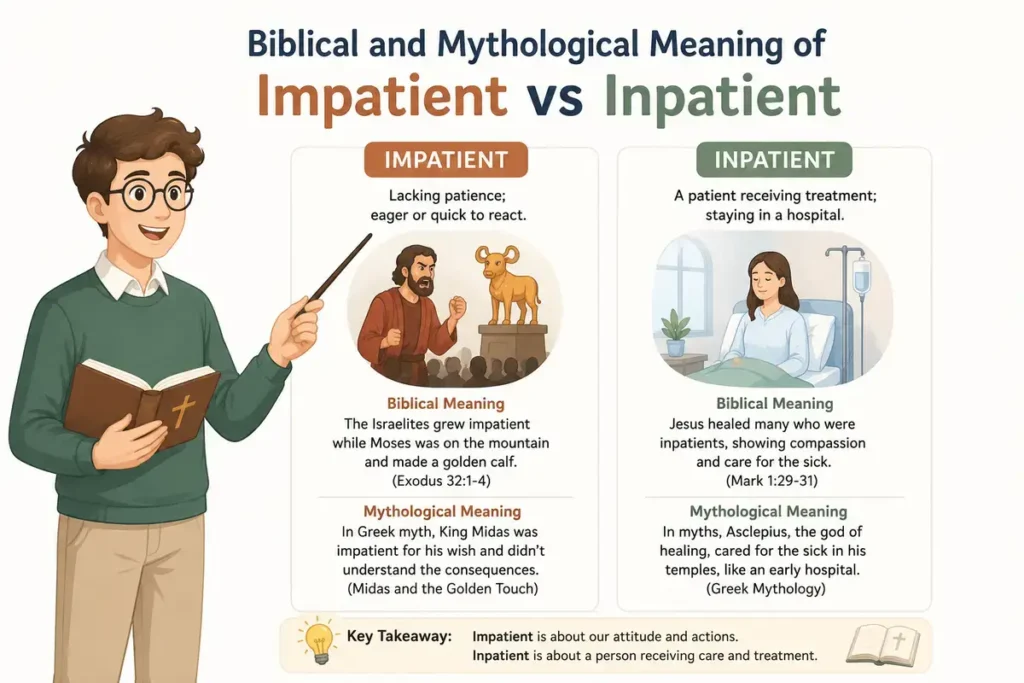
Biblical and Mythological Meaning of Impatient vs Inpatient
The words impatient and inpatient do not have a direct biblical or mythological meaning. They are everyday English words used for feelings and healthcare. However, the idea behind impatient appears in many old stories and teachings. Many cultures teach the value of patience. People are often reminded that good things take time.
Characters who cannot wait may face problems because they act too quickly. For example, many traditional stories include a person who wants success immediately but learns that patience and wisdom are needed.
The idea behind inpatient is more connected with kindness, healing, and caring for people. Many stories from different cultures show the importance of helping those who are sick or weak. So, while these words are not famous symbols in religious or mythological texts, their ideas connect with common human experiences:
- Impatient connects with learning patience.
- Inpatient connects with receiving care and support.
Symbolism Explained in Simple Words
Words can sometimes represent bigger ideas. The meanings of both words can help us understand two different parts of human life.
What One Version Represents
Impatient represents urgency, strong desire, and the struggle to wait. An impatient person may represent:
- A person who wants fast results.
- Someone who feels frustrated with delays.
- A person learning self-control.
- Someone who needs to slow down and think.
In stories, an impatient character often learns an important lesson. They discover that rushing does not always create better results. The deeper message of impatient is simple: Sometimes waiting is part of success.
What the Other Version Represents
Inpatient represents care, healing, and support.
An inpatient may represent:
- A person receiving medical attention.
- A time of recovery.
- The importance of healthcare workers.
- A need for kindness and understanding.
Unlike impatient, inpatient is not about behavior or emotions. It describes a person’s place in a healthcare situation.
The simple meaning is:
An inpatient is someone who needs care inside a medical facility.
Related Words You Should Know
Learning related words makes the difference between words even easier.
Patient
A patient person can wait calmly without becoming upset. Example:
- She is patient with young children.
Patient
A patient is also a person receiving medical treatment. Example:
- The doctor checked the patient.
The word has two meanings.
Patience
Patience means the ability to wait calmly. Example:
- Learning a language requires patience.
Impatiently
Impatiently means doing something in an annoyed or rushed way. Example:
- He waited impatiently for the answer.
Inpatient Care
Inpatient care means medical treatment where a person stays in a hospital. Example:
- The hospital provides inpatient care.
Outpatient
An outpatient receives medical care but does not stay overnight. Example:
- She visited the clinic as an outpatient.
Hospitalized
Hospitalized means someone is admitted to a hospital. Example:
- He was hospitalized after the accident.
Restless
Restless means unable to relax or stay still. Example:
- The children became restless during the long wait.
How People Actually Use Impatient vs Inpatient in Daily English
The best way to understand both words is by seeing how people use these words naturally.
Everyday Uses of Impatient
- I am getting impatient because the website is loading slowly.
- My little brother becomes impatient when he has to wait for his turn.
- She was impatient to hear the final results.
- Don’t be impatient. The food will be ready soon.
- The driver became impatient because traffic was not moving.
- He answered in an impatient voice.
- The students were impatient for the school trip to begin.
- I felt impatient while waiting in the long line.
These examples show that impatient is connected with waiting and feelings.
Everyday Uses of Inpatient
- The doctor admitted my uncle as an inpatient.
- The hospital has a separate area for inpatient care.
- The nurse checked every inpatient during the night.
- The inpatient stayed at the hospital for several days.
- The medical team helped the inpatient recover.
- The hospital provides services for both inpatient and outpatient care.
- The patient became an inpatient after surgery.
These examples show that inpatient belongs mainly to healthcare conversations.
Common Mistakes People Make
Many people make small mistakes with these words because they look almost identical. Here are the most common errors.
Mistake 1: Using Inpatient for Feelings
Incorrect:
- I was inpatient because my friend was late.
Correct:
- I was impatient because my friend was late.
Why?
The sentence talks about frustration and waiting, so use impatient.
Mistake 2: Using Impatient for Hospital Patients
Incorrect:
- The hospital has many impatient rooms.
Correct:
- The hospital has many inpatient rooms.
Why?
The sentence talks about hospital areas, so use inpatient.
Mistake 3: Thinking They Are Different Spellings of One Word
Some people think one spelling is American English and the other is British English.
That is not true.
Both words are correct English words, but they have different meanings.
Mistake 4: Forgetting the Extra Letter
A common spelling mistake is writing:
- impatient
when you mean:
- inpatient
Remember:
Inpatient has “in” + “patient.”
Think:
A person is inside the hospital.
Mistake 5: Confusing Patient Meanings
The word “patient” itself has two meanings.
It can mean:
- A calm person who can wait.
- A person receiving medical care.
The extra letters change the meaning:
- impatient = not patient with waiting.
- inpatient = patient inside a hospital.
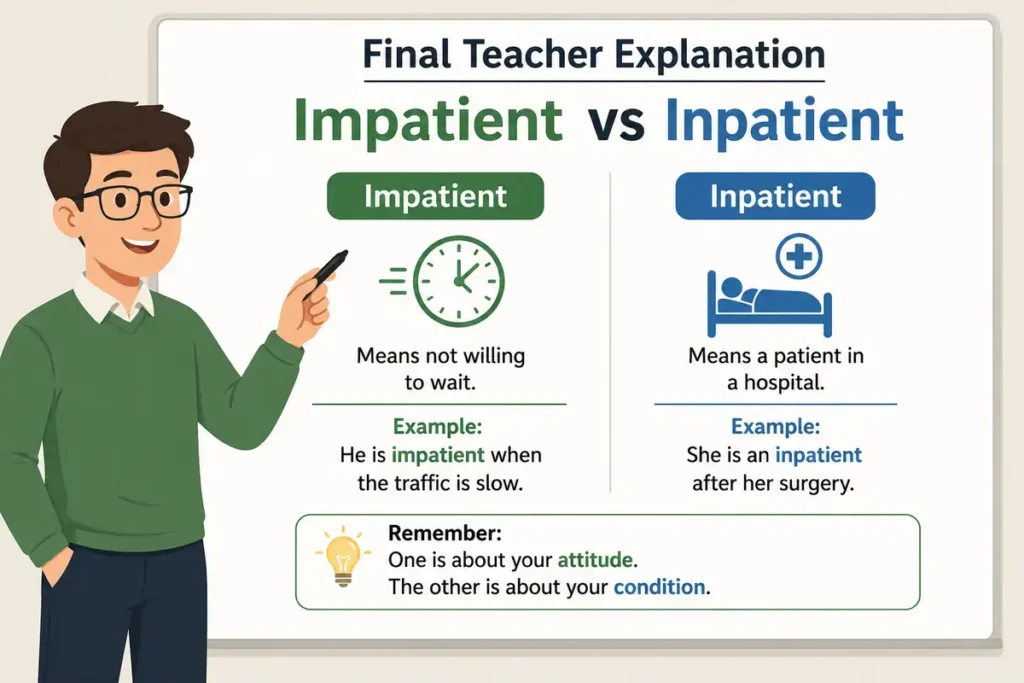
Final Teacher Explanation about Impatient vs Inpatient
If I were explaining both words in a classroom, I would say:
“These two words look like twins, but they have completely different jobs.”
Impatient talks about feelings.
When you cannot wait, you feel impatient.
For example:
- I am impatient for my vacation.
You are excited or annoyed because you want something to happen soon.
Inpatient talks about healthcare.
When someone stays in a hospital for treatment, that person is an inpatient.
For example:
- The hospital admitted him as an inpatient.
The easiest way to remember them is:
Impatient means “I cannot wait.”
Inpatient means “I am inside a hospital.”
Whenever you are confused, look at the situation.
Are you talking about waiting?
Use impatient.
Are you talking about medical care?
Use inpatient.
That simple trick will help you choose the right word every time.
Final Answer Quick Recap
The difference between is simple.
Impatient describes a feeling. It means someone does not want to wait and may feel annoyed or restless.
Inpatient describes a person who stays in a hospital for treatment and care.
They sound similar, but they belong to different situations. One is about emotions, and the other is about healthcare.
Remember this easy rule:
An impatient person cannot wait.
An inpatient person is inside a hospital.
For another common grammar confusion, see Pentoxide vs Pentaoxide: Which One Is Correct?.
Conclusion
Understanding impatient vs inpatient becomes easy when you focus on meaning instead of spelling. Impatient is about feelings, waiting, and frustration. Inpatient is about a person receiving medical care in a hospital.
Many people confuse these words because they look and sound similar, but their uses are completely different. Knowing the situation helps you choose the correct word.
The easiest takeaway is:
Impatient means you cannot wait. Inpatient means you are receiving hospital care.
Frequently Asked Questions FAQs
What does impatient mean in simple words?
Impatient means feeling annoyed because you have to wait or because something is taking too long.
What does inpatient mean in simple words?
Inpatient means a person who stays in a hospital for medical treatment.
Is it correct to use impatient or inpatient?
Both words are correct, but they have different meanings. Use impatient for feelings and inpatient for hospital care.
Why do people get confused between impatient and inpatient?
People confuse them because they look almost the same and have similar sounds.
Can I use both forms in writing?
Yes, you can use both words in writing, but only when their meanings match the sentence.
When should I use impatient?
Use impatient when you talk about waiting, frustration, or a person who wants something quickly.
When should I use inpatient?
Use inpatient when you talk about someone staying in a hospital for treatment.
