
Many people search for puddy or putty because the two words sound very similar. When spoken quickly, it can be hard to tell which one is correct. This often leads to spelling mistakes in writing and confusion in everyday conversations.
The simple answer is that putty is the standard English word. It is a soft material used for filling holes, sealing glass, or repairing surfaces. Puddy is usually not considered the correct spelling in standard English.
If you have ever wondered about words, this guide will explain everything in simple words. By the end, you will know the meaning, the difference, and which form you should use in writing.
Need another quick comparison? Read Implicit vs Complicit: Essential Meanings With Examples 2026.
Simple Answer in One Look
Putty is the correct standard English word.
Puddy is usually a misspelling or a way some people pronounce the word.
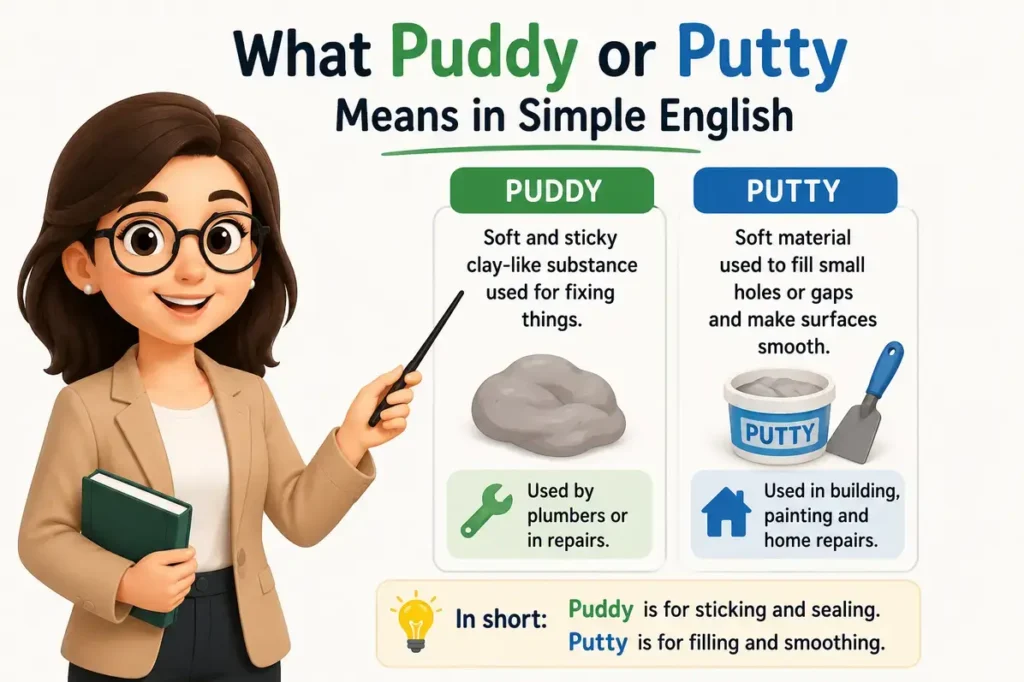
What Puddy or Putty Means in Simple English
When people ask about words, they are usually trying to find out which spelling is correct. The word putty refers to a soft substance. People use it to fill cracks, repair small holes, or hold window glass in place. For example:
- The worker used putty to fix the crack.
- We bought putty from the hardware store.
- The old window needed fresh putty.
The word feels simple because it describes something soft and moldable. You can press it, shape it, and smooth it with your hands or tools. Many people hear the word spoken and think it sounds like “puddy.” That is where the confusion begins. In standard English dictionaries, putty is the accepted spelling.
Why People Mix These Words
The confusion happens mostly because of pronunciation. In many English accents, the letter combination “tt” sounds very close to a soft “d” sound. For example:
- Better may sound like “bedder.”
- Butter may sound like “budder.”
- Little may sound like “liddle.”
When people hear the word instead of seeing it written, they often assume it should be spelled with a “d.” This is a common mistake. Another reason is that English spelling does not always match pronunciation perfectly. Many words sound one way but are written another way. For example:
- Water sounds like “wader.”
- City sounds like “cidy.”
- Pretty sounds like “priddy.”
The same thing happens with putty. The correct spelling remains putty. Children learning English often make this mistake because they write words exactly as they hear them. Even adults can become confused if they have rarely seen the word written.
Clear Difference Explained Simply
Here is the difference in the easiest way possible.
Putty
- Standard English spelling
- Found in dictionaries
- Used in writing
- Refers to a soft filling material
Puddy
- Usually a misspelling
- Not the standard form
- Often comes from pronunciation
- Should generally be avoided in formal writing
Think of it this way:
| Word | Correct Standard English? | Meaning |
|---|---|---|
| Putty | Yes | Soft filling or sealing material |
| Puddy | No (usually) | Common spelling mistake of putty |
If you are writing an email, school paper, article, report, or social media post, use putty.
Easy Memory Trick
Remember this sentence:
Putty has two Ts, and that is the correct spelling.
Whenever you are unsure about choose putty.
Which Form Should You Use Puddy vs Putty?
You should use putty almost every time. This is the spelling recognized in dictionaries, books, schools, newspapers, and professional writing. Examples:
✅ Correct:
- The carpenter applied putty around the window.
- I need some putty to fill the hole.
- The repair kit includes putty.
❌ Incorrect:
- The carpenter applied puddy around the window.
- I need some puddy to fill the hole.
- The repair kit includes puddy.
If your goal is correct English, always choose putty. The only time you may see “puddy” is in special situations such as:
- Personal nicknames
- Character names
- Informal jokes
- Dialect writing
- Creative storytelling
Outside of those cases, putty is the right choice.
Easy Real-Life Sentences You Can Use
Here are some simple examples with the correct word.
- I used putty to repair the crack in the wall.
- The window frame needed fresh putty.
- Please buy a small container of putty.
- He pressed the putty into the hole.
- The repair worker smoothed the putty carefully.
- This putty dries very quickly.
- The old putty started falling apart.
- We used putty before painting the wall.
Now look at these incorrect examples:
- I used puddy to repair the crack.
- The puddy dried overnight.
These are not standard English spellings.
Where Puddy and Putty Expression Comes From (Simple History)
The word putty has been part of English for hundreds of years. It originally came from older European words connected to materials used in building and repairing things. Over time, English speakers adopted the word putty to describe a soft mixture used by workers and builders. Long before modern repair products existed, people used putty around windows and wooden surfaces.
The basic idea has stayed the same for centuries. Even today, builders, painters, and homeowners still use different kinds of putty for repairs. The spelling has remained putty throughout its history. That is another reason dictionaries continue to recognize putty as the standard form.
Can Putty Have Other Meanings?
Yes. Besides the repair material, people sometimes use putty in expressions. For example: “Like putty in someone’s hands.” This means a person is very easy to influence or persuade. Example:
- He was like putty in her hands.
The sentence does not talk about repair material. Instead, it compares a person to something soft and easy to shape. This figurative meaning is common in English conversations, movies, books, and stories.
Common Questions
Is puddy a real word?
Usually, no. Most of the time, it is simply a misspelling of putty.
Which spelling should I use?
Use putty.
Is putty used in everyday English?
Yes. People use it when talking about repairs, construction, painting, windows, and home improvement.
Can I write puddy in formal writing?
No. Formal writing should use putty.
Many readers also check Its Called vs It Called: Meaning, Grammar, and Examples.
Transition to Deeper Meaning
Now that you understand the basic difference there is more to learn. Words often carry meaning beyond their dictionary definitions. In the next section, we will look at how putty appears in culture, symbolism, expressions, and everyday communication.
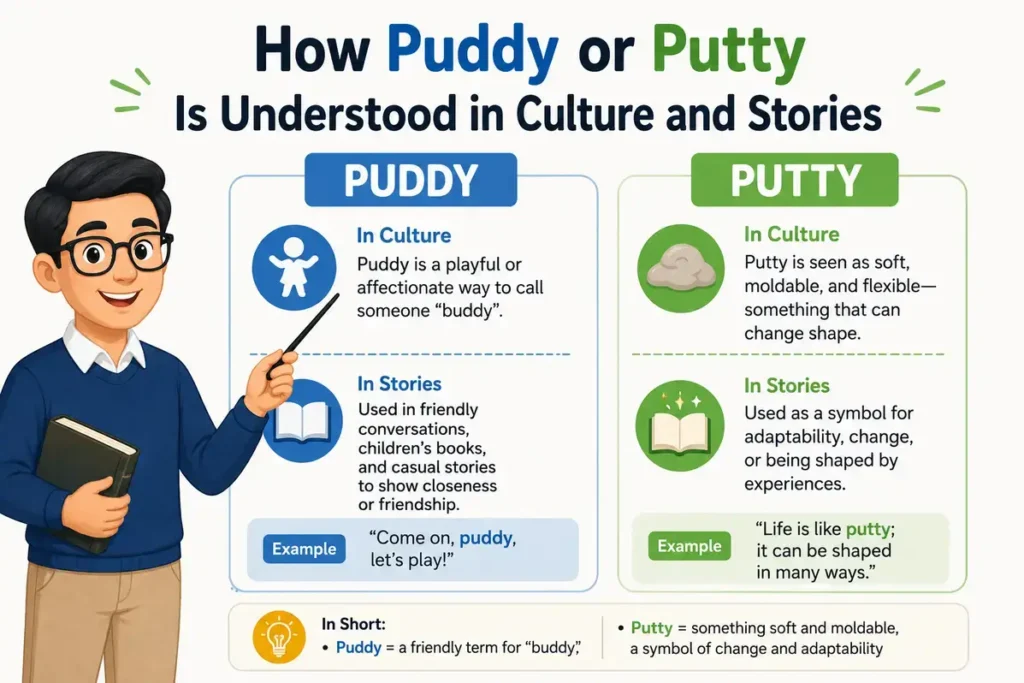
How Puddy or Putty Is Understood in Culture and Stories
When people hear the word putty, they usually think about repairs, building work, or fixing something that is broken. Because putty is soft and easy to shape, it has also become a symbol in stories and everyday speech. Writers often use putty to describe something that can be changed or molded. For example:
- His opinion was like putty.
- The child was like putty in her grandmother’s hands.
These examples do not talk about the actual repair material. Instead, they describe a person or idea that can be influenced easily. In movies and books, soft materials often represent flexibility. They can change shape without breaking. Because putty is one of those materials, it sometimes appears as a symbol of change and adaptation.
The spelling puddy does not have the same cultural meaning. Most people simply see it as a mistaken spelling of putty. That is why discussions almost always focus on spelling rather than meaning. In everyday culture, putty is connected with:
- Repairing things
- Fixing problems
- Making improvements
- Shaping something into a better form
- Flexibility and change
These ideas help explain why the word appears in many expressions and comparisons.
Puddy vs Putty in Biblical and Mythological Meaning
There is no major biblical meaning attached directly to putty. The word itself is mainly connected to construction and repair work. However, some people compare putty to other soft materials mentioned in religious writings, such as clay. In the Bible, clay is sometimes used as a symbol of something that can be shaped by a creator.
Because putty is also soft and moldable, some readers make a loose comparison between the two materials. This comparison is symbolic rather than literal. In mythology, putty does not play an important role. Ancient stories usually mention materials like clay, stone, gold, or wood instead.
So if you are studying there is no special religious rule connected to choosing the correct spelling. The standard English form remains putty.
Symbolism Explained in Simple Words
What Putty Represents
When people use putty symbolically, it often represents:
- Flexibility
- Change
- Adaptation
- Improvement
- Repair
- Influence
Think about a piece of putty in your hand. You can shape it into many forms. You can press it, stretch it, and smooth it. Because of this, people sometimes compare putty to someone who is open to change. Example: “She was like putty in her coach’s hands.”
This means she listened carefully and accepted guidance easily. Putty can also symbolize fixing problems. A damaged wall can be repaired with putty. Because of this, the word sometimes suggests healing, improvement, or making something better.
What Puddy Represents
When discussing the word puddy usually does not carry a separate symbolic meaning. Most of the time, it simply represents:
- A spelling mistake
- A pronunciation-based spelling
- Informal writing
- A misunderstanding of the correct word
Unlike putty, it does not have a widely accepted dictionary meaning. That is why writers, teachers, and editors recommend using putty.
Symbolism Comparison
| Word | Common Symbolic Meaning |
|---|---|
| Putty | Flexibility, repair, change, improvement |
| Puddy | Usually viewed as a misspelling |
This simple comparison helps show why one form is accepted and the other is generally avoided.
Related Words You Should Know
Learning related words can make the meaning easier to remember.
Clay
A soft natural material used to make pottery and sculptures.
Sealant
A material used to block air, water, or gaps.
Filler
A substance used to fill holes or cracks.
Compound
A material made from several ingredients mixed together.
Caulk
A soft sealing material often used around windows and bathrooms.
Repair
The act of fixing something that is damaged.
Patch
A small repair applied to a damaged area.
Moldable
Easy to shape or form.
Flexible
Able to bend or change without breaking.
Smooth
Even and flat without rough spots. These words often appear in discussions about putty, home repairs, and building materials.
How People Actually Use Puddy and Putty in Daily English
Most English speakers use putty in practical situations. Here are some natural examples you may hear.
- “Can you buy some putty from the hardware store?”
- “The window needs new putty before winter.”
- “I used putty to fill the nail holes.”
- “This putty dries faster than the old one.”
- “Spread the putty evenly across the crack.”
- “The repair kit came with putty.”
- “The painter applied fresh putty before painting.”
- “That old putty is starting to crumble.”
- “The carpenter smoothed the putty carefully.”
- “Use a little putty to fix that small gap.”
You may occasionally hear someone say “puddy” when speaking. That usually happens because of pronunciation. For example:
- “Pass me the puddy.”
This is one of the biggest points to remember when studying .
Common Mistakes People Make
Many learners make the same mistakes. Here are the most common ones.
Mistake 1: Spelling It How It Sounds
❌ I bought some puddy.
✅ I bought some putty.
Many English words are not spelled exactly as they sound.
Mistake 2: Assuming Both Spellings Are Equal
✅ Putty is the standard spelling.
The dictionary form is putty.
Mistake 3: Using Puddy in Professional Writing
❌ The worker applied puddy around the frame.
✅ The worker applied putty around the frame.
Business writing, school assignments, and articles should use putty.
Mistake 4: Confusing Pronunciation With Spelling
Many people hear a soft “d” sound and think the word should contain a letter D. English pronunciation does not always work that way.
Mistake 5: Copying Informal Spellings Online
Social media posts sometimes contain spelling mistakes. Always double-check the dictionary spelling before using a word in formal writing.
Final Teacher Explanation of Puddy or Putty
Imagine you are sitting in a classroom and asking me which word is correct. My answer would be very simple. Putty is the correct English word. It refers to a soft material used to fill cracks, seal gaps, and repair surfaces. The word puddy usually appears because people write the word the way they hear it spoken. Many English speakers pronounce “tt” with a sound that resembles “d. That pronunciation can create confusion, but it does not change the correct spelling.
A good way to remember this is: If you are writing, choose putty. Think of the two Ts in the middle of the word. That spelling is accepted in dictionaries, schools, books, and professional writing. Whenever you see the question, remember that putty is the standard answer.
Final Answer
If you are choosing between use putty.
Putty is the correct dictionary spelling and the standard form in English.
Puddy is usually a spelling mistake based on pronunciation.
For correct writing, always choose putty.
You may also want to read Afterward vs Afterword: Complete English Guide 2026.
Conclusion
The confusion between words comes from pronunciation. Many English speakers say the word in a way that sounds like “puddy,” but the correct spelling remains putty. This word refers to a soft material used for repairs, filling cracks, and sealing gaps.
When writing emails, school assignments, articles, reports, or social media posts, choose putty. It is the accepted dictionary form and the spelling used throughout standard English. If you remember one thing from this guide, remember this simple rule: putty is correct.
Frequently Asked Questions (FAQs)
Is putty the correct spelling?
Yes. Putty is the standard English spelling.
Is puddy a real word?
Usually no. It is most often a misspelling of putty.
Why do people write puddy?
Many people spell it the way they hear it pronounced.
Can I use puddy in formal writing?
No. Formal writing should use putty.
What does putty mean in simple words?
It is a soft material used to fill holes, cracks, and gaps.
Why does putty sound like puddy?
In some accents, the “tt” sound is pronounced similarly to a soft “d.”
How can I remember the correct spelling?
Remember that the correct word has two Ts: putty.
