
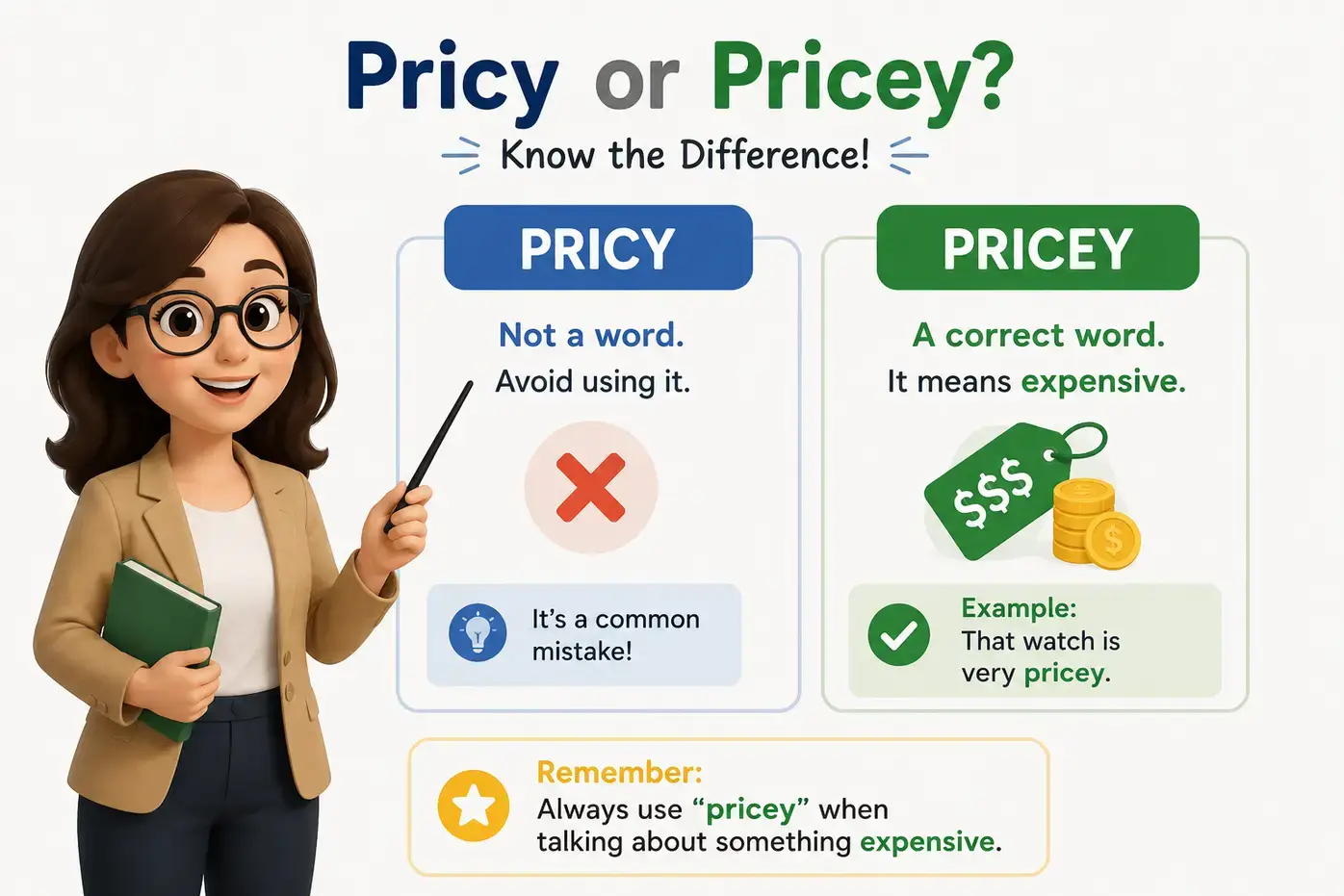
Have you ever stopped while writing and wondered, “Should I use pricy or pricey?” You are not alone. Many English learners and even native speakers get confused by this spelling question. The good news is that the answer is simple once you understand the rule.
The debate about pricy or pricey comes up often because both words look like they should be correct. They sound the same when spoken aloud. However, only one spelling is widely accepted in standard English writing.
In this guide, you will learn the difference between which form is correct, why people mix them up, and how to use the right word with confidence in everyday conversations and writing.
For another common grammar confusion, see Busing or Bussing: Which Spelling Is Correct?.
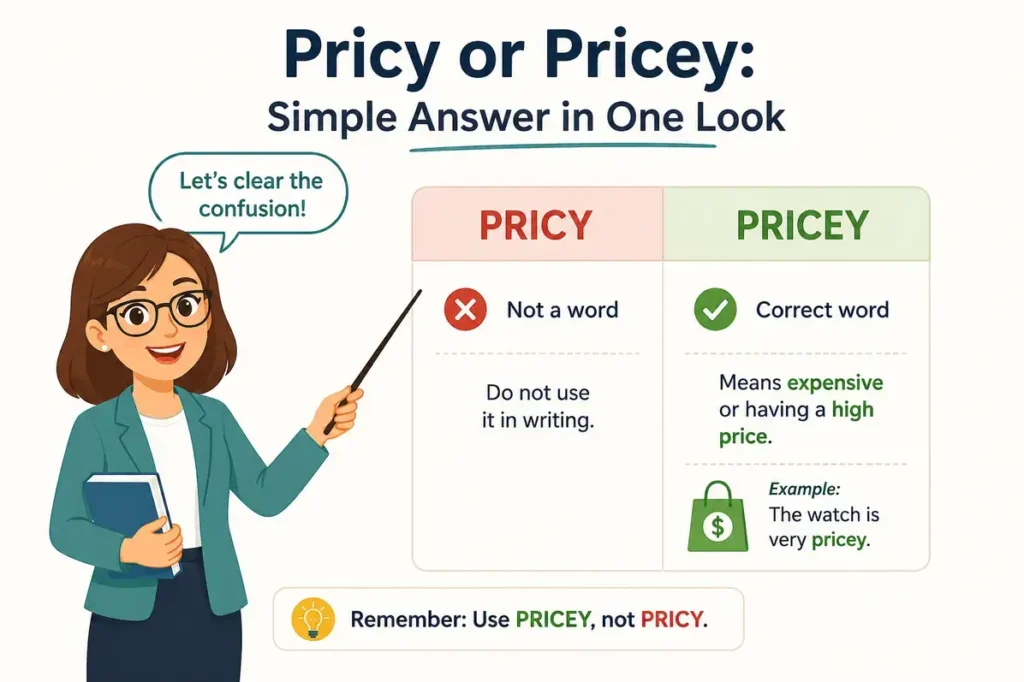
Pricy or Pricey: Simple Answer in One Look
Pricey is the correct and standard spelling. Pricy is also recognized by some dictionaries, but pricey is much more common and preferred in modern English. If you want the safest choice for school, work, or professional writing, use pricey.
What Does Pricy or Pricey Mean in Simple English?
The word pricey means something costs a lot of money. In other words, it is another way to say that something is expensive.Imagine you walk into a store and see a pair of shoes that costs $500. You might say: “Those shoes are really pricey.” You are simply saying that the shoes cost more money than you expected or wanted to pay.
Simple definition:
Pricey = expensive or costing more than expected.
People often use this word in casual conversations because it sounds more friendly than the word expensive. For example:
- “This restaurant is a bit pricey.”
- “That phone looks nice, but it’s too pricey for me.”
- “Hotels near the beach can get pricey during summer.”
In each example, pricey means that the price is high.
Synonyms for pricey
Here are some words with similar meanings:
- Expensive
- Costly
- High-priced
- Overpriced
- Premium-priced
Among these choices, expensive is the most common synonym.
Why Do People Mix Pricy or Pricey
Many people become confused because both spellings seem logical. Here are the main reasons this happens.
1. Both words sound exactly the same.
When people hear the word in conversation, they cannot tell if the spelling ends with -y or -ey. For example:
- pricey → sounds like
- pricy → sounds like
Since the pronunciation is identical, writers often guess the spelling.
2. English spelling is not always predictable.
English has many words that follow different spelling patterns. For example:
- spice → spicy
- ice → icy
- juice → juicy
After seeing these examples, many people assume that price should become pricy. That assumption makes sense. However, language does not always follow one perfect pattern.
3. Some dictionaries list both spellings.
Another reason for confusion is that a few dictionaries recognize pricy as a variant spelling. This causes people to think both forms are equally common. In reality, pricey appears far more often in books, articles, websites, and everyday writing.
4. Autocorrect may not always help.
Different writing tools have different language settings. Some spell-checkers accept pricy, while others suggest changing it to pricey. As a result, people continue asking which form they should trust.
Pricy or Pricey: Clear Difference Explained Simply
When comparing both the difference is mostly about preference and usage frequency.
| Word | Is It Correct? | Common in Modern English? | Best Choice? |
|---|---|---|---|
| Pricy | Sometimes accepted | Less common | No |
| Pricey | Yes | Very common | Yes |
Think of it this way:
- Pricey = the standard and safer option.
- Pricy = an alternative spelling that is much less common.
If you are writing:
- school assignments,
- blog posts,
- business emails,
- professional documents,
- social media content,
choose pricey.
Quick memory tip for Pricy or Pricey
The word pricey keeps more of the original word price.
Price → Pricey
This simple trick can help you remember the preferred spelling.
Which Form Should You Use?
The short answer is easy.
Use “pricey.”
It is the spelling that most readers expect to see. Writers, teachers, editors, and publishers usually prefer pricey because it looks more familiar.
When should you avoid “pricy”?
You do not necessarily have to avoid it completely. However, it may distract some readers because they are less used to seeing it. For example, imagine reading these two sentences:
- “The apartment was surprisingly pricey.”
- “The apartment was surprisingly pricy.”
Most English speakers will find the first sentence more natural.
A simple rule to remember
Ask yourself:
Do I want the spelling that almost everyone recognizes immediately?
If the answer is yes, choose pricey.
What do style guides recommend?
Most professional editors favor pricey because it is the dominant spelling in published English. This makes it the better option for:
- Academic writing
- Professional communication
- Website content
- Marketing materials
- Articles and reports
Easy Real-Life Sentences You Can Use for Pricy or Pricey
The best way to remember a word is to see it in everyday situations. Here are some examples using pricey correctly.
- This coffee shop is a little pricey, but the drinks are delicious.
- I wanted that jacket, but it was too pricey for my budget.
- The hotel looked beautiful, although it was quite pricey.
- New smartphones can be very pricey when they first come out.
- We found a cheaper restaurant because the first one seemed too pricey.
- Plane tickets become pricey during holiday seasons.
- That designer bag is nice, but it is definitely pricey.
- Houses in that neighborhood are getting more pricey every year.
Practice activity
Which sentence sounds better?
A. The concert tickets were pricy.
B. The concert tickets were pricey.
Best answer: Sentence B.
Even though some people may use Sentence A, Sentence B follows the more widely accepted spelling.
Where Pricy or Pricey Comes From (Simple History)
The word pricey developed from the noun price, which refers to the amount of money needed to buy something. Over time, English speakers added the ending -y to create an adjective describing things with high prices.
The word began appearing in informal English many years ago and gradually became a normal part of everyday speech. People liked using pricey because it sounded less formal than expensive. Compare these examples:
- “The car is expensive.”
- “The car is pricey.”
Both sentences have the same meaning. However, pricey often feels more conversational and relaxed.
Why does “pricy” exist?
As the word spread, some writers naturally spelled it as pricy because it matched patterns found in other English words. Over time, dictionaries noticed this usage and recorded it as a variant spelling. Still, pricey remained the dominant choice. That is why language experts generally recommend using pricey whenever possible.
As you continue learning English, you will notice that some words have accepted variants. The key is understanding which form readers expect most often. the answer becomes much easier: Pricey is the spelling you should choose in most situations.
Transitioning from simple spelling choices to deeper language understanding can help you become a stronger writer. In the next section, we will look at how native speakers use this word in different contexts, common mistakes people make, and how vocabulary choices can shape the way your message is received by a larger audience.
How Is Pricy or Pricey Understood in Culture and Stories?
Words that describe money often carry emotional meaning. The discussion around pricy or pricey is not only about spelling. It also reflects how people feel about spending money. In everyday American culture, calling something pricey usually means two things:
- The item costs more than expected.
- The speaker is thinking carefully about the value of the purchase.
For example, someone might say: “That vacation package is a little pricey.” This does not always mean they cannot afford it. Instead, they may simply feel that the cost is higher than they hoped. In movies, books, and television shows, characters often use pricey when discussing luxury items such as:
- Designer clothing.
- Expensive restaurants.
- Large houses.
- Fancy vacations.
- New technology.
The word has a slightly casual tone. It sounds less serious than saying extremely expensive. For instance:
- “That watch is expensive.” (More formal.)
- “That watch is pretty pricey.” (More conversational.)
Because of this friendly tone, pricey appears often in daily speech.
For another common grammar confusion, see Loot vs Lute: Ultimate Difference Guide 2026.
Biblical and Mythological Meaning of Pricy or Pricey (If Applicable)
These words does not have direct biblical meanings. They are modern English terms related to cost and value. However, many religious and mythological stories teach lessons about money and wise choices. Common themes include:
- Avoiding greed.
- Using resources wisely.
- Understanding that some things are more valuable than money.
- Appreciating kindness and relationships over possessions.
In simple terms, pricey describes a high cost. It does not suggest that buying expensive things is right or wrong. The meaning stays neutral. For example: “The necklace was pricey.” This sentence only tells us about the cost. It does not judge the person’s decision.
Symbolism Pricy or Pricey Explained in Simple Words
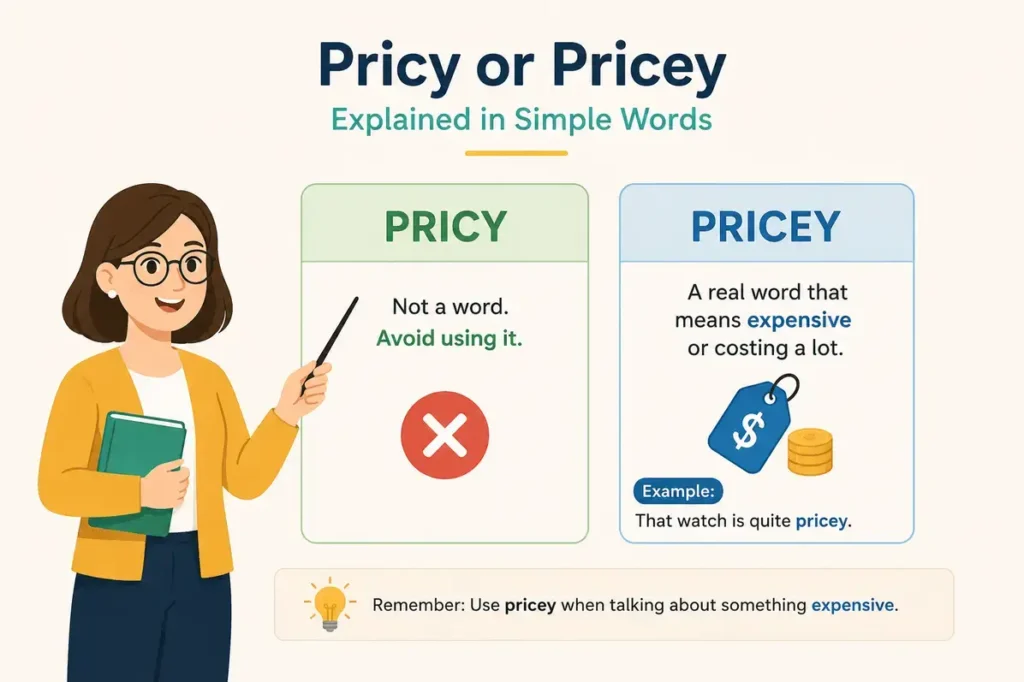
Although mainly concerns with spelling, people sometimes connect these words with ideas about money and lifestyle.
What Does Pricey Represent?
The standard spelling pricey often represents:
- High quality.
- Luxury experiences.
- Careful spending decisions.
- Special occasions.
- Premium products.
Examples:
- A pricey wedding dress.
- A pricey hotel with ocean views.
- A pricey smartphone with advanced features.
The word can carry both positive and negative feelings.
Positive:
“The meal was pricey, but it was amazing.”
Negative:
“The repair bill was too pricey for my budget.”
What Does Pricy Represent?
The spelling pricy usually represents the same idea because it has the same meaning. However, readers may interpret it differently because it is less common. Some people may think:
- It looks unusual.
- It appears less polished.
- It may be a spelling mistake.
That is why many writers choose pricey instead.
Simple Comparison
| Version | Symbolic Feeling |
|---|---|
| Pricey | Standard, familiar, polished |
| Pricy | Alternative, less expected |
| Both | Something that costs a lot |
The emotional meaning stays the same. The difference is mostly reader preference and spelling familiarity.
Related Words You Should Know About Pricy or Pricey
Learning related words can expand your vocabulary.
Expensive
Costs a lot of money.
Example: The concert tickets were expensive.
Costly
Usually used in formal situations.
Example: Repairing the roof was costly.
Overpriced
Costs more than something seems worth.
Example: Many tourists felt the souvenirs were overpriced.
Affordable
Reasonably priced and easier to buy.
Example: We found an affordable apartment.
Cheap
Low in price.
Example: These notebooks were surprisingly cheap.
Budget-friendly
Suitable for people trying to save money.
Example: The restaurant offers budget-friendly meals.
Premium
Higher quality and usually more expensive.
Example: They chose a premium service package.
Knowing these related terms helps you choose the right word for different situations.
How Do People Actually Use Pricy or Pricey in Daily English?
Native speakers use pricey regularly in conversations. Here are some real-life examples.
- “That new laptop looks great, but it’s a bit pricey.”
- “The restaurant was nice, although the menu was pretty pricey.”
- “Organic groceries can sometimes be pricey.”
- “I love those shoes, but they’re too pricey for me right now.”
- “Hotels near the airport are usually pricey during holidays.”
- “The concert tickets became pricey after they almost sold out.”
- “This neighborhood is beautiful, but the houses are pricey.”
- “Designer handbags are often very pricey.”
- “The mechanic’s estimate seemed a little pricey.”
- “That coffee shop is pricey, yet people keep coming back.”
Common speaking patterns
People often pair pricey with words such as:
- A bit pricey.
- Too pricey.
- Quite pricey.
- Really pricey.
- Surprisingly pricey.
These combinations sound very natural in spoken English.
Common Mistakes People Make With Pricy or Pricey
Even simple words can cause confusion. Here are mistakes many learners make.
Mistake 1: Using pricy in formal writing.
Less effective:
“The company offers pricy services.”
Better:
“The company offers pricey services.”
Mistake 2: Thinking the meanings are different.
Some people believe have separate definitions. They do not. Both mean expensive.
Mistake 3: Assuming one spelling is completely wrong.
While pricey is preferred, pricy does appear in some dictionaries. The issue is usage preference, not meaning.
Mistake 4: Using pricey for every expensive situation.
Sometimes another word works better. For example:
Formal report:
“The project was costly.”
Casual conversation:
“The project was pretty pricey.”
Easy correction tip
Remember this sentence: When in doubt, choose pricey. That simple rule will help you avoid most mistakes.
Final Teacher Explanation About Pricy or Pricey
Imagine you are sitting in an English classroom, and a student raises a hand and asks: “Teacher, which one is correct: pricy or pricey?” Here is the answer I would give.
Both spellings have been used by English speakers. However, pricey is the form most people recognize and expect. If you want your writing to sound natural and polished, choose pricey. You do not need to memorize complicated grammar rules. Just remember these points:
- Pricey means expensive.
- Pricey is the preferred spelling.
- Pricy exists but is less common.
- Use pricey in school, work, blogs, and everyday writing.
English can sometimes feel confusing because not every word follows a perfect pattern. That is normal. The goal is not perfection. The goal is clear communication. By choosing pricey, you make your meaning easy for readers to understand.
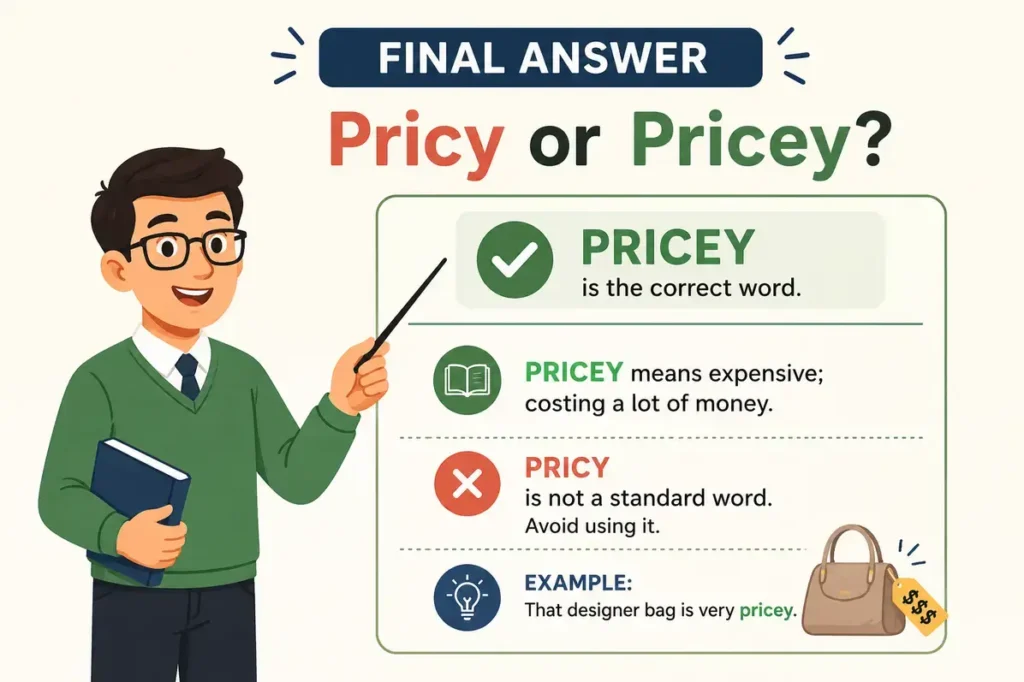
Final Answer: Pricy or Pricey
If you choose pricey. It is the standard spelling used by most writers and readers. Both forms mean expensive, but pricey is the safer and more natural choice for everyday and professional English.
Frequently Asked Questions (FAQs)
Is it correct?
Pricey is the preferred spelling. Pricy is less common but sometimes accepted as a variant.
What does pricey mean in simple words?
It means expensive or costing more money than expected.
Why do people get confused between pricy or pricey?
Both words sound exactly the same, and English spelling patterns can be inconsistent.
Can I use pricy in writing?
You can, but pricey is usually the better choice because most readers recognize it immediately.
Is pricey formal or informal?
Pricey is slightly informal and conversational. It works well in everyday writing and speech.
What is another word for pricey?
Common alternatives include expensive, costly, high-priced, and overpriced.
Should students use pricey or pricy in assignments?
Students should use pricey because it is the standard spelling preferred by teachers and editors.
Do pricy and pricey have different meanings?
No. Both words mean the same thing. The main difference is that pricey is much more widely used.
Many readers also check Until or Untill: Easy Guide with Examples.
Conclusion
The question of pricy or pricey may seem small, but understanding the difference can improve your confidence as an English writer. The good news is that the rule is easy to remember. Both spellings refer to something that costs a lot of money. However, pricey is the version that appears more often in books, articles, websites, and everyday communication.
If you ever pause while writing and wonder which form to choose, think of this simple classroom rule: When you mean expensive, write pricey. That one choice will help your English sound more natural, polished, and easy for readers to understand.
