
Many people get confused about implicit vs complicit because the two words look and sound a little alike. They also appear in news stories books school lessons and everyday conversations. Even though they are similar in spelling they have very different meanings.
The good news is that learning much easier than most people think. Once you know what each word means you will never wonder which one fits your sentence. A simple memory trick can help you remember the difference for years.
In this guide you will learn the meaning of each word the difference between them when to use each one and plenty of easy examples. By the end you will feel confident every time you see or use these words.
A related grammar guide is Cryer vs Crier: Avoid This Common Spelling Mistake.
Simple Answer in One Look
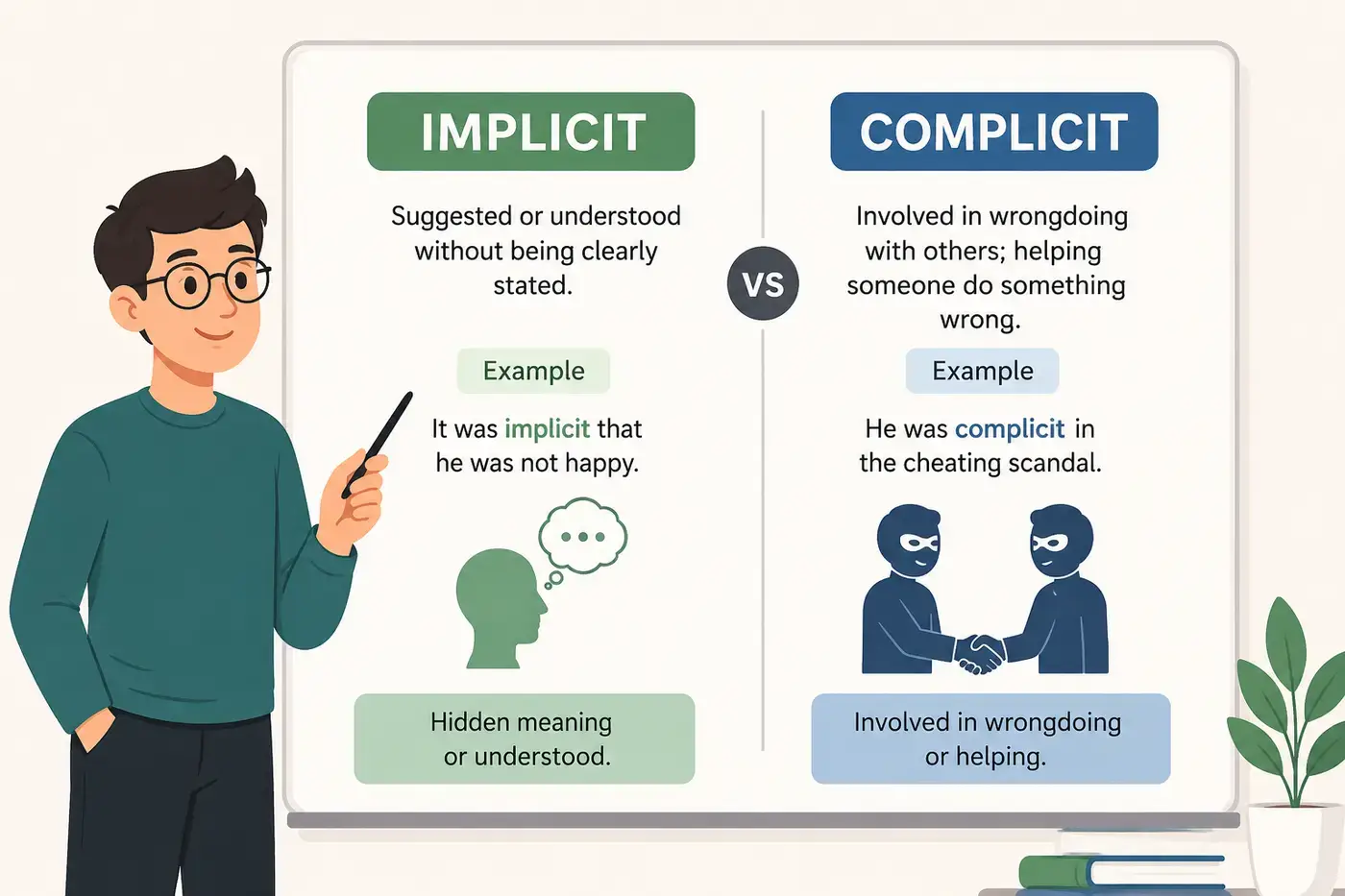
Implicit means something is understood without being said directly.
Complicit means someone is involved in doing something wrong or helping it happen.
Simple rule:
- Implicit = Hidden meaning.
- Complicit = Helping with wrongdoing.
That is the biggest difference.
What Implicit vs Complicit Means in Simple English
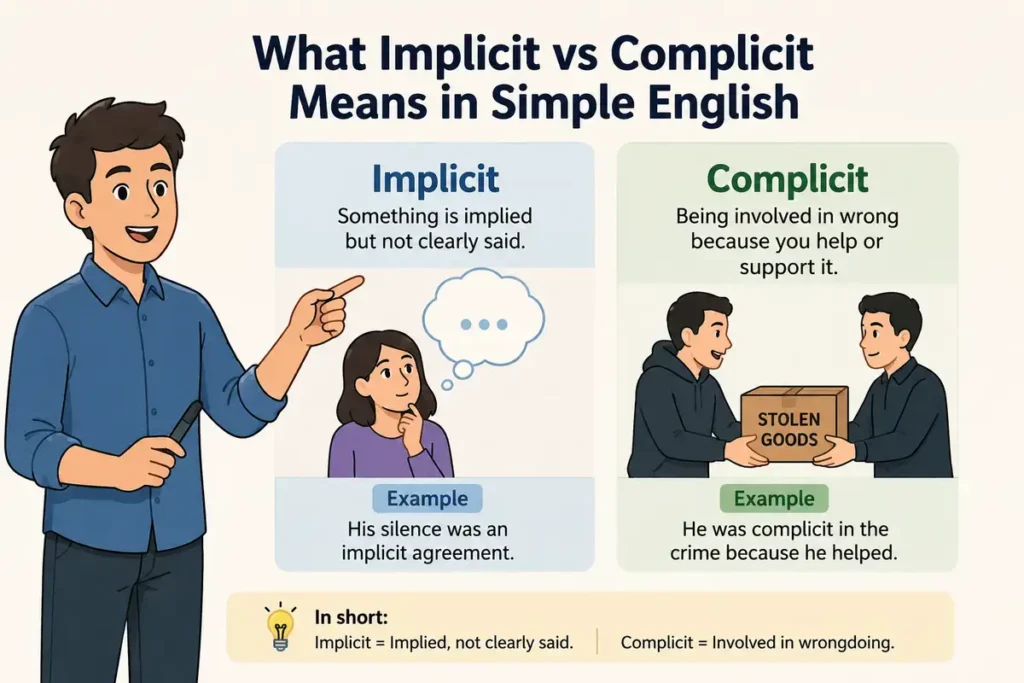
Imagine your teacher smiles and points to the classroom door without saying anything. You understand that she wants you to close it. She never said the words but you still understood the message. That is implicit. An implicit message is not spoken clearly. People understand it from actions clues or the situation. Here are simple examples.
- His answer gave implicit support for the plan.
- There was an implicit promise that everyone would be treated fairly.
- The rules were implicit even though nobody explained them.
Now think about a different situation. A student sees a friend cheating on a test. Instead of stopping it the student helps hide the answers. That student is complicit. Being complicit means helping with something wrong or allowing it to happen when you play a part in it. Here are simple examples.
- She was complicit in the theft.
- He became complicit by hiding the truth.
- The workers were complicit in the dishonest plan.
Notice how these words belong to very different ideas. Implicit is about meaning. Complicit is about actions connected to wrongdoing. That simple idea makes much easier to remember.
Why People Mix these words
Many English learners and even native speakers confuse these words. Here are the biggest reasons.
They Look Almost the Same
Both words end with licit. When people read quickly they may not notice the different beginning.
- implicit
- complicit
Their similar spelling makes mistakes common.
They Sound Similar
Both words have almost the same rhythm.
When someone hears them in conversation they may not catch the first part of the word.
Both Are Common in News Stories
You often hear these words in reports about politics business law and social issues. For example someone may say:
- There was implicit support for the policy.
- Several people were complicit in the crime.
If you do not know both meanings these sentences can seem confusing.
They Both Describe Something That Is Not Obvious
This is another reason people mix them up.
An implicit message is hidden.
A complicit person may secretly help with something wrong.
Since both ideas are not always easy to see people sometimes think the words mean the same thing.
They do not.
People Guess Based on Similar Spelling
When readers are unsure they often guess.
That guess can lead to mistakes like these.
❌ He was implicit in the crime.
✅ He was complicit in the crime.
❌ She gave complicit approval.
✅ She gave implicit approval.
These mistakes happen because the words look alike but have different meanings.
Clear Difference Explained Simply
Here is the easiest way to compare.
| Implicit | Complicit |
|---|---|
| Means understood without being spoken. | Means involved in wrongdoing. |
| Describes ideas messages or meaning. | Describes people and their actions. |
| Usually not negative. | Almost always negative. |
| Connected with hidden meaning. | Connected with guilt or responsibility. |
| Example: An implicit agreement. | Example: A complicit partner. |
You can also remember it like this.
Implicit asks: What is being understood?
Complicit asks: Who helped with something wrong?
That simple question often gives you the correct answer right away.
Quick Comparison
Implicit
- Hidden meaning.
- Silent understanding.
- Not directly stated.
- Often about communication.
Complicit
- Helping wrongdoing.
- Sharing responsibility.
- Taking part in something dishonest.
- Often about behavior.
This comparison makes the difference between very clear.
Which Form Should You Use?
A simple question will help you choose the right word every time.
Are You Talking About Meaning?
Use implicit. Examples:
- There was an implicit warning.
- We had an implicit understanding.
- Her smile gave implicit approval.
Are You Talking About Wrongdoing?
Use complicit. Examples:
- He was complicit in the fraud.
- They became complicit by staying silent.
- She was complicit in hiding the evidence.
Easy Memory Trick
Think about the first letters.
Implicit starts with IM.
Think:
IM = Implied meaning.
Now look at the other word.
Complicit starts with COM.
Think:
COM = Companion in wrongdoing.
The memory trick does not explain the history of the words but it makes choosing between them much easier.
Another Easy Test
Ask yourself this question.
Can I replace the word with “implied”?
If yes use implicit. Example:
The agreement was implicit.
The agreement was implied.
That works.
Now try the second word.
He was complicit in the crime.
He was implied in the crime.
That does not work.
So complicit is correct.
Easy Real Life Sentences You Can Use
These examples sound natural in everyday English.
- There was an implicit rule to be kind to everyone.
- Her smile gave implicit permission to begin.
- We had an implicit agreement to meet after school.
- He became complicit by helping hide the mistake.
- She refused to be complicit in the dishonest plan.
- The manager stayed quiet but his support seemed implicit.
- Nobody wanted to become complicit in breaking the rules.
- The family had an implicit understanding that dinner was at six.
Read these sentences aloud.
Notice that implicit always talks about ideas messages or understanding.
Notice that complicit always talks about helping with something wrong.
That pattern makes the difference much easier to remember.
Where these Words Expression Comes From Simple History
The story behind these words is interesting but also easy to understand. Implicit comes from a Latin word that means folded into or included without being shown openly. Over time English speakers used it to describe ideas that are understood without being spoken directly.
That is why an implicit message is hidden inside the situation instead of being clearly stated. Complicit also comes from Latin. Its older meaning was connected with being joined together. Later English speakers began using it for people who share responsibility in something wrong.
Today the word almost always has a negative meaning. Even though these words share part of their spelling they followed different paths and developed different meanings. That is why it is a common question for English learners. One word is about hidden meaning. The other is about shared guilt. Knowing this simple history can make the meanings easier to remember.
As you can see the difference between is not just about spelling. Each word carries its own idea and is used in different situations. In the next section you will learn how these words appear in culture stories news everyday conversations and common English expressions. You will also discover simple memory tricks common mistakes and expert tips that make choosing the correct word feel natural every time.
How Is Understood in Culture and Stories
The difference between implicit vs complicit becomes even clearer when you look at stories movies and everyday life. An implicit message is something the audience understands without anyone saying it. Writers and filmmakers use this all the time. A character may smile look away or stay silent. The audience understands the feeling without hearing any words.
For example a father quietly puts his coat over his sleeping child. He never says “I love you.” His love is implicit because it is shown through his actions.
Now think about complicit. This word often appears in crime stories mystery books and history lessons. A person may not steal anything with their own hands but they help hide the truth. That person becomes complicit because they helped the wrong action continue. Here are two simple examples.
Implicit example
A friend keeps your secret without talking about it. There is an implicit promise of trust.
Complicit example
A friend helps another student cheat during a test. That friend is complicit in cheating.
Stories often teach us that hidden kindness is good but helping wrongdoing has serious results. That simple idea helps you remember.
Many readers also check Gradual vs Insidious: Easy Guide with Real-Life Sentences.
Biblical And Mythological Meaning Of Implicit Vs Complicit
The Bible does not use the modern words implicit and complicit very often. Still the ideas behind them appear in many stories.
Implicit In Biblical Ideas
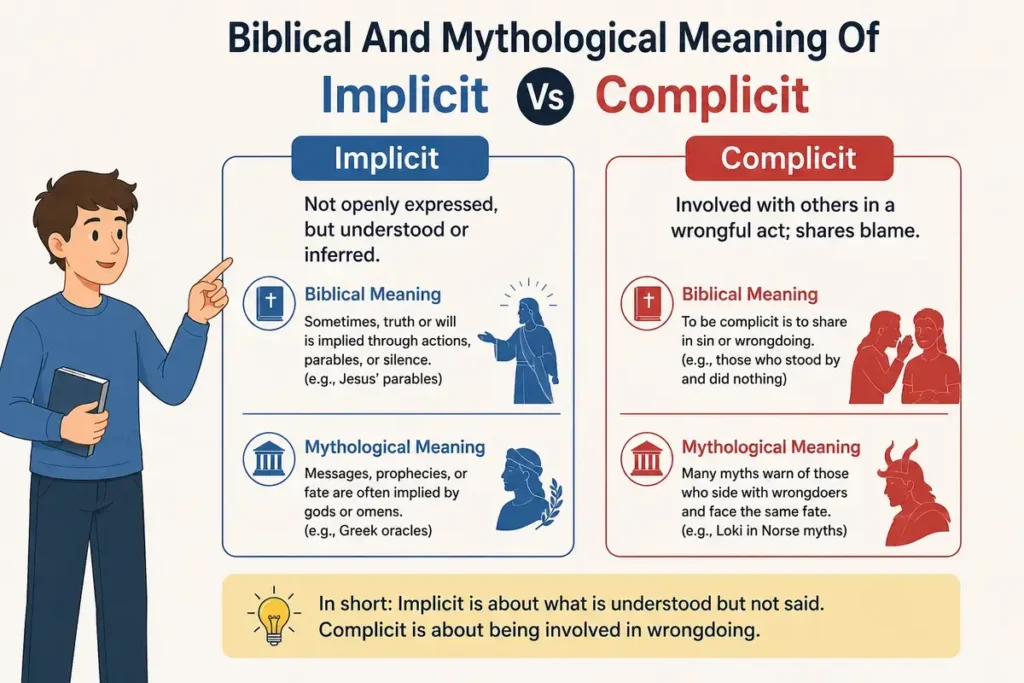
Many Bible stories contain implicit lessons. For example Jesus often taught through parables. Sometimes He explained the lesson directly. Other times readers understood the deeper meaning by thinking carefully. The message was not always spoken in one simple sentence. It was often implicit.
Complicit In Biblical Ideas
The idea of being complicit appears more clearly. Many stories show people helping or supporting actions they knew were wrong. For example someone may stay silent while another person does something evil. Even without doing the wrong action themselves they still share some responsibility. The lesson is simple. Doing nothing when you can stop wrongdoing may make you complicit.
Mythology
Many myths from different cultures also show these ideas. Heroes often receive implicit signs instead of direct instructions. Villains sometimes have helpers who become complicit because they choose to support evil actions. These stories remind us that choices matter.
Symbolism Explained In Simple Words
What Implicit Represents
When people think about implicit they often connect it with quiet understanding. It can represent:
- Trust.
- Respect.
- Hidden meaning.
- Silent agreement.
- Care shown through actions.
- Wisdom that does not need many words.
For example a hug can give implicit comfort without anyone speaking.
What Complicit Represents
Complicit usually represents something very different. It often stands for:
- Shared guilt.
- Wrong choices.
- Helping dishonesty.
- Ignoring what is right.
- Responsibility for bad actions.
For example someone who knows about bullying but encourages it becomes complicit.
Simple Comparison
| Implicit | Complicit |
|---|---|
| Hidden understanding | Shared wrongdoing |
| Quiet communication | Helping something wrong |
| Often positive or neutral | Nearly always negative |
| Based on meaning | Based on actions |
When you remember these ideas choosing between those words becomes much easier.
Related Words You Should Know
Learning similar words helps you understand both words even better.
Implied
Something suggested without saying it directly.
Example: His smile implied that everything was okay.
Unspoken
Not said aloud but understood.
Example: There was an unspoken rule to wait your turn.
Assumed
Believed without needing proof.
Example: Everyone assumed the meeting would start at nine.
Silent
Done without speaking.
Example: They gave silent support to the team.
Involved
Taking part in something.
Example: She was involved in the school project.
Responsible
Being answerable for your actions.
Example: He was responsible for cleaning the room.
Guilty
Having done something wrong.
Example: The guilty player admitted the mistake.
Accomplice
A person who helps another person commit a crime.
Example: The thief escaped with an accomplice.
These related words make your English vocabulary stronger.
How People Actually Use it In Daily English
Here are real examples you might hear.
- We had an implicit agreement to split the bill.
- Her smile gave implicit permission to continue.
- The teacher gave an implicit reminder by pointing at the clock.
- Nobody wanted to become complicit in spreading rumors.
- He was complicit because he helped hide the truth.
- She refused to stay complicit in the dishonest business.
- There was an implicit expectation that everyone would help clean up.
- The workers were not complicit because they reported the problem.
- His silence gave implicit support to the idea.
- I never want to be complicit in hurting someone else.
These examples show how the words fit naturally into everyday English.
Common Mistakes People Make
These mistakes happen often.
Mistake One
❌ He was implicit in the crime.
✅ He was complicit in the crime.
A crime involves wrongdoing so complicit is correct.
Mistake Two
❌ She gave complicit approval.
✅ She gave implicit approval.
Approval can be suggested without being spoken.
That makes implicit the right word.
Mistake Three
Thinking both words mean the same thing.
They do not.
Implicit is about meaning.
Complicit is about helping wrongdoing.
Mistake Four
Using complicit for everyday teamwork.
❌ We were complicit in finishing the project.
✅ We worked together to finish the project.
The word complicit should only be used when something wrong happened.
Mistake Five
Forgetting the emotional difference.
Implicit is usually neutral.
Complicit is almost always negative.
Remembering this emotional difference makes the correct choice much easier.
Final Teacher Explanation Of Implicit Vs Complicit
Imagine you are sitting in my classroom. I write two words on the board.
Implicit
Complicit
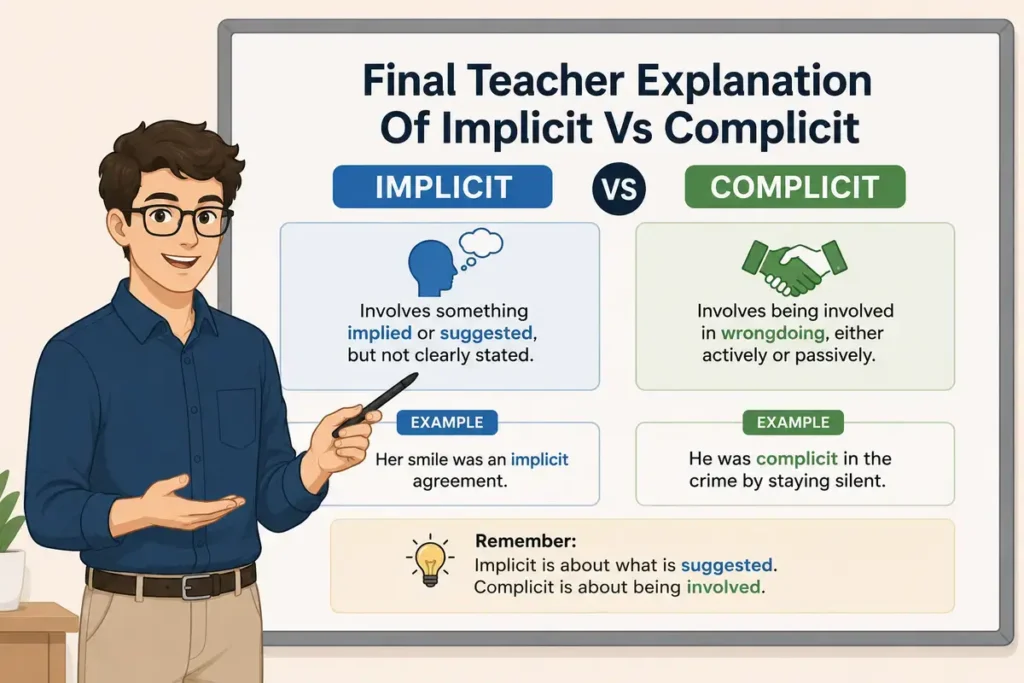
Then I ask one easy question. Are we talking about a meaning or about wrongdoing? If the answer is meaning use implicit. If the answer is wrongdoing use complicit. That is the easiest rule you will ever learn for these words. Do not worry that they look alike.
Many English learners make the same mistake at first. After reading enough examples your brain starts to notice the difference automatically. Whenever you read a book watch the news or hear these words in conversation ask yourself the same simple question. Meaning or wrongdoing? That one question will guide you to the correct answer almost every time.
Final Answer About Implicit Vs Complicit
The difference between implicit vs complicit is simple once you know the main idea. Implicit means something is understood without being said directly. Complicit means someone helps with or shares responsibility for something wrong. Remember this easy rule.
Implicit equals hidden meaning.
Complicit equals shared wrongdoing.
You can use that rule with confidence in both speaking and writing.
A related grammar guide is Is It Gray or Grey? Simple Difference and Correct Usage (2026).
Conclusion
Understanding the difference between is easier once you know what each word means. Implicit describes something that is suggested or understood without being said directly. Complicit describes someone who is involved in or helps with wrongdoing, even if they are not the main person responsible.
Although these words sound similar, they have completely different meanings and should never be used in place of each other. If you are talking about hidden ideas or unspoken messages, use implicit. If you are talking about someone who shares responsibility for a bad action, use complicit.
A simple way to remember the difference is this: implicit is about meaning, while complicit is about involvement. Keeping this rule in mind will help you choose the correct word every time and make your writing clearer and more accurate.
Frequently Asked Questions
What does implicit mean in simple words?
Implicit means something is understood without being said directly.
What does complicit mean in simple words?
Complicit means helping with or sharing responsibility for something wrong.
What is the main difference?
Implicit is about hidden meaning. Complicit is about helping wrongdoing.
Why do people confuse?
They look alike and sound similar, but they have completely different meanings.
Can I use implicit and complicit in the same sentence?
Yes. For example, His implicit approval made others complicit in the dishonest plan.
Is complicit always negative?
Almost always. It usually describes involvement in something dishonest or harmful.
Is implicit positive or negative?
It can be positive, negative, or neutral. It simply means the message is not stated directly.
Which word should I use in writing?
Use implicit for hidden meaning or silent understanding. Use complicit for helping or sharing responsibility in wrongdoing.
