
Have you ever stopped while writing and wondered about footnote before or after period placement? Many students, writers, and professionals ask this exact question. The good news is that the rule is much easier than it seems.
The question comes up because different punctuation rules exist in English writing. Some people place the footnote number before the period, while others put it after. Knowing the correct style can help your writing look polished and professional.
In this guide, you will learn the answer in simple words. We will look at why people get confused, how major style guides handle footnotes, and which form you should use in everyday writing.
Learn the difference in Suing or Sueing Explained With Easy Rules and Examples.
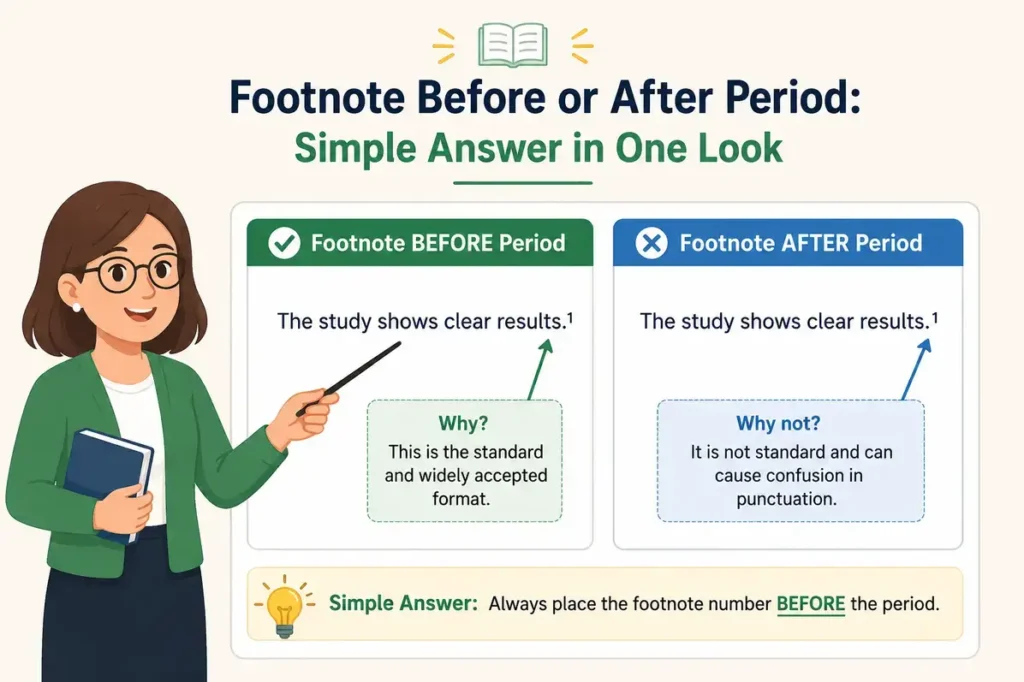
Footnote Before or After Period: Simple Answer in One Look
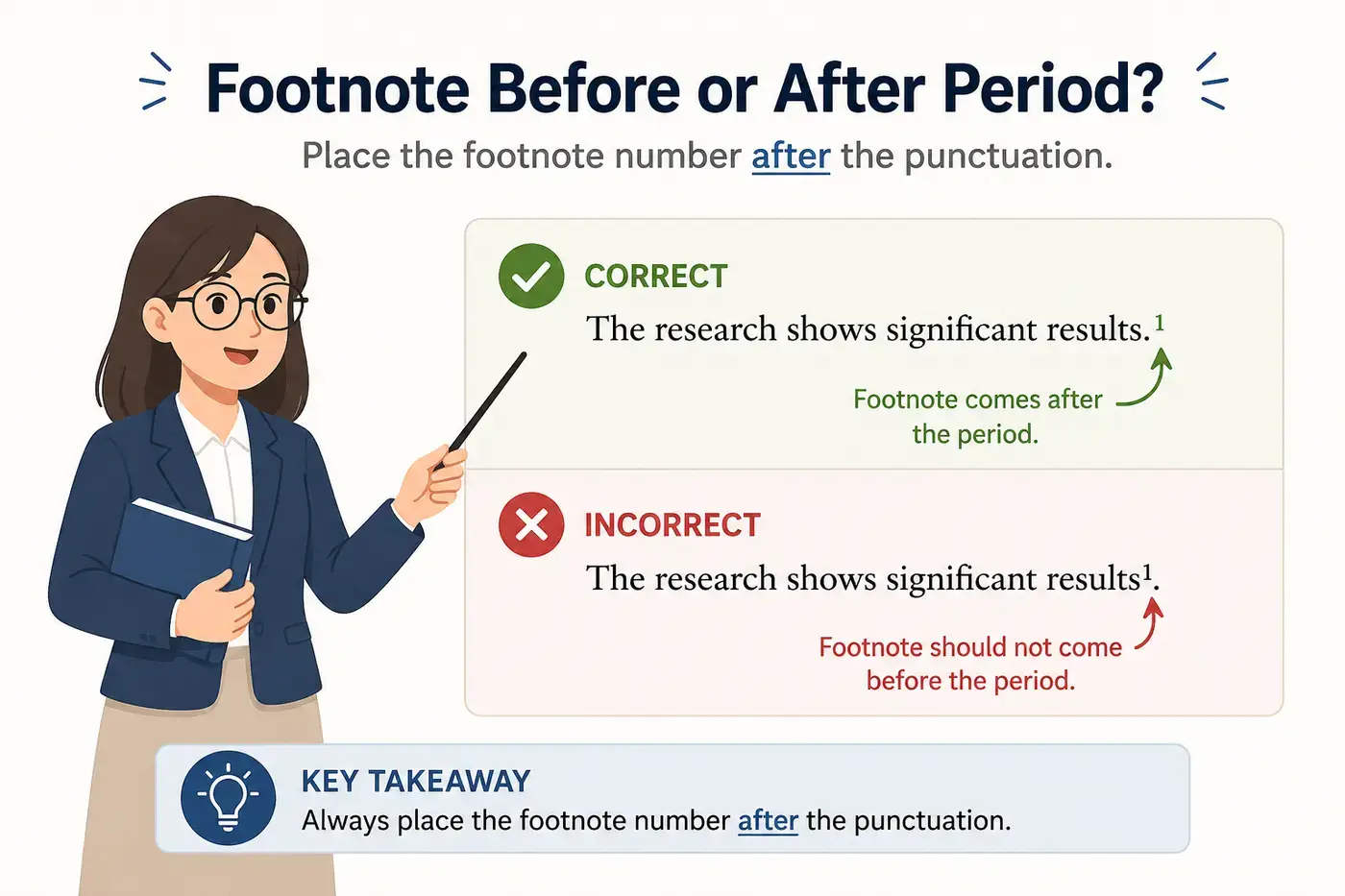
In most English writing styles, the footnote number goes after the period at the end of the sentence.
Correct:
The meeting was moved to Friday.¹
Incorrect:
The meeting was moved to Friday¹.
If your teacher, publisher, or organization uses a specific style guide, always follow that guide.
What Footnote Before or After Period Means in Simple English
A footnote is a small number that gives readers extra information. It may point to a source, explain an idea, or add details that do not fit into the main text. Think of a footnote as a tiny sign that tells readers, “There is more information waiting for you at the bottom of the page.” The question is simply asks where that tiny number should sit. Should it look like this?
The book became an instant success.¹ Or like this? The book became an instant success¹. Most of the time, the first example is correct. The period comes first. The footnote number follows it. This rule helps keep the sentence clear and easy to read.
Why do footnotes exist?
Footnotes help writers:
- Give credit to sources.
- Share extra explanations.
- Avoid making sentences too long.
- Provide facts without interrupting the main message.
Writers in history, literature, law, and academic subjects often use footnotes.
Why People Mix Footnote Before or After Period
Many people struggle because they see different examples in different places. Here are some common reasons for the confusion.
Different style guides use different rules
Schools, publishers, and organizations may follow different writing styles. For example:
- One style guide may place the note after the punctuation.
- Another style guide may have special rules for certain situations.
When students move from one writing system to another, they notice these differences.
Footnotes look very small
Footnote numbers are tiny superscript numbers. Because they are small, writers may not pay much attention to where they belong. For example:
- The concert ended early.
- The concert ended early.
At first glance, both examples might seem acceptable.
People copy what they see online
Not every website follows professional writing standards. A student may read one article that uses footnotes correctly and another that does not. Over time, this creates uncertainty.
Some writers confuse footnotes with citations
Parenthetical citations often follow different rules. For example:
- According to the report (Smith, 2024).
- The report reached the same conclusion.
Because citation systems vary, people sometimes apply the wrong rule to footnotes.
Footnote Before or After Period: Clear Difference Explained Simply
If you are wondering this comparison can help.
Standard footnote placement
Correct pattern:
Sentence + period + footnote number. Example:
The museum closed earlier than expected.
Incorrect placement
Wrong pattern:
Sentence + footnote number + period.
Example:
The museum closed earlier than expected.
Easy way to remember Footnote Before or After Period
Think of the period as finishing the sentence first. After the sentence is complete, the footnote number steps in to provide additional information.
Quick comparison
Correct:
- She accepted the award gracefully.
- We arrived before sunset.
- The experiment produced similar results.
Incorrect:
- She accepted the award gracefully.
- We arrived before sunset.
- The experiment produced similar results.
Visual memory trick
Imagine the period closing the door on the sentence. The footnote number stands just outside that door, ready to guide readers to more details. That image helps many students remember the rule.
Which Form Should You Use Footnote Before or After Period?
For most writers, the answer is simple. Use the footnote after the period. That means your sentence should end like this: Example sentence.¹
When should you follow this rule?
Use this form if you are writing:
- School assignments.
- Research papers using common academic styles.
- Articles and blog posts.
- History papers.
- Professional documents that allow footnotes.
Can exceptions exist?
Yes. Some publishers have their own style rules. If your teacher gives different instructions, follow those instructions. If a company handbook provides a style guide, use that guide.
A simple rule for students
If nobody has given you special instructions, place the footnote number after the period. That choice will be correct in many situations.
Teacher tip
When proofreading your work, check the ending of each sentence that contains a footnote. Ask yourself: “Did I finish the sentence with a period before adding the footnote number?” If the answer is yes, you are probably following the standard rule.
Easy Real-Life Sentences You Can Use for Footnote Before or After Period
These examples show the correct way to handle placement.
- The company opened its first office in 1985.
- Her grandmother taught her this recipe years ago.
- Scientists continued studying the unusual results.
- The painting was restored during the summer.
- The city expanded rapidly during that decade.
- Students submitted their projects on Friday.
- The speech received a standing ovation.
- Researchers later confirmed the findings.
Notice that each sentence ends with a period first. The footnote number appears immediately after the period.
Everyday speaking versus formal writing
People do not say footnote numbers out loud in conversations. Footnotes belong mainly in written work. You may use them when:
- Writing reports.
- Preparing essays.
- Creating historical documents.
- Publishing books.
- Sharing research findings.
In casual text messages, footnotes are rarely necessary.
Where Footnote Before or After Period or Expression Comes From (Simple History)
The word footnote combines two simple ideas. The foot refers to the bottom part of a page. The word note means a short piece of information. Together, they describe notes placed at the bottom of a page. Writers have used footnotes for hundreds of years. Historians used them to show where information came from. Scholars used them to explain difficult ideas without interrupting the main discussion.
As books and academic writing became more organized, footnotes developed standard placement rules. Over time, many major style systems adopted the practice of placing footnote numbers after periods. This approach improved readability and created consistency across publications.
Why consistency matters
Imagine reading a book where footnotes appeared in different places on every page. It would become distracting. Standard rules help readers focus on the content instead of the formatting. That is one reason why the footnote after the period rule remains so common today.
Common Questions Students Ask about Footnote Before or After Period
Is footnote before or after period always the same?
No. Most styles use, but you should follow any instructions provided by your teacher or publisher.
Why does the footnote go after the period?
The period completes the sentence. The footnote then points readers toward additional information.
Should I memorize this rule?
Yes. It is a small detail, but it makes your writing look more professional.
What if I forget?
Use this simple reminder:
Finish the sentence first. Add the footnote second.
That memory trick works well for many writers.
Does this rule apply to books and essays?
In many cases, yes. Books, essays, and academic papers often follow this pattern. Always check the required style guide if one has been assigned.
Final Classroom Reminder
Students often worry too much about tiny formatting details. The good news is that the answer to is usually straightforward. Complete the sentence with a period. Then place the footnote number immediately afterward. Once you practice this pattern a few times, it quickly becomes a habit.
As you continue learning, you may discover that punctuation rules often have reasons behind them. Understanding those reasons can make grammar feel less confusing and much easier to remember.
In the next section, we will go beyond the basic rule. We will look at specific style guides, special situations involving quotation marks and multiple footnotes, and the cultural reasons that shape writing conventions across different fields.
How Footnote Before or After Period Is Understood in Culture and Stories
The topic may seem like a tiny grammar detail, but it represents something bigger in writing culture. It shows that good writing pays attention to both ideas and presentation. People often think that strong writing is only about having smart thoughts. That is true to a point. However, the way information is organized also matters. Footnotes have long been associated with:
- Careful research.
- Respect for sources.
- Academic honesty.
- Clear communication.
When readers see properly placed footnotes, they often view the writer as organized and trustworthy. Stories, historical books, and biographies sometimes use footnotes to provide extra facts. A reader can enjoy the main story while also discovering deeper information through the notes.
In this way, footnotes act like helpful guides. They quietly support the main text without interrupting it. The question reflects the larger goal of writing: helping readers understand ideas in the clearest way possible.
Why small details matter
A missing footnote may confuse readers. A misplaced footnote may distract them. Correct placement helps everything flow smoothly. That is why teachers and editors pay attention to these details.
Still confused? Compare Spoilt vs Spoiled: Complete English Guide 2026.
Footnote Before or After Period: Biblical and Mythological Meaning (If Applicable)
The phrase does not have a biblical or mythological meaning. It is a modern writing convention used in books, articles, and academic work. However, many ancient texts included explanations written in margins or separate notes.
People studying religious writings sometimes added comments to explain difficult passages. These notes helped future readers understand the original message. While those historical notes were not always identical to today’s footnotes, they served a similar purpose. They provided:
- Clarification.
- Additional context.
- Supporting information.
From ancient manuscripts to modern essays, people have always looked for ways to explain ideas more fully. Footnotes are simply one modern version of that practice.
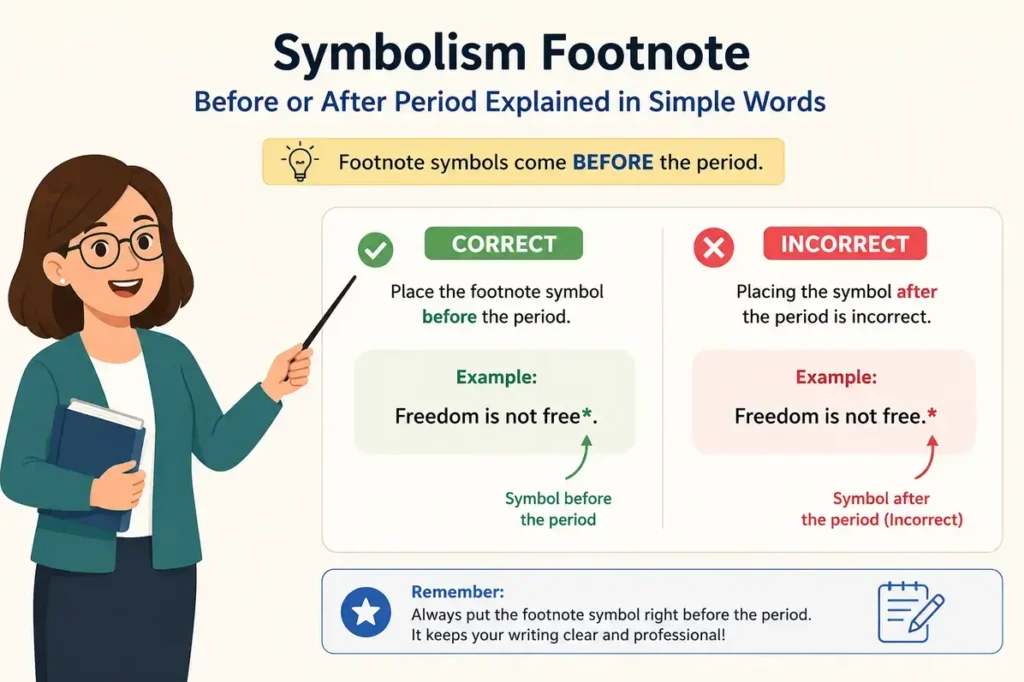
Symbolism Footnote Before or After Period Explained in Simple Words
Although it is mainly a formatting question, it can symbolize two different approaches to writing.
What Footnote After the Period Represents
The standard form represents:
- Completion.
- Order.
- Clarity.
- Professional writing.
The sentence finishes first. The supporting information comes second. This approach tells readers: “I have completed my thought. If you want more details, here they are.” Many people see this arrangement as balanced and easy to follow.
What Footnote Before the Period Represents
The less common form, where they may represent:
- Alternative style traditions.
- Special publishing requirements.
- Different editorial preferences.
It is not always wrong. It simply follows different conventions in certain situations. The key lesson is this: Writing is about helping readers understand your message. Consistency matters more than personal preference.
Simple comparison
Footnote after the period:
- Most common.
- Easy to recognize.
- Used in many academic settings.
Footnote before the period:
- Less common.
- May appear in special styles.
- Depends on specific guidelines.
Related Words You Should Know
Learning related terms can help you better understand rules.
Footnote
A note placed at the bottom of a page. It provides extra information or cites a source.
Endnote
A note placed at the end of a chapter or document. It works like a footnote but appears in a different location.
Citation
Information that tells readers where facts or ideas came from. Citations give credit to original sources.
Reference
A source used during writing. References often appear in a list at the end of a paper.
Bibliography
A complete list of sources consulted during research. It helps readers locate the original materials.
Source
The book, article, website, or document that provides information. Sources support the writer’s claims.
Superscript
The small raised number used to mark a footnote. Example: Understanding these terms makes academic writing much less intimidating.
How People Actually Use Footnote Before or After Period in Daily English
Most people do not discuss during casual conversations. However, the rule becomes useful in many real-life situations.
College essays
Students use footnotes to support their arguments. Correct placement helps papers appear polished.
Research projects
Researchers rely on footnotes to show where information originated. Readers can verify the facts.
Historical writing
Historians often include notes explaining dates, events, or sources. Footnotes strengthen credibility.
Professional reports
Businesses sometimes use footnotes to provide legal or technical details.
Published books
Authors may add notes for explanations that would interrupt the flow of the main text.
Real-life examples
- I added in my history essay.
- Our professor checked every citation carefully.
- The article used footnotes to explain difficult terms.
- The editor corrected the placement of several notes.
- She reviewed the style guide before submitting her paper.
- The biography included helpful footnotes on each page.
- We learned citation rules in English class.
- The researcher documented every source correctly.
- His thesis contained dozens of footnotes.
- The teacher reminded us to proofread our formatting.
These examples show that footnote rules are practical tools, not just classroom exercises.
Common Mistakes People Make Using Footnote Before or After Period
Even experienced writers sometimes struggle with placement. Here are the most common mistakes.
Mistake 1: Putting the footnote before the period
Incorrect:
The team won the championship.
Correct:
The team won the championship.
Mistake 2: Forgetting to check the required style guide
Different institutions may follow different standards.
Solution:
Always review assignment instructions.
Mistake 3: Using footnotes inconsistently
One page follows one pattern. Another page follows a different pattern.
Solution:
Choose the required style and apply it throughout the document.
Mistake 4: Assuming all citation systems work the same way
Footnotes, endnotes, and parenthetical citations have different rules.
Solution:
Learn the system required for your assignment.
Mistake 5: Ignoring proofreading
Tiny formatting mistakes are easy to miss.
Solution:
Read your document slowly before submitting it.
Teacher correction tip for Footnote Before or After Period
Ask yourself: “Did I complete the sentence first?” If yes, place the footnote after the period unless another style guide says otherwise.
Final Teacher Explanation (Very Important)
Imagine that we are sitting together in an English classroom. A student raises a hand and asks: “Teacher, should I use?” My answer would be simple. In most cases, place the footnote after the period.Finish your sentence. Add the period. Then insert the footnote number.
That pattern keeps your writing neat and easy to understand. Do not panic if you occasionally see different examples. Writing styles sometimes vary. The most important thing is following the instructions provided by your teacher, publisher, or organization.
Remember this: Good writing is not about memorizing hundreds of complicated rules. Good writing is about communicating clearly. The question becomes much easier when you focus on helping your readers. Complete the thought first. Provide supporting information second. With practice, this rule will become automatic.
Final Answer (Quick Recap)
If you are wondering the standard rule is simple. In most English writing styles, the period comes first, and the footnote number follows immediately after it. Easy memory trick: Finish the sentence. Then add the footnote.
Frequently Asked Questions (FAQs)
What does footnote before or after period mean?
It asks where the footnote number should appear in relation to the period at the end of a sentence.
Is it correct to place a footnote after the period?
Yes. In many writing styles, this is the standard approach.
Why do people get confused about footnote placement?
Different style guides use different conventions, which can lead to mixed examples.
Can I use both forms in writing?
Only if your required style guide allows it. Consistency is very important.
When should I use footnotes?
Use footnotes when you need to cite sources or provide extra information without interrupting the main text.
Are footnotes and endnotes the same thing?
No. Footnotes appear at the bottom of the page, while endnotes appear at the end of a chapter or document.
Should students memorize the footnote rule?
Yes. It is a useful writing skill that can improve the appearance of essays and reports.
What is the easiest way to remember footnote placement?
Use this simple reminder:
Sentence. Period. Footnote.
You may also want to read Encode vs Incode: Meaning, Differences, and Examples.
Conclusion
The question of footnote before or after period may seem small, but understanding it can improve the quality of your writing. Most of the time, the correct approach is to place the footnote number after the period. This method creates a clean reading experience and follows the conventions used in many academic and professional settings.
Do not worry if you encounter different examples from time to time. Writing styles can vary. The key is to follow the instructions provided by your teacher, editor, or style guide and remain consistent throughout your work.
As a classroom teacher might say, “Small details help strong ideas shine.” Master this simple rule today, and your future writing will look more polished, professional, and reader-friendly.
