
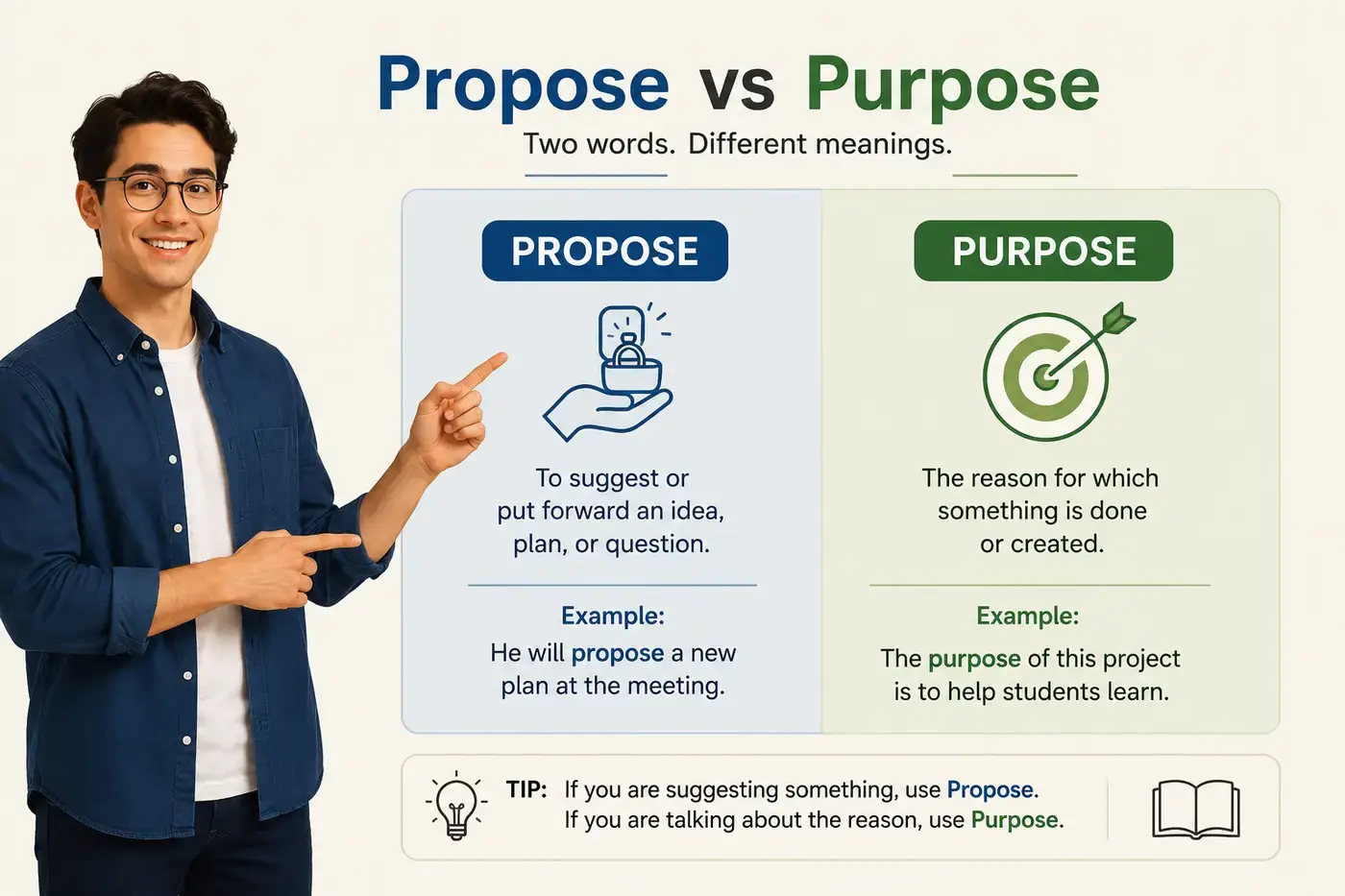
Many English learners get confused by propose vs purpose because the two words look similar and sound a little alike. Even native English speakers sometimes stop for a second before choosing the right one. The good news is that the difference is much easier than it first seems.
If you have ever wondered which word is correct in a sentence, you are in the right place. This guide explains in very simple English. You will learn what each word means, how to use it, and how to remember the difference without memorizing difficult grammar rules.
By the end of this lesson, you will know when to use propose, when to use purpose, and how to avoid one of the most common English word mix-ups.
You may also want to read Investor vs Investee: What Is the Difference?.
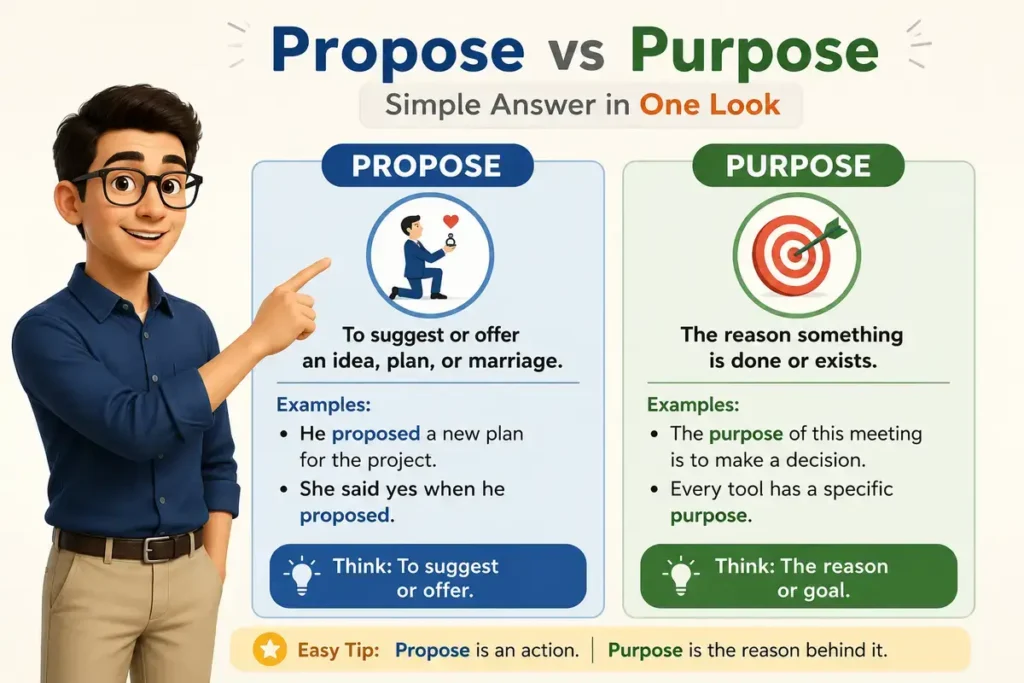
Simple Answer in One Look about Propose vs Purpose
Propose is a verb. It means to suggest an idea or ask someone to marry you.
Purpose is usually a noun. It means the reason something exists or is done.
Quick example:
- I propose a new plan.
- The purpose of this lesson is to help you learn.
What Does Means in Simple English
The easiest way to remember and it is think about action and reason.
A person proposes something. That means they suggest an idea, plan, or solution. It is an action.
A purpose is the reason behind something. It answers the question, “Why?”
Imagine your teacher says, “I propose a class trip.” The teacher is making a suggestion. Now imagine the teacher says, “The purpose of the trip is to learn about history.” here, the teacher is explaining the reason for the trip. Think of it like this.
- Propose = Suggest.
- Purpose = Reason.
That one small idea can help you remember these words every time.
Think About a School Project
Your class wants to plant flowers outside the school. One student says, “I propose planting roses.” That student is making a suggestion. Then another student says, “The purpose of planting flowers is to make the school look beautiful.” Now they are explaining the reason.
The first sentence uses propose.
The second sentence uses purpose.
Both words work together, but they do different jobs.
Another Simple Example about Propose vs Purpose
Your family is planning a picnic.
Your brother says, “I propose going to the lake.”
He is suggesting a place.
Your mother says, “The purpose of the picnic is to spend time together.”
She is explaining the reason.
Notice how easy it becomes once you know what each word does.
Why People Mix These Words
Many learners confuse for a few simple reasons.
They Look Similar
Both words begin with pur or pro sounds and end with similar letters. When reading quickly, people may not notice the difference.
They Sound Somewhat Alike
The pronunciation is different, but the words are close enough that learners sometimes hear one and think of the other.
They Are Common in Formal English
You often see both words in school books, business writing, speeches, and reports. Because they appear in similar places, people may believe they mean nearly the same thing.
They Both Can Be About Plans
This is another reason for the confusion. A proposal often has a purpose. For example:
“I propose building a new park.”
“The purpose of the park is to give families a place to relax.”
The first sentence gives the idea.
The second sentence explains why.
Learners Translate From Their First Language
In some languages, one word may cover both ideas. When people translate directly into English, they may accidentally choose the wrong word.
Fast Typing Causes Mistakes
Many writing mistakes happen because people type quickly. For example:
❌ I purpose a new meeting.
The correct sentence is:
✅ I propose a new meeting.
Or people write:
❌ The propose of this lesson is grammar.
The correct sentence is:
✅ The purpose of this lesson is grammar.
Clear Difference Explained Simply
Here is the easiest comparison between both words.
| Propose | Purpose |
|---|---|
| Action word | Usually a naming word |
| Means to suggest | Means reason |
| Someone does it | Something has it |
| Talks about an idea | Talks about why something exists |
| Often followed by a plan | Often followed by an explanation |
You can also remember it like this.
Use propose when you want to:
- Suggest an idea.
- Offer a plan.
- Recommend something.
- Ask someone to marry you.
Use purpose when you want to:
- Explain why something exists.
- Describe a goal.
- Tell the reason behind an action.
- Explain the aim of a project.
Easy Memory Trick
Ask yourself this question.
Am I suggesting something?
If yes, use propose.
Am I explaining why something exists?
If yes, use purpose.
This quick question works almost every time.
Which Form Should You Use Propose vs Purpose?
When choosing between words follow these easy rules.
Rule 1
Use propose when someone gives an idea. Examples:
- I propose a different answer.
- She proposed a better plan.
- They proposed building a library.
Rule 2
Use purpose when talking about a reason. Examples:
- The purpose of the meeting is to solve the problem.
- The purpose of homework is practice.
- The purpose of exercise is better health.
Rule 3
Ask Yourself “Can I Replace It?”
Replace propose with suggest.
If the sentence still makes sense, propose is probably correct. Example:
I propose another idea.
I suggest another idea.
Both work.
Replace purpose with reason. Example:
The purpose of the lesson is learning.
The reason for the lesson is learning.
Both make sense.
Rule 4
Look for Common Patterns
You will often see these patterns.
Propose + idea
- propose a plan
- propose a solution
- propose a change
- propose a rule
Purpose + of
- purpose of the meeting
- purpose of the law
- purpose of the book
- purpose of the game
These patterns appear again and again in English.
Rule 5
Think About the Question
If the sentence answers:
“What do you suggest?”
Use propose.
If the sentence answers:
“Why is it here?”
Use purpose.
Easy Real Life Sentences You Can Use
Here are simple everyday examples.
- I propose leaving early tomorrow.
- She proposed a new way to solve the problem.
- They proposed building a playground.
- The purpose of this book is to teach English.
- The purpose of the meeting is to share ideas.
- Our teacher explained the purpose of the test.
- My friend proposed going out for pizza.
- The purpose of exercise is to keep your body healthy.
More Daily Examples
At home:
- Dad proposed painting the kitchen.
- The purpose of the paint is to protect the walls.
At school:
- Our class proposed a science fair.
- The purpose of the fair is to help students learn.
With work:
- My manager proposed a new schedule.
- The purpose of the new schedule is to save time.
With friends:
- Sarah proposed watching a movie.
- The purpose of meeting was to celebrate her birthday.
These examples show that both words often appear in the same conversation, but they have different meanings.
Where Propose vs Purpose Words Expression Comes From Simple History
Learning a little history can make easier to remember. The word propose comes from an old Latin word that meant to put forward. Imagine someone placing an idea on a table so everyone can see it. That is exactly what proposing is. You put an idea in front of other people. The word purpose also comes from Latin. Over many years, it came to mean an aim, a goal, or a reason. Even after hundreds of years, the meanings have stayed almost the same. That is why modern English still uses:
- propose for suggesting.
- purpose for explaining a reason.
Many English words have changed over time, but these two have kept their main ideas. You can still see their original meanings in everyday conversations. For example:
“We propose a new project.”
This means putting a new idea forward.
“The purpose of the project is to help children.”
This explains the goal behind the project. Knowing this simple history makes the difference much easier to remember.
As you can see, understanding is mostly about knowing the difference between suggesting an idea and explaining a reason. Once that becomes natural, these words become much easier to use. In the next section, we will go beyond the basic meanings and look at how these words appear in culture, everyday life, symbolism, common expressions, and practical communication so you can use them with even more confidence.
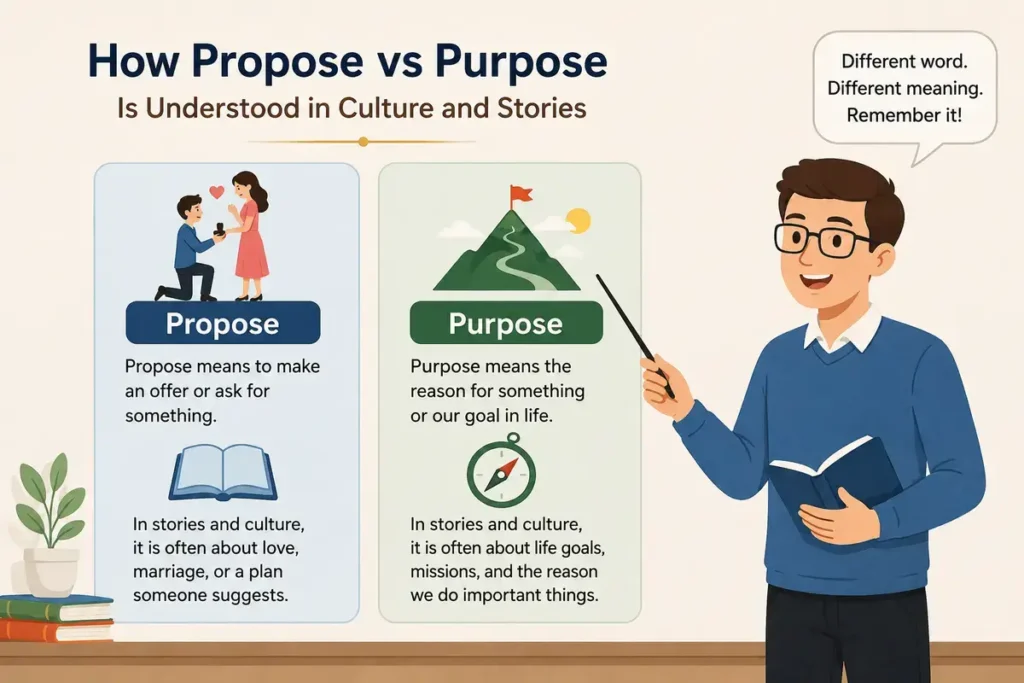
How Propose vs Purpose Is Understood in Culture and Stories
The difference between words are not just about grammar. These words also appear in stories, movies, books, and everyday conversations. Each one carries a different idea. When someone says they want to propose, people usually think about sharing a new idea or asking someone to get married. In many stories, the main character proposes a brave plan that helps everyone. In romantic stories, a proposal often becomes one of the happiest moments.
The word purpose has a deeper meaning. It is often connected with goals, dreams, and the reason people do something. Many stories are about a person trying to find their purpose in life. That purpose helps them make good choices and keep going during hard times. Think about a simple story.
A young girl wants to clean her neighborhood.
She says, “I propose that we all work together.”
Her friends agree.
The purpose of their project is to make the streets cleaner.
The first sentence gives the idea.
The second sentence explains why they are doing it.
You will see this pattern in many books, movies, and even cartoons.
Good stories usually begin with someone proposing an idea.
They become meaningful because that idea has a clear purpose.
Learn the difference in Copys or Copies: Which Word Is Correct and How Do You Use It?.
Biblical and Mythological Meaning
The Bible does not use the exact lesson of keywords, but both ideas appear in many passages. People often propose plans. Sometimes those plans succeed. Sometimes they change because a different path is chosen. The word purpose appears much more often in Bible discussions. It usually refers to God’s purpose or a person’s purpose in life. In simple words, it means having a reason or goal.
Many people believe every person has a purpose, even if they do not understand it right away. In mythology, heroes often begin a journey because someone proposes a mission or challenge. The hero then discovers the true purpose of the adventure.
This simple pattern appears in stories from many cultures.
The proposal starts the journey.
The purpose explains why the journey matters.
Symbolism Explained in Simple Words
Words often carry emotional meaning beyond their dictionary definitions.
What Propose Represents
The word propose represents:
- New ideas.
- Fresh beginnings.
- Hope.
- Courage to speak.
- Taking the first step.
- Sharing a solution.
- Building something better.
When someone proposes something, they are showing confidence and creativity.
They believe their idea can help.
What Purpose Represents
The word purpose represents:
- Direction.
- Meaning.
- Goals.
- Hope for the future.
- Personal growth.
- A reason to keep trying.
- Understanding why something matters.
Purpose gives actions meaning.
Without purpose, people may feel lost.
With purpose, people know where they are going.
This makes the difference between easy to picture.
A proposal starts the journey.
Purpose guides the journey.
Related Words You Should Know About Propose vs Purpose
Here are some useful words connected with above keyword.
Suggest
To give someone an idea.
Example: I suggest taking the bus.
Recommend
To tell someone that something is a good choice.
Example: The teacher recommends reading every day.
Offer
To present something for others to accept.
Example: She offered a helpful solution.
Plan
A set of steps to reach a goal.
Example: We made a plan for the weekend.
Goal
Something you want to achieve.
Example: My goal is to become a doctor.
Aim
Another word for purpose or goal.
Example: The aim of this class is to improve your English.
Mission
An important job or purpose.
Example: Our mission is to help others.
Reason
Why something happens.
Example: The reason for the meeting is simple.
Objective
A clear goal.
Example: The objective is to finish the project today.
Learning these related words makes it easier to understand in different situations.
How People Actually Use it in Daily English
Here are real examples you may hear every day.
- I propose meeting after lunch.
- She proposed a better way to finish the work.
- They proposed adding more trees to the park.
- The purpose of this class is to improve speaking skills.
- The purpose of the sign is to keep people safe.
- Can I propose another idea?
- What is the purpose of this meeting?
- Our manager proposed a new schedule.
- The purpose of the app is to make learning easier.
- My brother proposed going on a road trip.
Notice something important.
Every sentence with propose includes an idea or suggestion.
Every sentence with purpose explains a reason or goal.
That simple pattern almost never changes.
Common Mistakes People Make With Propose vs Purpose
Many learners make the same mistakes. Here are the most common ones.
Mistake 1
❌ I purpose a new plan.
✅ I propose a new plan.
Remember, you propose an idea.
Mistake 2
❌ The propose of this lesson is grammar.
✅ The purpose of this lesson is grammar.
Purpose explains the reason.
Mistake 3
❌ She proposed her purpose yesterday.
✅ She proposed a new project yesterday.
Or
✅ She explained her purpose yesterday.
Choose the word based on the meaning.
Mistake 4
❌ What is your propose?
✅ What is your purpose?
Ask about a person’s reason or goal by using purpose.
Mistake 5
❌ The purpose me a better idea.
✅ He proposed a better idea.
Purpose is not used as the action in this sentence.
Easy Memory Tip
Ask yourself one question.
“Am I giving an idea?”
If yes, choose propose.
“Am I explaining the reason?”
If yes, choose purpose.
This quick trick helps almost every time.
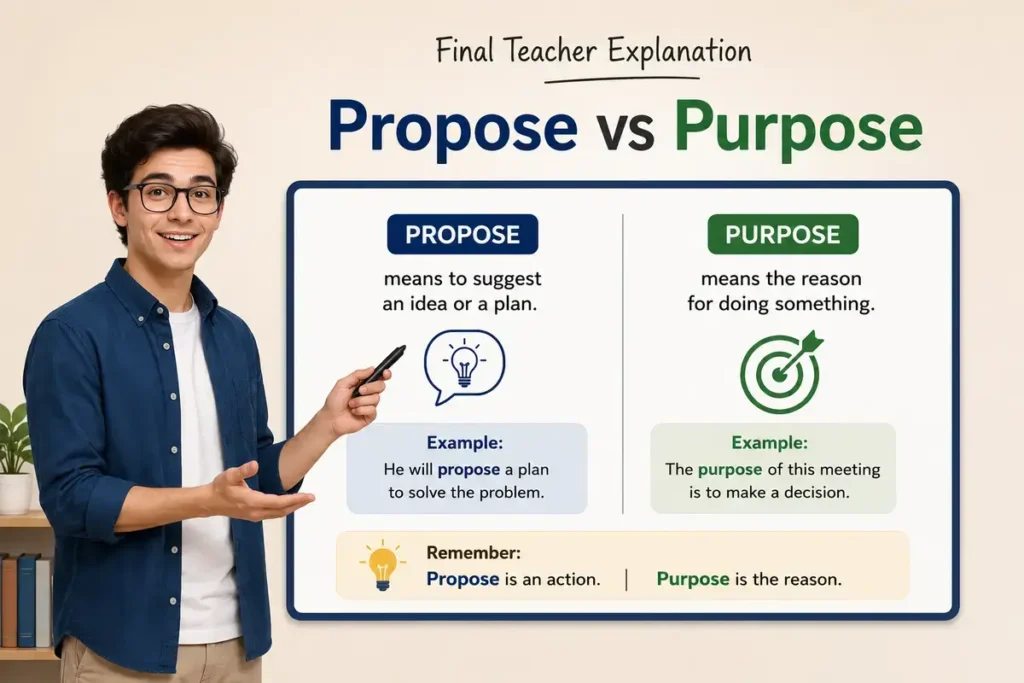
Final Teacher Explanation About Propose vs Purpose
Imagine you are sitting in a classroom. I write two words on the board.
Propose
Purpose
Then I ask two simple questions. First question.
“Who has an idea?”
That answer is propose.
Second question.
“Why are we doing it?”
That answer is purpose.
That is the whole lesson.
You do not need difficult grammar words.
You only need to remember this.
A proposal gives people something new to think about.
A purpose gives people a reason to care.
One starts with an idea.
The other explains why the idea matters.
Whenever you see boht words, think about these two questions.
What is being suggested?
Why is it being done?
If you can answer those questions, you will almost always choose the correct word.
Final Answer About Propose vs Purpose Quick Recap
The difference between is simple. Use propose when you suggest an idea, plan, or solution. Use purpose when you explain the reason, goal, or aim behind something. Remember this easy rule: propose means “suggest,” while purpose means “reason.”
You may also want to read Transferred or Transfered: Simple Guide to Spelling and Meaning.
Conclusion
Understanding is easier than many learners expect. Although the words look similar, they have different jobs. Use propose when you are sharing an idea, making a suggestion, or offering a plan. Use purpose when you are explaining the reason, goal, or aim behind something. Keep asking yourself, “Am I suggesting something or explaining why?” That simple question will help you choose the correct word with confidence every time.
Frequently Asked Questions
What does propose mean in simple words?
Propose means to suggest an idea or offer a plan for other people to consider.
What does purpose mean in simple words?
Purpose means the reason why something exists or why someone does something.
Is it correct to use propose or purpose?
It depends on your sentence. Use propose for suggestions and purpose for reasons or goals.
Why do people confuse about words?
They look and sound a little alike, but they have different meanings. One is about suggesting, and the other is about explaining why.
Can I use both words in one sentence?
Yes. For example, “I propose a new project because its purpose is to help students.”
Is propose a verb?
Yes. Propose is usually a verb because it shows an action.
Is purpose a noun?
Yes. Purpose is usually a noun because it names a reason or goal.
How can I remember words?
Think of this easy rule. Propose equals suggest. Purpose equals reason.
