

Many English learners get confused about investor vs investee because both words are connected to money and investing. They often appear in business news, company reports, and everyday financial discussions. Since the words look similar, people sometimes use the wrong one.
The good news is that the difference is very easy to understand. One gives money, and the other receives money. Once you remember this simple idea, you will know which word to use every time.
In this guide, you will learn the meaning of each word, why people confuse them, and how to use them in real-life sentences. Everything is explained in simple US English so it is easy to follow.
Learn the difference in Capital vs Capitol: Which One Should You Use Guide (2026).
Simple Answer in One Look About Investor vs Investee
An investor is a person or company that puts money into a business or project.
An investee is the person, company, or project that receives the investment.
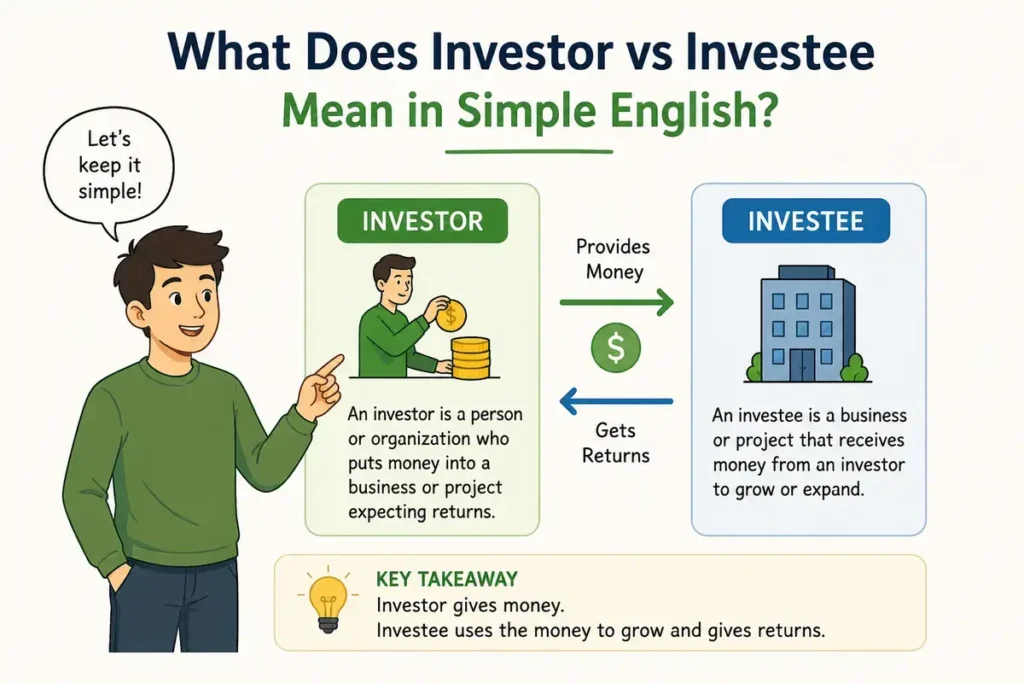
What Does Investor vs Investee Mean in Simple English?
Think about lending a friend a pencil. You are the one giving the pencil. Your friend is the one receiving it. The same idea works with investing.
An investor gives money.
An investee receives money.
Here is another simple way to remember it.
- Investor = Gives money.
- Investee = Receives money.
Imagine that Sarah gives $20,000 to a new bakery. Sarah is the investor. The bakery is the investee.
This simple picture can help you remember the difference whenever you see these words.
What Is an Investor?
An investor is someone who puts money into something because they hope it will grow over time. The investment could be in:
- A company.
- A small business.
- Real estate.
- Stocks.
- A startup.
- A new project.
Investors usually expect something in return. For example:
- More money later.
- A share of the business.
- Regular income.
- Long-term growth.
Example:
“Maria invested money in a local coffee shop.”
Maria is the investor.
What Is an Investee?
An investee is the business, company, or organization that receives the investment. Instead of giving money, it accepts money from investors. Example:
“A software company received funding from several investors.”
The software company is the investee. It uses the money to grow, hire workers, build products, or expand into new markets.
Why Do People Mix These Words in Investor vs Investee?
Many people confuse because the words start with the same root word, invest. When two words begin the same way, our brains often think they have the same job. There are a few more reasons why this happens.
Both Words Talk About Investing
People see both words in financial news and business reports. For example:
- The investor increased funding.
- The investee expanded its business.
Since both sentences are about investing, learners may mix up the roles.
The Ending Looks Similar
The endings -or and -ee can be confusing. Many English words use these endings. Some people do not know that they often show different roles. Usually:
- -or means the person doing the action.
- -ee means the person or thing receiving the action.
Examples include:
- Employer → Employee.
- Trainer → Trainee.
- Interviewer → Interviewee.
Business English Uses These Words Often
These words are common in:
- Company reports.
- Business meetings.
- Investment articles.
- Financial statements.
- Startup discussions.
If English is not your first language, seeing both words together can make them easy to confuse.
Clear Difference Explained Simply
The easiest way to remember is to think about who gives the money.
| Investor | Investee |
|---|---|
| Gives money | Receives money |
| Person or company investing | Business or project receiving funds |
| Owns or buys an interest | Receives support to grow |
| Takes the investment action | Accepts the investment |
| Looks for profit | Uses the money for development |
Here is an easy memory trick.
Investor = Gives.
Investee = Gets.
If you remember who gives and who gets, you will almost never confuse these words.
A Simple Story to Remember
Imagine Jack has saved $50,000. He gives the money to a small game company. Jack is the investor. The game company is the investee. Years later, the company becomes successful. Jack earns money because of his investment. Nothing about the roles changes. Jack is still the investor. The company is still the investee.
Which Form Should You Use in Investor vs Investee?
Choosing the correct word becomes easy once you ask one simple question. Who is giving the money? If someone is giving money to help a business grow, use investor. Example:
“The investor bought shares in the company.”
Now ask another question. Who is receiving the money? If a business or organization receives the investment, use investee. Example:
“The investee used the funds to build a new factory.”
Here is a quick rule.
Use investor for the giver.
Use investee for the receiver.
If you remember this rule, you can choose the correct word in almost every situation.
A Helpful Memory Trick
Think of these familiar word pairs.
- Employer → Employee.
- Interviewer → Interviewee.
- Trainer → Trainee.
Now match the pattern.
- Investor → Investee.
The -or word acts.
The -ee word receives.
Easy Real-Life Sentences You Can Use With Investor vs Investee
Reading real examples makes the difference much easier to remember.
- The investor gave money to the new restaurant.
- The investee used the money to buy new equipment.
- Every investor hopes the business will grow.
- The investee thanked its investors for their support.
- My uncle became an investor in a local company.
- The investee hired more workers after receiving funding.
- A smart investor studies the business before investing.
- The investee shared its yearly results with investors.
Practice saying these sentences aloud. You will quickly become comfortable using both words correctly.
Mini Practice Quiz
Choose the correct word.
1. Lisa invested in a clothing company. Lisa is the ________.
Answer:
Investor.
2. The clothing company received the money. It is the ________.
Answer:
Investee.
3. The startup accepted funding from three people. The startup is the ________.
Answer:
Investee.
4. David bought shares in the startup. David is the ________.
Answer:
Investor.
Where Does Investor vs Investee Come From? (Simple History)
Both words come from the English verb invest. The word invest has been used for hundreds of years. It first meant putting something into another thing. Later, people began using it for putting money into businesses, land, and other opportunities. Over time, English created two different nouns.
Investor became the name for the person who invests.
Investee became the name for the person, business, or organization that receives the investment.
The endings also help explain their jobs. The ending -or often names the person doing something. The ending -ee often names the person or thing receiving the action. That same pattern appears in many everyday English words, making easier to understand once you notice it.
As you continue learning, you will see that is only part of the story. These words also appear in business culture, accounting, legal documents, and financial conversations. In the next section, you will learn how they are used in real life, what they symbolize, common mistakes to avoid, and helpful tips that will make these words easy to remember forever.
How Investor vs Investee Is Understood in Culture and Stories
The idea behind investor vs investee is found in many cultures, even if people do not use these exact words. For hundreds of years, people have supported others by sharing money, tools, land, or resources. Someone with extra resources helped another person start a farm, open a shop, or build a business. In modern life, this same idea is called investing.
The investor is the helper who provides money because they believe something good can grow.
The investee is the person or business that receives the support and works hard to succeed.
You can even see this idea in many movies and stories. A young inventor has a great idea but does not have enough money. A business owner believes in the idea and provides funding. The business owner becomes the investor. The young inventor’s company becomes the investee. The story is not just about money.
It is also about trust. The investor trusts the investee to use the money wisely. The investee works hard to reward that trust by growing the business. That is why these words often suggest teamwork instead of competition.
A related grammar guide is Pentoxide vs Pentaoxide: Which One Is Correct?.
Is There a Biblical or Mythological Meaning Behind Investor vs Investee?
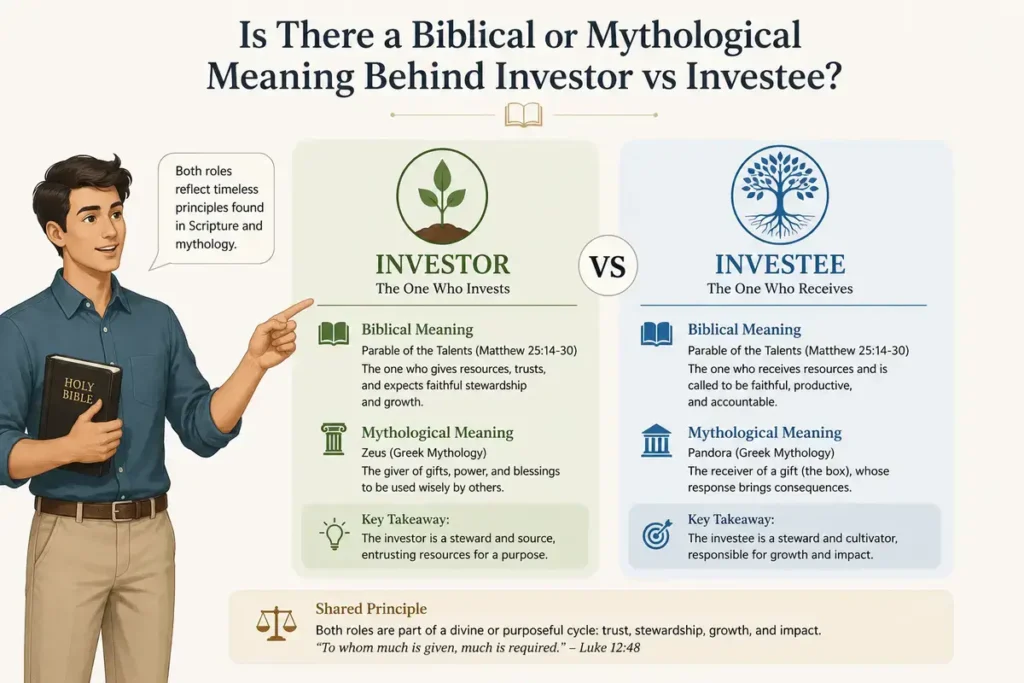
There is no direct mention of the words investor or investee in the Bible. These are modern business words. However, the Bible often talks about using money wisely, being responsible, and taking good care of what you have. One well-known example is the Parable of the Talents. In that story, servants receive money from their master. Some use it wisely and make it grow.
Another servant hides the money and does nothing with it. The lesson is about responsibility and making good use of opportunities. It is not about the words investor vs investee, but it teaches similar values. In mythology, there are no direct examples of these business terms either. Many myths, however, include kings, leaders, or gods giving people resources or gifts to complete an important task.
The focus is usually on trust, responsibility, and wise choices. So while does not come from religion or mythology, the ideas behind the words match lessons about responsibility, growth, and good judgment.
Symbolism Explained in Simple Words
Although investor vs investee are business terms, people sometimes connect them with simple ideas and values.
What Investor Represents
An investor often represents:
- Belief in the future.
- Confidence.
- Opportunity.
- Support.
- Hope for growth.
- Smart planning.
- Taking careful risks.
An investor says,
“I believe this idea can succeed.”
That belief is often just as valuable as the money itself.
What Investee Represents
An investee often represents:
- Growth.
- New beginnings.
- Hard work.
- Responsibility.
- Learning.
- Progress.
- Trust.
An investee accepts support and works toward success. Without effort from the investee, the investment may not succeed.
Simple Comparison
Investor symbolizes giving.
Investee symbolizes receiving.
Investor provides opportunity.
Investee creates results.
Investor takes a chance.
Investee accepts the challenge.
Together, they show how cooperation can help everyone succeed.
Related Words You Should Know About Investor vs Investee
Learning a few related words makes even easier to understand.
Investment
Money placed into something with the hope of earning more later. Example:
“The investment helped the company grow.”
Investing
The action of putting money into a business, stock, or project. Example:
“My parents started investing years ago.”
Startup
A new business that is just beginning.
Many startups look for investors.
Shareholder
Someone who owns part of a company by buying shares.
Many investors become shareholders.
Capital
Money used to start or grow a business. Example:
“The company needed more capital.”
Funding
Money given to support a business or project. Example:
“The new hospital received funding.”
Equity
Ownership in a business.
Some investors receive equity instead of being paid back directly.
Return on Investment (ROI)
The money earned from an investment compared with the money spent.
A good investment usually has a positive return.
Venture Capital
Money invested in new companies that have high growth potential.
These investments usually involve higher risk.
Portfolio
A collection of investments owned by one investor.
Some investors own stocks in many different companies.
How People Actually Use Investor vs Investee in Daily English
Most people do not use every day in casual conversations. These words are more common in business, finance, company meetings, and news reports. Still, you may hear sentences like these.
- My uncle became an investor in a local restaurant.
- The investee used the money to open two new stores.
- The investor believes the company will grow quickly.
- Every investee must use the funds responsibly.
- We are looking for investors to support our new idea.
- The investee hired more employees after receiving funding.
- A smart investor always studies the business first.
- The startup became an investee after signing the agreement.
- Several investors attended the company meeting.
- The investee shared its yearly progress with everyone.
These examples show that each word has its own clear role.
Common Mistakes People Make With Investor vs Investee
Many learners make the same mistakes when using.
The good news is that they are easy to fix.
Mistake 1: Calling the Company the Investor
❌ The company received money from many investors, so it is the investor.
✅ The company received money from many investors, so it is the investee.
Remember:
Receiving money means investee.
Mistake 2: Calling the Person Giving Money the Investee
❌ Sarah invested $100,000. She is the investee.
✅ Sarah invested $100,000. She is the investor.
The person giving the money is always the investor.
Mistake 3: Thinking Both Words Mean the Same Thing
Some learners believe the words are interchangeable.
They are not.
Each word describes a different role.
Investor gives.
Investee receives.
Mistake 4: Forgetting the Word Endings
Many people ignore the endings. Remember this simple pattern.
- -or often means the one doing the action.
- -ee often means the one receiving the action.
The same pattern appears in many English words.
Mistake 5: Guessing Without Asking One Question
Before choosing a word, ask yourself:
“Who is giving the money?”
If you can answer that question, you will almost always choose the correct word.
Final Teacher Explanation of Investor vs Investee
Imagine we are finishing today’s English lesson together. You only need to remember one simple idea.
The investor gives.
The investee receives.
Everything else grows from that rule. If a person, company, or organization provides money to help another business grow, that person or company is the investor. If a business accepts that money, it becomes the investee. Do not worry if you forget the meanings at first. Even many English learners confuse these words because they look alike. The easiest memory trick is this:
Investor = Gives money.
Investee = Gets money.
Once you remember that picture, you will understand almost every time you see the words in books, news articles, business reports, or conversations. Practice reading the example sentences again. Soon the difference will feel completely natural.
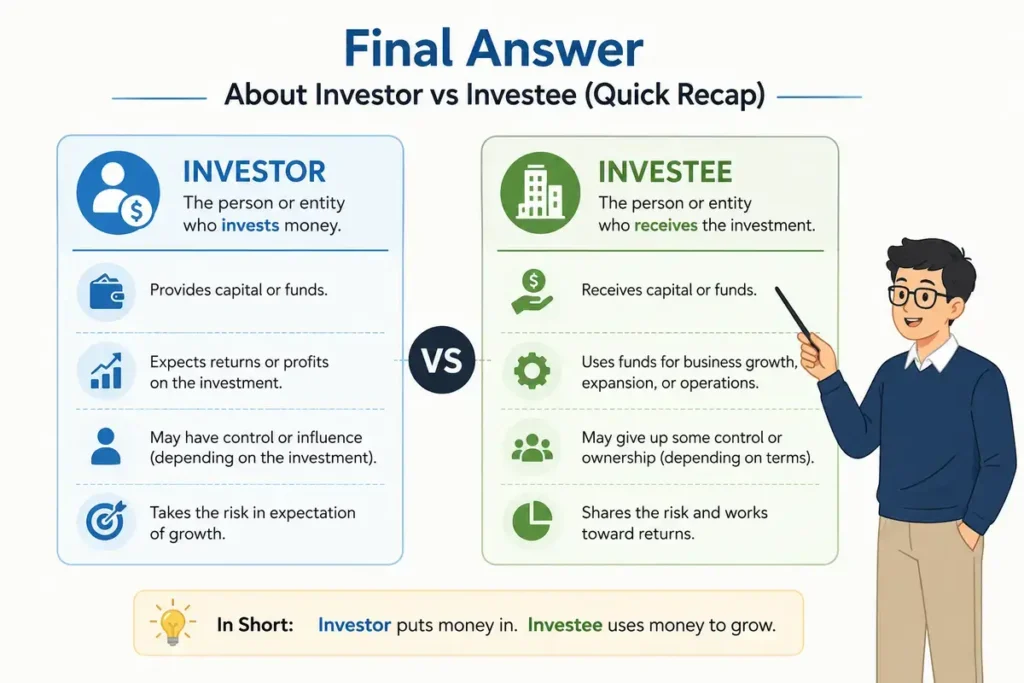
Final Answer About Investor vs Investee (Quick Recap)
The difference between is simple.
An investor is the person or company that gives money to a business or project.
An investee is the business, organization, or project that receives the money.
Remember this easy rule:
Investor gives. Investee gets.
That simple sentence will help you choose the correct word every time.
Need another quick comparison? Read Prooving vs Proving: Which Spelling Is Correct?.
Conclusion
Understanding investor vs investee is much easier than it first appears. Both words come from the verb invest, but they describe two different roles. The investor is the one who provides money because they believe in future growth. The investee is the person, company, or organization that receives that money and uses it to grow. Whenever you are unsure, ask yourself one simple question: Who is giving the money? If they are giving it, they are the investor. If they are receiving it, they are the investee. This easy rule will help you use both words correctly in business writing, financial news, and everyday English.
Frequently Asked Questions
What does investor mean in simple words?
An investor is a person or company that puts money into a business or project to help it grow and hopes to earn money later.
What does investee mean in simple words?
An investee is the business, company, or organization that receives money from an investor.
What is the difference?
The investor gives the money. The investee receives the money.
Is investor or investee a person?
An investor is usually a person or a company. An investee is often a company, business, organization, or project.
Why do people confuse?
People confuse them because both words come from the verb invest and look almost the same.
Can I use investor and investee in the same sentence?
Yes. For example: “The investor gave money to the investee to help the business grow.”
Which word is used more often?
Investor is much more common in everyday English, news articles, and business conversations. Investee is mostly used in finance, accounting, and legal writing.
How can I remember?
Remember this simple rule:
Investor gives. Investee gets.
If you know who gives the money, you will always know which word to use.
