
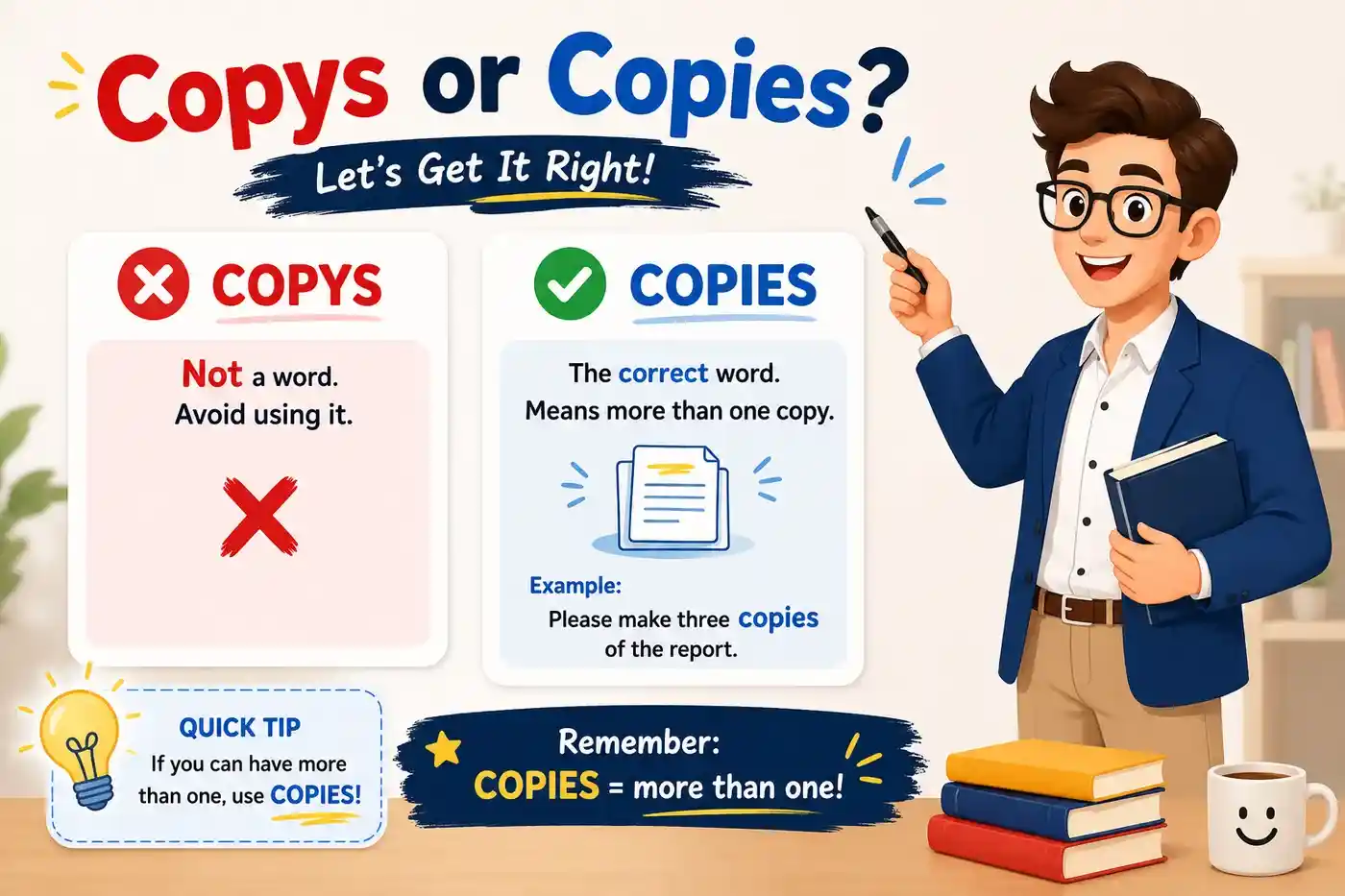
Many people get confused about copys or copies when writing emails, homework, reports, or social media posts. The two words look very similar, but only one is correct in standard English.
If you have ever wondered about you are not alone. This is one of the most common spelling mistakes because people are unsure what happens when a word ends with the letter “y.”
The good news is that the rule is simple. Once you understand it, you will know exactly which form to use every time.
Still confused? Compare Meantime Or Mean Time: How To Use Each One (2026).
Copys or Copies: Simple Answer in One Look
When choosing the correct word is copies.
Copys is not considered a correct English spelling.
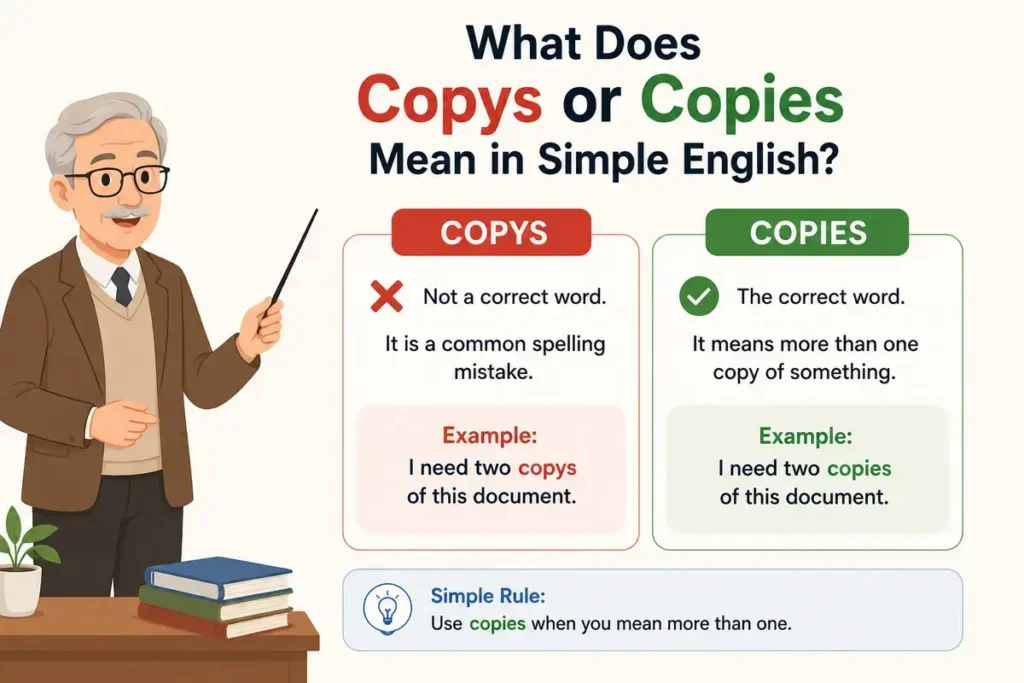
What Does Copys or Copies Mean in Simple English?
Before we talk about spelling, let’s understand the meaning of the word. A copy is something that is made from an original. For example:
- A copy of a book.
- A copy of a document.
- A copy of a photo.
- A copy of a report.
When there is more than one copy, we use the plural form. That plural form is copies. Examples:
- I printed three copies of the report.
- She gave us two copies of the worksheet.
- The teacher made copies for the whole class.
In simple words, copies means more than one copy.
What Is a Copy?
A copy can be:
- A printed document.
- A photograph.
- A digital file.
- A duplicate item.
- A written version of something.
Examples:
- Please send me a copy of the receipt.
- I saved a copy on my computer.
- The library has a copy of that book.
When there are several of them, we say copies.
Why Is Copies So Common?
You see this word almost everywhere because people often make duplicates of things.
Schools use copies.
Offices use copies.
Because the word appears so often, people naturally want to know the correct spelling.
Why Do People Mix These Words Copys or Copies?
The confusion happens because English spelling can sometimes feel tricky. Many people think making a word plural is as easy as adding the letter “s.” For example:
- Book → books
- Car → cars
- Pen → pens
Since copy ends with a “y,” some people write:
- Copy → copys
It seems logical at first. But English has a special spelling pattern for many words ending in “y.” Because of that pattern, the spelling changes before adding the plural ending.
The Word Looks Correct at First
One reason people write copys is that it looks similar to many other plural words. For example:
- Desk → desks
- Chair → chairs
- Table → tables
Someone may think:
“If I add s to copy, I get copys.”
But English follows a different rule for this type of word.
Fast Typing Causes Mistakes
Another reason is speed. When people type quickly, they may not stop to think about the spelling rule. As a result, they accidentally write copys even though they know copies is correct.
New Learners Often Guess
English learners often try to find patterns.
Since many words simply add “s,” they may guess that copy works the same way.
That guess leads to the spelling mistake.
Copys or Copies: Clear Difference Explained Simply
The difference is easy once you see it.
Quick Comparison of Copys or Copies
| Word | Correct? | Meaning |
|---|---|---|
| Copys | No | Incorrect spelling |
| Copies | Yes | More than one copy |
Easy Visual Example
Singular:
- One copy
Plural:
- Two copies
- Three copies
- Ten copies
Notice that copy changes to copies.
Copys or Copies: Easy Rule to Remember
If a word ends in a consonant plus the letter y, the y usually changes before making it plural. Examples:
- Baby → babies
- City → cities
- Lady → ladies
- Story → stories
- Copy → copies
This is the same pattern.
Common Mistake
Wrong:
- I printed five copys.
Correct:
- I printed five copies.
Wrong:
- The teacher handed out copys.
Correct:
- The teacher handed out copies.
Copys or Copies: Which Form Should You Use?
You should always use copies when you need the plural form of copy. This is the spelling accepted in:
- Schools
- Colleges
- Books
- Newspapers
- Business writing
- Professional documents
When to Use Copy
Use copy when talking about one item. Examples:
- I need a copy.
- She has a copy.
- The office sent a copy.
When to Use Copies
Use copies when talking about more than one item. Examples:
- I need two copies.
- She printed five copies.
- The office sent several copies.
Teacher’s Easy Rule
Think about the number.
One item:
- Copy
More than one:
- Copies
Never use copys in standard English writing.
A Helpful Memory Trick
Look at the word city.
The plural is cities.
Not citys.
Now look at copy.
The plural is copies.
Not copys.
The same spelling pattern works for both words.
Copys or Copies in Everyday Situations
You probably see this word more often than you realize.
At School
Students often hear:
“Please make three copies of your assignment.”
Teachers may say:
“Bring two copies of your essay tomorrow.”
At Work
Office workers often use the word. Examples:
- Please print five copies.
- I need extra copies for the meeting.
- The manager requested more copies.
At Home
Families use the word too. Examples:
- We made copies of the photos.
- Dad printed copies of the tickets.
- Mom saved copies of the documents.
Online
Digital files can also have copies. Examples:
- Keep backup copies.
- Save extra copies on your computer.
- Make copies before editing the file.
Easy Real-Life Sentences You Can Use for Copys or Copies
Here are simple examples you can use in daily conversation.
- I printed three copies of my report.
- She needs two copies of the form.
- The teacher gave us copies of the worksheet.
- Please bring extra copies tomorrow.
- We made copies of the family photo.
- He saved copies of the files.
- The office requested several copies.
- I handed out copies to everyone.
Common Everyday Phrases
You may hear these often:
- Make copies of the document.
- Print extra copies.
- Keep backup copies.
- Bring two copies.
- Send copies by email.
These are all correct examples.
Where Does Copys or Copies Come From? (Simple History)
The word copy has been used in English for hundreds of years. It came from older words that referred to a written version or reproduction of something. As books, records, and documents became more common, people used the word copy more frequently. Over time, English applied its normal spelling rule to create the plural form. That gave us:
- Copy → Copies
The spelling follows the same pattern used by many other English words ending in a consonant and the letter y. Examples include:
- Story → stories
- Baby → babies
- Country → countries
- Family → families
Because copy follows this pattern, copies became the accepted plural form.
Why the Spelling Changed
The change helps readers recognize the word more easily. English has used this pattern for a very long time. That is why copies looks natural to native speakers while copys looks incorrect.
Why You Still See Copys Sometimes
Most examples of copys come from:
- Typing mistakes
- Spelling errors
- Autocorrect problems
- English learners practicing the language
It is not accepted as the standard spelling in modern English.
Common Questions About Copys or Copies
Is Copys Ever Correct?
No.
In standard English, copys is considered a spelling mistake.
Is Copies Singular or Plural?
Copies is plural.
It means more than one copy.
What Is the Singular Form?
The singular form is copy. Example:
- I have one copy.
What Is the Correct Choice Between Copys or Copies?
The correct choice is copies. This is the spelling used in professional, academic, and everyday writing.
Transition to the Next Section
Now that you understand the basic difference between copys or copies, the next section will go deeper into how this word is used in culture, communication, symbolism, and everyday English. You will also learn why copies play an important role in learning, sharing information, and preserving ideas.
You may also want to read Affend vs Offend: Meaning, Difference, and Examples.
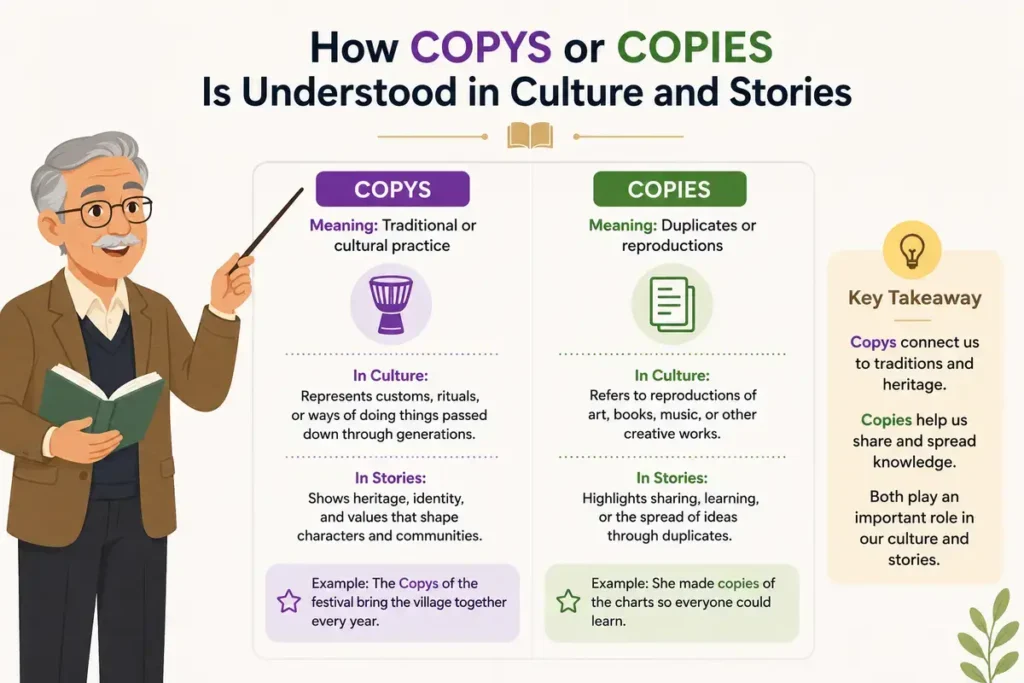
How Copys or Copies Is Understood in Culture and Stories
The word copies may seem simple, but it appears in many parts of life and culture. People have always made copies of things they wanted to keep, share, or protect. Long ago, books were copied by hand. Before printers existed, people spent hours creating copies of important writings. Stories, poems, and historical records survived because someone made copies of them. Without copies, many famous stories could have disappeared forever. Even today, copies help people share information. For example:
- Schools make copies of lessons.
- Libraries keep copies of books.
- Businesses keep copies of records.
- Families keep copies of photos.
In stories and movies, a copy can also represent something that looks like the original. You might hear about:
- A copy of a treasure map.
- A copy of an old letter.
- A copy of a secret document.
These copies often help move the story forward. Because of this, the word copies is often connected with sharing, learning, remembering, and preserving important things.
Biblical and Mythological Meaning of Copys or Copies
The word copies itself does not have a special biblical meaning. However, copies have played an important role in religious history. Before printing presses existed, religious writings were copied by hand. People carefully created copies of sacred texts so future generations could read them. This helped preserve important teachings.
In mythology and ancient stories, copies sometimes appeared as replicas, drawings, or written versions of important objects. These copies helped pass knowledge from one generation to another. So while copies is not a religious symbol itself, the act of making copies has helped protect important ideas throughout history.
Symbolism Copys or Copies Explained in Simple Words
What Copies Represents
The correct word copies often represents:
- Sharing knowledge.
- Saving information.
- Learning.
- Communication.
- Preservation.
When someone makes copies, they usually want others to have access to the same information. For example:
- A teacher shares copies with students.
- A company shares copies of reports.
- A family keeps copies of memories.
Because of this, copies often symbolizes connection and learning.
What Copys Represents
The word copys does not have a special meaning because it is not the accepted spelling. However, when people see copys, it often represents:
- A spelling mistake.
- A typing error.
- A learning opportunity.
Many English learners write copys before learning the correct spelling rule. For that reason, copys can remind us that mistakes are part of learning.
Copys or Copies Symbolism Comparison
| Word | Symbolic Idea |
|---|---|
| Copies | Sharing, preserving, teaching |
| Copys | Learning from mistakes |
This comparison makes the difference easy to remember.
Related Words You Should Know About Copys or Copies
Learning related words can help you understand copies better.
Copy
One version of something. Example:
“I have one copy of the book.”
Duplicate
An exact copy of something. Example:
“This file is a duplicate.”
Reproduction
A copy made from an original item. Example:
“The museum displayed a reproduction of the painting.”
Replica
A copy designed to look like the original. Example:
“They built a replica of the old ship.”
Backup
An extra copy saved for safety. Example:
“Always keep a backup of your files.”
Document
A written or printed record. Example:
“Please send the document.”
File
Information stored on a computer. Example:
“I saved the file yesterday.”
Original
The first version of something. Example:
“This is the original photo.”
Understanding these related words makes it easier to use copies correctly.
How People Actually Use Copys or Copies in Daily English
People use copies every day in schools, homes, offices, and online conversations. Here are some natural examples.
At School
“Please bring two copies of your homework.”
“The teacher printed extra copies.”
At Work
“I need three copies of this report.”
“Can you email me copies of the files?”
At Home
“We made copies of the family pictures.”
“I keep copies of important documents.”
At the Store
“Please make two copies of this form.”
“The clerk printed extra copies.”
Online
“Save backup copies before editing.”
“I uploaded copies to cloud storage.”
During Travel
“Keep copies of your passport.”
“Bring copies of your reservation.”
During Meetings
“Everyone received copies of the agenda.”
“The manager handed out copies.”
These examples show how common the word copies is in everyday English.
Common Mistakes People Make With Copys or Copies
Many learners make the same mistakes. The good news is that they are easy to fix.
Mistake 1: Writing Copys
Wrong:
“I printed three copys.”
Correct:
“I printed three copies.”
Remember:
Copy becomes copies.
Mistake 2: Using Copy for More Than One
Wrong:
“I printed three copy.”
Correct:
“I printed three copies.”
When the number is more than one, use copies.
Mistake 3: Forgetting the Y Change
Many people simply add s.
Wrong:
Copy → Copys
Correct:
Copy → Copies
Mistake 4: Mixing Singular and Plural Forms
Wrong:
“These copy are ready.”
Correct:
“These copies are ready.”
Always match the word with the correct number.
Copys or Copies: Easy Correction Rule
Think of these examples:
- Baby → Babies
- City → Cities
- Story → Stories
- Copy → Copies
The same pattern works every time.
Why the Rule Behind Copys or Copies Matters
Some people think spelling rules do not matter. But correct spelling helps readers understand your writing quickly. Imagine seeing these two sentences:
- Please print five copies.
- Please print five copys.
Most readers immediately recognize the first sentence as correct. Good spelling creates clear communication. It also helps with:
- School assignments.
- Business emails.
- Job applications.
- Reports.
- Professional documents.
Small spelling improvements can make your writing look stronger and more polished.
How to Remember Copys or Copies Forever
Many students want a simple memory trick. Here is one that works well. Think about the word city.
Plural:
City → Cities
Now think about copy.
Plural:
Copy → Copies
Both follow the same pattern. You already know cities is correct. That makes copies easy to remember too. Another trick is this: If a word ends with a consonant and y, the ending usually changes before making it plural. Examples:
- Lady → Ladies
- Family → Families
- Country → Countries
- Copy → Copies
This simple rule solves the problem almost every time.
Final Teacher Explanation of Copys or Copies
Imagine you are sitting in my classroom and asking:
“Which one should I write?”
My answer would be simple. Always choose copies when talking about more than one copy. The spelling copys is not accepted in standard English. The mistake happens because many people try to add s directly to the word copy. But English follows a different pattern. The word changes before becoming plural. That is why we write:
- One copy
- Two copies
- Three copies
Once you remember this pattern, you will use the correct spelling naturally. The goal is not just to memorize the rule. The goal is to recognize it quickly whenever you write.
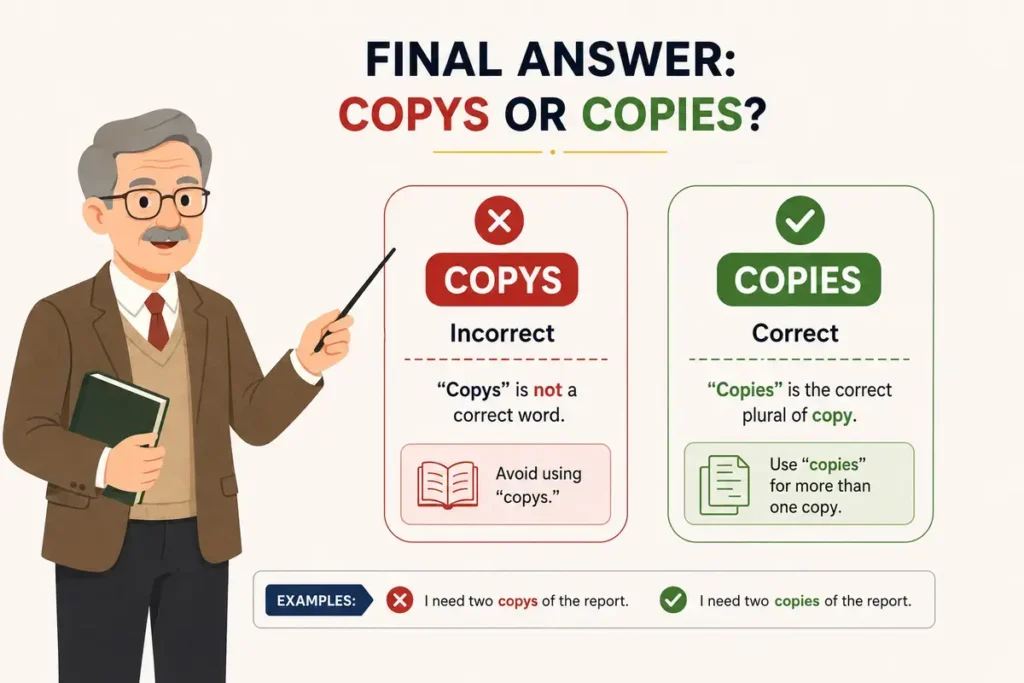
Final Answer: Copys or Copies?
When choosing the correct word is copies.
Use copy for one item and copies for more than one item.
Copys is not accepted in standard English writing.
Remember: One copy, two copies.
Still confused? Compare Instalments or Installments: Complete Grammar Guide 2026.
Conclusion
The choice between copys or copies is actually very simple once you know the rule. Copies is the correct plural form of copy. Copys is considered a spelling mistake in standard English. Whenever you mean more than one copy, use copies. This spelling appears in books, schools, offices, websites, and professional writing. Remember the easy pattern:
- City → Cities
- Baby → Babies
- Story → Stories
- Copy → Copies
Follow this rule, and you will avoid one of the most common English spelling mistakes.
Frequently Asked Questions (FAQs)
Is copies the correct spelling?
Yes. Copies is the correct plural form of copy.
Is copys ever correct?
No. Copys is considered a spelling mistake in standard English.
Why do people write copys?
Many people simply add s without remembering the spelling rule for words ending in y.
What is the singular form of copies?
The singular form is copy.
How do I remember the difference?
Think of city and cities. Copy follows the same pattern and becomes copies.
Can I use copies in formal writing?
Yes. Copies is correct in formal, academic, and professional writing.
What does copies mean?
Copies means more than one copy of a document, file, photo, book, or other item.
Is copies used in everyday English?
Yes. People use copies every day at school, work, home, and online.
