
Many people get confused about dutchess vs duchess because the two words look almost the same. A single extra letter changes everything. If you have ever wondered which spelling is correct, you are not alone.
The confusion around dutchess vs duchess happens often in writing, online searches, and even social media posts. Some people assume both forms are acceptable. Others think one is simply an older version of the other. The truth is much simpler.
In this guide, you will learn the real difference between dutchess vs duchess, which form is correct in standard English, why people mix them up, and how to use the right word with confidence in everyday situations.
A related grammar guide is Bailer or Baler: Difference Explained Simply 2026 Guide.
Simple Answer in One Look: Dutchess vs Duchess
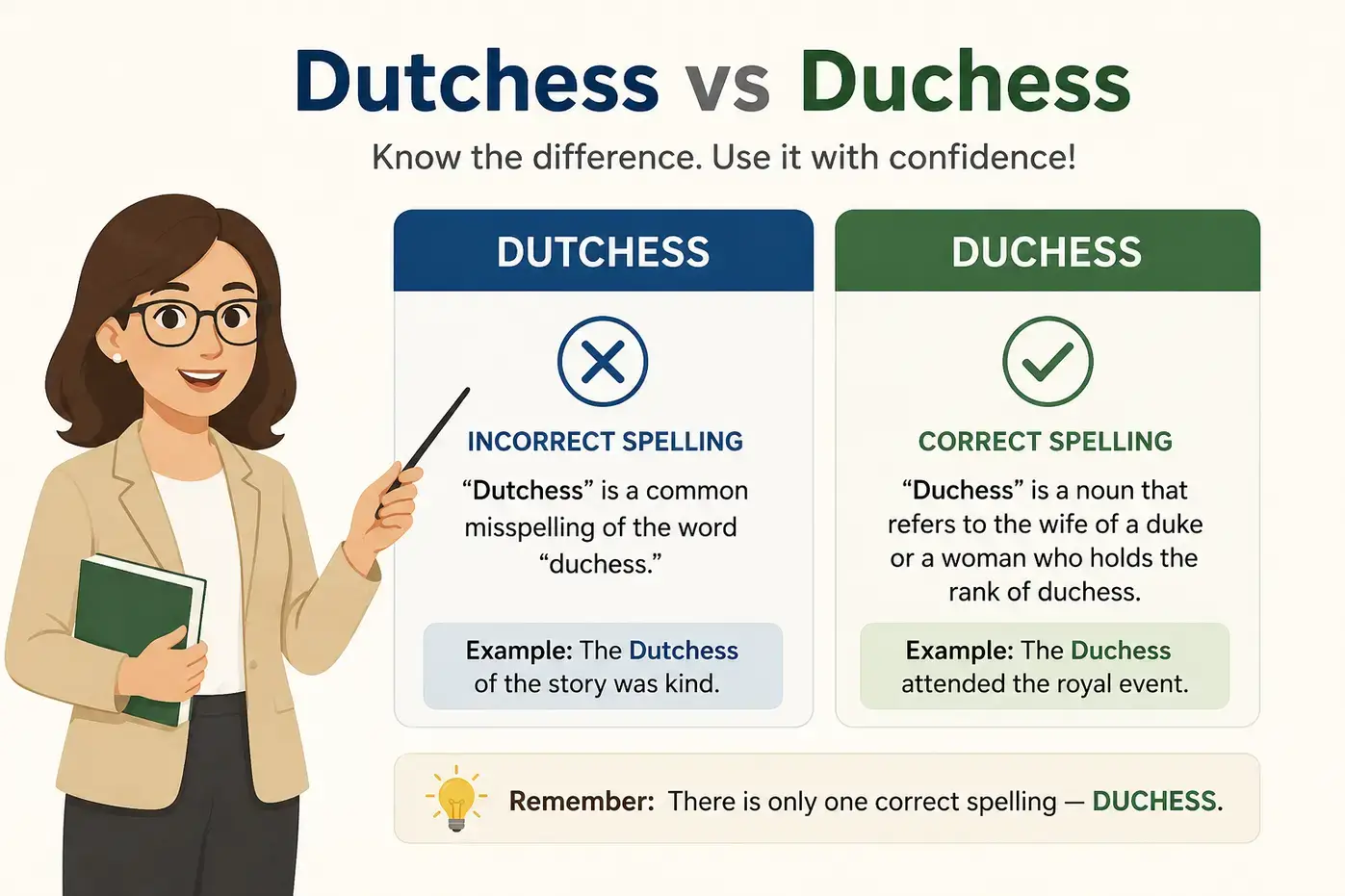
Duchess is the correct English word for a female duke or the wife of a duke.
Dutchess is usually considered a misspelling of duchess, although it may appear in place names or business names.
If you are writing standard English, use duchess.
What Does Dutchess vs Duchess Mean in Simple English?
To understand dutchess vs duchess, think about royalty.
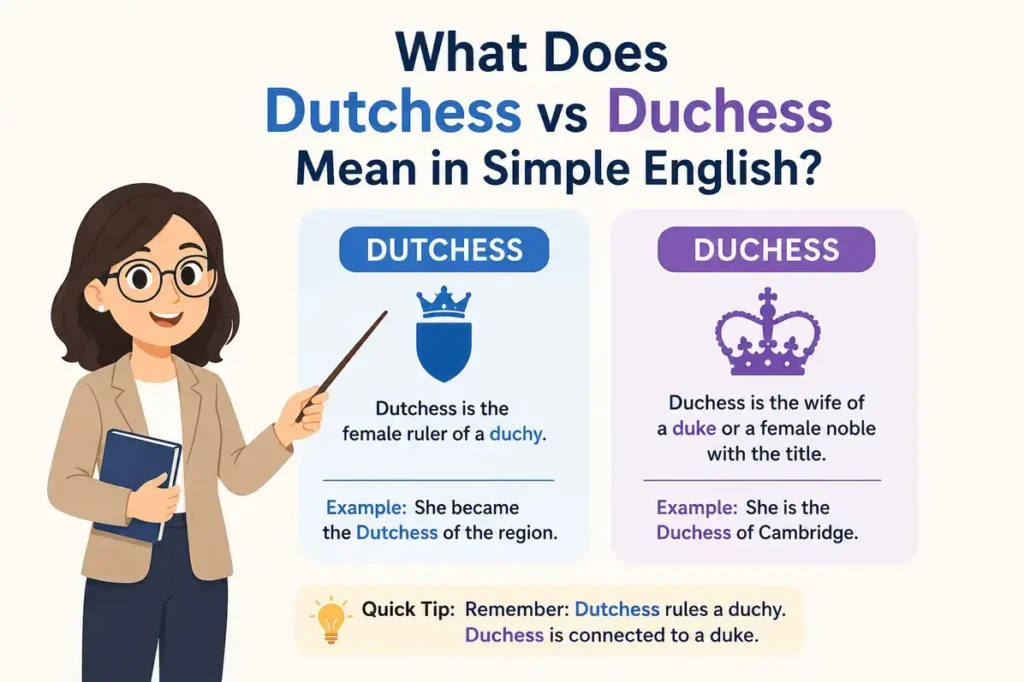
A duchess is a woman who holds the rank of duke or is married to a duke. This title belongs to noble families in some countries.
For example:
- A duke is a high-ranking nobleman.
- A duchess is the female version of a duke.
The word dutchess, on the other hand, does not have the same meaning in regular English dictionaries. Most of the time, it appears because someone accidentally adds the letter “t” while spelling duchess.
Imagine a student writing quickly during a test. They know the word sounds like “duchess,” but they type dutchess instead. This small spelling mistake happens more often than you might expect.
What Is a Duchess?
A duchess is:
- A woman with the rank of duke.
- The wife of a duke.
- A member of certain royal or noble families.
For example:
- The duchess attended the charity event.
- The young duchess became popular because of her kindness.
Is Dutchess a Real Word?
In everyday English, dutchess is not accepted as the correct spelling for the royal title.
However, you may see Dutchess used in:
- County names.
- Company names.
- Brand names.
- Local organizations.
When referring to nobility, duchess is the correct choice.
Why Do People Mix Dutchess vs Duchess?
The confusion between dutchess vs duchess happens for several simple reasons.
1. The Words Sound Similar
People often spell words based on how they sound.
The pronunciation of duchess can lead some writers to believe there should be a “t” in the middle. As a result, they write dutchess.
2. English Spelling Can Be Tricky
English contains many words that do not follow obvious spelling patterns.
For example:
- Watch → watched
- Catch → catcher
- Dutch → Dutchman
Because people already know the word Dutch, they sometimes mistakenly connect it with duchess.
3. Typing Errors Are Common
Modern writing happens quickly.
People type emails, social media posts, and messages without checking every word. A simple extra letter can turn duchess into dutchess.
4. Search Engines Show Similar Results
If someone searches for dutchess vs duchess, search engines often understand the intended meaning.
This can make people think both spellings are equally acceptable.
5. Lack of Exposure to Royal Titles
Not everyone uses words related to nobility in daily life.
Many people rarely encounter terms such as:
- Duke
- Duchess
- Countess
- Baroness
Without frequent exposure, spelling mistakes become more likely.
Dutchess vs Duchess: Clear Difference Explained Simply
Understanding the difference becomes easy when you see the words side by side.
Duchess
Meaning: A female duke or the wife of a duke.
Correct in standard English? Yes.
Used for: Royal and noble titles.
Example: The duchess greeted the guests warmly.
Dutchess
Meaning: Usually a misspelling of duchess.
Correct in standard English? No.
Used for: Sometimes appears in proper names.
Example: Dutchess County is located in New York.
Mini Comparison Table
| Feature | Duchess | Dutchess |
|---|---|---|
| Standard English spelling | Yes | No |
| Refers to nobility | Yes | No |
| Found in dictionaries | Yes | Usually no |
| Common writing mistake | No | Yes |
| May appear in names | Rarely | Sometimes |
Easy Way to Remind Dutchess vs Duchess
Think of these two words:
- Duke → Duchess
- Count → Countess
Notice how both female titles end with -ess.
There is no extra “t” added.
This simple trick can help you avoid the mistake forever.
Which Form Should You Use?
The answer is straightforward.
Use duchess whenever you are talking about a female noble title.
Examples include:
- historical writing,
- biographies,
- news articles,
- classroom assignments,
- everyday conversations about royalty.
Avoid using dutchess unless you are writing the official name of a place or organization.
Use Duchess When:
- Referring to a female duke.
- Mentioning royal families.
- Writing academic content.
- Creating professional documents.
- Using standard English.
Examples:
- The duchess hosted a fundraiser.
- Everyone admired the duchess for her charity work.
- The duchess traveled across the country.
Use Dutchess Only When It Is Part of a Name
Examples:
- Dutchess County
- Dutchess Community College
- Businesses with “Dutchess” in their official titles
In these situations, changing the spelling would actually be incorrect because proper names should remain exactly as they are.
A Simple Rule to Remember Dutchess vs Duchess
Ask yourself this question:
Am I talking about a royal title?
If the answer is yes, choose duchess.
If you are copying an official place name that uses Dutchess, keep that original spelling.
This rule works almost every time.
Easy Real-Life Sentences You Can Use
Reading examples helps new vocabulary stick in your memory.
Here are some simple sentences using duchess correctly.
- The duchess visited the local school.
- Everyone applauded when the duchess entered the hall.
- The duchess supported many community projects.
- We learned about the duchess in history class.
- The duchess wore a beautiful blue dress.
- A famous duchess inspired people around the world.
- The young duchess enjoyed meeting children at the event.
- The newspaper published an article about the duchess.
Now look at these examples:
- ❌ The dutchess attended the ceremony.
- ✅ The duchess attended the ceremony.
- ❌ She became a dutchess after marriage.
- ✅ She became a duchess after marriage.
The correct spelling for the title is always duchess.
Where Dutchess vs Duchess Comes From (Simple History)
The word duchess has a long history. It developed from older European languages connected to noble titles. The male title duke has existed for many centuries. Over time, English created the feminine form duchess by adding the ending -ess. This ending was commonly used to show female versions of certain titles. For example:
- Prince → Princess
- Count → Countess
- Host → Hostess
- Duke → Duchess
As English evolved, duchess became the accepted spelling. The form dutchess never developed as the standard version of the title. Instead, it mostly appeared through spelling mistakes or as part of certain proper names. Understanding the history makes the spelling easier to remember. The title follows a traditional pattern that English speakers have used for generations.
Why This History Matters
Knowing where words come from can improve spelling. Instead of memorizing random letters, you begin to see patterns. In this case:
- Duke becomes duchess.
- Count becomes countess.
- Prince becomes princess.
Once you recognize these patterns, choosing the correct form becomes much easier. As your understanding grows, you may also start noticing how language reflects culture, history, and social traditions. In the next section, we will move beyond simple spelling rules and explore deeper questions about usage, cultural context, common misconceptions, and situations where people still struggle with dutchess vs duchess today.
Dutchess vs Duchess: How This Word Is Understood in Culture and Stories
When people hear the word duchess, they often think about royal families, grand palaces, and historical stories. In books and movies, a duchess is usually shown as an important woman with social influence and responsibilities.
However, not every duchess in stories is the same. Some are kind and generous. Others are strict or ambitious. The title itself does not describe a person’s character. It simply describes a noble position.
The confusion in dutchess vs duchess becomes more noticeable because popular culture frequently uses royal titles. People may see the correct spelling in one place and the incorrect spelling in another, especially on social media or unofficial websites. In children’s stories, historical novels, and television dramas, the word duchess often represents:
- Grace and elegance.
- Leadership within noble families.
- Responsibility toward others.
- Wealth and social status.
- Historical traditions.
The spelling dutchess does not carry these cultural meanings. It is generally viewed as a spelling error unless it appears as part of an official name.
Learn the difference in Comprable vs Comparable: Easy Meaning, and Examples.
Dutchess vs Duchess: Biblical and Mythological Meaning (If Applicable)
When discussing dutchess vs duchess, many people wonder if these words have a biblical meaning.
The simple answer is no.
The Bible does not commonly use the title duchess because the social systems described in biblical times were different from later European noble systems.
Similarly, major mythological traditions do not usually include the title duchess as an important role.
That said, stories from different cultures often include women with leadership positions. While they may not be called duchesses, they can represent similar ideas such as:
- Wisdom.
- Responsibility.
- Courage.
- Service to others.
It is helpful to remember that duchess is mainly a historical and cultural title rather than a religious term.
The spelling dutchess has no recognized biblical or mythological meaning.
Dutchess vs Duchess: Symbolism Explained in Simple Words
Words sometimes carry symbolic meanings beyond their dictionary definitions. In the case of dutchess vs duchess, the symbolic difference is quite clear.
Dutchess vs Duchess: What Duchess Represents
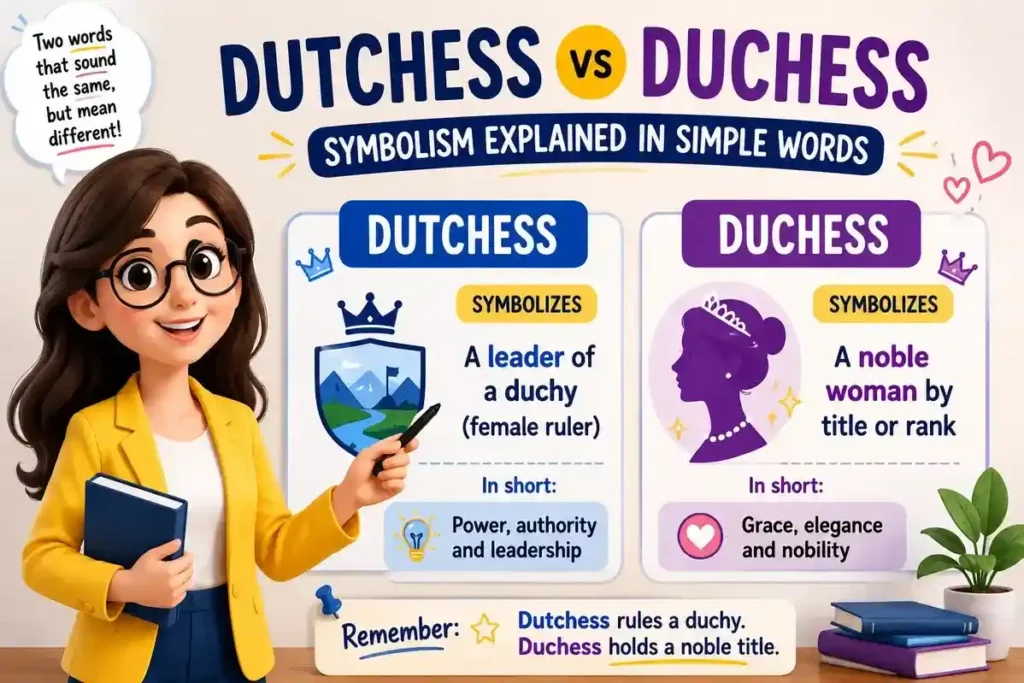
The word duchess often symbolizes:
- Leadership.
- Respect.
- Tradition.
- Elegance.
- Responsibility.
- Social influence.
Because duchesses appear in historical records and cultural stories, people may associate the title with dignity and service. For example, someone might say: “She handled the situation with the grace of a duchess.” In this sentence, the speaker is describing poise and confidence.
Dutchess vs Duchess: What Dutchess Represents
The word dutchess usually represents something very different. In most situations, it symbolizes:
- A spelling mistake.
- Confusion between similar-looking words.
- A typing error.
However, when Dutchess appears in official names, it simply represents that specific organization or place. For example:
- Dutchess County.
- Dutchess Community organizations.
Outside these special cases, dutchess does not carry the cultural symbolism associated with duchess.
Simple Comparison
Think of it this way:
- Duchess = noble title with historical meaning.
- Dutchess = usually an incorrect spelling.
This easy comparison helps many learners remember the difference.
Related Words You Should Know
Learning related vocabulary can strengthen your understanding of dutchess vs duchess.
Duke
A duke is a male noble title in certain countries. Example: The duke attended the ceremony.
Duchess
The female form of duke. Example: The duchess greeted visitors warmly.
Prince
A male member of a royal family.
Example: The prince represented the king.
Princess
The female counterpart of prince.
Example: The princess spoke to the children.
Count
A noble title used in some European traditions.
Example: The count managed large estates.
Countess
The female form of count.
Example: The countess hosted the gathering.
Baron
A lower-ranking noble title.
Example: The baron advised the ruler.
Baroness
The female version of baron.
Example: The baroness supported charitable causes.
Nobility
People who belong to a noble social class.
Example: Many members of the nobility attended the celebration.
These related terms can help you understand how noble titles work in English.
Dutchess vs Duchess: How People Actually Use It in Daily English
Most people do not use the word duchess every day. Still, it appears in many real-life situations. You may hear it in:
- History lessons.
- News reports.
- Books.
- Movies.
- Online discussions about royal families.
Here are some natural examples.
- “I watched a documentary about a famous duchess.”
- “Our teacher explained what a duchess was during history class.”
- “The novel featured a young duchess who wanted independence.”
- “I accidentally typed dutchess instead of duchess.”
- “Can you check if I spelled duchess correctly?”
- “That television series focused on the life of a duchess.”
- “The article discussed the duties of a duchess.”
- “I saw the word Dutchess in the name of a county.”
- “Many people search for dutchess vs duchess online.”
- “Once you learn the difference, it becomes easy to remember.”
These examples show that duchess is mainly used in educational, historical, and cultural contexts.
Dutchess vs Duchess: Common Mistakes People Make
Many learners make the same mistakes while writing these words. The good news is that they are easy to fix.
Mistake 1: Adding an Extra Letter
Incorrect:
- Dutchess.
Correct:
- Duchess.
Remember:
There is no extra “t” in the royal title.
Mistake 2: Assuming Both Spellings Are Acceptable
Some people believe both forms are interchangeable. This is incorrect. Use duchess in standard English writing.
Mistake 3: Ignoring Context
Sometimes Dutchess appears in proper names. For example:
- Dutchess County.
Changing that official spelling would be a mistake. Always pay attention to context.
Mistake 4: Relying Only on Spell Check
Technology can help, but it is not perfect. Understanding the actual meaning behind the word gives you greater confidence.
Mistake 5: Memorizing Without Understanding
Students sometimes memorize spellings without learning why they exist. A better approach is this:
- Duke → Duchess.
This connection makes the correct spelling easier to remember.
Dutchess vs Duchess: Final Teacher Explanation
Imagine we are finishing today’s classroom lesson. A student raises their hand and asks: “Teacher, how do I know which word to use?” My answer would be simple.
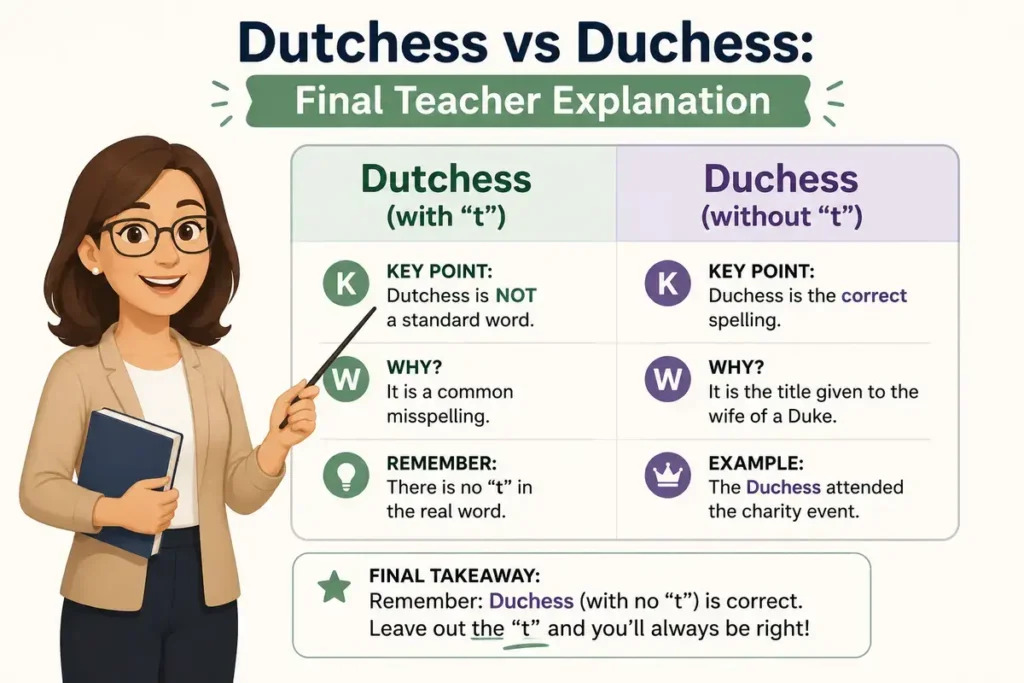
If you are talking about a female noble title, use duchess. If you see Dutchess as part of an official place name or organization, keep that original spelling. Most of the confusion comes from the words looking and sounding similar. You do not need to memorize long grammar rules. Just remember this pattern:
- Duke becomes duchess.
- Count becomes countess.
- Baron becomes baroness.
English can sometimes feel challenging, but small spelling differences become easier once you understand the meaning behind them. As a teacher, I encourage students to focus on understanding rather than memorizing.
When you understand why a word exists, correct usage becomes natural. The next time you encounter dutchess vs duchess, you will know exactly what to do. Choose duchess for the title. Use Dutchess only when copying an official name. That is the key lesson.
Dutchess vs Duchess: Final Answer (Quick Recap)
The correct spelling for the female title of a duke is duchess. The form dutchess is usually a spelling mistake, although it may appear in official names such as places or organizations. When writing standard English, remember this simple rule: If you mean the noble title, always use duchess.
Many readers also check Lay vs Lie: Which One Should You Use Grammar Guide 2026?.
Conclusion
Understanding dutchess vs duchess does not have to be difficult. At first glance, the two words seem almost identical. Yet their uses are very different. Duchess is the accepted English term for a female duke or the wife of a duke. It has historical roots and continues to appear in books, news reports, and discussions about royal families.
Meanwhile, dutchess is generally considered an incorrect spelling when referring to that title. The only common exceptions occur when it forms part of an official name. The easiest way to remember the difference is to connect duchess with duke. Once that relationship becomes clear, the correct spelling feels much more natural.
As with many areas of English, practice builds confidence. The more often you read and use the correct form, the less likely you are to make mistakes. Keep learning one word at a time. Small improvements lead to strong communication skills.
Frequently Asked Questions (FAQs)
What does duchess mean in simple words?
A duchess is a woman who holds the rank of duke or is married to a duke.
Is dutchess or duchess correct?
Duchess is the correct spelling for the noble title. Dutchess is usually a misspelling.
Why do people confuse dutchess vs duchess?
The words look and sound similar, which makes spelling mistakes common.
Can I use both forms in writing?
No. Use duchess in standard English. Use Dutchess only if it is part of an official name.
When should I use the word duchess?
Use it when referring to a female duke or the wife of a duke.
Is Dutchess a real word?
It may appear in proper names, but it is not the standard spelling of the royal title.
How can I remember the correct spelling?
Think of this pattern: Duke → Duchess. There is no extra “t.”
Does duchess have a biblical meaning?
No. The title is mainly connected to European nobility rather than biblical traditions.
