
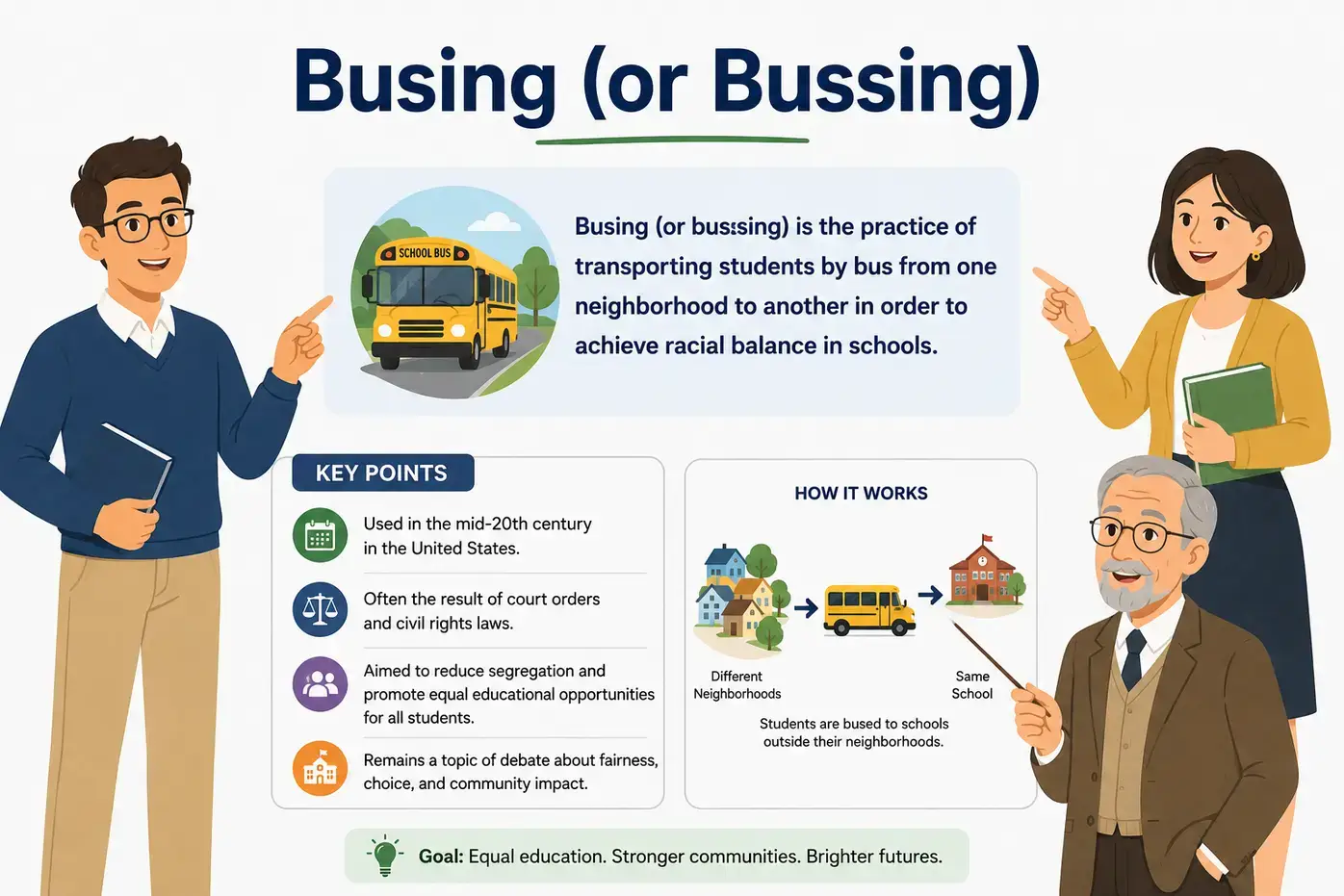
Many people get confused about busing or bussing because both spellings appear in English. You may see one version in a school article and another in a restaurant job ad. That can make it hard to know which one is correct.
The good news is that both busing and bussing are accepted spellings in English. The preferred form often depends on the meaning, style guide, and country where the English is being used. If you have ever wondered this guide will explain the difference in very simple words. By the end, you will know which spelling to use and why.
Need another quick comparison? Read Steam vs Steem: Which Is Correct And Simple Meaning (2026).
Busing or Bussing: Simple Answer in One Look
Both “busing” and “bussing” are correct.
- Busing is often used when talking about transportation by bus.
- Bussing is commonly used when talking about clearing tables in restaurants.
- Some style guides accept either spelling.
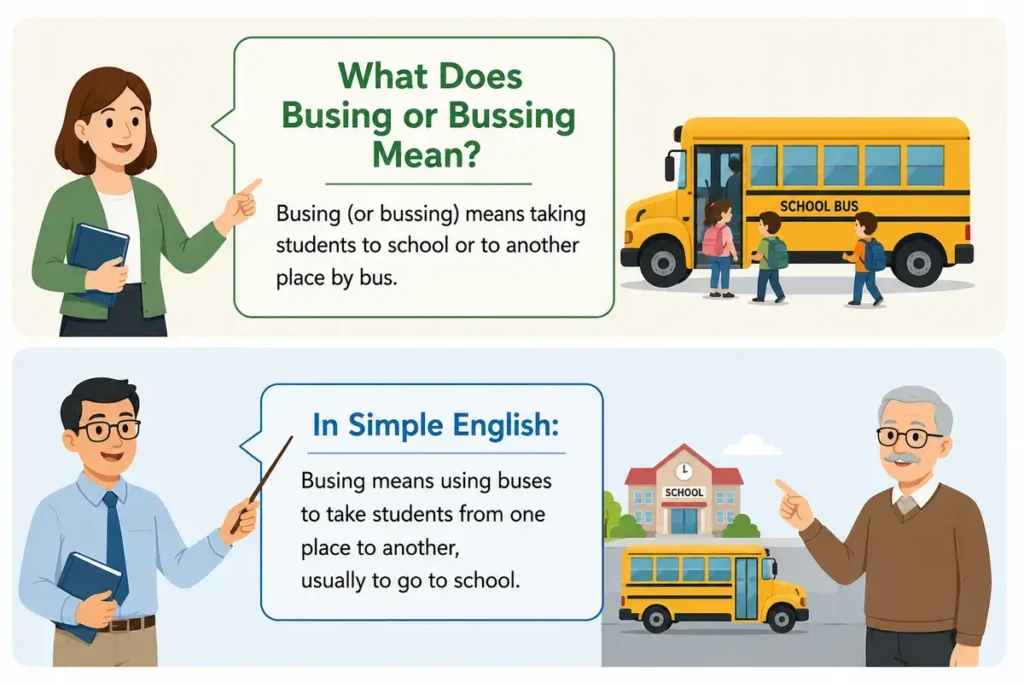
What Does Busing or Bussing Mean in Simple English?
The words come from the noun bus. When used as a verb, they can mean:
- Carrying people by bus.
- Moving students or passengers from one place to another by bus.
- Clearing dirty dishes from restaurant tables.
For example:
- The school is busing students to the museum.
- The worker is bussing tables after lunch.
The meaning usually becomes clear from the sentence.
Why Do People Mix These Words Busing or Bussing?
People mix up for a few simple reasons.
Both Spellings Exist
Unlike many English words, both versions are accepted. When people see two correct spellings, confusion naturally happens.
Different Style Guides Prefer Different Forms
Some dictionaries show both spellings. Some editors prefer busing. Others prefer bussing, especially in restaurant-related writing.
The Double-S Rule
Many English learners think a word must double the final consonant before adding “-ing.” For example:
- run → running
- sit → sitting
Because of this pattern, many people expect:
- bus → bussing
But English does not always follow one simple rule.
Different Countries Use Different Preferences
American English often favors busing for transportation. Many restaurant businesses still use bussing when talking about table service. Because both forms appear in real life, people become unsure which one to choose.
Clear Difference Explained Simply
Here is the easiest way to understand busing or bussing.
Busing
Usually connected with transportation. Examples:
- Busing students to school.
- Busing passengers to the airport.
- Busing workers to a job site.
Bussing
Often connected with restaurants. Examples:
- Bussing tables.
- Bussing dishes.
- Bussing trays after customers leave.
Quick Comparison
Busing
- Common in transportation
- Often used for schools and travel
- Frequently seen in news writing
Bussing
- Common in restaurants
- Often used for clearing tables
- Frequently seen in hospitality jobs
Remember that many dictionaries accept both spellings, but these usage patterns are common.
Which Form Should You Use?
The best choice depends on what you are writing.
Use “Busing” When Talking About Transportation
Examples:
- The district is busing students across town.
- The company is busing workers to the factory.
- Visitors are being busing to the event site.
Many American publications prefer this spelling.
Use “Bussing” When Talking About Restaurant Work
Examples:
- She spent the afternoon bussing tables.
- The restaurant hired workers for bussing duties.
- He was bussing dishes after dinner.
This spelling helps readers quickly understand that you are talking about restaurant service.
If Your Style Guide Says Otherwise
Always follow the style guide used by your school, workplace, or publisher. Consistency matters more than choosing one spelling over the other.
Easy Real-Life Sentences You Can Use for Busing or Bussing
Here are some simple examples.
- The school is busing students to the science center.
- Our company is busing employees to the conference.
- She was bussing tables during the lunch rush.
- The waiter spent the evening bussing dishes.
- The city is busing visitors to the festival.
- He earned extra money by bussing tables on weekends.
- The team was busing players to the stadium.
- They finished bussing the tables before closing time.
These examples show how context helps readers understand the meaning.
Busing or Bussing: Where This Word Comes From (Simple History)
The word bus comes from a longer word that was used for public transportation many years ago. As buses became common, people started using bus as both a noun and a verb. For example:
- noun: We rode the bus.
- verb: The school bused students to another building.
Over time, writers began using different spellings when adding endings like -ed and -ing. That is one reason why both busing and bussing appeared in English. Eventually, dictionaries accepted both forms. Today, people still use both spellings depending on context, industry, and personal preference.
As English changed over the years, the two versions continued to exist side by side. That is why the question still comes up so often. In the next section, we will look at deeper meanings, cultural use, symbolism, common mistakes, and practical tips that make these words even easier to understand.
How Is Busing or Bussing Understood in Culture and Stories?
These words are usually connected with movement, work, and helping people. When people hear busing, they often think about school buses, city transportation, or groups of people traveling together. It can remind people of daily life, education, and community services.
When people hear bussing, they often think about restaurant workers. In many movies, TV shows, and stories, young workers start by bussing tables before moving into bigger jobs. Because of this, the word can suggest hard work, learning, and responsibility. Neither word is emotional on its own. Their meaning mostly comes from the situation in which they are used. For example:
- A school story may talk about busing students to a new school.
- A restaurant story may describe a teenager bussing tables after class.
Both words are connected to everyday life, which is why most English speakers understand them easily.
Many readers also check Immerse vs Emerse: Meaning, Usage, and Correct Word Guide.
Does Busing or Bussing Have a Biblical or Mythological Meaning?
No. Busing or bussing does not have a direct biblical meaning. The words are modern terms that developed from the word bus, which refers to transportation. You will not find these words in ancient myths or traditional religious stories. However, some people may connect the ideas behind the words with larger themes such as:
- Service
- Helping others
- Travel
- Community
- Working together
These ideas appear in many cultures and religions, but the words themselves do not have a special biblical or mythological meaning.
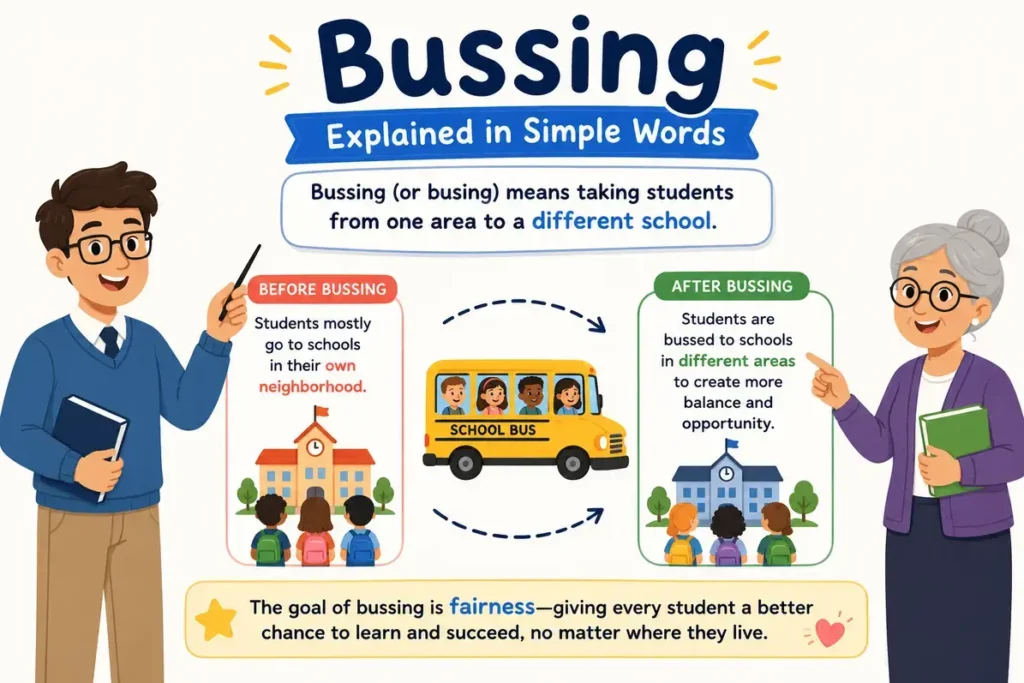
Symbolism Busing or Bussing Explained in Simple Words
Sometimes words can suggest ideas beyond their basic meaning.
What One Version Represents: Busing
The spelling busing is often linked to transportation. Because of that, people may connect it with:
- Moving forward
- Progress
- Education
- Travel
- Bringing people together
For example, school busing helps students reach their destination. Symbolically, it can represent a journey or a path toward learning.
What the Other Version Represents: Bussing
The spelling bussing is often linked to restaurant work. Because of that, people may connect it with:
- Service
- Responsibility
- Teamwork
- Hard work
- Starting small and growing
Many workers begin with entry-level jobs such as bussing tables. For this reason, the word can symbolize effort and learning through experience.
Simple Comparison
| Busing | Bussing |
|---|---|
| Transportation | Restaurant work |
| Movement | Service |
| Travel | Teamwork |
| Education | Responsibility |
| Getting somewhere | Helping others |
These symbolic meanings are not official definitions. They are simply ideas people may connect with the words.
Related Words You Should Know about Busing or Bussing
When learnin it helps to know a few related words.
Bus
A vehicle that carries many passengers. Example:
We took a bus downtown.
Bused
Past tense of bus. Example:
The students were bused to another campus.
Transport
Moving people or things from one place to another. Example:
The company transports workers every day.
Transit
A public transportation system. Example:
The city has a good transit network.
Table Service
Helping customers in a restaurant. Example:
The restaurant offers full table service.
Waiter
A person who serves food and drinks. Example:
The waiter brought our order quickly.
Busser
A restaurant worker who clears tables. Example:
The busser cleaned the table after we left.
Passenger
A person traveling in a vehicle. Example:
The bus carried fifty passengers.
Knowing these words makes it easier to understand how is used in real English.
How Do People Actually Use Busing or Bussing in Daily English?
Most people use these words in very normal situations. Here are some examples you may hear.
- The school is busing students to the sports event.
- They are busing workers from the parking area.
- My cousin spent the summer bussing tables.
- She started her restaurant career by bussing dishes.
- The city is busing visitors to the festival grounds.
- He worked evenings bussing tables to earn extra money.
- The district is busing children to a larger school.
- We saw employees bussing tables after lunch.
- The company is busing staff to the construction site.
- She learned a lot while bussing in a busy restaurant.
These examples show that context usually tells you which meaning is intended.
Common Mistakes People Make With Busing or Bussing
Many learners make the same mistakes. Here are the most common ones.
Mistake 1: Thinking Only One Spelling Is Correct
Incorrect idea:
- Only busing is correct.
- Only bussing is correct.
Correction:
Both spellings are accepted in English.
Mistake 2: Using Different Spellings in the Same Article
Example:
- The school is busing students.
- The district began bussing students.
Correction:
Choose one style and stay consistent unless there is a reason to switch.
Mistake 3: Forgetting the Meaning Changes With Context
Some people think the spelling always changes the meaning. Correction: Context matters more than spelling. Readers usually understand the meaning from the sentence.
Mistake 4: Mixing Up Bus and Busser
Incorrect:
He worked as a bus.
Correct:
He worked as a busser.
A bus is a vehicle.
A busser is a restaurant worker.
Mistake 5: Following Social Media Instead of a Style Guide
Many online posts use whichever spelling the writer prefers.
Correction:
If you are writing for school, work, or publication, follow the required style guide.
Final Teacher Explanation of Busing or Bussing
Imagine you are sitting in my classroom and asking: “Which is correct?” My answer would be simple. Both are correct.
If you are talking about transportation, many writers prefer busing.
If you are talking about restaurant work, many writers prefer bussing.
The most important thing is understanding your audience and being consistent throughout your writing. Do not worry if you see both spellings in books, articles, or websites. English often allows more than one accepted spelling. When you read the whole sentence, the meaning usually becomes very clear. So instead of memorizing complicated rules, remember this simple idea:
- Busing often relates to transportation.
- Bussing often relates to restaurant service.
That one rule will help you most of the time.
Final Answer: Busing or Bussing?
Both busing and bussing are correct spellings.
Busing is commonly used for transportation and moving people by bus.
Bussing is commonly used for clearing tables in restaurants.
If your school, company, or publisher has a style guide, follow that guide and stay consistent.
Learn the difference in Woman vs Women: Easy Difference Explained Clearly (2026).
Conclusion
The question of busing or bussing confuses many English learners because both spellings exist. The good news is that both forms are accepted.
In everyday English, busing is often connected with transportation, schools, and travel. Bussing is often connected with restaurant work and clearing tables. Even so, context matters more than spelling in many situations.
The easiest way to remember the difference is this: think of busing when people are riding a bus and bussing when workers are clearing tables. If you follow that simple rule and stay consistent in your writing, you will use these words correctly with confidence.
Frequently Asked Questions (FAQs)
Is correct?
Yes. Both spellings are correct and accepted in English.
What is the difference?
Busing is often used for transportation. Bussing is often used for restaurant table service.
Which spelling is more common?
Many writers use busing for transportation, while many restaurants use bussing for table-clearing duties.
Can I use both forms in the same article?
You can, but it is usually better to stay consistent unless the meanings are different.
Is bussing tables correct English?
Yes. Bussing tables is a common phrase in restaurants.
Is busing students correct English?
Yes. Busing students is a common phrase in schools and transportation discussions.
Why do people get confused?
People get confused because both spellings are accepted and appear in different situations.
Which spelling should students use?
Students should follow their teacher’s preferred style guide. If no guide exists, busing is widely accepted for transportation topics.
