
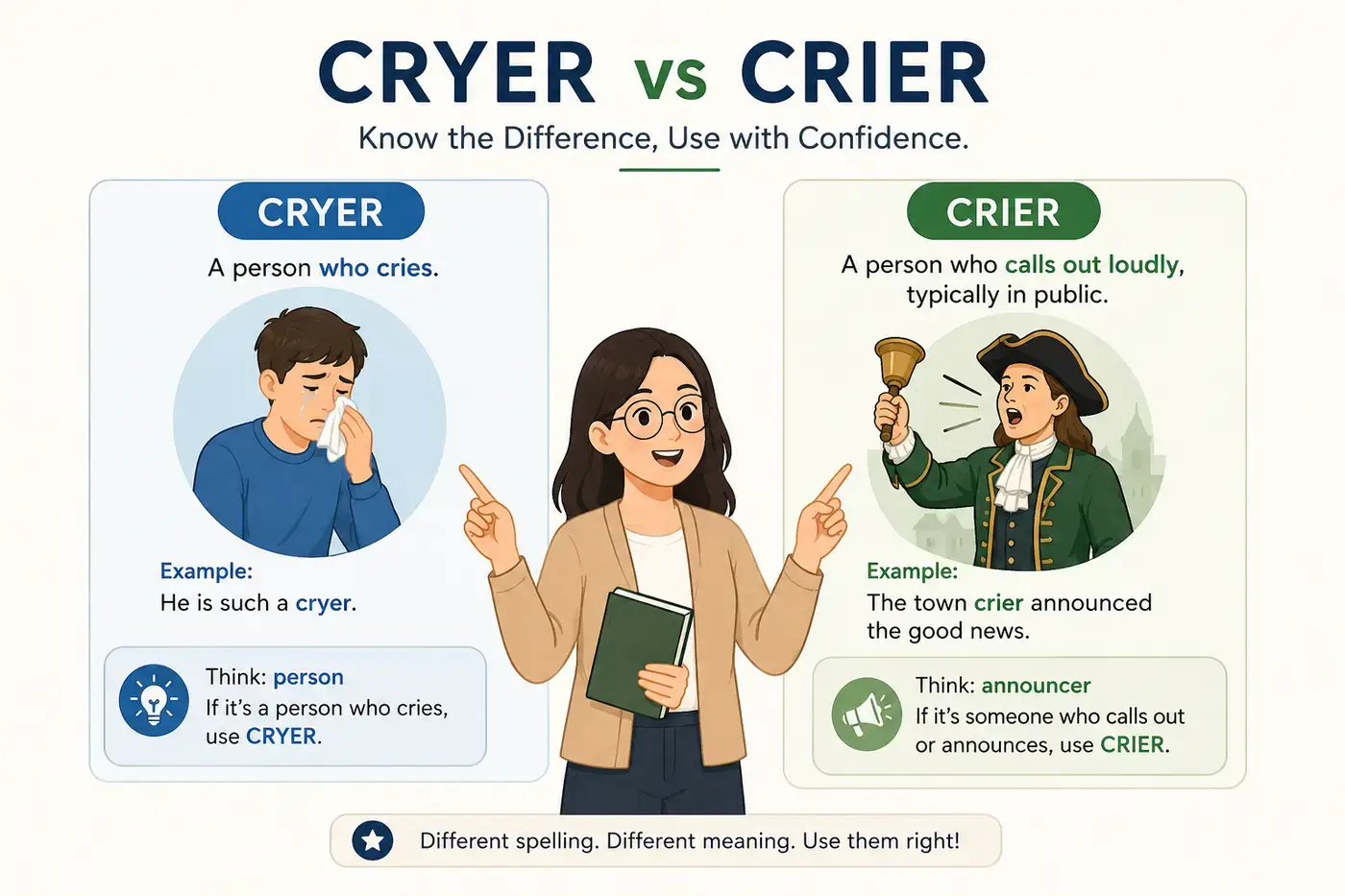
Many people get confused about cryer vs crier because both words look almost the same. You may see one spelling in old books and another in modern writing. That makes it hard to know which one is right.
The good news is that the answer is simple. Once you understand the small difference, you will know which spelling to use in school, at work, and in everyday English. This guide explains in very easy words with clear examples.
If you have ever searched for the difference between and wondered which is correct, or asked how to use crier or cryer, you are in the right place.
For another common grammar confusion, see Receiver vs Reciever: Complete English Guide 2026.
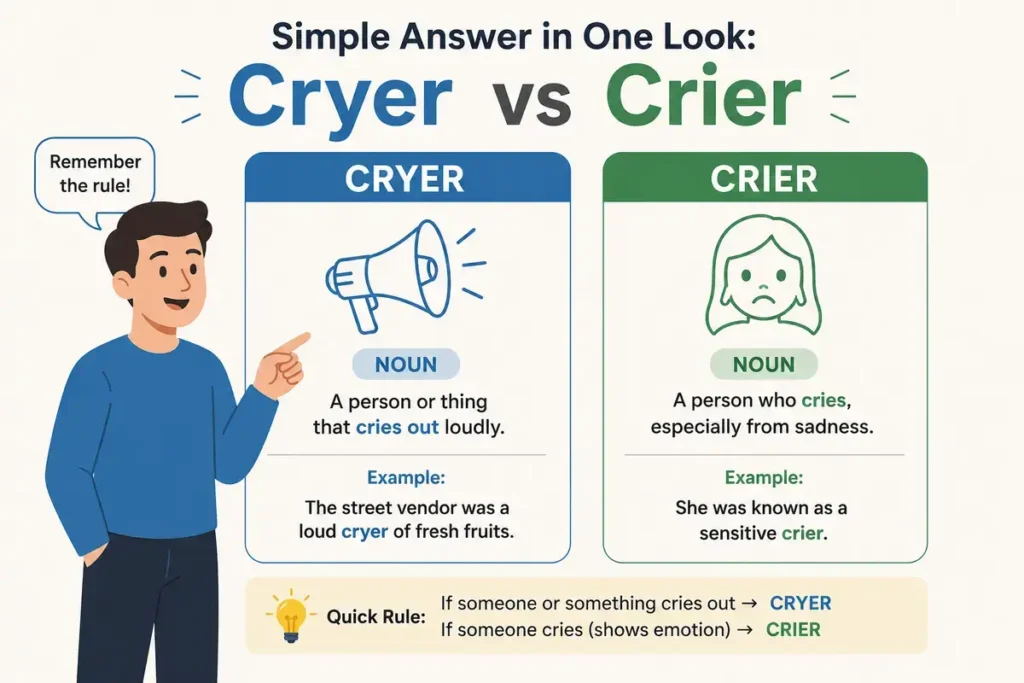
Simple Answer in One Look: Cryer vs Crier
Crier is the correct and modern spelling in almost all situations.
Cryer is an old spelling. Today, it is mainly seen as a last name or in older historical texts.
What Does Cryer vs Crier Mean in Simple English?
To understand words first think about the verb cry.
The word crier comes from the verb cry, but it does not always mean someone who is crying because they are sad. A crier can mean:
- A person who cries often.
- A person who makes public announcements, such as a town crier.
For example:
- My little brother is a loud crier.
- The town crier rang a bell before speaking.
The spelling cryer has the same historical meaning, but modern English almost always uses crier instead. Think of it like this:
- Crier = today’s standard spelling
- Cryer = older or family-name spelling
That is the easiest way to remember the difference.
Why Do People Mix These Words?
Many English words change y to i before adding certain endings. That rule makes people wonder if cry should become cryer or crier. The spelling looks confusing because the base word ends in y. People also mix these words because:
- Both spellings look possible.
- Older books sometimes use cryer.
- Some people have the last name Cryer.
- Spell check may not explain why one spelling is preferred.
- Online discussions often show both forms without explaining the difference.
Imagine seeing these two sentences:
- The town cryer announced the news.
- The town crier announced the news.
Since both seem similar, many learners are unsure which one is correct. The second sentence is the one used in modern English.
Clear Difference Explained Simply
Here is an easy comparison.
| Crier | Cryer |
|---|---|
| Standard modern English spelling | Older spelling |
| Used in dictionaries | Rare in modern writing |
| Means a person who cries or announces news | Mostly found in historical texts or as a surname |
| Best choice for writing today | Usually not recommended for normal writing |
Another simple way to remember it:
Crier
- Modern
- Correct
- Common
- Best for everyday English
Cryer
- Old spelling
- Rare
- Mostly a family name
- Seen in historical writing
If you are writing an essay, email, article, or school paper, choose crier.
Which Form Should You Use for Cryer vs Crier?
If your goal is correct modern English, use crier. Use cryer only if:
- You are talking about a person whose last name is Cryer.
- You are quoting an old document.
- You are discussing historical spellings.
For almost every other situation, crier is the right answer. Here are some simple rules.
Use crier when talking about someone who cries.
Example:
- The baby is a quiet crier.
Use crier when talking about a town crier.
Example:
- The town crier announced the new law.
Use crier in school and professional writing.
Example:
- The article described the town crier’s job.
Use cryer only when the spelling is part of a name or old text.
Example:
- The letter mentioned Mr. Cryer.
These easy rules solve almost every question.
Easy Real-Life Sentences You Can Use
Here are simple examples you can copy and practice.
- The baby is not a loud crier.
- Everyone listened to the town crier.
- She has always been an easy crier during movies.
- The crier rang a bell before speaking.
- My teacher explained why crier is the modern spelling.
- We read an old book that used cryer instead.
- Mr. Cryer visited our school yesterday.
- Most dictionaries recommend crier for normal writing.
Reading these sentences several times will help you remember the correct spelling naturally.
Where Does Cryer vs Crier Come From? (Simple History)
The story behind goes back hundreds of years. Long ago, English spelling was not fixed. Writers often spelled the same word in different ways. That is why both cryer and crier appeared in older books and records. As English became more standardized, dictionaries and publishers began choosing one spelling for many words. Over time, crier became the accepted spelling.
The word comes from the Old French word crier, which meant “to shout” or “to call out.” It later became part of Middle English and kept the spelling crier in standard modern English. That is why you now see:
- town crier
- public crier
- loud crier
The spelling cryer slowly became uncommon except in names and historical documents. So, if you are wondering why both forms exist, the answer is simple: English spelling changed over time, and crier became the standard choice.
As you can see, understanding is not difficult once you know the history and the modern spelling rule. In the next section, we will look at how these words appear in culture, old traditions, literature, symbolism, common mistakes, expert writing tips, and frequently asked questions so you can use crier with complete confidence.
How Is Cryer vs Crier Understood in Culture and Stories?
The words have a long history in stories and everyday life. Even though crier is the modern spelling, the idea behind the word has stayed the same for hundreds of years. Long ago, people did not have phones, television, or the internet. When the king, mayor, or local leaders wanted to share important news, they asked a town crier to tell everyone. The town crier would:
- Ring a bell.
- Stand in a busy place.
- Speak loudly.
- Share news with the public.
This made the town crier an important person in the community. The word crier is also used in another way. It can describe someone who cries easily because of sadness, happiness, fear, or even laughter. For example:
- My sister is a happy crier.
- He is not a big crier.
- The baby became a loud crier after waking up.
In older books, you may also find cryer instead of crier. This does not change the meaning. It simply shows how English spelling looked in the past. Today, stories, movies, and history books almost always use crier.
Still confused? Compare Unkept or Unkempt: Common Mistakes You Should Avoid.
Does Cryer vs Crier Have a Biblical or Mythological Meaning?
The words does not have a special meaning in the Bible. However, the Bible often talks about people who cry out to God. These people ask for help, pray, or warn others. They are described by actions, not by the noun crier. For example, prophets sometimes cried out to the people with important messages.
In mythology, there is no famous character called a crier or cryer. Still, many old stories include messengers who travel from place to place to announce news. These characters are similar to a town crier because they tell people important information. So, while crier is not a biblical or mythological title, the idea of announcing messages appears in many cultures.
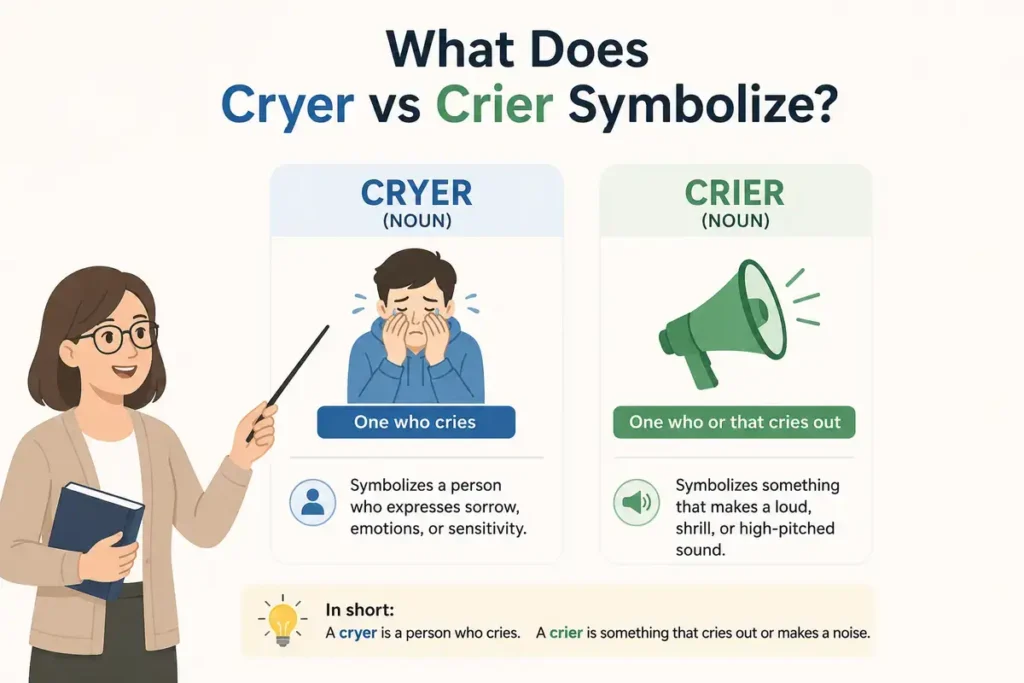
What Does Cryer vs Crier Symbolize?
Words can carry ideas beyond their basic meanings. In cryer vs crier, the modern spelling and the older spelling can remind us of different things.
What Does Crier Represent?
The word crier often represents:
- Speaking important news
- Honest communication
- Public announcements
- Strong emotions
- Open expression
A town crier reminds people that sharing information helps a community stay connected. A person who is called a crier reminds us that showing emotions is a normal part of being human.
What Does Cryer Represent?
The word cryer usually represents:
- Older English spelling
- Family history
- Historical documents
- Traditional writing
Today, cryer is more likely to appear as a surname than as the common noun. When people see cryer, they often think of old records instead of modern English. The meanings are almost the same, but their use is different.
Related Words You Should Know About Cryer vs Crier
Learning similar words makes English easier.
Cry
To shed tears or speak loudly.
Example: She began to cry.
Crying
The action of shedding tears.
Example: The crying baby needed food.
Cried
The past form of cry.
Example: He cried after watching the movie.
Town Crier
A person who announces public news.
Example: The town crier welcomed visitors.
Announcement
Important information shared with many people.
Example: The school made an announcement.
Messenger
Someone who delivers news or messages.
Example: The messenger arrived before sunset.
Herald
A person who officially announces important news.
Example: The herald introduced the king.
Caller
Someone who calls or announces something.
Example: The bingo caller spoke clearly.
These related words help you understand where crier fits in English vocabulary.
How Do People Actually Use Cryer vs Crier in Daily English?
Most people use crier, not cryer, in normal conversation and writing. Here are real-life examples.
- My baby is a quiet crier.
- Jake has always been a happy crier during weddings.
- The town crier welcomed everyone to the festival.
- She is not much of a crier, even during sad movies.
- The old newspaper talked about the town crier.
- Our teacher explained why crier is the correct spelling.
- I saw the spelling cryer in a very old book.
- Mr. Cryer is our new neighbor.
- The museum has a costume worn by a town crier.
- Most dictionaries recommend crier for modern English.
Notice that almost every everyday example uses crier.
Common Mistakes People Make with Cryer vs Crier
Many English learners make the same mistakes. Here are the most common ones.
Mistake 1: Using Cryer in Modern Writing
❌ The town cryer rang the bell.
✅ The town crier rang the bell.
Modern English uses crier.
Mistake 2: Thinking Both Spellings Are Always Equal
Some people believe both spellings are equally common today.
That is not true.
Crier is the accepted modern spelling.
Mistake 3: Forgetting That Cryer Can Be a Last Name
If someone’s family name is Cryer, keep that spelling. Example:
✅ Mr. Cryer visited our class.
Do not change another person’s name.
Mistake 4: Guessing the Spelling
Many learners simply write the version that looks right.
Instead, remember this easy rule:
Modern English = crier
Mistake 5: Mixing Old and New Spellings
If you are writing a school paper, blog post, email, or report, stay with crier unless you are quoting an old document.
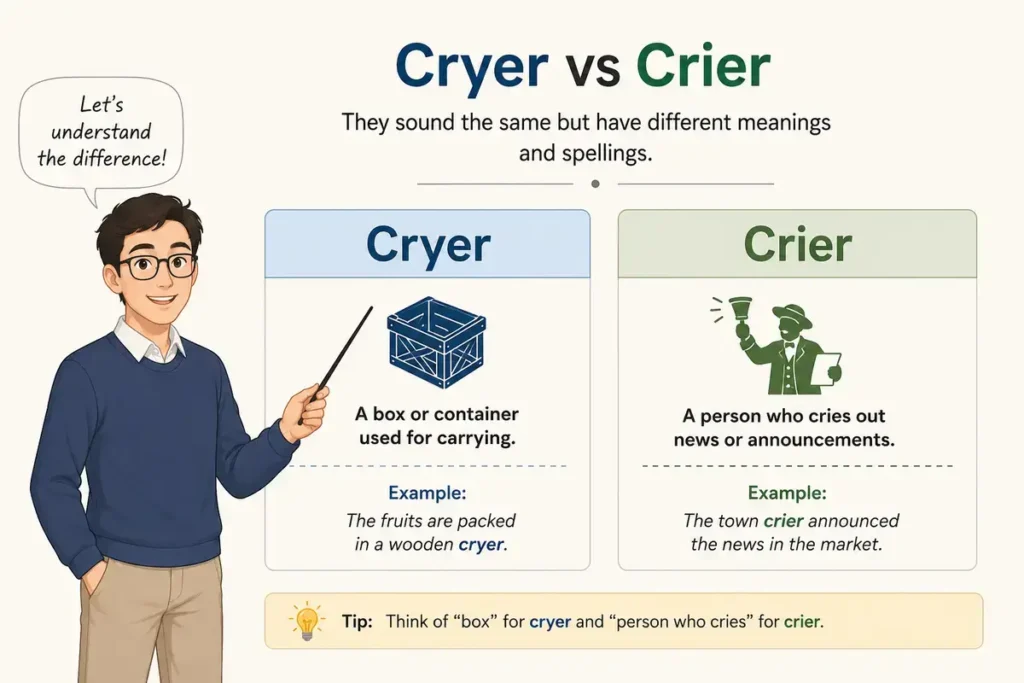
Final Teacher Explanation of Cryer vs Crier
Imagine we are ending today’s English lesson. The question is simple. Which spelling should you use? The answer is crier. It is the spelling used in modern dictionaries, schools, newspapers, books, and websites.
The spelling cryer is not completely wrong because it appeared in older English and still exists as a surname. However, it is not the spelling most people use today.
A simple way to remember the rule is this: If you are writing modern English, choose crier. If you are reading history or talking about someone’s last name, you may see cryer. Once you remember this one rule, you will probably never confuse again.
Final Answer About Cryer vs Crier
The correct modern spelling is crier.
Use crier for someone who cries or for a town crier who announces public news. Use cryer only in historical writing or when it is part of a person’s last name. For almost every situation in modern English, crier is the right choice.
A related grammar guide is Comprable vs Comparable: Easy Meaning, and Examples.
Conclusion
Understanding cryer vs crier is easier than it first seems. Both spellings have the same historical roots, but modern English clearly prefers crier. It is the standard spelling for someone who cries and for a town crier who announces public news. The spelling cryer is now mostly found in old texts or as a surname. If you use crier in everyday writing, you will be following modern English correctly and avoiding one of the most common spelling mistakes.
Frequently Asked Questions
What does crier mean in simple words?
A crier is someone who cries or someone who announces public news, like a town crier.
Is cryer or crier correct?
Crier is the correct spelling in modern English. Cryer is mostly an older spelling or a surname.
Why do people confuse?
The words look very similar, and older books sometimes use cryer, which causes confusion.
Can I use cryer in school writing?
No. Unless you are quoting an old text or writing a person’s last name, use crier.
Is cryer a real English word?
Yes. It is an older spelling and is also used as a family name, but it is rare in modern English.
What is a town crier?
A town crier was a person who walked through a town and loudly announced important news before modern media existed.
Is crier used today?
Yes. It is still used for people who cry easily and when talking about historical town criers.
How can I remember the difference?
Remember this simple rule: Modern English uses crier. Cryer is mainly for history or names.
