
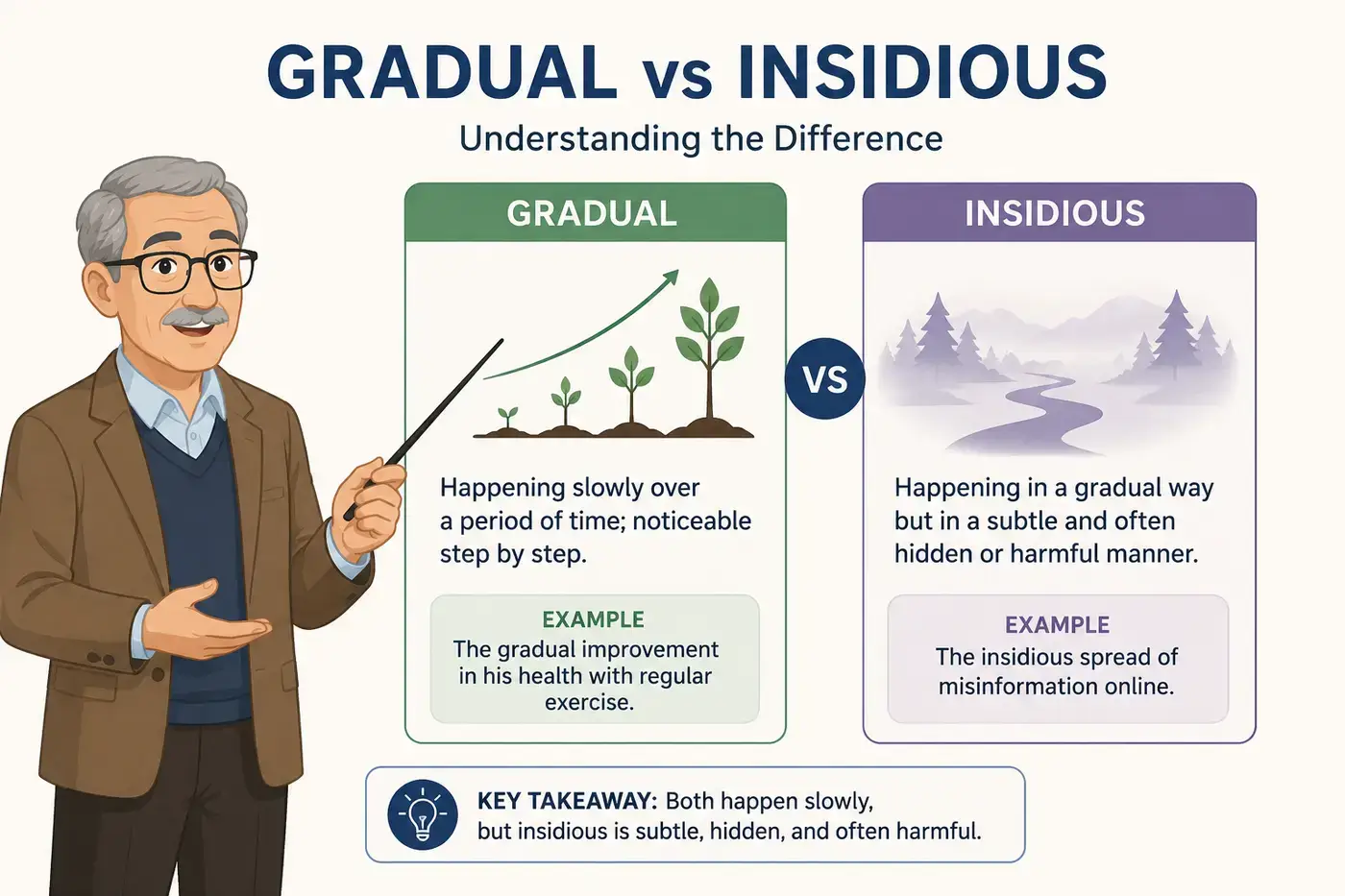
Many English learners get confused about gradual vs insidious because both words describe things that happen over time. They may sound similar in some situations, but they do not mean the same thing. Knowing the difference helps you speak and write more clearly.
If you have ever wondered about the simple answer is this: gradual describes something that happens slowly, while insidious describes something that spreads slowly in a harmful or hidden way. One word is neutral, and the other has a negative meaning.
This guide explains in very simple English. You will learn what each word means, why people confuse them, and how to use them correctly in everyday conversations and writing.
For another common grammar confusion, see Nosey or Nosy: Which Spelling Is Correct (2026 Guide)?.
Simple Answer in One Look: Gradual vs Insidious
Gradual means something happens little by little over time.
Insidious means something harmful grows slowly and often without people noticing it at first.
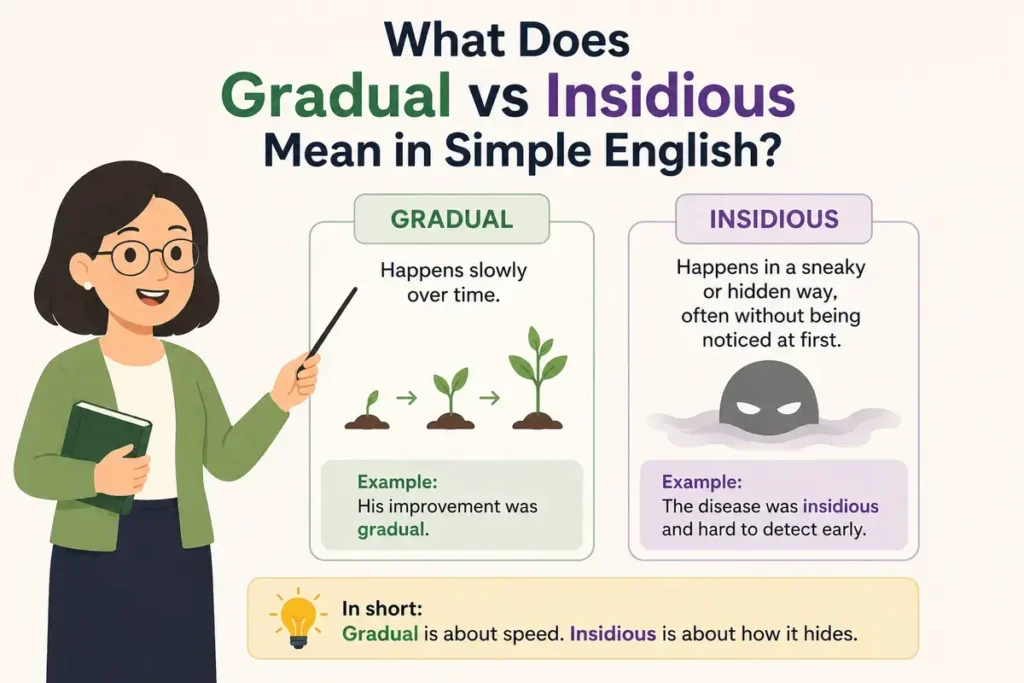
What Does Gradual vs Insidious Mean in Simple English?
When learning think about one simple question. Is the change simply slow, or is it slow and dangerous? The word gradual only tells us that something takes time. It does not tell us if the change is good or bad. Examples include:
- A child grows taller little by little.
- The weather becomes warmer during spring.
- Your reading skills improve after months of practice.
All of these changes happen slowly. None of them suggest danger. Now look at insidious. This word also describes something that happens slowly. The big difference is that it usually describes something harmful. It often stays hidden until it becomes a serious problem. For example:
- A disease slowly damages the body.
- A bad habit quietly grows stronger.
- False information slowly changes people’s opinions.
With insidious, people often do not notice the problem until much later. A simple way to remember it is:
- Gradual = slow change.
- Insidious = slow hidden harm.
Why Do People Mix Gradual vs Insidious?
Many people confuse gradual vs insidious because both words describe things that take time. When someone hears either word, they often think only about the idea of “slow. But there is one important difference. Gradual talks about speed. Insidious talks about both speed and hidden danger. Here are some examples. Someone says: “The changes were gradual.”
This means the changes happened little by little. Now compare it with: “The changes were insidious.” This means the changes happened slowly, but they also caused harm that people did not notice at first. People also mix these words because both appear in news articles, health reports, books, and school writing. Without knowing their exact meanings, they can seem almost the same.
A good trick is to ask yourself: Does the sentence describe a hidden problem? If yes, insidious may be the better choice. If not, gradual is usually correct.
Clear Difference Explained Simply: Gradual vs Insidious
Here is an easy comparison.
Gradual vs Insidious Meaning
Gradual
- Means slow progress or slow change.
- Can describe good, bad, or neutral situations.
- Does not suggest danger.
- Focuses only on time.
Insidious
- Means slow hidden harm.
- Usually describes negative situations.
- Often involves danger or damage.
- Focuses on hidden effects.
Easy Way to Remember Gradual vs Insidious
Think of climbing a hill. If you slowly walk to the top, your climb is gradual. Now imagine a small crack forming in the hill. It slowly grows bigger until the hill collapses without warning. That slow hidden damage is insidious.
Quick Comparison Table
| Gradual | Insidious |
|---|---|
| Slow change | Slow hidden harm |
| Neutral meaning | Negative meaning |
| Good or bad | Almost always harmful |
| Easy to notice over time | Often unnoticed at first |
| Focuses on pace | Focuses on hidden danger |
Which Form Should You Use in Gradual vs Insidious?
Choosing becomes easy once you remember one rule. Use gradual when you simply mean “slow.” Examples:
- A gradual improvement.
- A gradual increase.
- A gradual recovery.
- A gradual decline.
Use insidious when the slow change is secretly causing harm. Examples:
- An insidious disease.
- An insidious lie.
- An insidious problem.
- An insidious threat.
Ask yourself these questions. Is the change simply slow? Choose gradual. Is the change slow, hidden, and harmful? Choose insidious. This simple rule works in most situations.
Easy Real-Life Sentences Using Gradual vs Insidious
Here are simple everyday examples.
- The weather changed gradually during the week.
- She made gradual progress in learning English.
- His confidence grew gradually after many months.
- The road climbed gradually toward the mountain.
- The illness had an insidious beginning.
- Stress can have insidious effects on your health.
- The scam used insidious tricks to fool people.
- The bad habit became insidious over time because nobody noticed it.
Notice that gradual often appears in normal daily situations. Insidious usually appears when talking about danger, illness, dishonesty, or hidden problems.
Where Does Gradual vs Insidious Come From? Simple History
Looking at the history of gradual vs insidious makes their meanings easier to remember. The word gradual comes from a Latin word meaning “step.” It gives the idea of moving one step at a time. That is why it describes slow progress. The word insidious also comes from Latin. It originally described someone who waited in secret to attack another person. Over time, English speakers began using it for hidden dangers that slowly cause harm.
Even today, the original ideas remain clear. Gradual still feels like taking small steps. Insidious still suggests hidden danger that quietly grows stronger.
As you continue learning English, you will discover that is more than just choosing between two similar words. Each one creates a different feeling for the reader. In the next section, we will look at deeper meanings, common mistakes, symbolism, cultural use, and practical tips so you can use both words naturally and confidently in real life.
How Is Gradual vs Insidious Understood in Culture and Stories?
People use both words in stories because both words describe change over time. The difference is the feeling they create. A gradual change often feels normal. It shows growth, learning, healing, or natural progress. Readers usually expect a gradual change because life often moves step by step. For example:
- A shy child gradually becomes confident.
- A small town gradually grows into a busy city.
- Friends gradually learn to trust each other.
These changes feel calm and natural. An insidious change creates a very different feeling. It makes readers think something bad is happening quietly. For example:
- An insidious illness slowly weakens a person.
- An insidious enemy secretly makes a plan.
- An insidious rumor spreads through a school.
The danger is often hidden at first. That makes stories more exciting because people do not see the problem until later. This is why writers choose carefully. One shows slow progress. The other shows slow hidden danger.
You may also want to read Grately vs Greatly: How Do You Use It?.
Is There a Biblical or Mythological Meaning for Gradual vs Insidious?
There is no special biblical meaning for gradual or insidious. They are regular English words. Still, both ideas appear in many Bible stories. The idea of gradual can describe faith growing little by little. Wisdom, kindness, and trust often develop over time. The idea behind insidious appears when temptation, lies, or evil slowly enter someone’s life without being noticed at first.
The words themselves are not special religious terms, but their meanings fit many lessons about making wise choices and watching for hidden dangers. In mythology and old stories, heroes often become stronger through gradual learning and practice. At the same time, villains often use insidious plans that stay hidden until the last moment. So even though these words are not religious words, their ideas appear in many cultures and stories.
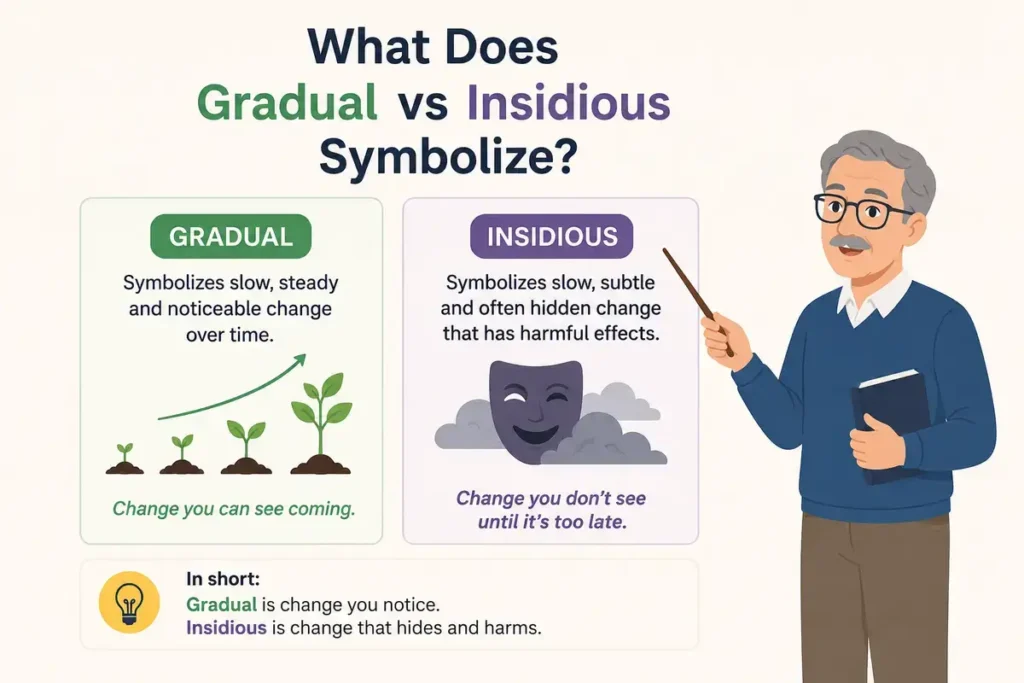
What Does Gradual vs Insidious Symbolize?
What Gradual Represents
gradual usually represents positive or natural change. It can symbolize:
- Growth
- Learning
- Patience
- Healing
- Experience
- Progress
- Small daily improvement
Think about planting a tree. The tree grows slowly. Every day the change is small, but after many years it becomes tall and strong. That is the idea behind gradual.
What Insidious Represents
insidious usually represents hidden danger. It can symbolize:
- Secret problems
- Dishonesty
- Slow damage
- Hidden fear
- Disease
- Quiet danger
- Bad habits
Imagine a tiny crack in a wall. At first, nobody notices it. Months later, the wall becomes unsafe. That hidden danger is what insidious represents. The simple difference is easy to remember.
Gradual builds.
Insidious destroys quietly.
Related Words to Gradual vs Insidious You Should Know
Learning related words makes even easier.
Slow
Means not fast. It simply describes speed.
Steady
Means something continues without stopping.
Progressive
Means developing step by step over time.
Incremental
Means growing in small pieces or small steps.
Hidden
Means not easy to see or notice.
Secret
Means kept away from other people.
Harmful
Means causing damage or problems.
Dangerous
Means able to cause injury or trouble.
Subtle
Means difficult to notice at first.
Sneaky
An informal word for someone acting secretly or dishonestly.
Knowing these words helps you understand in different situations.
How Do People Actually Use Gradual vs Insidious in Daily English?
Here are common examples you may hear.
- Her English improved gradually after six months.
- The company made gradual changes to its website.
- We noticed a gradual drop in temperature.
- His confidence grew gradually every week.
- The disease had an insidious beginning.
- Stress can have insidious effects on your health.
- The scam used insidious methods to fool older people.
- An insidious rumor spread through the office.
- The team’s skills improved gradually with practice.
- Nobody noticed the insidious problem until it became serious.
Native English speakers often use gradual when talking about learning, weather, business, sports, health, and personal growth. They usually use insidious when talking about diseases, crime, lies, pollution, addiction, or hidden dangers.
Common Mistakes With Gradual and Insidious
Many English learners make the same mistakes.
Mistake 1: Using Insidious for Any Slow Change
❌ The flowers grew insidious.
✅ The flowers grew gradually.
Flowers are not harmful, so gradual is correct.
Mistake 2: Using Gradual for Hidden Danger
❌ The gradual disease spread without anyone noticing.
✅ The insidious disease spread without anyone noticing.
The sentence describes hidden harm, so insidious fits better.
Mistake 3: Thinking Both Words Mean Exactly the Same
They both describe something happening over time. But only insidious includes the idea of hidden danger.
Mistake 4: Forgetting the Negative Meaning of Insidious
Many learners think insidious simply means slow. It almost always carries a negative meaning.
Mistake 5: Using Insidious for Positive Situations
❌ She made insidious progress.
✅ She made gradual progress.
Progress is normally positive, so gradual is the right choice.
Final Teacher Explanation of Gradual vs Insidious
Imagine I am standing in front of a classroom. I would tell my students to remember only one simple idea. Both words describe something that takes time. That is why people confuse gradual vs insidious.
But they are not the same. Gradual simply means slow. It does not tell us if something is good or bad. A gradual improvement, gradual change, or gradual increase can all be positive.
Insidious means slow in a dangerous way. The harm often stays hidden until much later. When you see insidious, think about hidden problems. When you see gradual, think about slow steps. If you remember this one rule, you will almost always choose the correct word. The more you read and practice, the more natural these words will become.
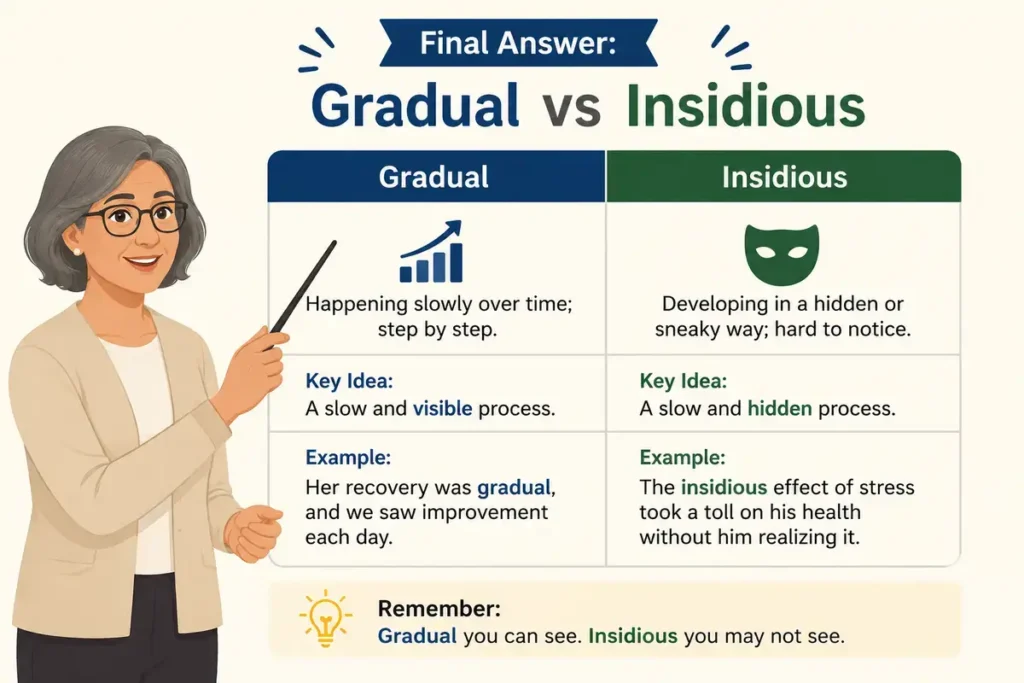
Final Answer: Gradual vs Insidious
The difference between is simple.
Gradual means something happens little by little over time.
Insidious means something harmful develops slowly and often stays hidden at first.
If the change is simply slow, choose gradual.
If the change is slow, hidden, and harmful, choose insidious.
Still confused? Compare Receiver vs Reciever: Complete English Guide 2026.
Conclusion
Understanding is easier than many learners think. Both words describe things that happen slowly, but they create very different meanings. Gradual focuses on slow, step-by-step change and can describe positive, negative, or neutral situations. Insidious describes something harmful that grows quietly and is often difficult to notice at first. When you ask yourself, “Is this simply a slow change, or is it a hidden danger?” the correct choice becomes much clearer. With regular reading and practice, using will soon feel natural.
Frequently Asked Questions
What is the difference?
Gradual means slow change. Insidious means slow hidden harm or danger.
Is gradual a positive word?
Usually, yes. It can also describe neutral or negative changes, but it does not suggest hidden danger.
Is insidious always negative?
Almost always. It usually describes harmful situations, diseases, lies, or hidden problems.
Can I use gradual and insidious in the same sentence?
Yes. For example: The gradual changes became insidious when nobody noticed the damage.
Why do people confuse?
Both words describe something that happens over time. The difference is that insidious also includes hidden harm.
Which word is better for improvement?
Use gradual because improvement usually happens step by step.
Which word is better for disease?
Usually insidious, especially if the disease develops slowly without clear signs at first.
How can I remember?
Think of this simple rule:
Gradual = slow steps.
Insidious = slow hidden danger.
