
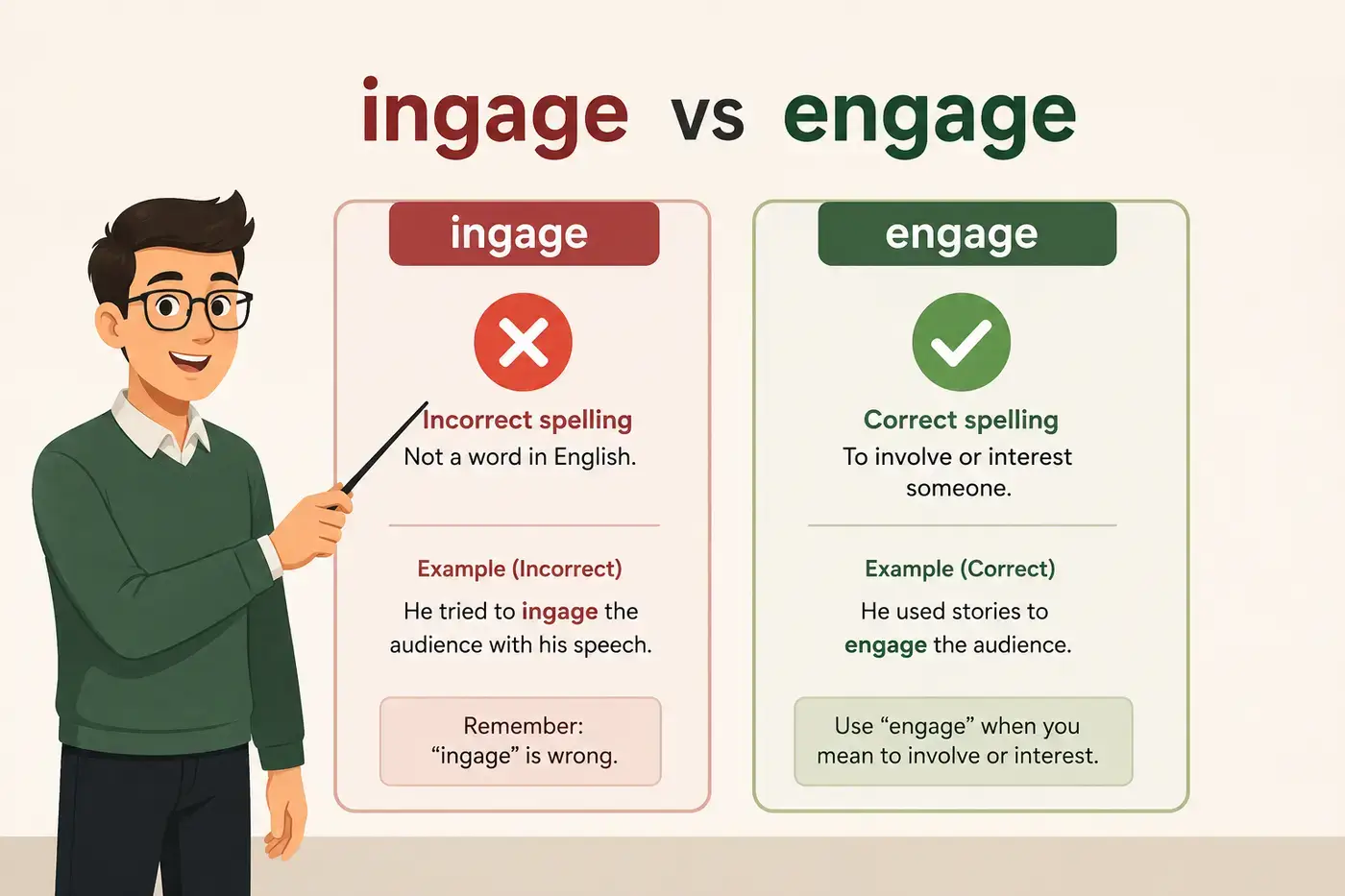
Many people search for ingage vs engage because they are not sure which spelling is correct. This mistake is common. The good news is that the answer is simple. Once you understand it, you will probably never confuse these words again.
If you have ever typed ingage in a message, email, or school paper, you are not alone. Many English learners and even native speakers make this mistake because the words sound very similar. That is why so many people ask about words online.
This guide explains the correct spelling in very simple English. You will learn the meaning, the difference, why people get confused, and how to use the correct word in everyday life. By the end, you will know exactly which form to use with confidence.
Still confused? Compare Comprable vs Comparable: Easy Meaning, and Examples.
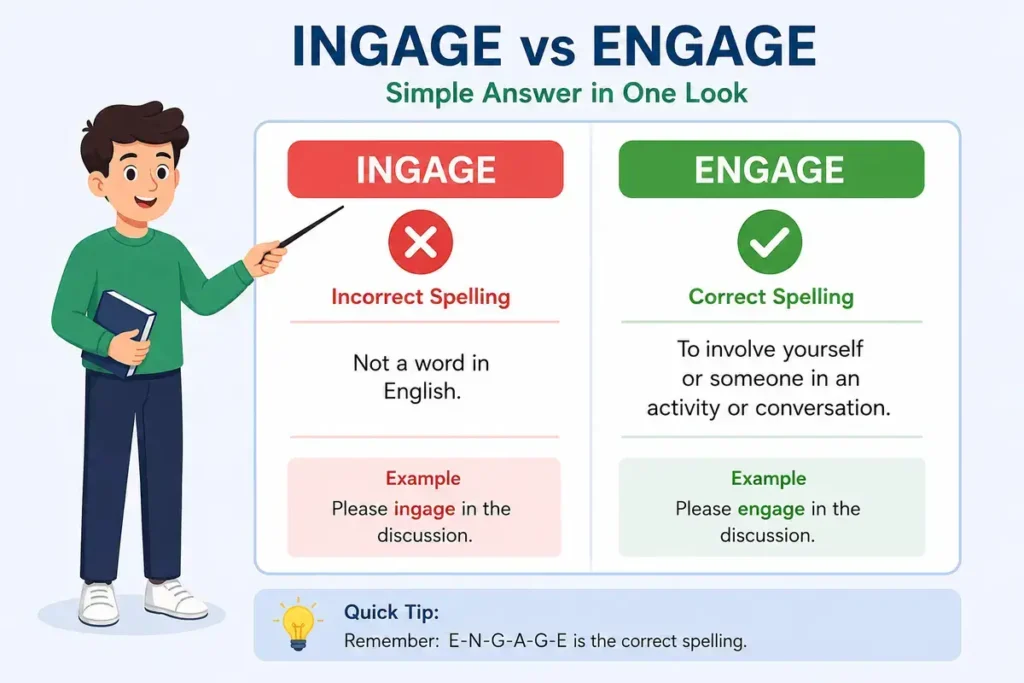
Simple Answer in One Look
Engage is the correct English word.
Ingage is a misspelling. It is not accepted in standard English.
If you are choosing between words always use engage.
What does Means in Simple English
The word engage has several simple meanings. Even though it has more than one meaning, they all share the idea of becoming connected, involved, or active. Here are the most common meanings.
Engage Means To Take Part
When you engage in something, you join it or become involved. Examples:
- I like to engage in class discussions.
- She engaged in the group project.
- The students engaged in the science activity.
In each sentence, the person takes part in something.
Engage Means To Get Someone’s Attention
You can also engage someone by making them interested. Examples:
- The teacher engaged the students with a fun story.
- Funny videos engage young children.
- Good books engage readers from the first page.
Here, engage means to keep someone interested.
Engage Means To Start Something
Sometimes engage means to begin using something. Examples:
- Engage the parking brake.
- The pilot engaged the engine.
- Press this button to engage the system.
This meaning is common in machines and equipment.
Engage Means To Talk Or Connect
People also use engage when speaking with others. Examples:
- Try to engage with your audience.
- Parents should engage with their children every day.
- The manager engaged with every employee.
Here, engage means to communicate or connect.
Engage Means To Promise Marriage
This meaning is less common in daily conversation but still correct. Examples:
- They decided to get engaged.
- She became engaged last year.
Notice that people usually say get engaged instead of simply engage when talking about marriage. No matter which meaning you use, engage is always the correct spelling.
Why People Mix These Words
Many people wonder why both words causes so much confusion. The answer is easier than you might think.
The Words Sound Almost The Same
English pronunciation can be tricky.
When people hear engage, it may sound like ingage, especially during fast speech.
Someone who has only heard the word may guess the spelling instead of learning it from reading.
English Has Many Similar Spellings
English contains many words that begin with en. For example:
- Enable
- Encourage
- Enrich
- Enjoy
- Enclose
People sometimes replace en with in because both sounds are common in English.
Fast Typing Creates Mistakes
Typing quickly can lead to spelling errors. Someone may accidentally write:
- ingage
- ingaged
- ingaging
Modern spell check usually changes these mistakes to the correct forms.
Learning By Sound
Many English learners first learn words by listening.
If they never see the correct spelling, they may believe ingage is correct.
This happens with many English words.
Different Accents
Some accents make engage sound closer to ingage.
Even then, the spelling does not change.
English spelling stays the same.
The Brain Guesses Patterns
Our brains often guess spellings based on familiar patterns.
For example, people may think:
- invite
- include
- inspire
Since these words begin with in, they may guess ingage instead of engage. This is a normal learning mistake.
Clear Difference Explained Simply
If you compare both words the difference is very easy.
| Word | Correct? | Meaning |
|---|---|---|
| Engage | ✅ Yes | Become involved, connect, attract attention, start using something |
| Ingage | ❌ No | Incorrect spelling of engage |
Here is another simple comparison.
Engage
- Real English word.
- Found in dictionaries.
- Used in books.
- Used in schools.
- Used in business.
- Used in newspapers.
Ingage
- Not a standard English word.
- Considered a spelling mistake.
- Should be corrected to engage.
Remember this easy rule. If your keyboard underlines ingage, it is because the spelling is wrong.
Which Form Should You Use
The answer is always simple.
Use engage every time.
Never use ingage in:
- School work.
- Homework.
- Emails.
- Business writing.
- Job applications.
- Essays.
- Reports.
- Social media posts if you want correct English.
Easy Rule To Remember
Think about the beginning of the word.
It starts with EN, not IN.
EN + GAGE = ENGAGE
You can also remember other common words that begin with EN.
- Enjoy
- Encourage
- Enable
- Enrich
- Enter
Seeing these words together helps your brain remember the correct spelling.
What About Different Word Forms
The spelling stays the same. Correct forms include:
- engage
- engages
- engaged
- engaging
- engagement
Incorrect forms include:
- ingage
- ingages
- ingaged
- ingaging
- ingagement
Every version should begin with EN.
Easy Real Life Sentences You Can Use
These examples show how people naturally use engage.
- Please engage with the class discussion.
- The teacher engaged every student.
- We should engage with our community.
- Good stories engage young readers.
- The speaker engaged the audience from the beginning.
- I want to engage in more outdoor activities.
- The company tries to engage its customers.
- The children quickly engaged in the game.
Now compare them with incorrect examples.
❌ Please ingage with the class.
✅ Please engage with the class.
❌ We ingaged everyone.
✅ We engaged everyone.
❌ The story was ingaging.
✅ The story was engaging.
Reading correct examples helps you remember the right spelling.
Where these Words Expression Comes From Simple History
The word engage has been part of English for hundreds of years. It came into English through French. Before that, it has older roots in European languages. Long ago, the word meant to make a promise or enter an agreement. Over time, people began using it in more ways. Today, engage can mean:
- become involved
- connect with others
- attract attention
- begin using something
- promise marriage
The spelling has stayed the same throughout modern English. The form ingage never became a standard English word. That is why dictionaries only recognize engage.
As you can see, the spelling question is actually very simple. The deeper story is how this word became such an important part of everyday English and why people use it in conversations, education, business, relationships, and even technology. In the next section, you will learn its cultural meaning, symbolism, common expressions, practical tips, and many more real life examples that make the word even easier to remember.
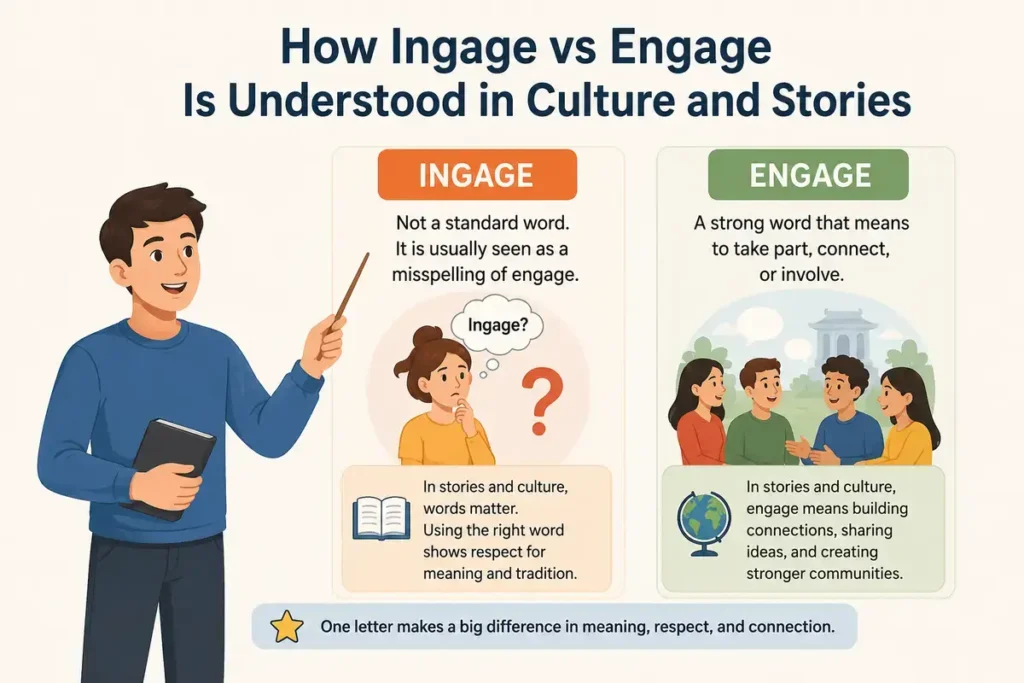
How does we Understood in Culture and Stories
When people hear the word engage, they usually think about connection. It is a word that brings people together. It can describe talking with others, joining an activity, helping a friend, or paying close attention. Teachers often ask students to engage in class. Parents encourage children to engage with family. Coaches tell players to engage with the team. In each case, the word shows active participation instead of standing on the side.
Stories also use the idea of engagement. A brave hero engages in a challenge instead of running away. A kind person engages with people who need help. A good leader engages everyone instead of leaving people out. Movies, books, and television shows often use this idea. Characters who engage with others usually build stronger friendships. They solve problems together and learn from each other.
The incorrect spelling ingage has no cultural meaning because it is simply a spelling mistake. You will not find it used as a real English word in books, newspapers, or trusted dictionaries. So, when people search they are really asking about the correct way to write a word that represents connection, action, and involvement.
You may also want to read Bony vs Boney: Learn the Correct Word in Minutes.
Biblical and Mythological Meaning of Ingage vs Engage
The word engage does not have a special meaning in the Bible. However, the ideas behind it appear many times. People are encouraged to engage with others through kindness, love, honesty, and service. Helping neighbors, listening carefully, and working together all reflect the idea of being engaged with people.
In mythology, heroes rarely succeed alone. They engage with friends, mentors, and communities. They accept challenges instead of avoiding them. This idea appears in stories from many cultures. The spelling ingage has no biblical or mythological meaning because it is not a recognized English word. If you are comparing both words only engage carries real meaning in literature and history.
Symbolism Explained in Simple Words
What Engage Represents
The word engage often represents positive actions. It can symbolize:
- Paying attention.
- Joining a group.
- Building relationships.
- Learning something new.
- Helping others.
- Taking action.
- Showing interest.
- Growing through teamwork.
When someone is engaged, they are not just watching. They are participating. That is why teachers, coaches, managers, and parents use this word so often.
What Ingage Represents
The word ingage does not have its own meaning. It usually represents:
- A spelling mistake.
- A typing error.
- Confusion caused by pronunciation.
- An incorrect form of engage.
That is why you should replace ingage with engage whenever you write. The difference is simple.
Engage carries meaning.
Ingage only shows an incorrect spelling.
Related Words You Should Know
Learning similar words makes English easier.
Engaged
This means someone is involved, interested, or promised to marry someone. Example:
She stayed engaged during the whole lesson.
Engaging
This describes something that keeps people’s attention. Example:
The movie was engaging from the beginning.
Engagement
This word has several meanings. It can mean participation, a planned meeting, or a promise to marry. Example:
Customer engagement helps a business grow.
Involvement
This means taking part in something. Example:
Parent involvement helps children learn.
Participate
This means to join an activity. Example:
Everyone participated in the game.
Connect
This means to build a relationship or communicate. Example:
Good teachers connect with their students.
Interact
This means to talk or work with other people. Example:
Children interact during recess.
Communicate
This means to share ideas or information. Example:
Friends communicate every day.
Join
This means to become part of something. Example:
Please join our reading club.
Focus
This means paying close attention. Example:
Students should focus during the lesson.
How People Actually Use it in Daily English
People use engage in many everyday situations. Here are some common examples.
- Please engage in today’s classroom activity.
- Try to engage with your customers politely.
- My children love engaging games.
- The speaker engaged everyone in the room.
- We should engage with our local community.
- The students engaged in a science experiment.
- Social media helps companies engage with customers.
- Parents should engage with their children every day.
- Good questions engage readers.
- The coach encouraged everyone to engage as a team.
Notice something important. Every correct sentence uses engage. None use ingage because it is not a correct English spelling.
Common Mistakes People Make
Many learners make the same mistakes. Once you know them, they are easy to avoid.
Mistake One
❌ Ingage with your audience.
✅ Engage with your audience.
Mistake Two
❌ She ingaged in the discussion.
✅ She engaged in the discussion.
Mistake Three
❌ This book is very ingaging.
✅ This book is very engaging.
Mistake Four
❌ Customer ingagement is important.
✅ Customer engagement is important.
Mistake Five
Thinking both spellings are correct.
Only engage is accepted in standard English.
Mistake Six
Spelling the word based only on pronunciation.
Many English words do not sound exactly like they are spelled.
Always remember that engage begins with EN.
Easy Memory Trick to recall
Think about these words.
- Enjoy
- Enable
- Encourage
- Enrich
- Enter
- Engage
All begin with EN.
This simple pattern helps you remember the correct spelling.
Final Teacher Explanation
Imagine you are sitting in my classroom. A student asks, “Should I write ingage or engage?” My answer is always the same. Write engage. That is the correct English word. Use it when you mean taking part, connecting with people, getting someone’s attention, starting an activity, or becoming involved.
Do not use ingage because it is only a spelling mistake. You do not need to memorize difficult grammar rules. Just remember one easy sentence. Every time you want to write this word, choose engage. The more you read books, articles, and good English websites, the more natural the correct spelling will become. Learning English is not about being perfect every time. It is about noticing small mistakes, fixing them, and becoming more confident every day.
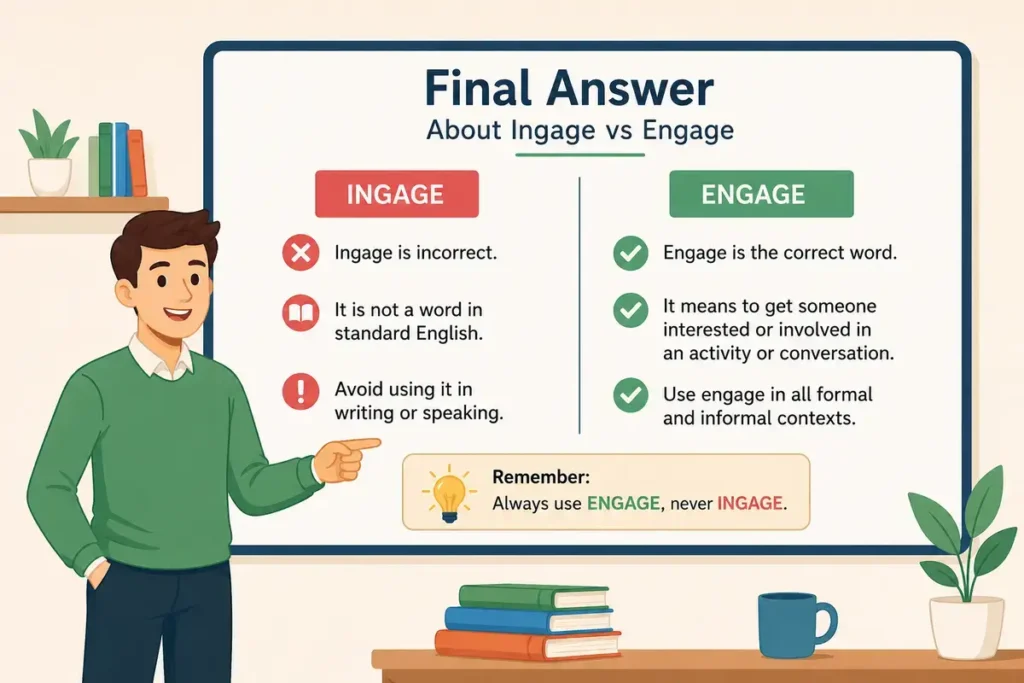
Final Answer About Ingage vs Engage
If you are choosing between the correct answer is always engage.
Ingage is an incorrect spelling and should not be used in formal or informal writing.
Remember this simple rule:
Engage is correct. Ingage is incorrect.
Once you remember that engage always starts with EN, you will avoid this mistake every time.
For another common grammar confusion, see Sentence or Sentance: Which Spelling Is Correct?.
Conclusion
The question about words has a simple answer. Engage is the correct English word, while ingage is only a spelling mistake. You can use engage when talking about joining an activity, connecting with people, gaining attention, or becoming involved. Once you remember that the word always begins with EN, you will write it correctly with confidence. Reading and using the word in everyday sentences will make the correct spelling feel natural over time.
Frequently Asked Questions
What does engage mean in simple words?
It means to join, connect, participate, or pay attention to something.
Is ingage a real English word?
No. Ingage is a misspelling of engage.
Which is correct?
Engage is the only correct spelling in modern English.
Why do people confuse?
The words sound similar when spoken, so many people guess the spelling instead of learning the correct one.
Can I use ingage in school writing?
No. Always use engage in essays, homework, emails, and professional writing.
What is the past tense of engage?
The past tense is engaged.
Example: We engaged in the discussion yesterday.
What does engaging mean?
Engaging means interesting or able to keep someone’s attention.
How can I remember the correct spelling?
Remember that it starts with EN, just like enjoy, enable, and encourage.
