
Many English learners ask about focussing or focusing because both spellings appear online and in books. This can make the correct choice feel confusing. The good news is that both forms are accepted in English, but one is more common in certain types of English.
If you are writing for a school paper, a blog, a business email, or a website, knowing the difference between helps your writing look more natural. Once you learn the simple rule, choosing the right spelling becomes easy.
This guide explains everything in clear US English. You will learn what each spelling means, why people mix them up, which one you should use, and how to use each form in real-life sentences.
A related grammar guide is Tapping vs Taping: Learn the Difference and Use Correctly.
Simple Answer in One Look
Both words are correct.
- Focusing is the standard spelling in American English and is also widely used around the world.
- Focussing is accepted in British English, although single “s” word is becoming more common there too.
If you write for an American audience, choose focusing.
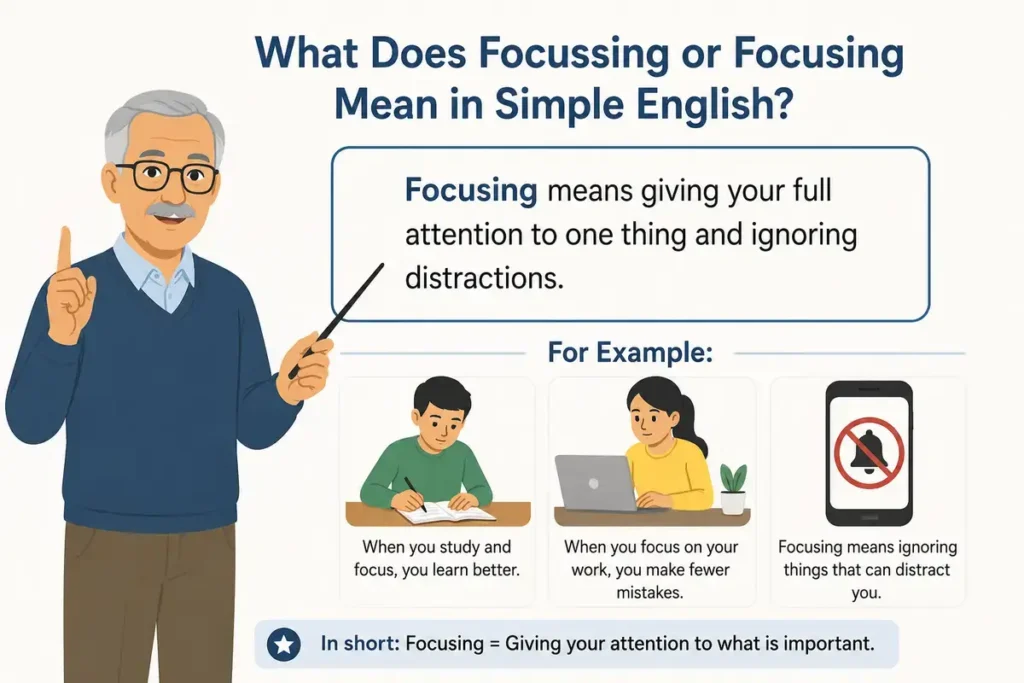
What Does Focussing or Focusing Mean in Simple English?
The word focusing means giving your full attention to something. It can also mean making something clear or pointing your eyes, camera, or thoughts toward one thing. Think about a student doing homework. If the student ignores everything else and pays attention only to math, the student is focusing on math. Here are some simple examples.
- I am focusing on my homework.
- She is focusing on her health.
- We are focusing on better customer service.
- The camera is focusing on the bird.
- He is focusing on his driving.
In every example, focusing means paying close attention to one thing. You can use this word in school, work, sports, photography, and everyday conversations.
Why People Mix These Words Focussing vs Focusing
Many people become confused about because English has different spelling rules in different countries. Some words double the final letter before adding -ing. For example:
- Run → Running
- Sit → Sitting
- Swim → Swimming
Because of these examples, some people think focus should become focussing. The confusion grows because both spellings appear in books, websites, newspapers, and dictionaries. Another reason is that British and American English sometimes use different spellings. For example:
| American English | British English |
|---|---|
| traveled | travelled |
| canceled | cancelled |
| color | colour |
| focusing | focussing (also focusing) |
When learners see both spellings, they wonder if one is wrong. Actually, both are correct. The choice mostly depends on the style of English you are using.
Clear Difference Explained Simply
The easiest way to remember the difference is this.
| Focusing | Focussing |
|---|---|
| American English | British English |
| Most common spelling worldwide | Less common today |
| Best for US writing | Accepted in UK writing |
| Preferred by many style guides | Still found in some British publications |
Here is another simple comparison.
Focusing
- Standard American spelling.
- Used by most US schools.
- Common in business writing.
- Seen in many websites and blogs.
- Safe choice for international readers.
Focussing
- Traditional British spelling.
- Still accepted.
- Seen in some UK books and newspapers.
- Less common than it was years ago.
If you write online for readers from many countries, focusing is usually the better choice because more people recognize it.
Which Form Should You Use for Focussing and Focusing?
The answer depends on your audience.
Use focusing if:
- You write in American English.
- Your audience is international.
- You create blog posts.
- You write business documents.
- You publish educational content.
- You want the most widely accepted spelling.
Use focussing if:
- You follow British English rules.
- Your school or company uses British spelling.
- You want to stay consistent with UK style.
The most important rule is simple. Do not switch between the two spellings in the same piece of writing. Choose one style and use it from beginning to end. That keeps your writing clean and professional.
Easy Real-Life Sentences You Can Use for Focussing or Focusing
These examples show how people naturally use the word every day.
- I am focusing on my science project this week.
- She is focusing on getting enough sleep.
- We are focusing on helping our customers.
- The teacher is focusing on reading skills today.
- He is focusing on saving money.
- The photographer is focusing the camera before taking the picture.
- They are focusing on winning the game.
- Our team is focusing on better communication.
If you use British English, you can replace in these examples, and the meaning stays the same.
Where Focussing or Focusing Word Comes From (Simple History)
The word focus comes from the Latin word focus, which originally meant hearth or fireplace, the place where a family’s fire burned. Over time, scientists began using focus to describe the point where light comes together. Later, people started using the word in everyday English to talk about attention and concentration.
Today, when someone says they are focusing, they simply mean they are giving careful attention to one thing instead of many things. As English spread to different countries, spelling styles also changed. American English and British English accepted both focusing and focussing, although single “s” word has become increasingly common in modern British writing as well.
Now that you understand the basic difference between, you are ready to look at how these spellings are used in culture, common expressions, writing styles, and everyday communication. The next section will also answer common questions, clear up myths, and help you feel confident every time you choose the correct spelling.
How Focussing or Focusing Is Understood in Culture and Stories
The idea behind is found in many cultures. People everywhere believe that success comes from paying attention to one goal at a time. Many stories teach that a person who stays focused reaches the finish line. A character who keeps changing direction often struggles to succeed.
Think about a student studying for an exam. If the student spends all day checking a phone, learning becomes harder. But if the student keeps focusing on the lesson, good results often follow. Sports stories teach the same lesson. A runner focuses on the finish line. A basketball player focuses on making the next shot.
Movies also use this idea. The main character usually has a goal. The story becomes exciting because the character keeps focusing on that goal, even when life becomes difficult. Parents also use this word every day. They may say: “Stop worrying about everything else. Start focusing on your homework.”
Teachers often say: “Keep focusing on the question.” Managers might tell a team: “We’re focusing on helping our customers this month.” So, while it may look like different spellings, the meaning is always about giving your attention to something important.
Need another quick comparison? Read Brite vs Bright: What Is the Difference (2026 Guide)?.
Biblical and Mythological Meaning of Focussing vsFocusing
The Bible does not use the modern word focusing because it was written long before this English word became common. However, the idea of focusing appears many times. People are encouraged to keep their minds on wisdom, faith, kindness, and doing what is right. For example, many Bible stories show people staying faithful even during hard times. They do not give up because they keep their attention on God’s guidance.
Mythology also shares a similar idea. In many old stories, heroes succeed because they stay focused on one mission. They do not let fear, distractions, or temptation stop them. So, while it is not a biblical or mythological term, its meaning matches an idea found in many famous stories.
Symbolism Explained in Simple Words
What Focusing Represents
Focusing often represents:
- Clear thinking
- Strong attention
- Personal growth
- Learning
- Self-control
- Success through steady effort
When someone says they are focusing, people often imagine someone working hard toward a goal. For example:
A child focusing on reading.
A doctor focusing during surgery.
An athlete focusing before a race.
The word gives a feeling of calm, determination, and purpose.
What Focussing Represents
The meaning of focussing is exactly the same.
The only difference is spelling.
When readers see focussing, they may think the writer uses British English.
It can represent:
- British spelling style
- Careful attention
- Concentration
- Staying on one goal
Emotionally, there is no difference between, Only the spelling changes.
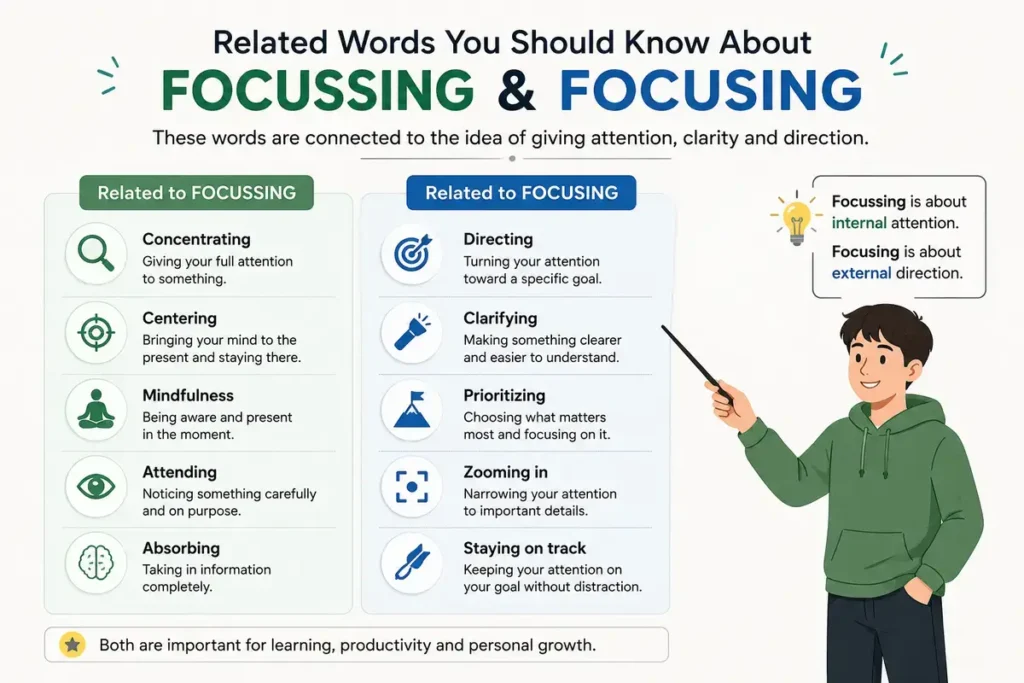
Related Words You Should Know About Focussing and Focusing
Here are some helpful words connected.
Focus
To give full attention to something. Example:
Focus on your work.
Concentrate
To think carefully about one thing. Example:
Please concentrate during the test.
Attention
The act of listening or watching carefully. Example:
The teacher has everyone’s attention.
Priority
The most important task. Example:
Safety is our top priority.
Goal
Something you want to achieve. Example:
Her goal is to become a doctor.
Mindful
Paying attention to what is happening right now. Example:
Be mindful of your words.
Determined
Not giving up easily. Example:
He stayed determined until he finished.
Productivity
Getting useful work done. Example:
Good planning improves productivity.
All these words help explain the idea behind.
How People Actually Use Focussing or Focusing in Daily English
Here are real examples you might hear every day.
- I’m focusing on finishing my homework tonight.
- She’s focusing on eating healthier meals.
- We’re focusing on improving customer service.
- Stop focusing on small mistakes.
- The camera is focusing correctly now.
- He keeps focusing on the future.
- They’re focusing on building a better team.
- My doctor told me to focus on getting enough sleep.
- The company is focusing on new products this year.
- Try focusing on one task at a time.
These examples sound natural because native speakers use this word in many different situations.
Common Mistakes People Make With Focussing vs Focusing
Many learners make the same mistakes. Here are the most common ones.
Mistake 1: Thinking One Spelling Is Always Wrong
❌ Focussing is incorrect.
✅ Both spellings are correct.
Remember:
- American English prefers focusing.
Mistake 2: Mixing Both Spellings
✅ Choose one spelling style and stay consistent.
Mistake 3: Using the Wrong Style for Your Audience
If your readers are mostly in the United States, use focusing.
If you write in British English, follow your organization’s style guide.
Mistake 4: Thinking the Meaning Changes
Some learners believe the spellings have different meanings.
They do not.
Both words mean giving attention to something.
Mistake 5: Forgetting Context
The word can describe:
- Mental attention
- A camera lens
- A business goal
- School work
- Sports
- Health
- Personal improvement
The meaning depends on the sentence, not the spelling.
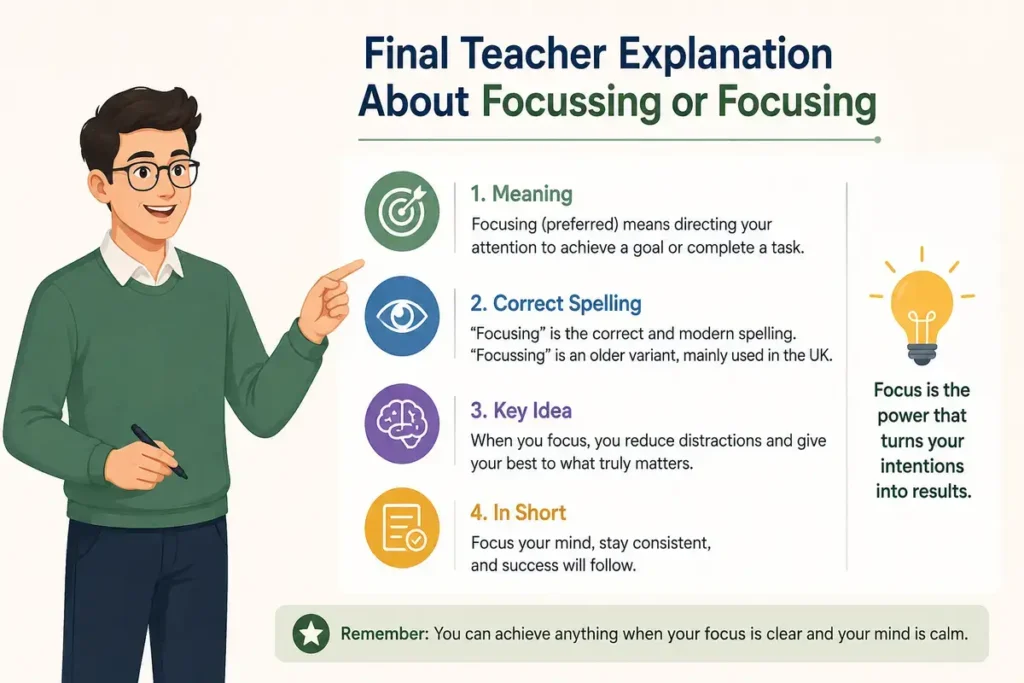
Final Teacher Explanation About Focussing or Focusing
Imagine you are sitting in my classroom. A student asks, “Teacher, should I write?” My answer is simple. If you write American English, use focusing. If you write British English, focussing is also correct, although many British writers now use focusing too. The most important lesson is not the extra s.
The most important lesson is being consistent. Pick one spelling style and keep using it throughout your writing. That makes your work look neat, professional, and easy to read. Whenever you forget the rule, remember this simple sentence: American English almost always uses focusing. British English may use either spelling, but focusing is becoming more common there too. If you remember that one sentence, you will almost never make this mistake again.
Final Answer About Focussing or Focusing (Quick Recap)
If you are choosing between both spellings are correct.
Focusing is the standard spelling in American English and the best choice for most international writing.
Focussing is accepted in British English, but single ‘s’ word is becoming more common there as well.
Choose one spelling style and use it consistently throughout your writing.
For another common grammar confusion, see Naive vs Nieve Explained With Easy Examples.
Conclusion
Understanding is much easier than it first seems. Both spellings are correct, and both mean giving your full attention to something. The real difference is not the meaning but the spelling style. Focusing is the preferred choice in American English and is also the most common spelling in international writing. Focussing is still accepted in British English, although many British writers now use single ‘s’ word as well. If you write for school, work, a blog, or your website, think about your audience first. Then choose one spelling and use it consistently throughout your writing. Following this simple rule will make your English look clear, natural, and professional. Once you remember this difference, you can use the word with confidence every time you write.
Frequently Asked Questions (FAQs)
Which is correct?
Yes. Both are correct. Focusing is preferred in American English, while focussing is accepted in British English.
Which spelling should I use for US English?
Use focusing. It is the standard American spelling.
Why do people get confused between?
People see both spellings in books and online. Different English styles also use different spelling rules.
Does have different meanings?
No. They have exactly the same meaning. Only the spelling is different.
Can I use both spellings in the same article?
No. Pick one spelling style and use it from beginning to end.
Is focusing becoming more common in British English?
Yes. Many modern British publishers and writers now use focusing.
What does focusing mean in simple words?
It means giving your full attention to one person, task, or goal.
Is focusing used only for attention?
No. It can also describe making a camera or other lens clear, but the idea of directing attention or clarity is the same.
