
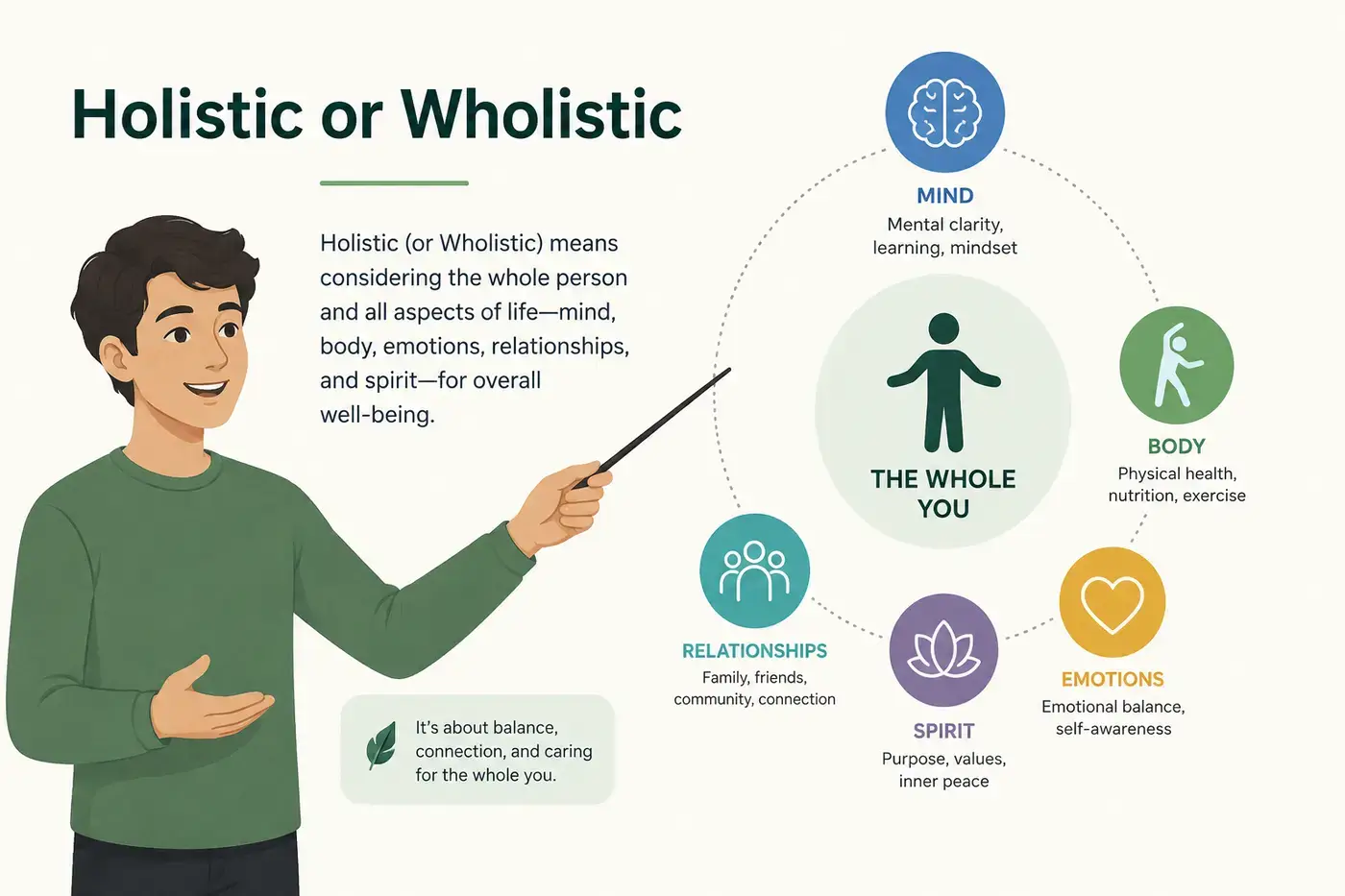
Many English learners ask about holistic or wholistic because both words look correct. You may see them in books, websites, schools, health articles, and business writing. This makes people wonder which spelling they should use and if the two words have different meanings.
The short answer is simple. Holistic is the standard and widely accepted spelling. Wholistic is a less common spelling that some writers use to highlight the idea of “whole.” In most situations, holistic is the better choice.
If you have ever searched for this guide will help you understand the difference in very simple English. By the end, you will know which spelling to use, why people confuse them, and how to use the word correctly in everyday writing.
You may also want to read Time Flies or Time Flys: Which Is Correct and Why (2026)?.
Holistic or Wholistic: Simple Answer in One Look
Holistic is the correct and standard spelling in modern English.
Wholistic has the same meaning, but it is much less common. Most teachers, dictionaries, editors, and professional writers recommend using holistic.
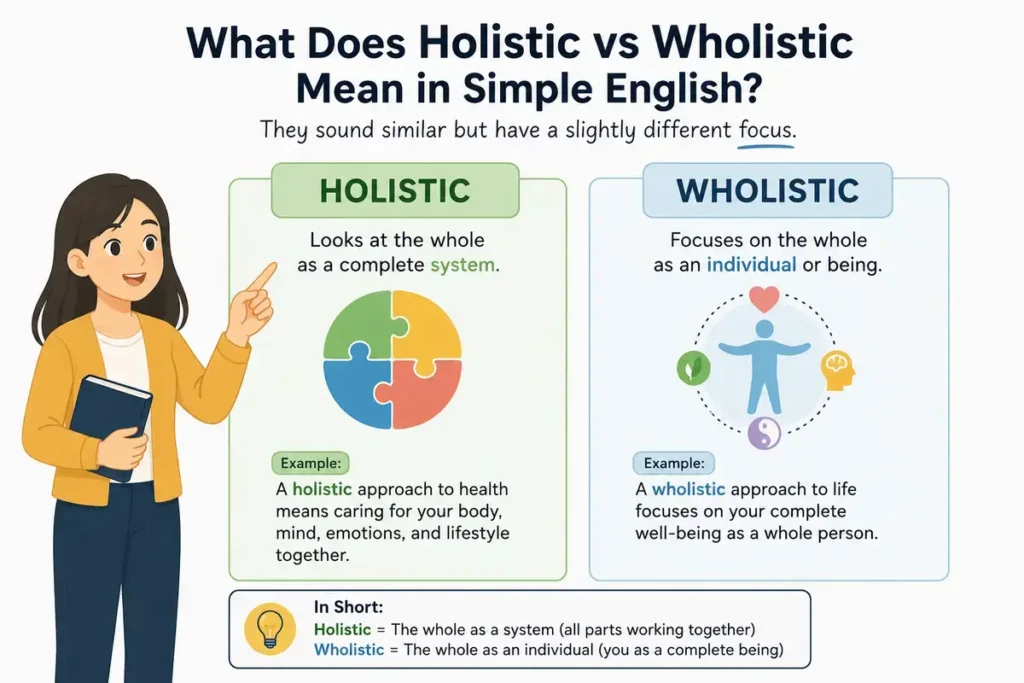
What Does Holistic vs Wholistic Mean in Simple English?
The both words describe looking at the whole picture instead of just one small part. Think about a tree. If you only look at one leaf, you may miss what is happening to the rest of the tree. A holistic view means looking at the roots, trunk, branches, leaves, soil, sunlight, and water together. The same idea works for people.
Imagine your friend feels tired every day. A holistic way of thinking does not only ask about sleep. It also looks at food, exercise, stress, emotions, work, and daily habits. Everything works together. That is the main meaning of holistic. It means:
- Looking at the whole instead of one part.
- Understanding how different parts work together.
- Solving problems by seeing the complete picture.
You can use the word in many areas. For example:
- education
- health
- business
- science
- psychology
- personal growth
No matter where you see it, the idea stays almost the same. Holistic means thinking about everything together instead of focusing on only one piece.
A Simple Definition
Holistic (adjective): looking at a person, object, or situation as one complete whole.
Easy Synonyms
These words can sometimes have a similar meaning.
- complete
- whole
- all-around
- full-picture
- balanced
- comprehensive
- connected
- total
Remember that these words are not perfect replacements in every sentence, but they share a similar idea.
Why Do People Mix These Words Holistic and Wholistic?
Many people become confused because both words sound exactly the same. When you hear someone say the word, you cannot tell which spelling they mean. Another reason is the word whole. People notice that holistic talks about looking at the whole picture. Because of this, some writers think the spelling should begin with whole. That is why they write: wholistic
It feels logical because the word whole is easy to recognize. But English spelling does not always follow what seems logical. Many English words come from older languages. Their spellings often stay the same, even if another spelling looks easier. Here are some everyday examples of this kind of confusion. People often wonder:
- adviser or advisor
- gray or grey
- toward or towards
- canceled or cancelled
English has many words with more than one spelling. Some are equally common. Others have one spelling that is much more widely accepted. In this case, holistic is the spelling most people expect to see.
Why You See Both Online
You may search the internet and find both spellings. That happens because:
- Some health organizations prefer wholistic for branding.
- Some writers want to stress the word whole.
- Older articles sometimes use the less common spelling.
- Different organizations have their own style guides.
Even so, holistic appears much more often in books, newspapers, schools, and dictionaries.
Clear Difference Explained Simply
The meaning of the two words is almost the same. The real difference is the spelling and how often people use each one.
| Holistic | Wholistic |
|---|---|
| Standard spelling | Alternative spelling |
| Used much more often | Used much less often |
| Found in most dictionaries | Also listed in some dictionaries as a variant |
| Preferred in schools and professional writing | Mostly used by certain groups or brands |
| Best choice for most writing | Usually not the first choice |
Think of It This Way
Imagine two roads leading to the same place.
One road is wide, smooth, and used by almost everyone.
The other road also reaches the same place, but far fewer people use it.
That is how compare.
Quick Comparison about Holistic or Wholistic
Holistic
- Standard spelling
- Best for school work
- Best for business writing
- Best for websites
- Best for books
- Most common choice
Wholistic
- Less common spelling
- Same meaning
- Sometimes chosen to emphasize “whole”
- Seen in some organizations and personal writing
Which Form Should You Use Holistic or Wholistic?
For almost every situation, choose holistic. It is the spelling that readers expect. It also matches most dictionaries and style guides. Use holistic when writing:
- essays
- homework
- blog posts
- articles
- reports
- emails
- business documents
- websites
- presentations
You may see wholistic in:
- business names
- wellness centers
- personal blogs
- alternative health groups
- special branding
Even there, the meaning does not change.
Easy Rule to Remember
If you are unsure, write holistic.
You will almost always be making the right choice.
A Memory Trick
Think about this sentence:
The standard word is holistic.
Even though the meaning includes the idea of a whole, the spelling begins with hol, not whole.
That simple trick can help you remember it.
Easy Real-Life Sentences You Can Use Holistic vs Wholistic
Here are some natural examples.
- Our teacher uses a holistic way of grading students.
- The doctor suggested a holistic approach to better health.
- Good parents often take a holistic view of their child’s learning.
- The company wants a holistic plan for solving customer problems.
- We need a holistic solution instead of fixing only one issue.
- She believes a holistic lifestyle includes healthy food, exercise, and enough sleep.
- The school focuses on the holistic growth of every student.
- A holistic plan considers every part of the project.
Examples With Wholistic
These are also correct, but less common.
- The clinic offers wholistic health services.
- She prefers the word wholistic because it reminds people to think about the whole person.
Most writers would simply replace.
Where This Word Comes From (Simple History)
The history of this word is actually very interesting. The word holistic came first. It developed from the idea of looking at something as a complete whole instead of separate pieces. Later, some writers started using wholistic. They added the letters wh because they wanted readers to notice the word whole.
The new spelling made the connection easier to see. However, the original spelling stayed much more popular. Over time, dictionaries continued to list holistic as the standard spelling. Some dictionaries also mention wholistic, but usually as a less common variant. That is why teachers, editors, and professional writers still recommend holistic for everyday English.
Why Didn’t the Spelling Change?
English keeps many older spellings. Even if another spelling seems easier to understand, the original form often stays because millions of people already use it. That is exactly what happened here. The standard spelling remained holistic, while other became an uncommon alternative.
As you can see, the difference between is mostly about spelling, not meaning. Both words point to the idea of seeing the whole picture, but holistic is the spelling that most people recognize and trust. In the next part, we will look at how this word is used in different cultures, health, education, business, and everyday life. We will also answer common questions, clear up popular myths, and share practical tips that make this word even easier to understand.
How Holistic or Wholistic Is Understood in Culture and Stories
The idea behind appears in many cultures around the world. Even if people use different words, the main idea is the same. It means looking at the whole instead of only one small part. Think about a family. If one family member is unhappy, it can affect everyone else. A holistic way of thinking says that each person is connected. You cannot fully understand one person without looking at the whole family.
The same idea appears in schools. A good teacher does not only care about test scores. The teacher also thinks about a student’s confidence, health, behavior, friendships, and learning style. That is called a holistic approach to education. In many stories, heroes also solve problems by seeing the complete picture.
Instead of fixing one small problem, they try to understand everything that is happening around them. They listen, observe, and think before making a decision. Businesses also use holistic thinking. For example, if sales are falling, a company may look at:
- Product quality
- Customer service
- Marketing
- Pricing
- Website design
Instead of blaming just one thing, they study everything together. That is the heart of holistic thinking. It reminds us that many things are connected.
For another common grammar confusion, see Comming vs Coming: Rule Every Student Needs (2026).
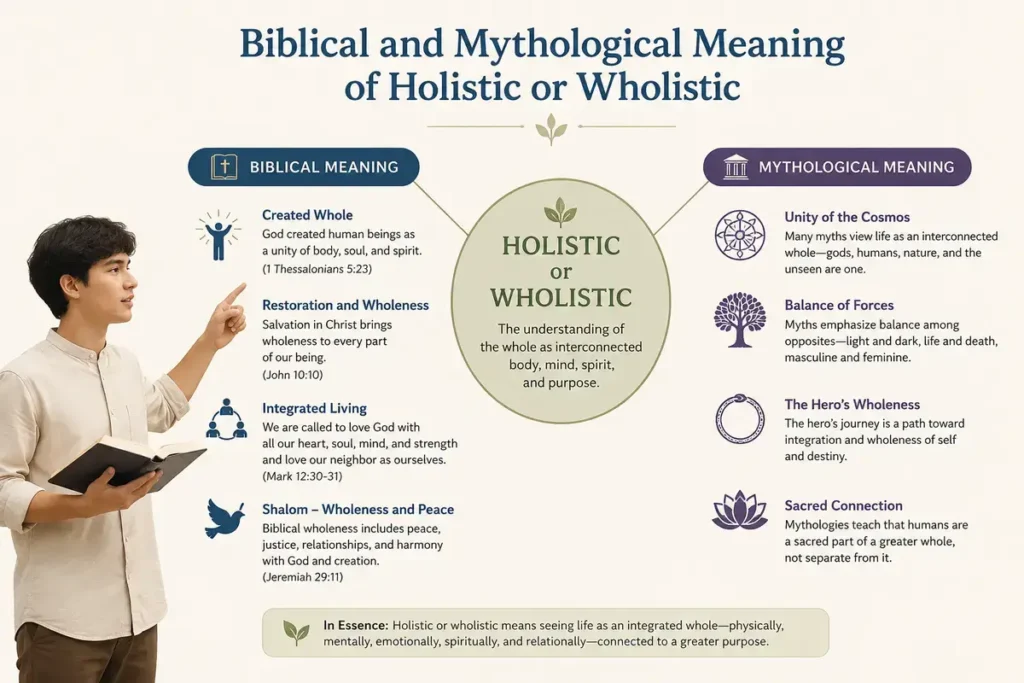
Biblical and Mythological Meaning of Holistic or Wholistic
The Bible does not use the words. However, many people believe the idea of caring for the whole person matches several biblical teachings. For example, the Bible often talks about loving God with your:
- Heart
- Soul
- Mind
- Strength
This shows that people are more than just their physical bodies. Many Christians also believe people should care for:
- Physical health
- Emotional health
- Spiritual life
- Relationships
This is similar to what many people call a holistic approach today. In mythology, there is no special meaning for the words. Still, many old stories teach that nature, people, animals, and the world are connected. That idea is close to holistic thinking because it focuses on the whole instead of separate pieces. So while the words themselves are modern, the basic idea has been around for a very long time.
Symbolism Explained in Simple Words
What Holistic Represents
The word holistic often represents:
- Balance
- Unity
- Complete understanding
- Teamwork
- Connection
- Healthy living
- Looking at the big picture
When people hear holistic, they often think about solving problems by understanding everything involved instead of only one part. It reminds people that every piece matters.
What Wholistic Represents
The word wholistic usually represents the same ideas. Some people choose this spelling because they want readers to notice the word whole. For them, the spelling itself reminds people to think about complete health or complete understanding. Even though the spelling is different, the message stays almost the same.
Simple Comparison
| Holistic | Wholistic |
|---|---|
| Standard spelling | Alternative spelling |
| Focuses on the complete picture | Also focuses on the complete picture |
| Used by most writers | Used by some organizations and writers |
| Best for everyday English | Mostly a personal style choice |
Related Words You Should Know About Holistic and Wholistic
Learning similar words makes English easier.
Whole
Means complete or not missing any part.
Example: I ate the whole pizza.
Complete
Means nothing is left out.
Example: Please complete your homework.
Comprehensive
Means covering many parts of a subject.
Example: The report gives a comprehensive review.
Balanced
Means everything works together in a healthy way.
Example: A balanced diet includes different kinds of food.
Integrated
Means different parts work together as one.
Example: The new system is fully integrated.
Wellness
Means overall health and well-being.
Example: Walking every day improves wellness.
Perspective
Means the way someone looks at a situation.
Example: Try to see the problem from another perspective.
Big Picture
A common English expression that means looking at everything together.
Example: Let’s look at the big picture before making a decision.
How People Actually Use Holistic or Wholistic in Daily English
Here are examples of how people naturally use these words.
- We need a holistic plan for the project.
- Our school believes in holistic learning.
- The doctor recommended a holistic treatment plan.
- She likes a holistic way of living.
- Good leaders take a holistic view of every problem.
- The company uses a holistic business strategy.
- We should look at the whole picture before deciding.
- His manager wants a more holistic solution.
- The clinic calls itself a wholistic health center.
- I usually write holistic because it is more common.
Notice something interesting.
Almost every everyday conversation use holistic. That is why learning the standard spelling is the safest choice.
Common Mistakes People Make With Holistic or Wholistic
Many English learners make the same mistakes. Here are the most common ones.
Mistake 1: Thinking Wholistic Is the Only Correct Spelling
❌ Wholistic is the correct spelling.
✅ Holistic is the standard spelling.
Mistake 2: Thinking the Two Words Have Different Meanings
❌ Holistic and wholistic mean different things.
✅ They have almost the same meaning.
Mistake 3: Using Wholistic in School Writing
Many teachers expect the standard spelling.
Use holistic unless your teacher asks for something different.
Mistake 4: Believing Holistic Is Wrong Because It Does Not Start With “Whole”
This is a common misunderstanding.
English spelling often comes from older languages.
Even if whole seems more logical, holistic is still the accepted spelling.
Mistake 5: Replacing Every Similar Word With Holistic
Not every sentence needs the word. Sometimes words like:
- complete
- balanced
- overall
- comprehensive
fit better.
Choose the word that matches your meaning.
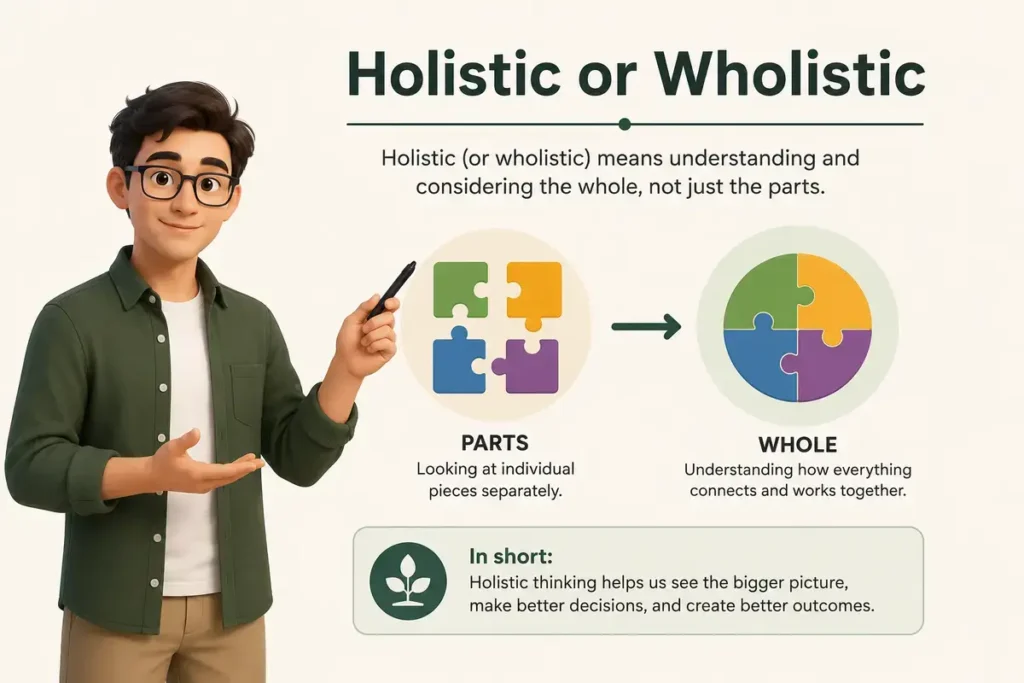
Final Teacher Explanation of Holistic or Wholistic
Imagine I am standing in front of a classroom. A student raises a hand and asks, “Should I write?” My answer would be very simple. Write holistic. That is the spelling used in most books, dictionaries, schools, newspapers, and professional writing. If you see wholistic, do not worry. It is not a completely different word.
It simply uses another spelling to remind readers about the idea of being “whole.” Both words point to the same idea. They encourage people to think about every part of a person or situation instead of only one piece. So here is the easiest rule to remember. If you are writing an essay, email, article, report, or homework, choose holistic. You will almost always be correct.
Final Answer About Holistic or Wholistic (Quick Recap)
If you are choosing between the best answer is holistic. Both spellings have the same basic meaning, but holistic is the standard and most widely accepted form. Use it for school, work, websites, and everyday writing because it is the spelling most readers expect.
Need another quick comparison? Read Bachelor vs Batchelor: Correct Grammar and Spelling Explained.
Conclusion
The question is really about spelling, not meaning. Both words describe the idea of seeing the whole picture, but holistic is the standard spelling used in modern English. It is the form you will find in most dictionaries, classrooms, books, and professional writing. If you want clear, natural, and correct English, choose holistic in almost every situation.
Frequently Asked Questions (FAQs)
What does holistic mean in simple words?
Holistic means looking at the whole person or the whole situation instead of only one part.
Which is correct?
Both spellings exist, but holistic is the standard spelling and the best choice for most writing.
Why do people get confused?
People notice the word whole and think the spelling should start with wh. That is why the confusion happens.
Can I use wholistic in writing?
Yes, but it is much less common. In most cases, holistic is the better choice.
Which spelling do teachers prefer?
Most teachers, editors, and dictionaries prefer holistic.
Do have different meanings?
No. They both describe looking at the complete picture instead of only one part.
Is holistic used in health and education?
Yes. It is very common in health, education, business, psychology, and personal development.
How can I remember the correct spelling?
Remember this simple rule: When in doubt, write holistic. It is the standard spelling and the one most readers expect.
