
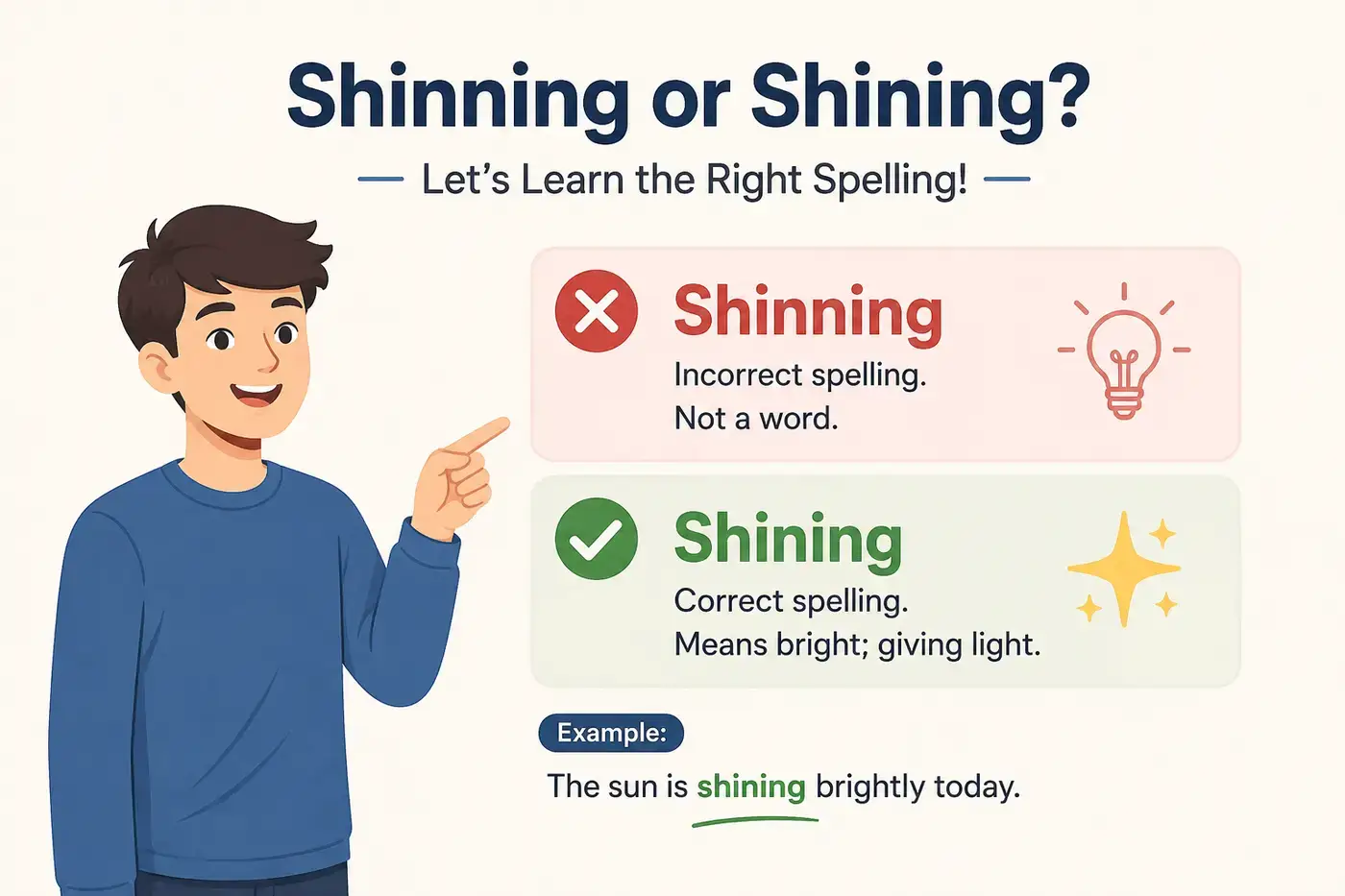
Many English learners get confused about shinning or shining because the two words look almost the same. You may see shining in books, messages, and everyday conversations, while shinning appears much less often. This makes people wonder which one is correct and when to use each word.
The short answer is simple. Shining is the correct word when you talk about giving off light, looking bright, or standing out. Shinning is a real English word too, but it has a very different meaning. It means climbing by using your hands and legs, usually up a rope, pole, or tree.
In this guide, you will learn the difference between and the easiest way possible. By the end, you will know which word to use, why people confuse them, and how to avoid this common mistake in your writing.
You may also want to read Dought vs Doubt: Which Is Correct and How Should You Use It?.
Simple Answer in One Look
Shining is the correct word when something gives off light or looks bright.
Shinning is correct only when someone climbs a pole, rope, or tree by gripping it with their hands and legs.
Quick rule:
- Use shining for light, brightness, success, or happiness.
- Use shinning only for climbing.
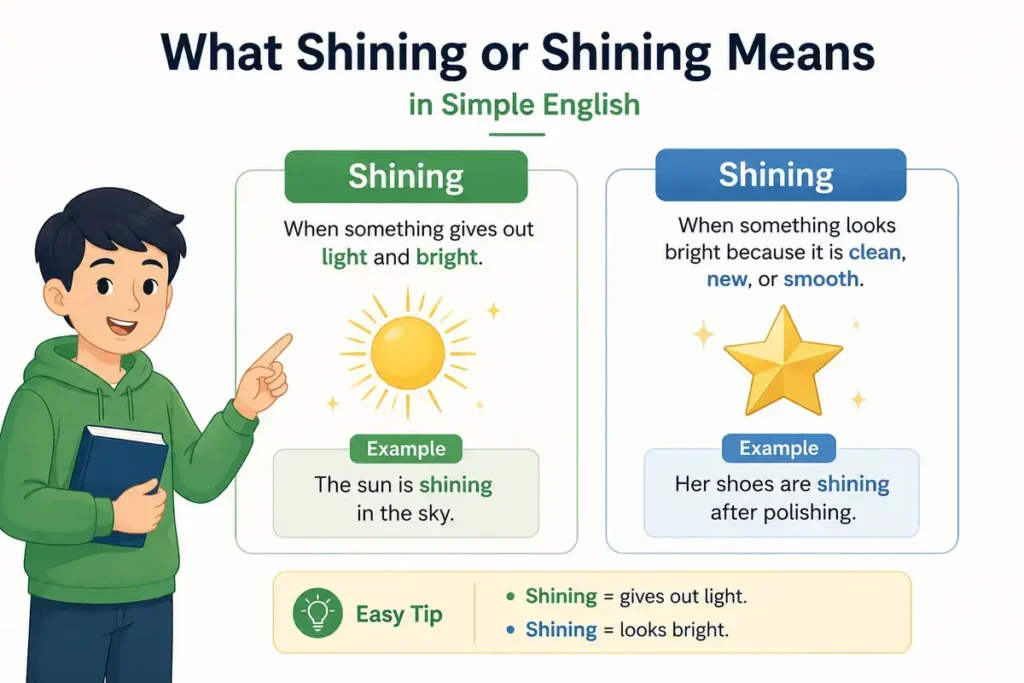
What Shinning or Shining Means in Simple English
The word shining comes from the verb shine. It describes something that gives off light or looks bright and clean. Examples:
- The sun is shining.
- Her shoes are shining.
- You did a shining job today.
People also use shining to describe someone who is doing very well. For example:
- She is a shining example of kindness.
- He has a shining smile.
Now let’s look at shinning.
The word shinning comes from the verb shin, which means climbing up something by holding it tightly with your arms and legs. For example:
- The child was shinning up the tree.
- The firefighter practiced shinning up a rope.
This word is much less common than shining. Many native English speakers may never use it in daily conversation. So even though both words are real English words, they describe completely different actions.
Why People Mix These Words Shinning or Shining
Many learners make this mistake because the words are only one letter apart. Here are the biggest reasons.
Both words look almost the same.
Compare them:
- shine → shining
- shin → shinning
The extra n changes the meaning completely.
People think every verb works the same way.
Some English verbs double the last letter before adding -ing. For example:
- run → running
- sit → sitting
Because of this pattern, many learners wrongly write:
- shine → shinning ❌
But shine does not follow that spelling rule.
The correct spelling is:
- shine → shining ✅
Autocorrect does not always help.
Since shinning is also a real word, spell check may not mark it as an error.
That is why many people accidentally use it when they really mean shining.
Pronunciation sounds similar.
When spoken quickly, It’s sound almost the same.
This causes even more confusion in writing.
Clear Difference Explained Simply
Here is an easy comparison.
| Shining | Shinning |
|---|---|
| Means giving off light | Means climbing with hands and legs |
| Very common | Rarely used |
| Comes from shine | Comes from shin |
| Used every day | Mostly found in climbing situations |
| Correct for the sun, stars, smiles, shoes, success | Correct for climbing a rope, tree, or pole |
Think of it this way.
If something is bright, use shining.
If someone is climbing, use shinning.
Easy memory trick
Light = Shining
Climbing = Shinning
This simple trick helps many learners remember the difference.
Which Form Should You Use for Shinning or Shining?
Most of the time, you should use shining. Use shining when talking about:
- the sun
- the moon
- stars
- lights
- clean objects
- happy smiles
- success
- hope
- talent
Examples:
- The stars are shining tonight.
- Your face is shining with joy.
- The floor is shining after cleaning.
- She has a shining future.
- His eyes were shining with excitement.
Use shinning only when someone climbs something using both arms and legs. Examples:
- The boy was shinning up the tree.
- The worker was shinning up the pole.
- The climber practiced shinning up the rope.
Since climbing like this does not happen every day, shinning is much less common. If you are unsure, ask yourself one simple question. Am I talking about light or climbing? If the answer is light, choose shining. If the answer is climbing, choose shinning.
Easy Real-Life Sentences You Can Use for Shinning or Shining
Here are simple examples you can copy into your own writing.
- The sun is shining brightly today.
- Her new shoes are shining.
- Your smile is shining with happiness.
- The stars were shining all night.
- The clean car is shining in the sunlight.
- The little boy was shinning up the tree.
- The firefighter practiced shinning up a training pole.
- The monkey was shinning up the tall coconut tree.
Notice that only the last three sentences use shinning because they describe climbing. All the other examples use shining because they describe brightness.
Where Shinning or Shining Word Comes From (Simple History)
The word shine has been part of English for hundreds of years. It comes from very old Germanic languages and has always been connected with light, brightness, and glowing objects. Over time, people also began using shining to describe someone who stands out because they are talented, kind, or successful.
The word shin, meaning to climb by holding something with your hands and legs, appeared later in English. It likely came from the idea of using your shins, the front part of your lower legs, while climbing a tree, rope, or pole. Because this action is not common in everyday life, the word shinning is much less popular than shining.
Today, you will see shining almost everywhere—in books, news articles, schools, songs, and daily conversations. Shinning still exists, but it is mostly used when talking about climbing in a very specific way.
As you can see, the difference between shinning or shining is actually very simple once you know the meaning behind each word. In the next part of this guide, we will look at deeper usage, common mistakes, cultural meanings, helpful memory tips, and frequently asked questions so you can use both words with complete confidence.
How Shinning or Shining Is Understood in Culture and Stories
When people read stories, poems, or watch movies, they almost always see the word shining. It is linked with light, hope, beauty, and success. A shining sun often means a happy day. A shining star can stand for dreams or a bright future. For example:
- The shining sun gave everyone hope after the storm.
- Her shining eyes showed how excited she was.
- He became the shining star of the team.
In many stories, light helps people find the right path. Because of this, shining often has a positive feeling. The word shinning is very different. It usually appears in stories where a person climbs a tree, a rope, or a pole. Adventure books may use it when characters escape danger or reach a high place. For example:
- The boy started shinning up the tree to save the kitten.
- The explorer kept shinning up the rope until he reached the top.
Since this action does not happen every day, shinning is much less common in books and conversations. The main idea is easy to remember.
- Shining brings the picture of light and happiness.
- Shinning brings the picture of climbing.
A related grammar guide is Pentoxide vs Pentaoxide: Which One Is Correct?.
Biblical and Mythological Meaning of Shinning or Shining
The Bible often talks about light, so the word shining fits many Bible verses. Light usually represents God’s presence, truth, hope, wisdom, and goodness. For example, believers may describe God’s glory as shining or say that a person’s faith is shining through their actions.
The Bible does not use shinning as a special religious idea. Since it simply means climbing, it has no common symbolic meaning in biblical writing. In mythology, many gods, heroes, magical objects, and heavenly places are described as shining because they are powerful, pure, or beautiful. For example:
- A shining sword may represent justice.
- A shining crown may represent honor.
- A shining city may represent peace.
The word shinning does not carry this kind of symbolic meaning in myths. It simply describes the action of climbing. So, if you are reading religious or mythological stories, shining is the word you will see much more often.
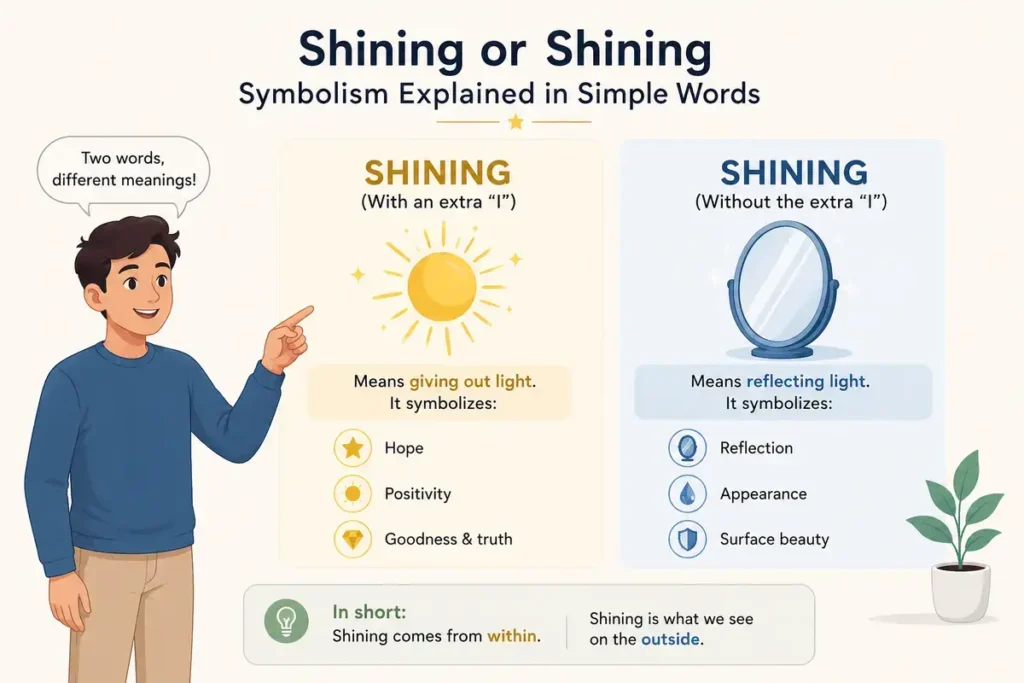
Symbolism Explained in Simple Words
What Shining Represents
The word shining often stands for positive ideas. It can represent:
- Hope
- Light
- Success
- Kindness
- Happiness
- Wisdom
- Beauty
- Cleanliness
- A bright future
People also use shining to describe someone who stands out because they are honest, talented, or caring. Examples:
- She is a shining example of kindness.
- His future looks shining and bright.
- Their friendship kept shining through hard times.
What Shinning Represents
The word shinning has a much simpler meaning. It usually represents:
- Climbing
- Effort
- Hard work
- Reaching higher
- Physical movement
- Determination
Examples:
- The child kept shinning up the rope.
- The climber was shinning toward the top.
Unlike shining, this word does not usually carry emotional or symbolic meaning. It mainly describes a physical action.
The easiest way to compare them is this:
| Shining | Shinning |
|---|---|
| Light | Climbing |
| Hope | Effort |
| Beauty | Physical action |
| Success | Moving upward |
| Very common | Rarely used |
Related Words You Should Know About Shinning or Shining
Learning similar words makes English easier.
Shine
The base verb. Example:
- The stars shine every night.
Shiny
Something that looks bright or smooth. Example:
- I bought shiny new shoes.
Bright
Full of light. Example:
- The room is bright.
Glow
To give off a soft light. Example:
- The candles glow at night.
Sparkle
To shine with many small flashes of light. Example:
- The diamonds sparkle beautifully.
Glitter
To shine with tiny bright reflections. Example:
- The snow glittered in the sunlight.
Climb
To move upward. Example:
- We climbed the hill.
Scale
Another word for climbing something difficult. Example:
- The rescue team scaled the wall.
Ascend
A more formal word for going upward. Example:
- The balloon slowly ascended.
Knowing these words helps you understand when shining or shinning fits best.
How People Actually Use Shinning or Shining in Daily English
In normal conversations, people almost always use shining. Here are real-life examples.
- The sun is shining today.
- Your shoes are shining after you cleaned them.
- She has a shining personality.
- His eyes were shining with happiness.
- The stars are shining tonight.
- This trophy is shining like new.
- You are a shining example for younger students.
- The little boy was shinning up the tree.
- The firefighter practiced shinning up the training pole.
- The monkey kept shinning up the tall tree.
Notice something interesting.
The first seven examples sound natural in everyday English. The last three are correct too, but you will hear them much less often because climbing this way is not a daily activity.
Common Mistakes People Make With Shinning or Shining
Many English learners make the same mistakes. Here are the most common ones.
Mistake 1: Writing
❌ The sun is shinning.
✅ The sun is shining.
The sun gives off light. It does not climb.
Mistake 2: Thinking shinning is always a spelling mistake
❌ Shinning is never a real word.
✅ Shinning is a real English word. It means climbing with your hands and legs.
Mistake 3: Adding an extra n to shine
Many learners remember words like:
- run → running
- sit → sitting
Then they think:
- shine → shinning ❌
But shine keeps only one n.
Correct:
- shine → shining ✅
Mistake 4: Using shinning in writing about light
❌ Her face was shinning with happiness.
✅ Her face was shining with happiness.
Mistake 5: Forgetting the meaning
Always ask yourself one question.
Is this about light or climbing?
If it is about light, use shining.
If it is about climbing, use shinning.
This simple question prevents almost every mistake.
Final Teacher Explanation About Shinning or Shining
Imagine you are sitting in my English class. I write two words on the board.
Shining
Shinning
At first, they look almost the same. That is why so many learners get confused. Then I ask one simple question. What is happening? If something is giving off light, looking bright, or making people think of hope, beauty, or success, the answer is always shining. If someone is climbing a tree, rope, or pole by using both hands and legs, the answer is shinning.
That is the whole difference. You do not need to memorize long grammar rules. Just remember two pictures. Picture one. A bright sun. That is shining. Picture two. A child climbing a tree. That is shinning. Whenever you feel unsure, think about these two pictures. They will guide you to the correct spelling every time.
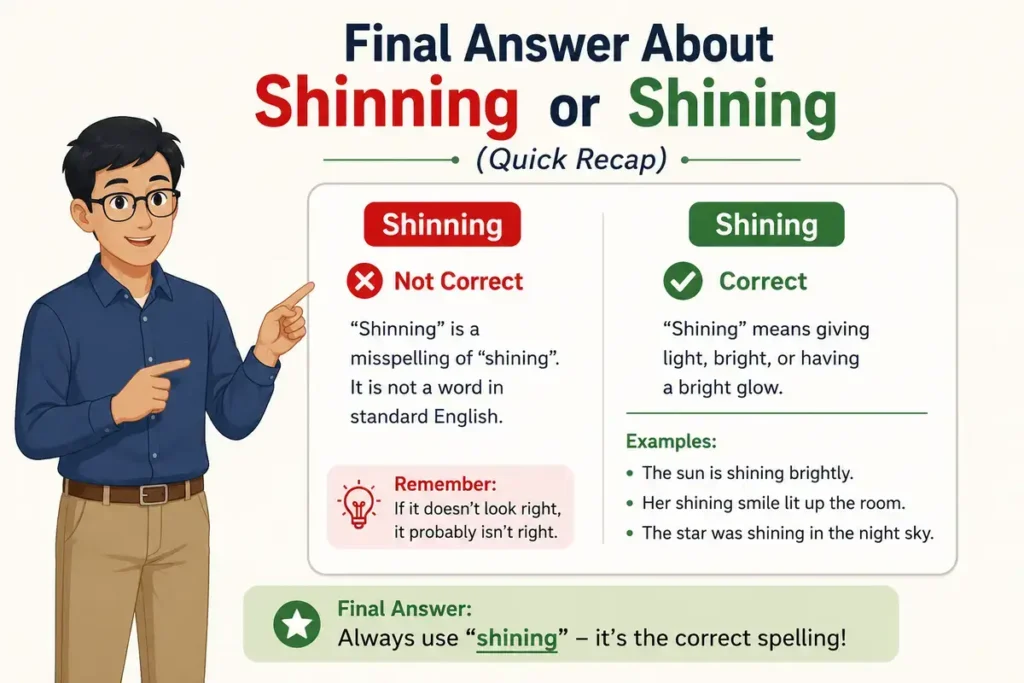
Final Answer About Shinning or Shining (Quick Recap)
If you are talking about light, brightness, happiness, or success, shining is the correct word.
Use shinning only when someone climbs a rope, tree, or pole using their hands and legs.
The easiest memory trick is:
Light = Shining
Climbing = Shinning
A related grammar guide is Sentence or Sentance: Which Spelling Is Correct?.
Conclusion
The confusion between is easy to solve once you know what each word means. Shining is the word you need when talking about light, brightness, beauty, hope, or success. It is common in everyday English and appears in books, conversations, and writing.
Shinning is also correct, but it has a very specific meaning. It describes climbing a tree, rope, or pole using your hands and legs. Since this action is uncommon, the word is much less common too.
Whenever you are unsure, remember this simple rule: If it shines, use shining. If someone climbs, use shinning. That one sentence will help you choose the correct word with confidence every time.
Frequently Asked Questions (FAQs)
What does shining mean in simple words?
It means giving off light or looking bright. It can also describe someone who is successful or kind.
Is shinning a real English word?
Yes. It is a real word, but it means climbing a tree, rope, or pole with your hands and legs.
Which is correct?
Both are correct, but they have different meanings. Shining is used for light. Shinning is used for climbing.
Why do people confuse?
The words look almost the same. Many learners also think every verb doubles the last letter before adding -ing, but shine does not.
Can I say, “The sun is shinning”?
No. The correct sentence is, The sun is shining.
When should I use shinning?
Use it only when someone is climbing a rope, pole, or tree by gripping it with their hands and legs.
Is shining more common than shinning?
Yes. Shining is used every day in speaking and writing.
How can I remember the difference?
Think of one simple rule: Light means shining. Climbing means shinning.
