
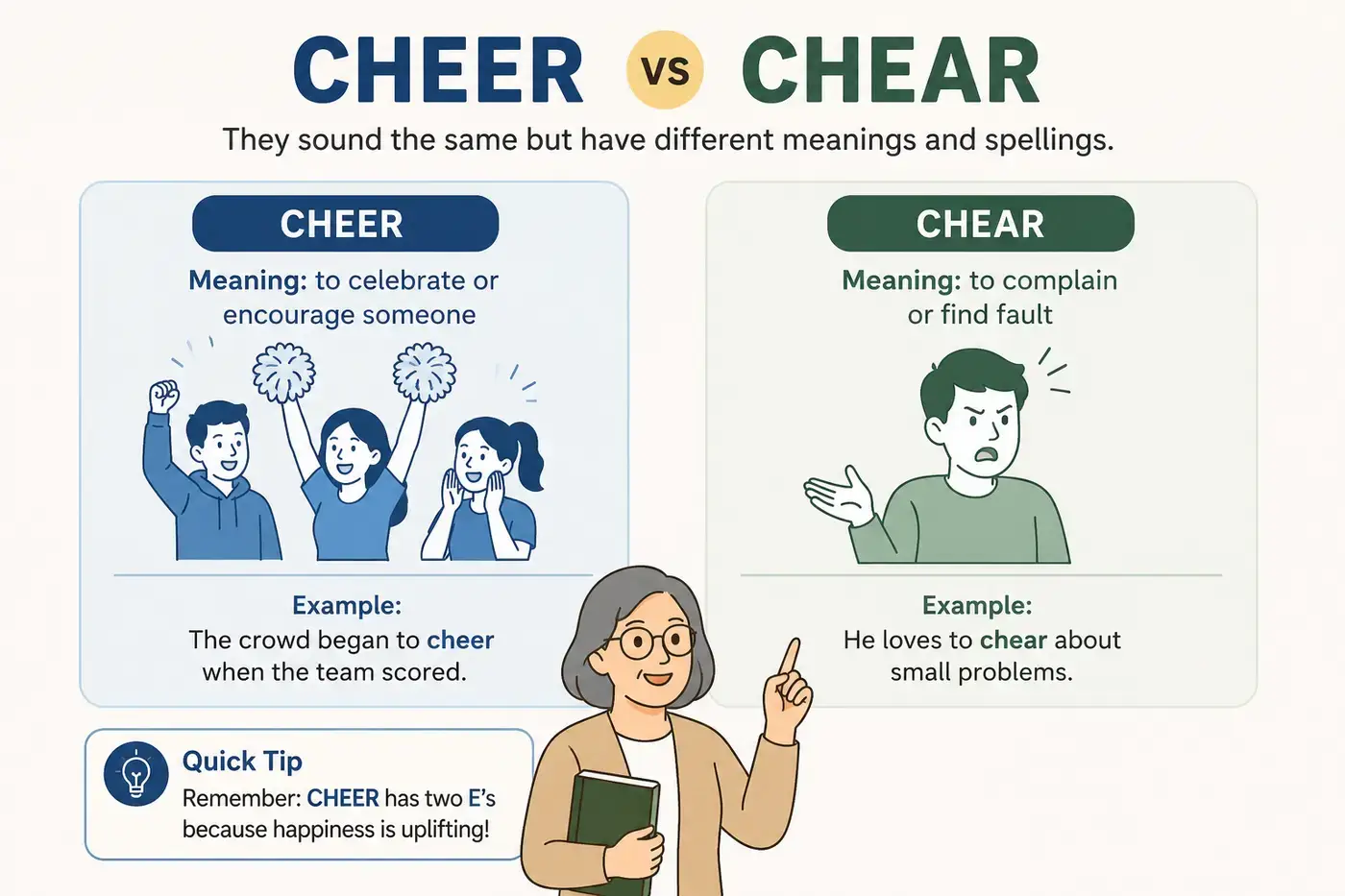
Many people search for cheer vs chear because both words look like they could be correct. It is easy to make this mistake, especially when writing quickly or learning English. The good news is that the answer is simple.
The correct spelling is cheer. The word chear is an old spelling that was used many hundreds of years ago. In modern English, you should almost always write cheer.
If you have ever wondered this guide will explain everything in very simple words. By the end, you will know which spelling to use, why people confuse them, and how to remember the correct form every time.
A related grammar guide is Lacs or Lakhs: Which Is Correct? Simple Meaning and Difference.
Simple Answer in One Look
Cheer is the correct modern English spelling.
Chear is an old spelling and is no longer used in normal writing.
If you are writing for school, work, emails, social media, or everyday conversations, always use cheer.
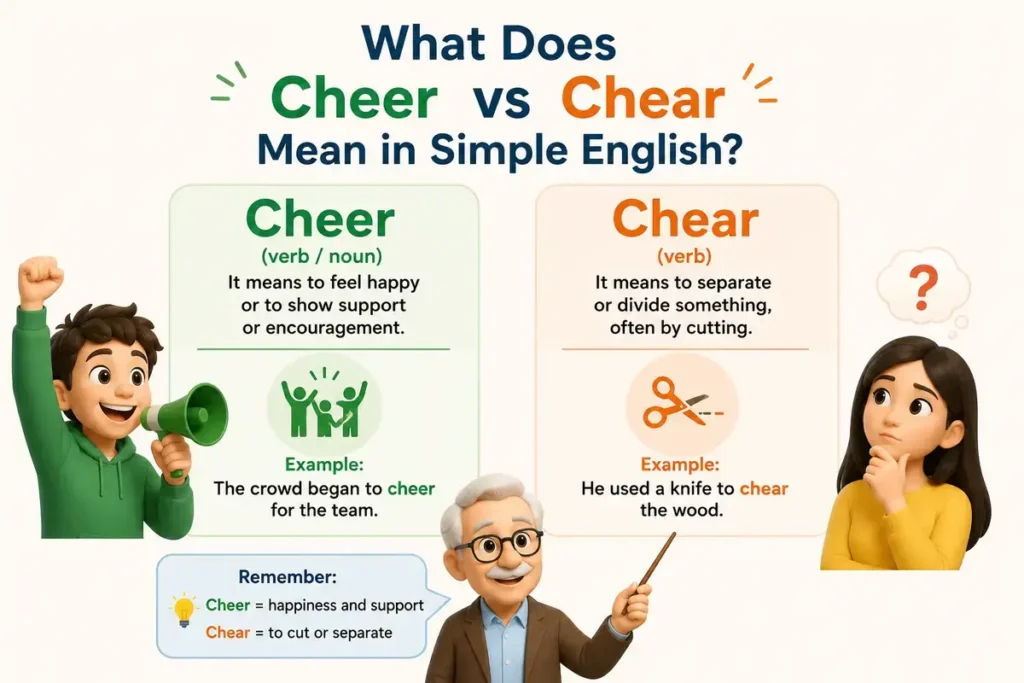
What Does Cheer vs Chear Mean in Simple English?
When people compare because they usually want to know if both spellings are correct. The simple answer is no. The word cheer has several meanings. It can mean happiness, support, encouragement, or loud shouts for someone. It can also be used as both a noun and a verb. Here are some common meanings of cheer. Cheer as happiness It means a feeling of joy or good spirits. Example:
- Her smile filled the room with cheer.
Cheer as support
It means shouting to encourage someone. Example:
- We cheer for our favorite team.
Cheer as encouragement
It means making someone feel happier. Example:
- Good news will cheer him up.
You may see chear while reading very old books or historical writings. In those texts, it was simply another way to spell cheer. Modern English no longer uses this spelling. So, when thinking remember that they do not have different meanings today. Only the spelling has changed over time.
Why Do People Mix Cheer and Chear?
Many English learners and even native speakers sometimes confuse. There are several simple reasons for this.
Look Very Similar
Only one letter is different.
- cheer
- chear
Because the words almost match, many people type the wrong one by accident.
The Sound Is Almost the Same
English spelling does not always match pronunciation. The letters ee and ea can sometimes sound alike in different words. For example:
- team
- dream
- clean
Because people know many words with ea, they may guess that chear is also correct.
Fast Typing Causes Mistakes
Sometimes people simply hit the wrong key while typing. Instead of writing cheer, they accidentally write chear. This is a spelling mistake, not another accepted spelling.
Old Books May Show Chear
If you read poetry, history books, or very old English writing, you might find chear. That does not mean you should use it today. Modern dictionaries list cheer as the correct spelling.
Learners Try to Follow Patterns
English has many spelling patterns. People see words like:
- wear
- bear
- pear
Then they think chear might fit the same pattern. Unfortunately, English has many exceptions, and cheer is one of them.
Clear Difference Explained Simply
The difference is very easy to understand.
Cheer
- Correct modern spelling
- Used in schools, books, newspapers, and websites
- Accepted everywhere
- Means happiness, support, or encouragement
Examples:
- We cheer every goal.
- The crowd gave a loud cheer.
- She tried to cheer me up.
Chear
- Old spelling
- Not used in modern English
- May appear in historical writing
- Should not be used in normal writing today
Quick Comparison
| Cheer | Chear |
|---|---|
| Correct today | Old spelling |
| Modern English | Historical English |
| Use in all writing | Avoid in normal writing |
| Found in dictionaries | Mostly found in old texts |
Easy Way to Remember Cheer vs Chear
Think about the word cheerleader. It always uses cheer. There is no word called chearleader. That simple memory trick helps many learners remember the correct spelling.
Which Form Should You Use?
If you are choosing the answer is always cheer. Use cheer in:
- School assignments
- Business writing
- Text messages
- Emails
- Books
- Blogs
- Social media posts
- Job applications
- Reports
Avoid using chear unless you are:
- Quoting an old document
- Studying historical English
- Reading classic literature
- Discussing old spellings
For almost every situation, cheer is the right choice.
Easy Rule
If you are writing English today, spell it cheer.
If you see chear, it probably comes from an older piece of writing.
That simple rule will keep your writing correct.
Easy Real-Life Sentences You Can Use with Cheer vs Chear
Here are everyday examples using the correct spelling.
- We always cheer for our school team.
- Your kind words really cheer me up.
- The children gave a loud cheer after the show.
- Everyone began to cheer when the singer walked on stage.
- Flowers bring cheer to the room.
- She smiled to cheer her friend.
- Fans cheer every time their team scores.
- Happy music adds cheer to the party.
Now look at these incorrect examples.
❌ We gave a loud chear.
✅ We gave a loud cheer.
❌ Please chear him up.
✅ Please cheer him up.
❌ The crowd started to chear.
✅ The crowd started to cheer.
These examples show that cheer is always the correct spelling in modern English.
Where Does Cheer vs Chear Come From? (Simple History)
The story behind is actually very interesting. Hundreds of years ago, English spelling was not fixed. People often spelled the same word in different ways. During that time, writers sometimes used:
- cheer
- chear
Both spellings could be found in books and poems. As English became more organized, dictionaries helped create standard spellings. Over time, cheer became the accepted form. The older spelling chear slowly disappeared from everyday use. Today, if you open a modern dictionary, you will find cheer. You might still discover chear in:
- Old poems
- Historical letters
- Classic books
- Early English documents
These examples are part of English history, not modern spelling. That is why students, teachers, writers, and editors all use cheer today. Understanding this history makes much easier to remember. Instead of thinking they are two different modern words, remember that one is simply the older version of the other.
As English changed over hundreds of years, cheer became the standard spelling that everyone uses now. In the next section, we will go beyond spelling. You will learn how cheer is used in culture, stories, sports, daily conversations, common expressions, and memory tricks that make the correct spelling easy to remember forever.
How Cheer vs Chear Words are Understood in Culture and Stories
The word cheer is connected with happiness, hope, and support in many cultures. People use it when they want to celebrate success or help someone feel better. A simple cheer can bring people together and create a friendly feeling. For example, sports fans cheer for their favorite teams. Families cheer when a child graduates. Friends cheer each other on before a big test or job interview.
The word also appears in songs, holiday greetings, books, and movies. During the holiday season, people often wish others “holiday cheer.” This means they hope everyone feels happy and enjoys the season. Children also learn the word at a young age. They hear teachers say things like:
- “Let’s cheer for our classmates.”
- “Give everyone a big cheer.”
These simple moments help children connect the word with kindness and encouragement. The older spelling chear has almost disappeared from everyday culture. You may only find it in old books, poems, or historical writings. Modern stories, newspapers, websites, and schools all use cheer. So, when people compare only cheer has a place in modern daily life and culture.
Learn the difference in Kinesthesiology vs Kinesiology: A Simple Guide for Beginners.
Biblical and Mythological Meaning of Cheer vs Chear
The exact word cheer is not a special biblical symbol, but the idea behind it appears many times. The Bible often encourages people to have courage, hope, joy, and gladness. Some Bible translations include words like:
- “Be of good cheer.”
- “Be cheerful.”
- “Rejoice.”
These messages remind people to stay hopeful, even during hard times. The spelling chear is not used because modern Bible translations follow today’s standard English spelling. In mythology, there is no famous symbol connected only to cheer. However, stories from many cultures celebrate happiness, victory, and joyful celebrations after challenges. These ideas match the meaning of cheer. So, while cheer is not a special religious or mythical word, its meaning of joy and encouragement fits many stories around the world.
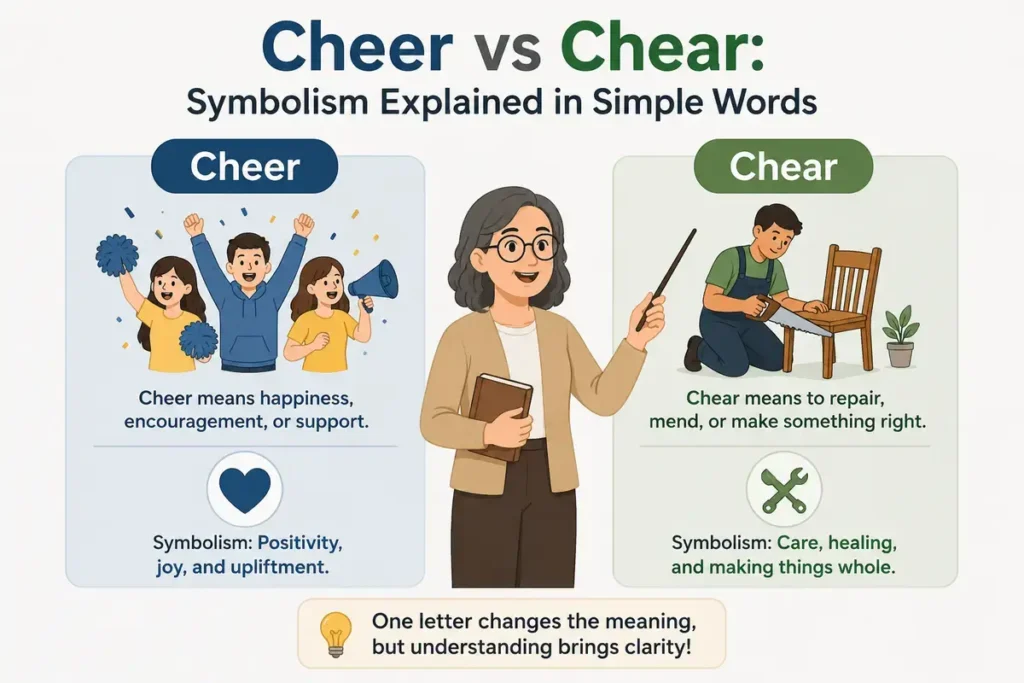
Symbolism Explained in Simple Words
Words often carry feelings as well as meanings. That is also true when comparing.
Cheer vs Chear: What One Version Represents
The word cheer represents many positive feelings. It can symbolize:
- Happiness
- Hope
- Friendship
- Support
- Celebration
- Team spirit
- Encouragement
- Positive energy
When a room is full of cheer, people feel welcome and happy. When someone says, “Cheer up,” they want you to smile again. That is why cheer is often linked with positive emotions.
Cheer vs Chear: What the Other Version Represents
The spelling chear does not carry a different meaning. Instead, it represents something different in language history. It reminds us that English spelling has changed over time. Today, chear mostly represents:
- Historical writing
- Old English spelling
- Ancient books
- Earlier forms of the language
It does not have a special emotional meaning that is different from cheer.
The biggest difference is simply this:
- Cheer belongs to modern English.
- Chear belongs to historical English.
Related Words You Should Know about Cheer vs Chear
Learning related words makes English easier.
Cheerful
Someone who feels happy and positive. Example:
She is always cheerful at school.
Cheerfully
Doing something with happiness. Example:
He answered cheerfully.
Cheerfulness
The quality of being happy and friendly. Example:
Her cheerfulness made everyone smile.
Cheerleader
A person who supports a sports team with chants and routines. Example:
The cheerleaders excited the crowd.
Cheer Up
A common phrase that means to become happier. Example:
Cheer up. Tomorrow will be better.
Encouragement
Words or actions that help someone keep trying. Example:
Your encouragement helped me finish.
Support
Helping another person. Example:
Thank you for your support.
Applause
Clapping to show approval. Example:
The audience gave loud applause.
Celebrate
To enjoy a happy event. Example:
We celebrated her birthday.
Joy
A strong feeling of happiness. Example:
The news brought great joy.
These related words help you understand why cheer is such a positive and useful English word.
How People Actually Use Cheer vs Chear in Daily English
Here are common ways people use cheer every day.
- Everyone cheered after the winning goal.
- My friends always cheer me on.
- Your message really cheered me up.
- The crowd gave a huge cheer.
- We decorated the house with holiday cheer.
- Please cheer for your classmates.
- Her smile brings cheer to everyone.
- Good music filled the party with cheer.
- The coach cheered the players before the game.
- We all stopped to cheer the runners.
Notice that every sentence uses cheer, not chear. That is because cheer is the accepted spelling everywhere in modern English.
Cheer vs Chear: Common Mistakes People Make
Many learners make the same mistakes.
Mistake 1: Writing Chear Instead of Cheer
❌ I want to chear you up.
✅ I want to cheer you up.
Mistake 2: Thinking Both Spellings Are Modern
Some people believe both spellings are accepted today.
That is not true.
Only cheer is correct in modern English.
Mistake 3: Copying Old Books
Old books sometimes use chear.
Do not copy that spelling into modern writing.
Mistake 4: Guessing the Spelling
People often think words with ea follow the same pattern. English spelling does not always work that way. Always remember:
Cheer uses ee.
Mistake 5: Forgetting Common Phrases
People sometimes misspell common expressions. Correct examples include:
- Cheer up.
- Cheer on.
- Holiday cheer.
- School cheer.
- Loud cheer.
Every one of these uses cheer.
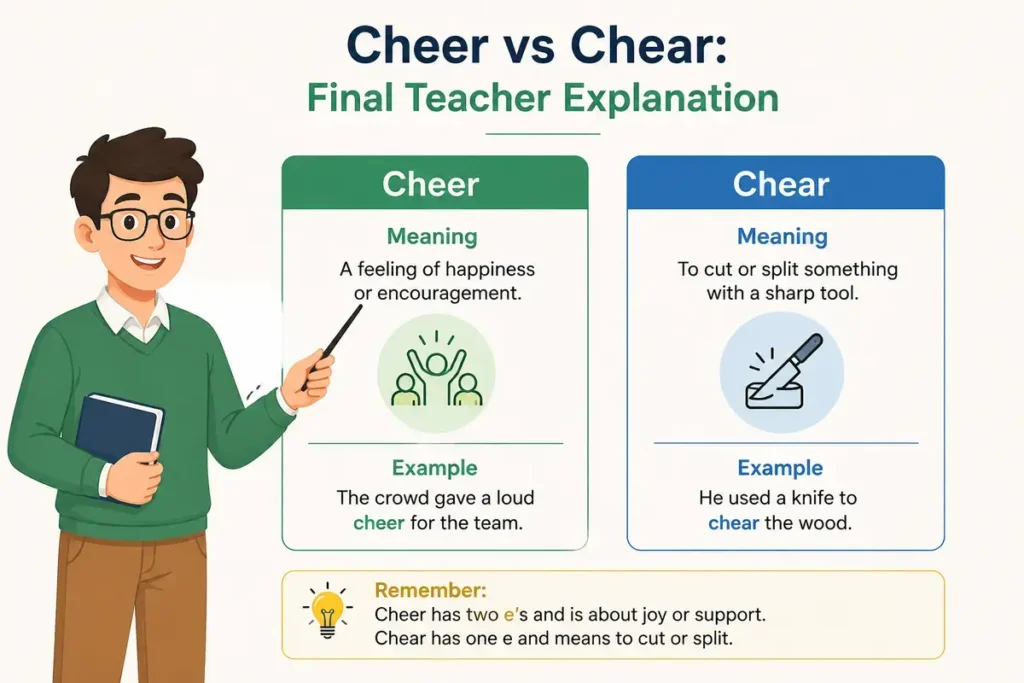
Cheer vs Chear: Final Teacher Explanation
Imagine I am standing in front of a classroom. A student asks,
“Should I write cheer or chear?”
My answer would be very simple. Always choose cheer. It is the spelling used by teachers, dictionaries, newspapers, websites, and English speakers around the world. The spelling chear belongs to older English. You may see it while reading historical books, but you should not use it in normal writing today. Here is the easiest way to remember it. Think about these common words:
- Cheerleader
- Cheer up
- Holiday cheer
- School cheer
- Loud cheer
Every one of them uses cheer. If you can remember those phrases, you will never confuse again. English has many spelling mistakes that happen because words sound alike. This is one of them. Once you know that cheer is the modern spelling, the choice becomes easy.
Cheer vs Chear: Final Answer (Quick Recap)
The correct spelling is cheer.
The spelling chear is an old form that is no longer used in modern English.
For school, work, emails, books, websites, and everyday conversations, always write cheer.
Remember this simple rule: Cheer is correct today. Chear belongs to the past.
Still confused? Compare Aerial vs Arial: Learn The Right Word complete guide (2026).
Conclusion
Understanding cheer vs chear is much easier than it first seems. In modern English, cheer is the only correct spelling for everyday writing. It means happiness, encouragement, support, or joyful shouting. The spelling chear is an old form that you may see in historical books, but it should not be used in schoolwork, business writing, emails, or daily conversations. If you remember the common phrases cheer up, cheer on, and holiday cheer, you will always choose the right spelling with confidence.
Frequently Asked Questions (FAQs)
What does cheer mean in simple words?
Cheer means happiness, encouragement, or shouting to support someone.
Is chear a real word?
Yes, but it is an old spelling. Modern English uses cheer instead.
Which is correct?
Cheer is the correct spelling for today’s English.
Why do people confuse?
They look very similar, and many English words use ea, so people sometimes guess the wrong spelling.
Can I use chear in modern writing?
No. Use cheer unless you are quoting an old historical text.
Is chear found in dictionaries?
Some historical dictionaries mention chear as an old spelling, but modern dictionaries list cheer as the standard word.
How can I remember the correct spelling?
Think of cheerleader, cheer up, and holiday cheer. They all use cheer.
Does chear have a different meaning?
No. It was simply an older spelling of cheer and does not have a separate modern meaning.
