
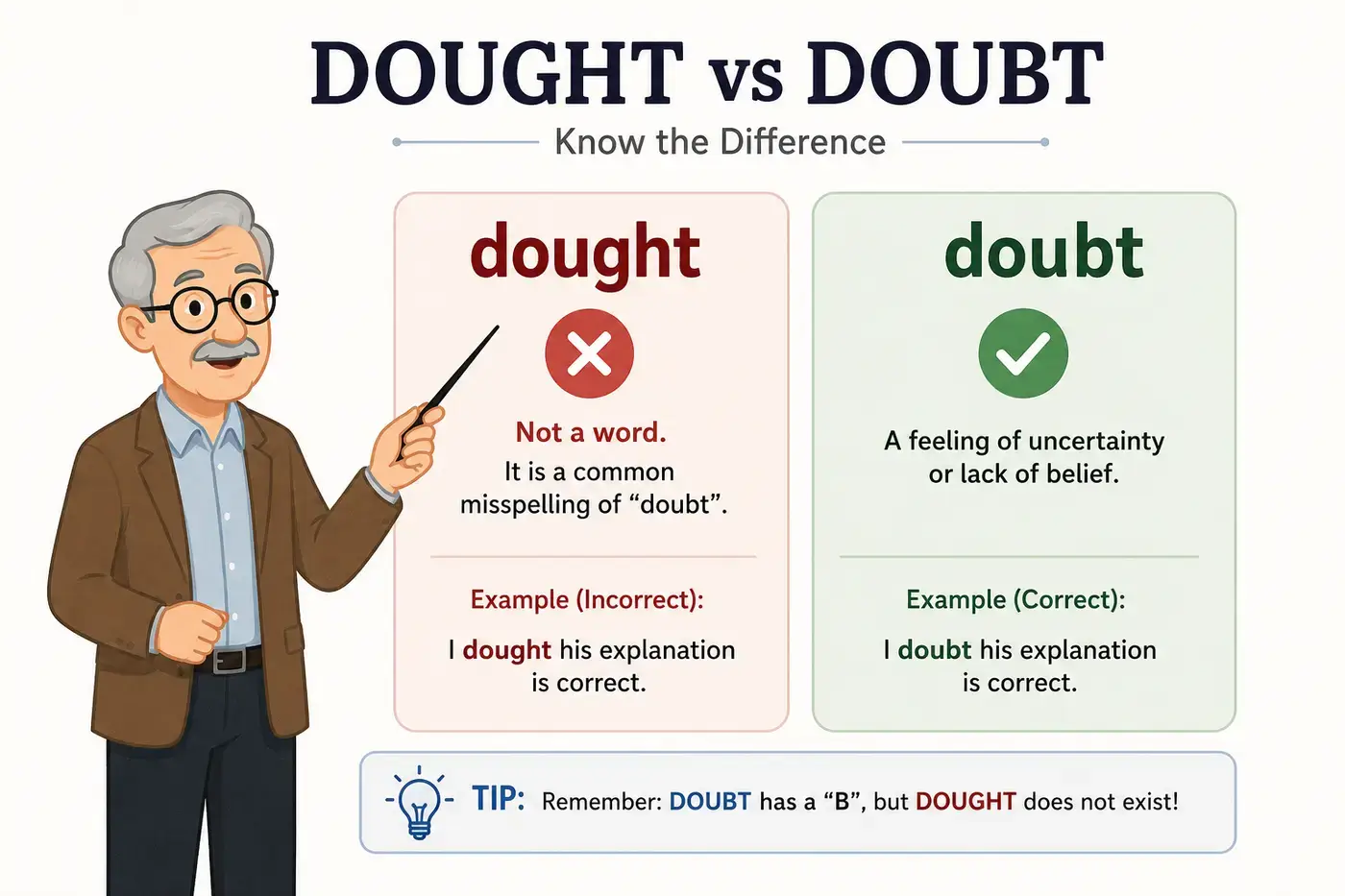
Many English learners get confused about dought vs doubt because the two words look very similar. When people hear the word spoken, they sometimes wonder if dought is another spelling of doubt or if both words are correct.
The short answer is simple. When comparing dought vs doubt, only doubt is the standard English word used today. The spelling dought is considered outdated, rare, and incorrect in most modern writing.
If you have ever typed dought instead of doubt, you are not alone. This is a common spelling mistake. In this guide, you will learn the difference, which form is correct, and how to use the word confidently in everyday English.
Need another quick comparison? Read Anyway vs Anyways: Which Is Correct and How to Use(2026).
Dought vs Doubt: Simple Answer in One Look
Doubt is the correct modern English word.
Dought is an old and rarely used form that is not used in normal modern English.
Correct: I doubt that it will rain today.
Incorrect: I dought that it will rain today.
What Dought vs Doubt Means in Simple English
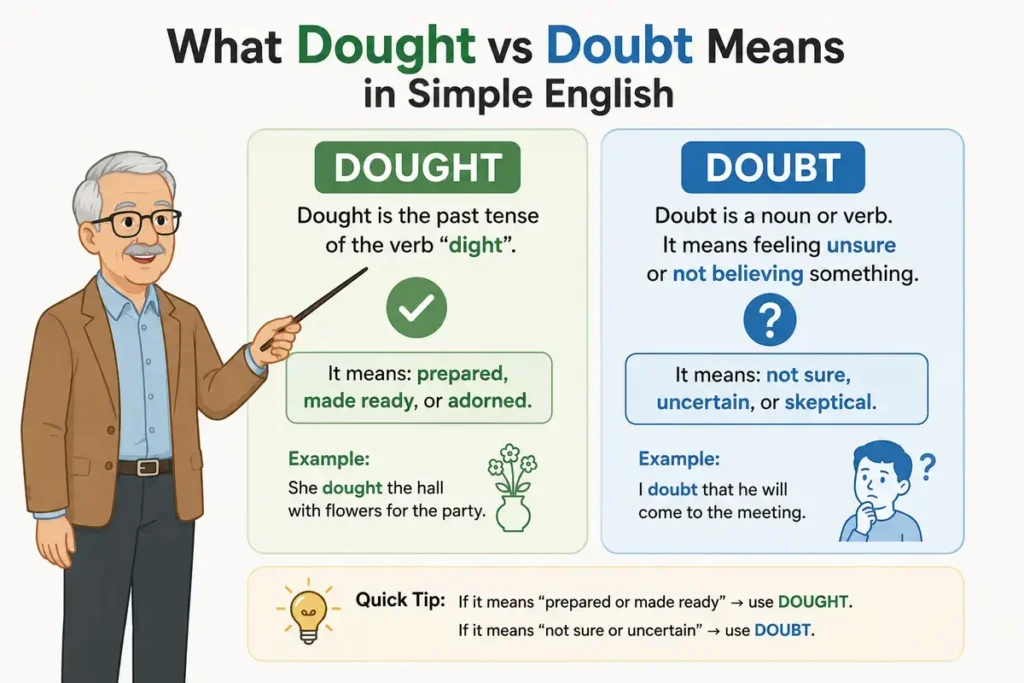
To understand dought vs doubt, you first need to know what doubt means. Doubt means feeling unsure about something. You are not completely certain. You may think something is true, but you are not fully convinced. For example:
- I doubt he will arrive on time.
- She doubts the story is true.
- We have doubts about the plan.
In all these examples, the person is uncertain. Think of doubt as a feeling of not being 100% sure. Here are some easy situations:
- You doubt a promise because it sounds unrealistic.
- You doubt an answer because it seems wrong.
The word can be used as a verb and as a noun. As a verb:
- I doubt his excuse.
- They doubt the results.
As a noun:
- I have a doubt.
- She has many doubts.
When people compare, they usually mean to write the word that shows uncertainty. In that case, doubt is always the right choice.
Why People Mix These Words Dought vs Doubt
Many people make mistakes with dought vs doubt for a few simple reasons.
The Words Look Similar
The spellings are very close.
- dought
- doubt
Only two letters are different. Because they look alike, people often type the wrong version without noticing.
English Spelling Can Be Tricky
English contains many silent letters n the word doubt, the letter b is silent. We say:
dout
We do not pronounce the b. Since people hear only the sound, they sometimes guess the spelling and end up writing dought.
Typing Errors Happen
Fast typing creates mistakes. Someone may know that doubt is correct but accidentally type dought. Spell-check tools usually catch this error, but not always.
Old English Forms Create Confusion
Some learners discover the word dought in historical texts or old dictionaries. They then assume it is a normal modern spelling. That assumption leads to confusion when comparing dought vs doubt.
Similar English Words Influence People
English has many words ending with -ought. For example:
- thought
- bought
- fought
- sought
Because these words are common, some people assume dought should exist too. This makes the spelling seem reasonable even though modern English uses doubt.
Dought vs Doubt: Clear Difference Explained Simply
The difference between dought vs doubt is actually very easy.
| Word | Modern English? | Meaning |
|---|---|---|
| Doubt | Yes | To feel unsure |
| Dought | No (rare/old) | Obsolete or historical form |
Think of it this way:
Doubt
✔ Correct today
✔ Used in speaking
Examples:
- I doubt his story.
- We doubt the results.
- She has no doubt.
Dought
✘ Not used in normal modern English
✘ Usually considered a spelling mistake
Examples:
- I dought his story. ✘
- We dought the results. ✘
These sentences should use doubt instead.
Quick Memory Trick
Remember this simple rule:
If you mean “unsure,” use doubt.
There is almost never a reason to use dought in modern writing.
Dought vs Doubt: Which Form Should You Use?
When deciding between dought vs doubt, choose doubt. That is the rule. You can safely use doubt in:
- School assignments
- Emails
- Text messages
- Social media posts
- Business writing
- Books and articles
- Everyday conversations
You should avoid dought because readers may think it is a spelling error.
Use Doubt for Uncertainty
Examples:
- I doubt that he knows the answer.
- They doubt the news report.
- She doubts the claim.
- We have doubts about the project.
In each sentence, someone feels uncertain.
Use No Doubt for Strong Belief
Interestingly, no doubt means almost the opposite feeling. Examples:
- She will no doubt succeed.
- There is no doubt about his talent.
Here, the speaker feels confident.
Use Without a Doubt
This phrase means “definitely.” Examples:
- It was without a doubt the best movie.
- She is without a doubt the strongest player.
These expressions all use doubt, never dought.
What About Historical Writing?
If you are studying old texts, you might occasionally see dought. Even then, modern writers usually explain that it is an old or obsolete form. For everyday English, stick with doubt.
Easy Real-Life Sentences You Can Use for Dought vs Doubt
These examples show how doubt works in normal conversations.
- I doubt that the store is open now.
- She doubts she can finish today.
- We doubt the information is correct.
- He has doubts about moving to another city.
- They doubt the team can win.
- I never doubted your ability.
- There is no doubt that she worked hard.
- Without a doubt, that was the right decision.
- My parents doubt the rumor is true.
- The teacher doubted the excuse.
Here are examples that are wrong:
- I dought the answer.
- She dought his promise.
- We dought the report.
Replace dought with doubt in every case.
Where This Word Expression Comes From (Simple History)
The history behind doubt helps explain why its spelling looks unusual. The word came into English many centuries ago from older European languages. Over time, it developed into the modern word doubt, which carries the meaning of uncertainty or lack of confidence. The silent b was added because of the word’s historical roots. That is why we write doubt but pronounce it like dout.
This silent letter confuses many learners today. The spelling dought appeared in some older forms of English long ago. However, it never became the standard modern spelling used by English speakers today. As English evolved, doubt became the accepted form.
That is why dictionaries, schools, style guides, and professional writers use doubt. When people search they are usually trying to find out which spelling survived into modern English. The answer is clear: Doubt is the modern and correct word.
Transition to Deeper Meaning
Now that you understand the basic difference between dought vs doubt, the next step is to look at how the idea of doubt appears in culture, stories, beliefs, everyday thinking, and common expressions. Understanding these deeper meanings will help you recognize and use the word more naturally in real life.
For another common grammar confusion, see Simpler Or More Simple: Easy Grammar Guide (2026).
How Dought vs Doubt Words Is Understood in Culture and Stories
When we talk about doubt, we are not only talking about spelling or grammar. We are also talking about a feeling. People everywhere understand doubt as “not being sure.”
In culture and stories, doubt often shows up when a person is at a turning point. A hero doubts themselves before making a big decision. A student doubts their answer before raising a hand. A friend doubts a rumor before believing it. This feeling is very human. Every culture shows it in simple ways:
- In movies, the main character often doubts their strength.
- In stories, people doubt what they hear before finding the truth.
So, when you think about dought vs doubt, remember this: only doubt carries this real meaning in modern English. Doubt is linked with thinking, questioning, and slowing down before believing something. It is not always negative. Sometimes doubt helps people avoid mistakes. For example:
- If you doubt a risky plan, you may stay safe.
- If you doubt fake news, you protect yourself from lies.
So in culture, doubt is both a warning signal and a thinking tool.
Biblical and Mythological Meaning of Dought vs Doubt (If Applicable)
Many religious and old stories, doubt appears as a test of belief. In simple terms, doubt is shown when a person struggles to fully trust what they cannot see. In the Bible, there are stories where people doubt and then learn a lesson about faith. One well-known idea is “doubting before believing.” It shows a human moment, not perfection. In mythology and old legends, doubt often appears when heroes face fear or uncertainty before a big action. The hero questions:
- “Am I strong enough?”
- “Is this the right path?”
- “Can I trust this message?”
These stories are not about grammar or spelling. They are about human emotion.There is no real mythological meaning for dought, because it is not used in modern storytelling language. The idea is always expressed with doubt. So again, when comparing only doubt carries meaning in culture, religion, and storytelling.
Symbolism Dought vs Doubt Explained in Simple Words
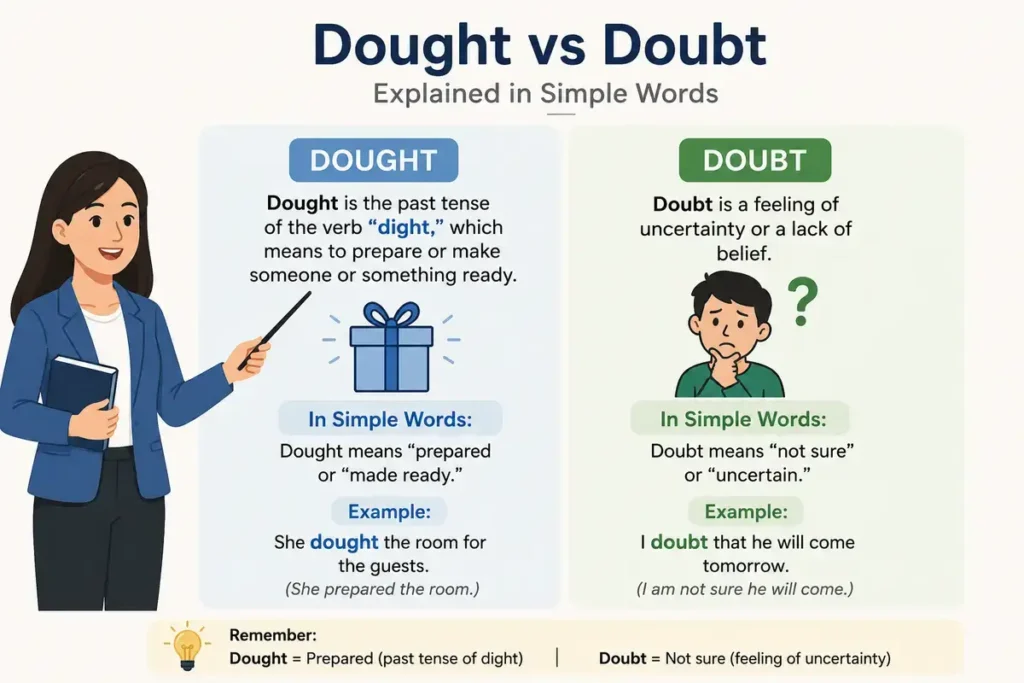
Doubt is not just a word. It is also a symbol of thinking, hesitation, and caution. Let’s break it down in a very simple way.
What One Version Represents
Doubt represents uncertainty.
It often means:
- Thinking before acting
- Questioning something
- Not fully trusting information
- Waiting for clarity
Emotionally, it feels like:
- “I am not sure yet.”
- “I need more time.”
- “Something does not feel fully right.”
Doubt is like a small pause in the mind. This pause can be helpful because it protects people from wrong choices.
What the Other Version Represents
Now let’s talk about dought. In modern English, dought does not carry real symbolic meaning. It is mostly seen as:
- A spelling mistake
- An old or unused form
- Something not used in daily English
So, it does not represent emotion, culture, or storytelling today. If someone uses dought, readers may stop and think it is incorrect. So symbolically:
- Doubt = thinking and uncertainty
- Dought = outdated or incorrect spelling
This is why only doubt is used in writing, speech, and learning.
Related Words You Should Know about Dought vs Doubt
To understand doubt better, here are some related words:
1. Uncertainty
Not being sure about something.
Example: I feel uncertainty about the results.
2. Confusion
When something is not clear in your mind.
Example: There is confusion about the rules.
3. Suspicion
A feeling that something may not be true.
Example: She has suspicion about the story.
4. Question
To ask or think about something carefully.
Example: He questioned the answer.
5. Hesitation
A short pause before doing something.
Example: She spoke with hesitation.
6. Trust
Believing something is true or safe.
Example: I trust my teacher.
7. Belief
Accepting something as true.
Example: He has strong belief in his idea.
All these words connect to doubt because they talk about thinking, believing, or not being fully sure.
How People Actually Use Dought vs Doubt in Daily English
People use doubt every day in simple conversations. Here are real-life examples:
- I doubt he will come today.
- She doubts the weather will stay good.
- I have no doubt about your skills.
- They doubt the story is real.
- There is no doubt she is right.
- I doubt this shop is open now.
- He has doubts about the plan.
- Without a doubt, that was amazing.
- We doubt the results are correct.
- I never doubted you for a second.
In daily English, doubt is used in three simple ways:
- To show uncertainty → I doubt it.
- To show belief → No doubt about it.
- To show confidence → Without a doubt.
You will hear this word in school, work, news, and casual talk.
Common Mistakes People Make using Dought vs Doubt
Many learners make small mistakes with dought vs doubt and related usage.
Mistake 1: Writing “dought” instead of “doubt”
Wrong: I dought his answer.
Correct: I doubt his answer.
This is the most common error. It happens because of spelling confusion.
Mistake 2: Forgetting the silent “b”
Some people try to spell it like it sounds:
Wrong guess: dout
Correct: doubt
Even though the b is silent, it must be written.
Mistake 3: Using “doubt” when certainty is needed
Wrong: I doubt 100% he is right.
Correct: I am sure he is right.
Doubt means uncertainty, not full certainty.
Mistake 4: Mixing “no doubt” and “without doubt”
Wrong confusion: He is no doubt the winner (when unsure tone is meant)
Correct: He is without a doubt the winner.
Both are correct, but meaning must match the sentence.
Simple Fix Rule
Always remember:
If you mean “unsure,” use doubt.
If you write dought, it is incorrect in modern English.
Dought vs Doubt: Final Teacher Explanation (Very Important)
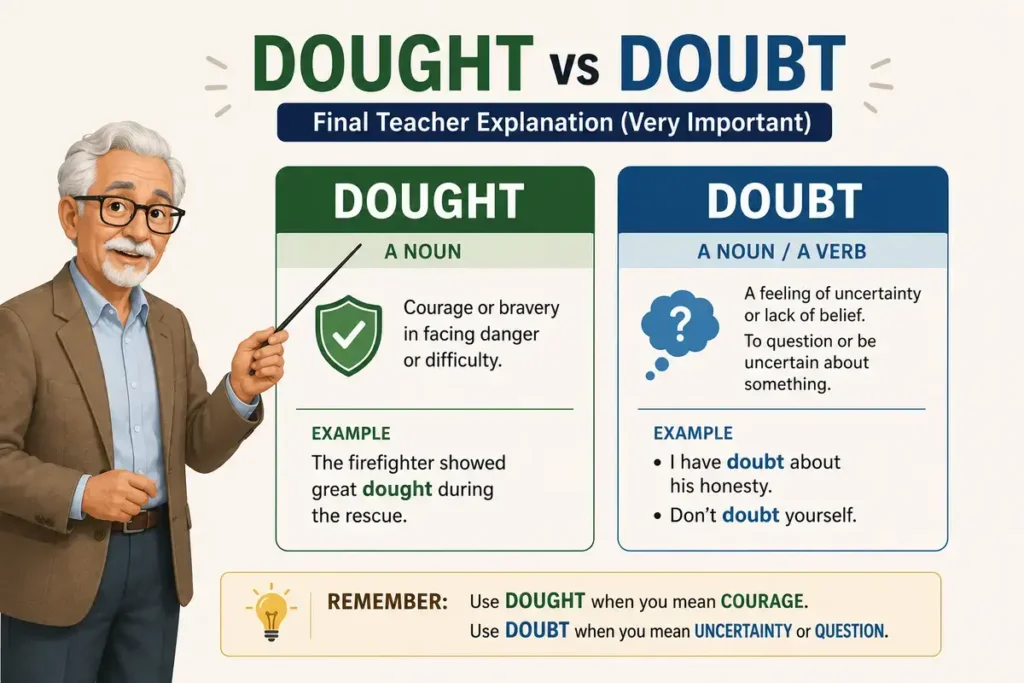
Let’s make this very simple, like a classroom lesson. When you see dought vs doubt, you only need to remember one thing: Doubt is the correct word in English today. It means you are not sure about something. You use it when your mind is thinking:
- “Is this true?”
- “Do I believe this?”
- “Should I accept this?”
We use it in speaking, writing, reading, and daily life. The word dought is not used in modern English. It is only seen in rare or old writing and is not needed in school or everyday communication. So if you are writing an essay, message, or email, always choose doubt. That is the safe and correct choice every time.
Dought vs Doubt: Final Answer (Quick Recap)
Doubt is the correct modern English word meaning uncertainty.
Dought is an outdated spelling and should not be used.
Always use doubt in speaking and writing.
It is the standard form in English today.
You may also want to read Witnesss Or Witness: Avoid Common Spelling Mistake (2026).
Conclusion
Now you clearly understand the difference in dought vs doubt. Only doubt is the correct word used in modern English. It shows uncertainty, hesitation, or lack of full confidence. The spelling dought is old, outdated, and not used in everyday writing or speaking.
If you remember one simple rule, it will always guide you right: when you mean “not sure,” use doubt. You will see this word in school, books, conversations, and formal writing everywhere. Keep this in mind, and you will never get confused again.
Frequently Asked Questions (FAQs)
1. What does doubt mean in simple words?
It means you are not fully sure about something.
2. Is dought a correct English word?
No, dought is not used in modern English writing.
3. Which is correct, dought or doubt?
Doubt is correct. Dought is outdated.
4. Why do people confuse?
Because the words look similar and English spelling is tricky.
5. Can I use doubt in formal writing?
Yes, doubt is the correct form for all types of writing.
6. What does no doubt mean?
It means something is certain or very clear.
7. What is the easiest way to remember doubt?
Think: “I am unsure,” then use the word doubt.
8. Is dought ever used today?
Only in rare historical contexts, not in modern English.
