
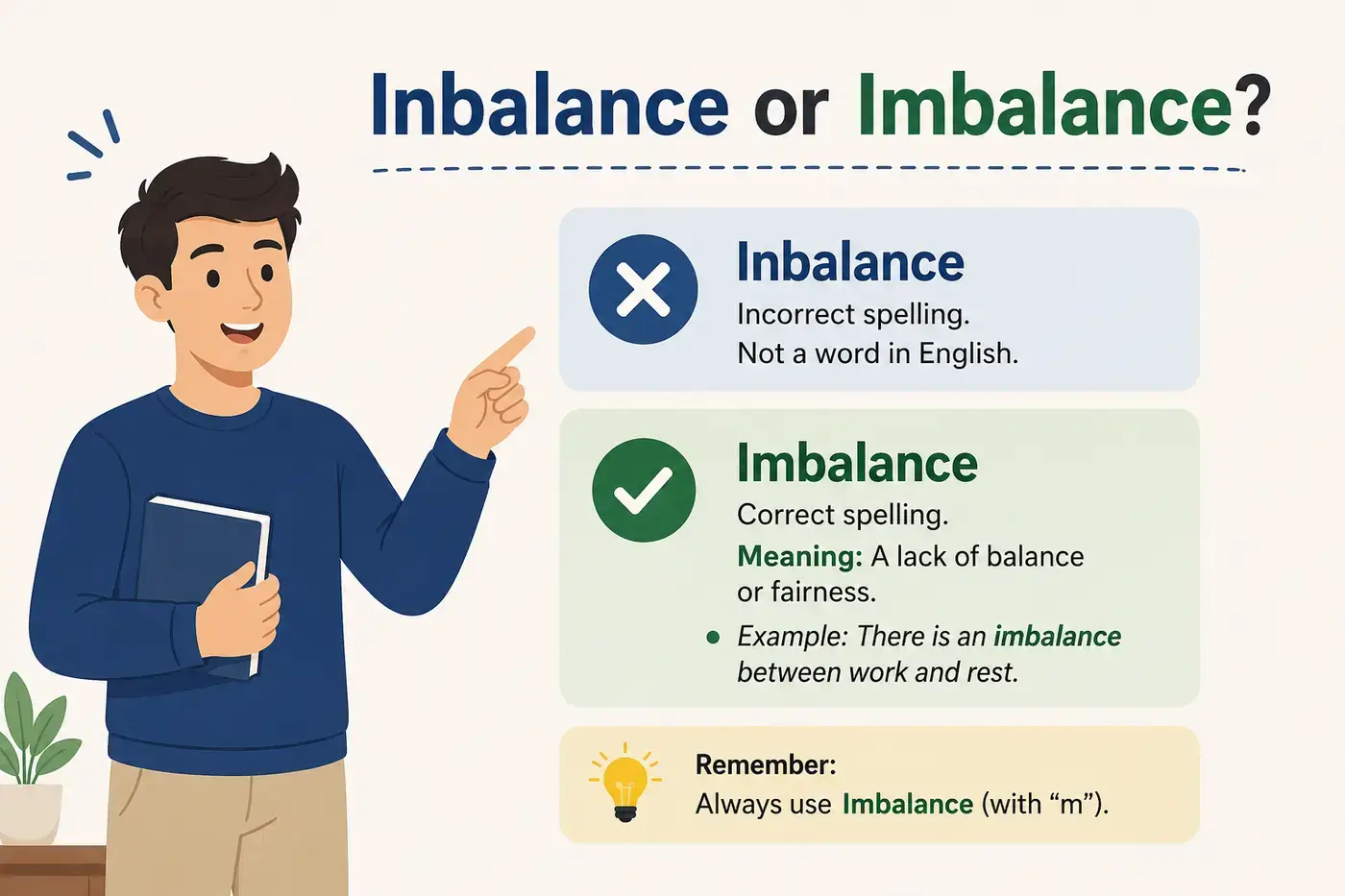
Many English learners get confused about inbalance or imbalance because both words seem possible at first glance. They both start with in, and they both look like they could be correct. That is why many people type the wrong spelling when they write or search online.
The good news is that the answer is simple. Imbalance is the correct English word. Inbalance is not a standard English word and should not be used in normal writing. Once you know the reason, it becomes much easier to remember the right spelling.
This guide explains in very simple English. You will learn what the word means, why people confuse it, how to use it correctly, and how to avoid making the same mistake again.
Need another quick comparison? Read Partys vs Parties: Which One Is Correct (2026 Guide)?.
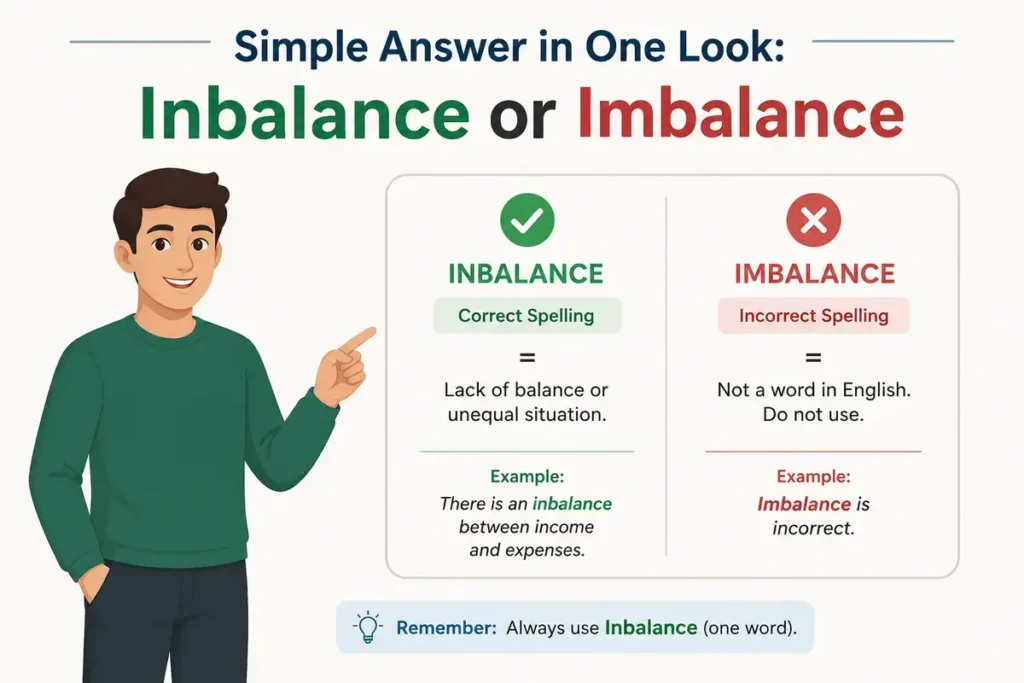
Simple Answer in One Look: Inbalance or Imbalance
Imbalance is the correct spelling.
Inbalance is incorrect in standard English.
If you are choosing between always use imbalance in school, work, emails, books, and everyday writing.
What Does Inbalance or Imbalance Mean in Simple English?
An imbalance happens when two or more things are not equal or not in the right amount. It can describe physical things, feelings, money, health, or many other situations. Think of a seesaw at a playground. If one child is much heavier than the other, one side goes down while the other goes up. The seesaw is out of balance. That is an imbalance. Here are a few simple examples.
- Too much work and not enough rest creates an imbalance.
- Spending more money than you earn creates a financial imbalance.
- Too much sugar in your diet can create an imbalance in your body.
- A sports team with all attackers and no defenders has an imbalance.
The word simply means a lack of balance. Some words with a similar meaning include:
- Unevenness
- Difference
- Inequality
- Mismatch
- Disproportion
- Lack of balance
All of these suggest that something is not even or properly balanced.
Why Do People Mix Up?
Many people write inbalance because they know that the prefix in- often means “not.” For example:
- Incomplete
- Incorrect
- Invisible
- Inactive
Since these words begin with in-, it feels natural to write inbalance. However, English spelling has special rules for some prefixes. When in- comes before words beginning with b, m, or p, the prefix usually changes to im-. That is why we write:
- Impossible
- Immature
- Impolite
- Immovable
- Imbalance
This spelling change makes the word easier to pronounce. So the correct form became imbalance. Another reason for the confusion is that many people search quickly online without checking a dictionary. Search engines often show common mistakes because many users type them. That does not make the spelling correct.
Clear Difference Between Explained Simply
Here is an easy comparison.
| Word | Correct? | Meaning |
|---|---|---|
| Imbalance | ✅ Yes | A lack of balance or equality |
| Inbalance | ❌ No | Incorrect spelling |
You can also remember it this way. Balance is the base word. When you want to say “not balanced,” English changes the prefix from in- to im-, giving us imbalance.
Inbalance or Imbalance in Everyday Writing
Imagine you are writing these sentences.
❌ There is an inbalance in the budget.
✅ There is an imbalance in the budget.
❌ The doctor found an inbalance in her hormones.
✅ The doctor found an imbalance in her hormones.
Only the second sentence is correct.
Inbalance or Imbalance in Professional Writing
Teachers, employers, editors, and examiners expect the correct spelling. Using imbalance shows that you understand standard English. Using inbalance may make readers think it is a spelling mistake.
Which Form Should You Use: Inbalance or Imbalance?
Always choose imbalance. This is the accepted spelling in American English and British English. Use it when talking about:
- Health
- Emotions
- Money
- Nature
- Sports
- Relationships
- Work
- Education
- Science
Never use inbalance in formal writing. If you accidentally type it, simply replace it with imbalance. Here is a very easy rule. If you mean “not balanced,” write “imbalance.” That rule works almost every time.
Easy Memory Trick for Inbalance or Imbalance
Think about these words.
- Impossible
- Impatient
- Immature
- Imbalance
Notice that they all begin with im before certain letters. Your brain can group them together. This makes imbalance much easier to remember.
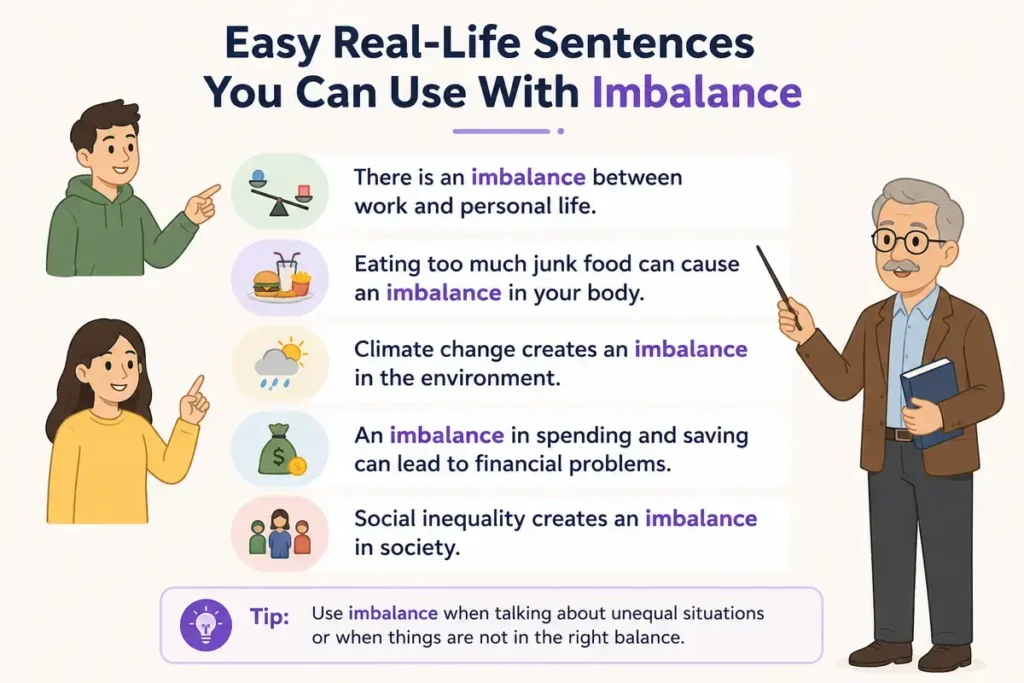
Easy Real-Life Sentences You Can Use With Imbalance
Here are simple examples you can copy into your own writing.
- The doctor found an imbalance in my diet.
- There is an imbalance between work and family time.
- The team has an imbalance in its defense.
- Too much screen time can create an imbalance in daily life.
- The company wants to fix the imbalance in pay.
- Heavy rain caused an imbalance in the local water system.
- Exercise helps reduce muscle imbalance.
Notice that every correct sentence uses imbalance. None of them use inbalance.
Where Does the Word Imbalance Come From? (Simple History)
The word balance came into English many hundreds of years ago. It was used to describe equal weight on both sides of a scale. Later, English added the prefix im- to show the opposite idea. So imbalance came to mean not balanced or out of balance. The prefix changed from in- to im- because the next letter is b. This pronunciation pattern has been part of English for a very long time. That is why dictionaries recognize imbalance as the standard spelling.
Inbalance never became an accepted standard English word. You will find imbalance in newspapers, books, schools, business reports, medical writing, and everyday conversations. As you can see, choosing between both words are actually very easy once you understand the spelling pattern. In the next section, we will look at how imbalance is used in culture, everyday life, health, emotions, common expressions, and frequently asked questions so you can use the word with complete confidence.
How Is Inbalance or Imbalance Understood in Culture and Stories?
When people hear the word imbalance, they often think about life being “out of balance.” This idea appears in stories, movies, books, and everyday conversations. Many stories show a character who has too much of one thing and not enough of another. That creates an imbalance that the character must fix before the story ends. For example:
- A person works all day but never spends time with family.
- A king has great power but no kindness.
- A student studies all the time but never rests.
- A team has many strong players but no good leader.
In each case, there is an imbalance. The story becomes better when balance returns. People also use imbalance when talking about emotions. Someone might say: “My life feels out of balance.” This usually means they have too much stress, too much work, or too many problems. The word is not only about numbers or objects. It can also describe feelings, relationships, and daily life.
When people compare they are really choosing between a misspelling and the correct word. The idea behind the word always stays the same: something is not balanced.
For another common grammar confusion, see Has Been Have Been: Simple Rules, and Examples (2026).
Biblical and Mythological Meaning of Inbalance or Imbalance
The Bible does not use the word imbalance very often in modern English translations. However, it talks many times about fairness, justice, wisdom, and balance. For example, honest weights and fair measures are praised because they show justice and honesty.
The opposite idea is an imbalance. It can mean unfair actions, unequal treatment, or poor choices. The lesson is simple. People should try to live with fairness, kindness, and wisdom. In many old myths from different cultures, balance is also important. Some stories describe:
- Light and darkness
- Good and evil
- Order and chaos
- Strength and wisdom
When one side becomes too powerful, an imbalance appears. The hero often works to restore balance. These stories teach that balance helps life stay healthy and peaceful.
Symbolism Explained in Simple Words
People often use imbalance as a symbol, even when they are not talking about physical balance.
What Inbalance Represents
Although inbalance is not a correct English word, some people write it by mistake when they want to describe something that is out of balance. It represents:
- A spelling mistake
- A common learner error
- Confusion about English prefixes
It should not be used in formal writing.
What Imbalance Represents
Imbalance is the correct word. It often symbolizes:
- Unequal situations
- Stress
- Poor health
- Unfair treatment
- Too much or too little of something
- A need for change
For example:
- An imbalance in nature can affect animals.
- An imbalance in work and rest can make people tired.
- An imbalance in a friendship can make one person feel ignored.
The word reminds us that balance often leads to healthier and happier lives.
Related Words You Should Know About Inbalance or Imbalance
Learning similar words helps you understand imbalance even better.
Balance
A state where everything is equal or in the right amount.
Example: She keeps a good balance between work and fun.
Equality
When people or things are treated fairly.
Example: The school believes in equality for every student.
Fairness
Treating everyone in an honest and equal way.
Example: Fairness makes people trust each other.
Harmony
Things work well together without problems.
Example: The family lived in harmony.
Stability
Being steady and not changing too much.
Example: Good planning brings stability.
Symmetry
Both sides look the same.
Example: The butterfly has beautiful symmetry.
Unevenness
One part is different from another.
Example: The road has unevenness after the storm.
Disproportion
One part is much larger or smaller than another.
Example: There is a disproportion between costs and income.
Inequality
People or groups do not have the same chances or treatment.
Example: Many people work to reduce inequality.
Mismatch
Two things do not fit together well.
Example: There was a mismatch between the job and his skills.
How Do People Actually Use Inbalance or Imbalance in Daily English?
Native speakers use imbalance in many different situations.
Here are some natural examples.
- There is an imbalance in our monthly budget.
- The doctor checked for a hormone imbalance.
- We need a better balance between work and family.
- The coach noticed an imbalance in the team’s defense.
- Too much homework can create an imbalance in free time.
- Eating only fast food may cause an imbalance in nutrition.
- The company wants to fix the imbalance in salaries.
- Climate change can create an imbalance in nature.
- She feels an emotional imbalance after losing her job.
These are the kinds of sentences you will hear in real conversations, classrooms, workplaces, and news reports.
Common Mistakes With Inbalance or Imbalance
Many learners make the same mistakes. Here are the most common ones.
Mistake 1: Writing Inbalance
❌ The report shows an inbalance.
✅ The report shows an imbalance.
Always remember that imbalance is the correct spelling.
Mistake 2: Thinking Both Words Are Correct
Some people believe both forms are accepted.
That is not true.
Only imbalance appears in standard English dictionaries.
Mistake 3: Forgetting the Prefix Change
Many learners remember the prefix in- but forget that it changes before certain letters. Before b, m, and p, it often becomes im-. That is why we write:
- Impossible
- Impatient
- Immature
- Imbalance
Mistake 4: Using Spell Check Too Late
Sometimes people write quickly and never check their spelling. Reading your work one more time helps you catch mistakes like inbalance.
Mistake 5: Copying Incorrect Spellings Online
The internet contains many spelling mistakes. Always trust a good dictionary instead of copying random examples.
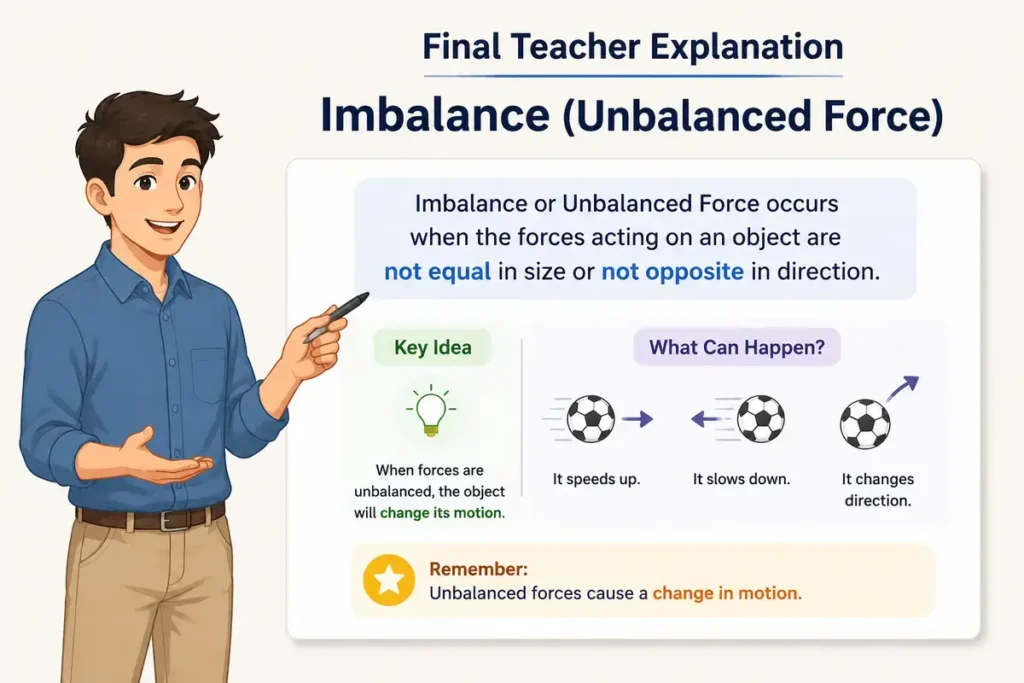
Final Teacher Explanation of Inbalance or Imbalance
Imagine you are sitting in my classroom. I write two words on the board.
Inbalance
Imbalance
Then I ask, “Which one should we use?” The answer is simple. Choose imbalance every time. The reason is not hard to understand. English changes the prefix from in- to im- before the letter b. That is why we also write:
- Impossible
- Impolite
- Immature
- Imbalance
The word inbalance looks logical, but English does not accept it as the standard spelling. Whenever you want to describe something that is not balanced, remember this easy rule: Use imbalance. Never use inbalance. If you follow that one rule, you will avoid one of the most common spelling mistakes in English.
Final Answer About Inbalance or Imbalance (Quick Recap)
If you are choosing the correct answer is always imbalance. Inbalance is a spelling mistake in standard English. Use imbalance whenever you talk about something that is unequal, uneven, or out of balance.
Many readers also check Bony vs Boney: Learn the Correct Word in Minutes.
Conclusion
The choice between is simple once you know the correct spelling. Imbalance is the correct English word and is used to describe a lack of balance or equality. Inbalance is not accepted in standard English and should be avoided in writing, school assignments, business documents, and everyday communication. A simple way to remember the difference is that imbalance follows the common English pattern where im comes before words that begin with b. When you use imbalance, your writing becomes clearer, more accurate, and more professional. If you ever stop and wonder which spelling is right, remember this easy rule. Choose imbalance every time.
Frequently Asked Questions (FAQs)
What is the difference?
Imbalance is the correct English word. Inbalance is an incorrect spelling.
Is inbalance a real English word?
No. Standard English dictionaries do not accept inbalance as the correct spelling.
Why do people write inbalance?
People often think the prefix should stay as in-, but English changes it to im- before the letter b.
When should I use imbalance?
Use it whenever something is not balanced, equal, or even.
Can I use inbalance in formal writing?
No. Always replace it with imbalance in school, work, exams, and professional writing.
Is imbalance correct in American and British English?
Yes. Both American English and British English use imbalance.
How can I remember the correct spelling?
Think about impossible, impolite, and immature. They all begin with im-, just like imbalance.
Does imbalance only describe health?
No. It can describe health, money, emotions, relationships, sports, education, business, nature, and many other situations.
