
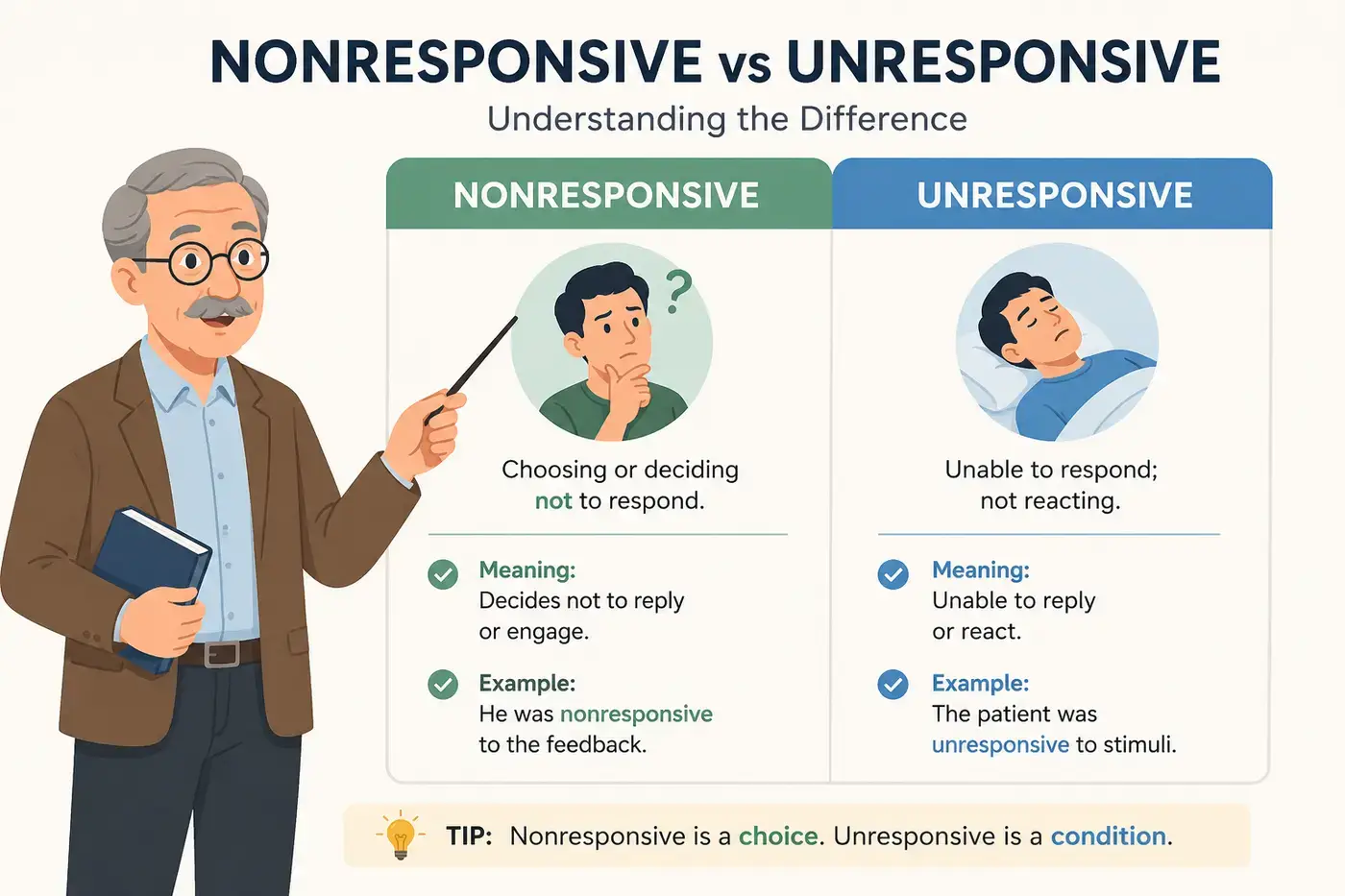
Many people get confused about nonresponsive vs unresponsive because the two words look very similar and often appear in the same situations. You may see them in healthcare, technology, business, customer service, or everyday conversations. Because both words describe a lack of response, many writers wonder if they mean exactly the same thing.
The truth is that nonresponsive vs unresponsive is usually a question of usage rather than correctness. Both words are correct English words. In many situations, they can mean nearly the same thing. Still, there are small differences in tone and common usage that can help you choose the better word.
If you are trying to understand this guide will explain everything in simple English. By the end, you will know what each word means, when to use it, and which choice sounds more natural in different situations.
Many readers also check Suing or Sueing Explained With Easy Rules and Examples.
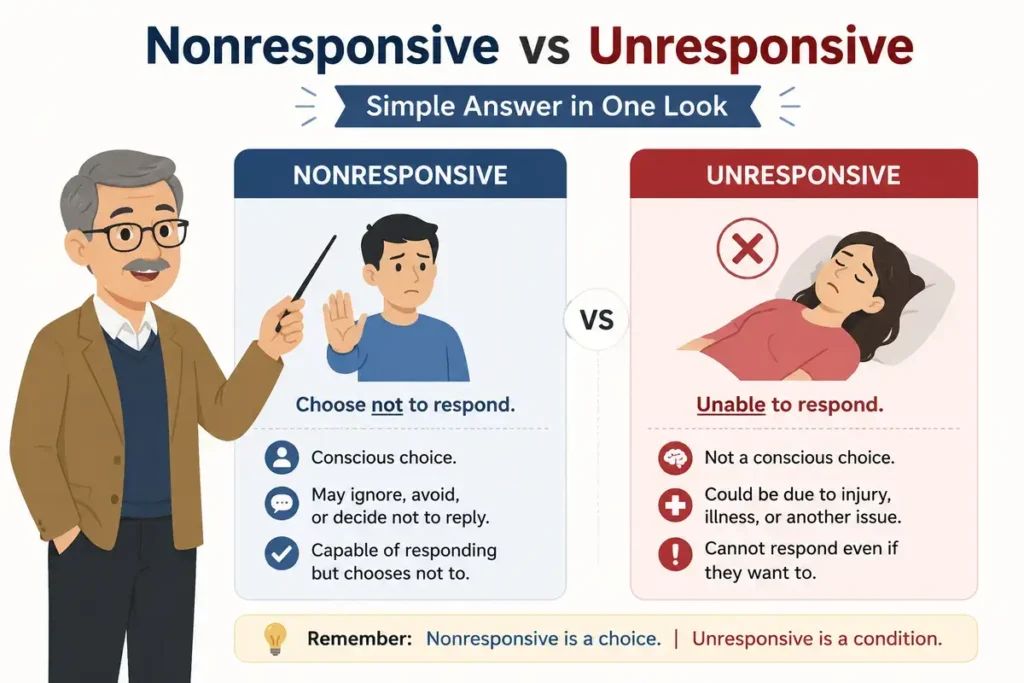
Nonresponsive vs Unresponsive: Simple Answer in One Look
Both words mean “not responding.” However:
- Unresponsive is more common in everyday English.
- Nonresponsive is often used in medical, technical, and professional settings.
In many cases, either word can work.
What Does Nonresponsive vs Unresponsive Mean in Simple English?
To understand this start with the word response. A response is a reaction, answer, or reply. If someone responds, they react to something. For example:
- A person answers a question.
- A computer reacts to a command.
- A customer replies to an email.
When there is no response, people may use either nonresponsive or unresponsive.
What Does Unresponsive Mean?
Unresponsive means someone or something is not reacting. Examples:
- The patient was unresponsive.
- My phone became unresponsive.
- The child was unresponsive to questions.
In each example, there was no reaction or reply.
What Does Nonresponsive Mean?
Nonresponsive also means not reacting or not replying. Examples:
- The software became nonresponsive.
- The customer was nonresponsive.
- The treatment was nonresponsive.
The meaning is very similar. That is why many people use the words interchangeably.
The Main Idea
Both words describe a lack of response. The difference is usually based on context and style rather than meaning.
Why Do People Mix These Words Nonresponsive vs Unresponsive?
People mix these words because they share nearly the same meaning. They also look similar. Compare them:
- Nonresponsive
- Unresponsive
Both contain the word responsive. The only difference is the beginning:
- Non-
- Un-
Both prefixes create a negative meaning. That naturally causes confusion.
They Appear in Similar Situations
You may hear both words in:
- Hospitals
- Offices
- Customer service
- Technology discussions
- News reports
For example:
“The patient was unresponsive.”
“The patient was nonresponsive.”
Many readers understand both sentences. Because the meanings overlap, people often think the words are identical.
Different Industries Prefer Different Words
Another reason for confusion is that some fields prefer one word over the other. For example:
- Doctors often use unresponsive.
- Technical reports may use nonresponsive.
- Everyday conversation usually favors unresponsive.
When learners see both forms, they may think one must be wrong. Actually, both are accepted English words.
Nonresponsive vs Unresponsive: Clear Difference Explained Simply
Although the meanings are close, there are small differences in how people use them.
Quick Comparison of Nonresponsive vs Unresponsive
| Feature | Nonresponsive | Unresponsive |
|---|---|---|
| Correct English word | Yes | Yes |
| Means not responding | Yes | Yes |
| Common in everyday speech | Less common | More common |
| Common in professional writing | Often | Sometimes |
| Common in healthcare | Yes | Very common |
| Common in technology | Yes | Yes |
Think About Tone
A simple way to remember the difference is this:
- Unresponsive often sounds more natural in daily conversation.
- Nonresponsive often sounds more formal or technical.
Example
Everyday conversation:
- My friend is unresponsive to my texts.
Technical report:
- The system became nonresponsive after the update.
Both sentences sound natural because they match the situation.
What Situations Use Unresponsive?
Unresponsive appears frequently when talking about people.
Medical Situations
Doctors often describe a person as unresponsive when the person does not react. Examples:
- The patient was unresponsive.
- The man remained unresponsive after the accident.
This usage is very common.
Everyday Situations
People also use unresponsive in normal conversations. Examples:
- She became unresponsive during the meeting.
- He was unresponsive to my questions.
- My teenager is unresponsive when asked to clean his room.
In these examples, the word means not reacting or not replying.
Emotional Situations
Sometimes unresponsive describes a lack of emotional reaction. Examples:
- He seemed unresponsive to the criticism.
- She was unresponsive to the good news.
The person heard the information but showed little reaction.
What Situations Use Nonresponsive?
Nonresponsive is common in professional and technical contexts.
Technology
Technology experts often use nonresponsive when devices stop reacting. Examples:
- The application became nonresponsive.
- The software was nonresponsive.
- The screen remained nonresponsive.
Business Communication
Companies sometimes use nonresponsive when discussing customers or contacts. Examples:
- The client became nonresponsive.
- Several leads were nonresponsive.
This means they stopped replying.
Research and Science
Researchers sometimes use nonresponsive to describe treatments, systems, or conditions. Examples:
- The disease was nonresponsive to treatment.
- The sample remained nonresponsive.
In these settings, nonresponsive sounds slightly more formal.
Nonresponsive vs Unresponsive: Which Form Should You Use?
The best choice depends on your situation.
Use Unresponsive When:
- Talking with friends.
- Writing everyday English.
- Describing people.
- Discussing reactions or emotions.
- Writing general content.
Examples:
- My phone is unresponsive.
- She was unresponsive to questions.
- He became unresponsive after hearing the news.
Use Nonresponsive When:
- Writing technical documents.
- Writing professional reports.
- Discussing software or systems.
- Writing formal business communication.
Examples:
- The server became nonresponsive.
- The customer remained nonresponsive.
- The software was nonresponsive after installation.
The Easy Rule
If you are unsure, choose unresponsive. It sounds natural in most situations and is widely understood. Nonresponsive is still correct, but it often sounds more formal.
Is One Word More Correct Than the Other?
No.
Both words are correct English. Many dictionaries include both. The real question is not correctness. The real question is which word fits the situation better. Think of them as close cousins. They share almost the same meaning but are often used in slightly different settings.
What Editors Usually Prefer
Many editors choose the word that sounds most natural for the audience.
For a medical article:
- The patient was unresponsive.
For a software report:
- The application became nonresponsive.
The choice depends on context.
Common Mistakes People Make using Nonresponsive vs Unresponsive
When comparing some mistakes appear often.
Mistake 1: Thinking One Word Is Wrong
Many learners believe one word must be incorrect.
That is not true.
Both words are accepted.
Mistake 2: Using Formal Language in Casual Situations
Example:
- My brother is nonresponsive to my jokes.
This is understandable, but many native speakers would simply say:
- My brother is unresponsive to my jokes.
The second sentence sounds more natural.
Mistake 3: Ignoring Context
Different situations often favor different words. Choosing the word that fits the setting helps your writing sound smoother.
Easy Real-Life Sentences You Can Use for Nonresponsive vs Unresponsive
Here are simple examples you can copy and use.
- My phone became unresponsive during the call.
- The patient was unresponsive when help arrived.
- She was unresponsive to my questions.
- The software became nonresponsive after the update.
- Our client has been nonresponsive for two weeks.
- The computer screen stayed nonresponsive.
- He seemed unresponsive to the criticism.
- The system remained nonresponsive throughout the test.
These examples show how both words work in real life.
Nonresponsive vs Unresponsive in Technology
Technology is one area where both words appear regularly. When a device stops reacting, people may use either word. Examples:
- The laptop is unresponsive.
- The laptop is nonresponsive.
Both are understandable. However, technical documents often choose nonresponsive. Software companies and IT teams frequently use that wording because it sounds more precise in technical reports.
Common Technology Examples
- Nonresponsive application
- Nonresponsive screen
- Nonresponsive software
- Unresponsive website
- Unresponsive device
- Unresponsive computer
You may see both versions depending on the writer.
Nonresponsive vs Unresponsive in Healthcare
Healthcare often favors unresponsive. Doctors, nurses, and emergency workers commonly use this word when describing a patient’s condition. Examples:
- The patient was unresponsive.
- The child remained unresponsive.
This wording has become standard in many medical situations. Although nonresponsive can sometimes appear, unresponsive is usually the more familiar choice in healthcare discussions.
You may also want to read Footnote Before or After Period? Rule You Can Remember.
Where Do These Nonresponsive vs Unresponsive Come From? (Simple History)
The history of these words is fairly simple. Both come from the word responsive. Responsive means reacting, replying, or responding. English often creates opposites by adding prefixes.
The Prefix “Un”
The prefix un means “not.” Examples:
- Happy → unhappy
- Fair → unfair
- Responsive → unresponsive
The Prefix “Non”
The prefix non also means “not.” Examples:
- Stop → nonstop
- Fiction → nonfiction
- Responsive → nonresponsive
Because both prefixes create a negative meaning, the resulting words end up with very similar definitions. That is why the confusion exists today.
Nonresponsive vs Unresponsive: Why Both Words Survived
English often keeps multiple words that mean nearly the same thing. Over time, speakers develop preferences.
Unresponsive became more common in everyday speech.
Nonresponsive became common in professional and technical settings.
Both remained part of modern English.
Final Quick Reminder About Nonresponsive vs Unresponsive
Remember these simple points:
- Both words are correct.
- Both mean not responding.
- Unresponsive is more common in everyday English.
- Nonresponsive is often more formal or technical.
- Context helps you choose the better option.
You do not need to worry too much about making a mistake because native speakers understand both words.
Transition to the Next Section
Now that you understand the basic difference between nonresponsive vs unresponsive, the next section will look at deeper meanings, symbolism, cultural usage, emotional meanings, and how these words are understood in different situations beyond simple dictionary definitions.
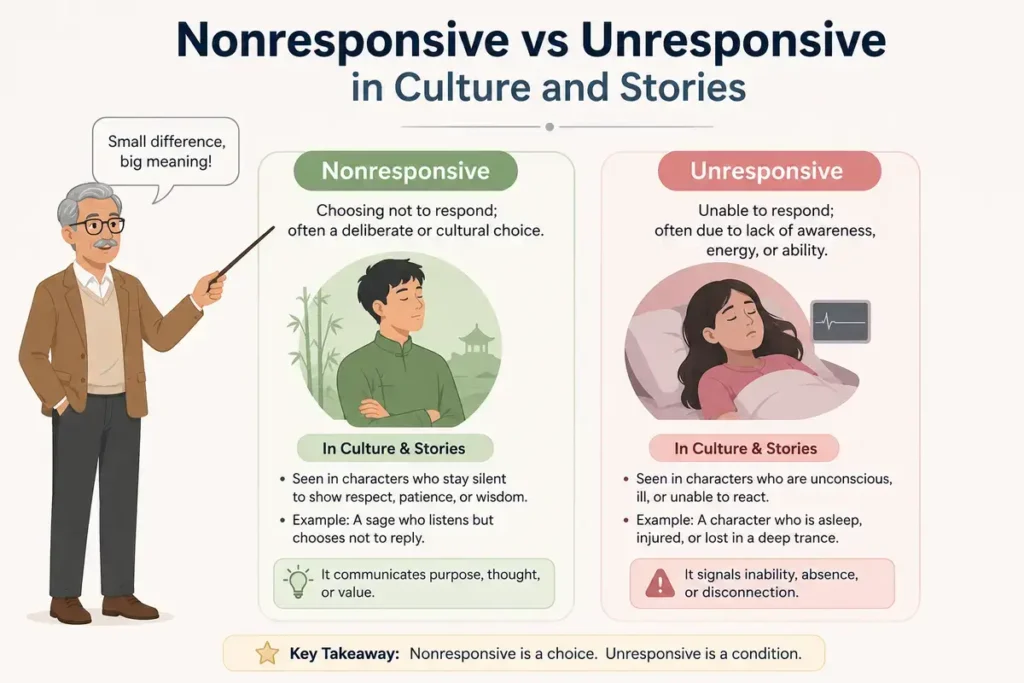
Nonresponsive vs Unresponsive in Culture and Stories
When people hear the words nonresponsive or unresponsive, they often think about more than just a lack of reply. In stories, movies, and everyday life, these words can describe distance, silence, or a missing connection. For example, a character in a story may become unresponsive after hearing sad news. The word does not only describe silence. It also suggests emotional withdrawal.
A nonresponsive character may ignore messages, avoid conversations, or refuse to participate in events. Writers use these words to show that something is not working as expected. That “something” could be:
- A person
- A friendship
- A relationship
- A computer
- A business partnership
In many stories, becoming unresponsive creates tension. Other characters want answers but cannot get them. That is why these words often carry emotional meaning in addition to their dictionary definitions.
Nonresponsive vs Unresponsive in Biblical and Mythological Meaning
There is no special biblical rule about nonresponsive vs unresponsive. Neither word appears as an important religious term. However, the idea behind the words can be found in many religious and mythological stories. Sometimes people in stories refuse to listen. Sometimes they ignore warnings. In these situations, a modern reader might describe them as unresponsive. For example:
- A person ignores wise advice.
- A group refuses to listen.
- Someone does not react to an important message.
These actions share the basic idea of not responding. In mythology, heroes and gods sometimes face characters who refuse to answer questions or requests. This creates conflict and moves the story forward. The symbolic idea is often the same: A lack of response can create problems, misunderstandings, or missed opportunities.
Nonresponsive vs Unresponsive Symbolism Explained in Simple Words
Words often develop symbolic meanings over time. The same is true.
What Nonresponsive Represents
Nonresponsive often represents:
- A blocked connection
- A technical problem
- A lack of progress
- Something not functioning properly
For example:
A nonresponsive computer symbolizes a system that has stopped working.
A nonresponsive customer may symbolize a stalled business opportunity.
Because the word appears frequently in technical and professional settings, it often suggests a process that has stopped moving forward.
What Unresponsive Represents
Unresponsive often represents:
- Emotional distance
- Silence
- Lack of interest
- Absence of reaction
For example:
An unresponsive friend may suggest emotional separation.
An unresponsive audience may suggest boredom or lack of engagement.
Because the word is common in everyday conversations, it often feels more personal and emotional.
Nonresponsive vs Unresponsive Symbolism Comparison
| Word | Common Symbolic Meaning |
|---|---|
| Nonresponsive | A system, process, or connection that is not working |
| Unresponsive | A person or situation showing little reaction |
Both suggest a missing response, but the emotional feeling can be slightly different.
Related Words You Should Know When Learning Nonresponsive vs Unresponsive
Learning similar words helps you understand the topic better.
Responsive
This means reacting or replying. Example:
“The teacher was responsive to student questions.”
Reactive
This means showing a reaction after something happens. Example:
“He was reactive to criticism.”
Silent
This means not speaking. Example:
“She stayed silent during the discussion.”
Ignoring
This means choosing not to respond.
Example: “He was ignoring my messages.”
Inactive
This means not doing anything. Example:
“The account has been inactive for months.”
Disconnected
This means no longer connected or communicating. Example:
“The device became disconnected.”
Absent
This means not present. Example:
“His attention seemed absent during class.”
Withdrawn
This describes someone who avoids interaction. Example:
“The student became withdrawn after moving schools.”
How People Actually Use Nonresponsive vs Unresponsive in Daily English
Native speakers use these words in many situations. Here are common examples.
Talking About Phones
“My phone is completely unresponsive.”
Talking About Computers
“The software became nonresponsive after the update.”
Talking About Friends
“My friend has been unresponsive all week.”
Talking About Emails
“The client is nonresponsive right now.”
Talking About Relationships
“He became unresponsive after our argument.”
Talking About Healthcare
“The patient was unresponsive when help arrived.”
Talking About Customer Service
“The company has been nonresponsive to complaints.”
Talking About School
“The student seemed unresponsive during the lesson.”
Talking About Meetings
“The team was unresponsive to the proposal.”
Talking About Online Messages
“She read my text but stayed unresponsive.”
These examples show how both words naturally appear in everyday English.
Common Mistakes People Make With Nonresponsive vs Unresponsive
Many learners make the same mistakes. The good news is that they are easy to fix.
Mistake 1: Thinking One Word Is Wrong
Wrong idea:
“Only one of these words is correct.”
Correct idea:
Both words are correct English words.
Mistake 2: Using Nonresponsive Everywhere
Example:
“My brother is nonresponsive to jokes.”
This is understandable, but many native speakers would simply say:
“My brother is unresponsive to jokes.”
That sounds more natural in daily conversation.
Mistake 3: Assuming They Always Mean Different Things
Some learners think the meanings are completely different. They are not. Most of the time, the meanings overlap. The main difference is usage and tone.
Mistake 4: Forgetting the Context
Consider these examples:
- Unresponsive patient
- Nonresponsive software
Both sound natural because they fit the situation. Choosing the right word often depends on context.
Mistake 5: Replacing Every Word With These Terms
Sometimes simpler words work better. For example:
Instead of:
“He was unresponsive.”
You might say:
“He did not answer.”
Choose the wording that sounds most natural for your audience.
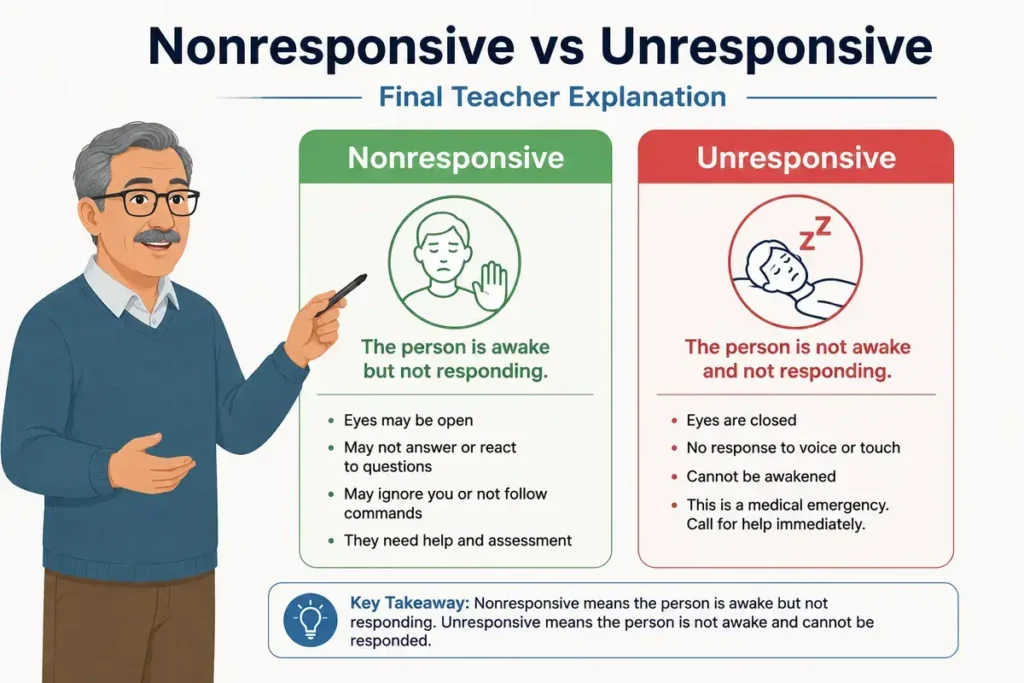
Nonresponsive vs Unresponsive Final Teacher Explanation
Imagine you are sitting in a classroom and asking me which word is correct. My answer would be simple. Both words are correct. Both mean that a person, object, system, or situation is not responding. The biggest difference is how people use them. Use unresponsive when talking about everyday situations, people, emotions, reactions, or normal conversations.
Use nonresponsive more often in technical, professional, scientific, or business situations. Do not spend too much time worrying about choosing the perfect word. Native speakers understand both. If you remember only one thing, remember this: Unresponsive sounds more natural in daily English, while nonresponsive often sounds more formal. That simple rule will help you most of the time.
Nonresponsive vs Unresponsive Final Answer (Quick Recap)
Both nonresponsive and unresponsive mean “not responding.”
Unresponsive is more common in everyday English and when talking about people.
Nonresponsive is often used in technical, business, and professional settings.
If you are unsure which word to choose, use unresponsive.
Learn the difference in Distress vs Duress: Meaning and Real-Life Examples.
Conclusion
Understanding nonresponsive vs unresponsive is easier than many people think. Both words describe a lack of response. Both are correct English words. The main difference is how they are commonly used. Unresponsive is usually the preferred choice in everyday speech, healthcare discussions, and personal situations.
Nonresponsive often appears in professional, technical, scientific, and business writing. When you are unsure, unresponsive is usually the safest option because it sounds natural to most readers. The more you read and hear these words in context, the easier the choice becomes.
Nonresponsive vs Unresponsive Frequently Asked Questions (FAQs)
What does mean in simple words?
Both words mean that a person or thing is not reacting, replying, or responding.
Is nonresponsive or unresponsive correct?
Both are correct English words. The best choice depends on the situation.
Which word is more common in daily English?
Unresponsive is more common in everyday conversation.
Why do people get confused?
The words look similar and have nearly the same meaning.
Can I use both forms in writing?
Yes. Both forms are accepted, but one may sound more natural depending on the context.
Is nonresponsive more formal than unresponsive?
In many cases, yes. Nonresponsive often sounds more technical or professional.
Which word is better for technology problems?
Nonresponsive is commonly used in technical reports, but unresponsive is also understood.
Which word is better for describing a person?
Unresponsive is usually the more natural choice when talking about people.
