
Many English learners get confused about rug vs rag because the two words look similar. They are both short words. They both refer to items made from fabric or cloth. Because of that, people sometimes use the wrong word by mistake.
The truth is that rug vs rag is not a spelling question. Both words are correct English words. The real question is knowing which word fits the situation. A rug and a rag are very different things.
If you are wondering this guide will explain the meanings, differences, examples, and simple rules so you can use each word correctly in everyday English.
A related grammar guide is Drier vs Dryer: Which One Should You Use(2026 Guide)?.
Rug vs Rag: Simple Answer in One Look
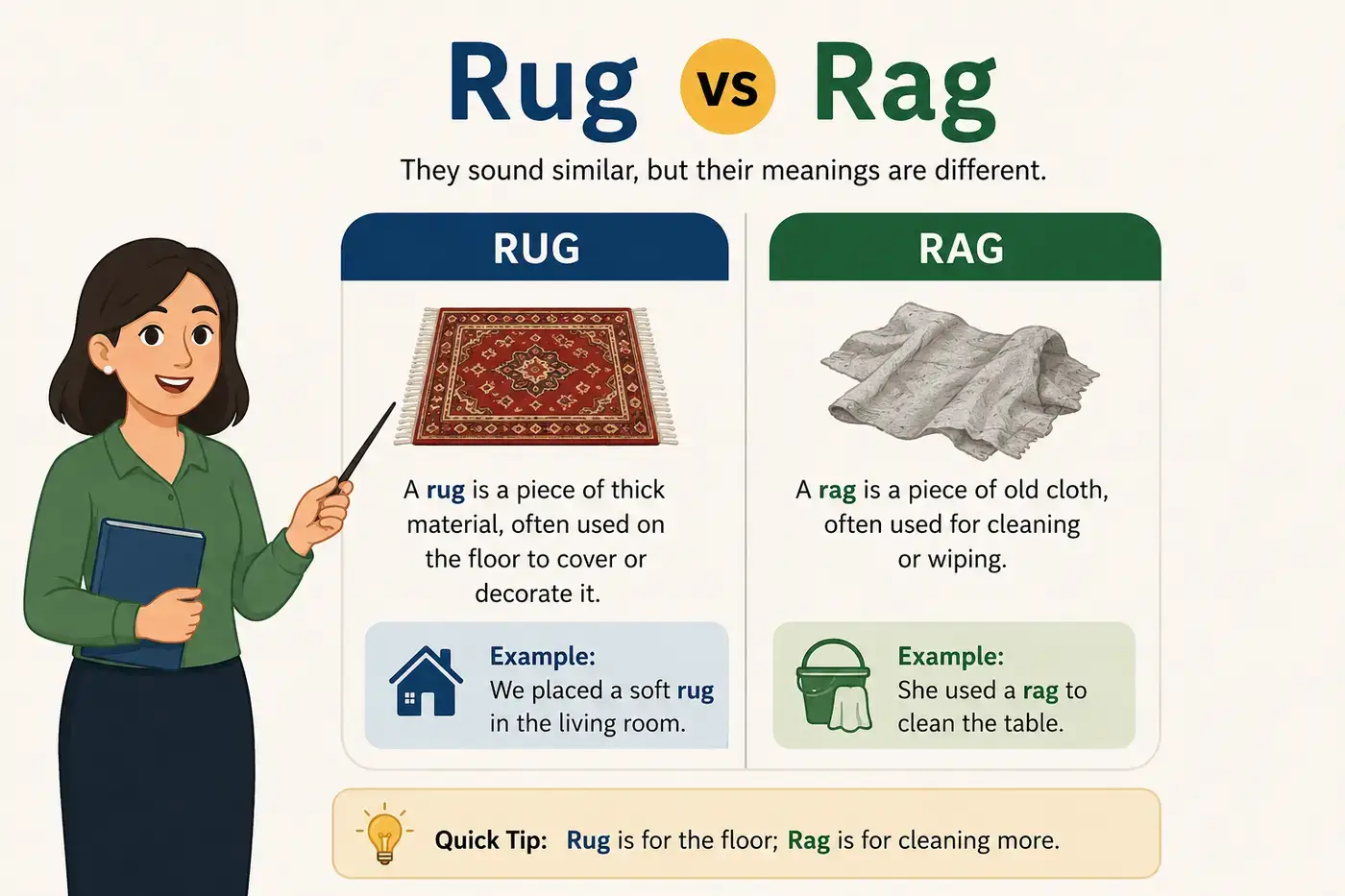
A rug is a floor covering.
A rag is a piece of old cloth often used for cleaning.
What Does Rug vs Rag Mean in Simple English?
To understand start by learning what each word means.
What Is a Rug?
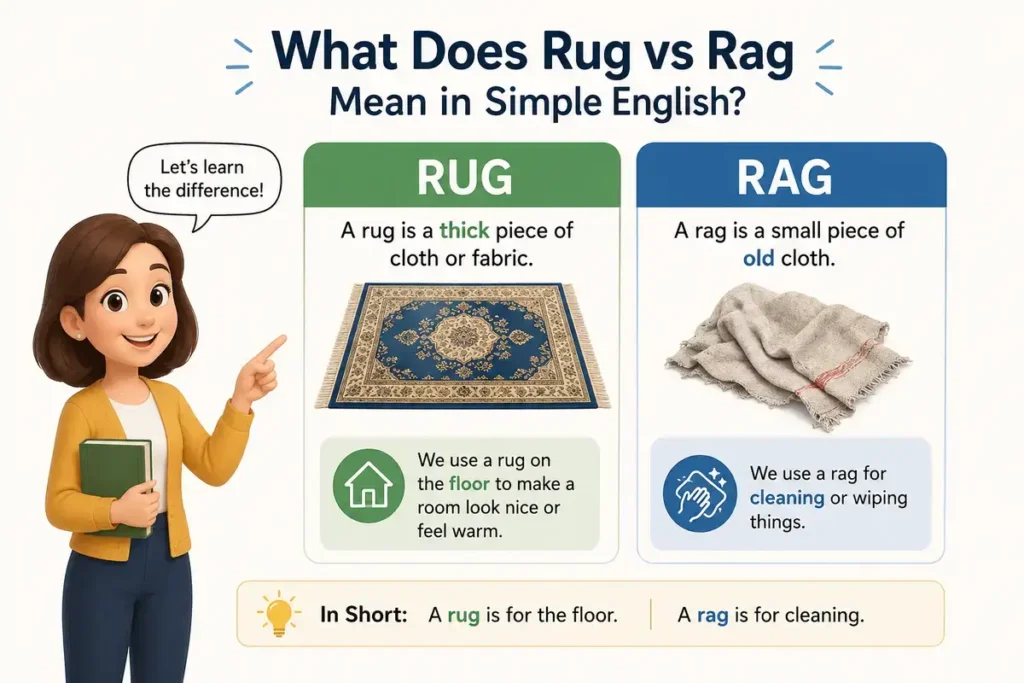
A rug is a piece of thick fabric placed on a floor. People use rugs to:
- Decorate a room
- Make a room feel warm
- Cover part of a floor
- Add comfort under their feet
You may find a rug in:
- Living rooms
- Bedrooms
- Offices
- Hallways
Example:
“The large rug made the room feel cozy.”
In this sentence, the rug is part of the room’s decoration.
What Is a Rag?
A rag is usually an old piece of cloth. People often use rags for:
- Cleaning windows
- Wiping tables
- Dusting furniture
- Washing cars
A rag is usually not meant for decoration. Example:
“He grabbed a rag to clean the spilled juice.”
Here, the rag is being used as a cleaning cloth.
Simple Meaning Comparison
Rug = floor covering
Rag = cleaning cloth
This simple rule helps most people remember the difference.
Why Do People Mix These Words Rug vs Rag?
Many learners confuse for a few simple reasons.
The Words Look Similar
Only one letter changes. Compare them:
- Rug
- Rag
Because the spelling is almost the same, people sometimes read too quickly and choose the wrong word.
Both Are Made of Fabric
Another reason is that both items are usually made from cloth or fabric.
A rug contains fabric.
A rag contains fabric.
This connection can make learners think the words are related in meaning.
Fast Speech Can Cause Confusion
When people speak quickly, the vowel sounds may not seem very different to new learners. For example:
- rug
- rag
A person learning English may hear them incorrectly.
People Learn One Word Before the Other
Many students learn the word “rug” early because it appears in children’s books.
The word “rag” may come later.
When learners see a cleaning cloth, they may accidentally call it a rug because that is the word they already know.
Similar Appearance Does Not Mean Similar Meaning
English has many words that look alike but mean different things. For example:
- Cap and cup
- Hat and hot
- Sit and set
The same thing happens. The words look similar, but they describe different objects.
Rug vs Rag: Clear Difference Explained Simply
When comparing focus on purpose.
Quick Comparison Table
| Rug | Rag |
|---|---|
| Covers a floor | Used for cleaning |
| Usually large | Usually small |
| Often decorative | Usually practical |
| Found in rooms | Found in cleaning supplies |
| New or decorative | Often old or reused |
Visual Way to Remember
Think about your home.
A rug stays on the floor.
A rag stays in a cleaning bucket or drawer.
That picture makes the difference easier to remember.
Rug Example
“The dog slept on the rug.”
The rug is on the floor.
Rag Example
“The dog owner used a rag to wipe muddy paws.”
The rag is used for cleaning.
One Easy Memory Trick
Rug = Room
Both words begin with the letter R and connect to home decoration.
Rag = Remove dirt
A rag helps remove dust, dirt, or spills.
This simple trick helps many learners remember the correct word.
Rug vs Rag in Everyday Situations
Looking at real situations makes the difference clearer.
In the Living Room
You may see:
- A sofa
- A table
- A lamp
- A rug
Example:
“We bought a new rug for the living room.”
In the Kitchen
You may see:
- Cleaning spray
- Paper towels
- A rag
Example:
“Use a rag to wipe the counter.”
After a Spill
If juice falls on the floor, you grab a rag. You do not grab a rug. Example:
“She picked up a rag and cleaned the spill.”
During Home Decorating
If you want your room to look nicer, you buy a rug. Example:
“The blue rug matched the walls perfectly.”
Which Form Should You Use?
Since both words are correct, your choice depends on what you mean.
Use “Rug” When Talking About Floor Coverings
Choose rug when discussing:
- Carpets
- Floor decoration
- Room design
- Home furniture
Examples:
- The rug is under the table.
- We bought a colorful rug.
- The rug feels soft.
Use “Rag” When Talking About Cloth for Cleaning
Choose rag when discussing:
- Wiping
- Cleaning
- Dusting
- Old cloth pieces
Examples:
- Use a rag to clean the mirror.
- The mechanic wiped his hands with a rag.
- She washed the windows with a rag.
Ask Yourself One Question
Is it on the floor?
If yes, use rug.
Is it used for cleaning?
If yes, use rag.
That simple question solves most mistakes.
Common Mistakes People Make using Rug vs Rag
Here are some mistakes learners sometimes make.
Incorrect
“I bought a beautiful rag for my living room.”
Correct
“I bought a beautiful rug for my living room.”
A decorative floor covering is a rug.
Incorrect
“Please use the rug to clean the table.”
Correct
“Please use the rag to clean the table.”
A cleaning cloth is a rag.
Incorrect
“The children sat on the rag during story time.”
Correct
“The children sat on the rug during story time.”
Again, the floor covering is a rug.
Easy Real-Life Sentences You Can Use for Rug vs Rag
Here are simple examples using rug.
- The rug is under the coffee table.
- We bought a new rug yesterday.
- The cat likes sleeping on the rug.
- That rug feels soft.
- The red rug looks beautiful.
- She cleaned the rug carefully.
- The rug covers part of the floor.
- We moved the rug closer to the sofa.
Now look at examples using rag.
- I used a rag to clean the sink.
- He wiped the table with a rag.
- The rag was wet after cleaning.
- She grabbed a rag from the drawer.
- Use a rag to remove the stain.
- The mechanic carried a dirty rag.
- Keep a rag nearby for spills.
- He washed the car with a rag.
These examples show the difference clearly.
Are Rug and Rag Ever Interchangeable?
No.
A rug and a rag are different objects. You generally cannot replace one word with the other. Look at these examples:
“The rug is on the floor.”
Correct.
“The rag is on the floor.”
Possible, but it changes the meaning completely. The first sentence describes a floor covering. The second sentence describes a cloth lying on the floor. Because the meanings are different, the words are usually not interchangeable.
Related Words You May Hear
When learning you may also see related words.
Words Related to Rug
- Carpet
- Mat
- Floor covering
- Runner
- Area rug
Example:
“The area rug sits under the dining table.”
Words Related to Rag
- Cloth
- Cleaning cloth
- Duster
- Wipe
- Towel
Example:
“Use a cleaning cloth to remove dust.”
Knowing these related words can improve your vocabulary.
Where Do Rug vs Rag Words Come From? (Simple History)
The word “rug” has been used in English for hundreds of years. Long ago, it referred to a thick covering used for warmth. Over time, people began using it for floor coverings and decorative pieces inside homes. The word “rag” is also very old.
It originally referred to a torn or worn piece of cloth. Because old cloth was often reused for cleaning, the word became closely connected to cleaning materials. Even though both words are old English words, they developed different meanings over time. That is why modern English treats them as completely separate words.
Learn the difference in Deep Seated vs Deep Seeded: What Does It Mean(2026)?.
Why Learning Rug vs Rag Matters
Small word differences can change meaning. Imagine saying:
“I cleaned the kitchen with a rug.”
People would probably understand what you mean, but the sentence sounds incorrect. Now compare:
“I cleaned the kitchen with a rag.”
That sounds natural and correct. Learning these differences helps your English sound more fluent and accurate. The good news is that the rule is simple.
Rug goes on the floor.
Rag helps with cleaning.
Transition to Deeper Meaning and Usage
Now that you understand the basic difference between rug vs rag, the next section will go deeper into symbolism, cultural meanings, common expressions, and the ways these words appear in stories and everyday life.
How Is Rug vs Rag Understood in Culture and Stories?
When people think they usually think about household items. But these words can also carry deeper meanings in stories, movies, and everyday conversations. A rug often represents comfort, warmth, and home. When a story describes a soft rug near a fireplace, it creates a feeling of safety and peace.
A rag often represents hard work, cleaning, or something old and worn out. In stories, a rag may show that a character is poor, hardworking, or trying to fix a problem. Because of these meanings, writers sometimes choose these words carefully to create a certain feeling. For example:
- A beautiful rug may suggest a comfortable home.
- An old rag may suggest struggle or hard work.
These ideas are not strict rules, but they are common in storytelling.
Rug vs Rag in Everyday Expressions
You may hear phrases like:
- “Pull the rug out from under someone.”
- “Dressed in rags.”
These expressions use the words in symbolic ways rather than their literal meanings. Understanding these expressions helps you understand English more naturally.
Biblical and Mythological Meaning of Rug vs Rag
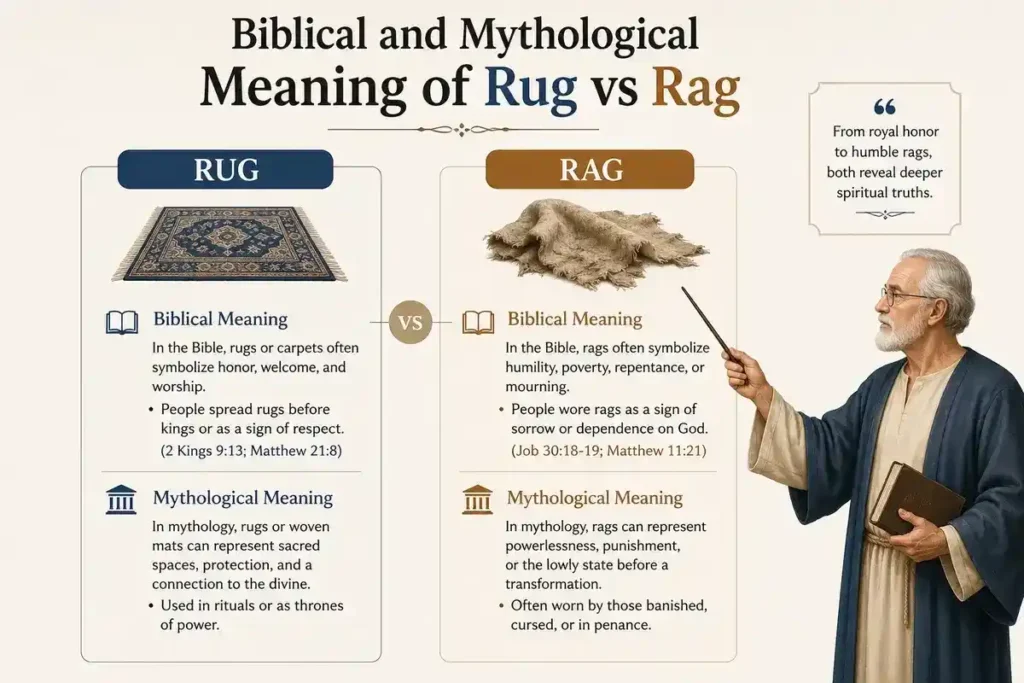
There is no major biblical rule specifically. However, cloth and coverings appear often in religious stories.
Rugs and Coverings
In many ancient cultures, rugs and woven coverings were valuable possessions. They could show:
- Hospitality
- Wealth
- Comfort
- Protection
People often placed coverings on floors or used them inside homes and gathering places.
Rags in Religious Stories
Rags often symbolize humility or poverty. In some religious stories, people wearing old clothes or rags are shown as struggling, suffering, or living simple lives. Because of this, rags can represent:
- Need
- Humility
- Hardship
- Simplicity
These meanings come from culture and storytelling rather than from the words themselves.
Rug vs Rag Symbolism Explained in Simple Words
What Does Rug Represent in Rug vs Rag?
In stories and culture, a rug often represents:
- Comfort
- Home
- Warmth
- Stability
- Security
Imagine walking into a room with a soft rug. The room feels welcoming. That is why rugs are often linked with positive feelings. Example symbolism:
- A clean rug may represent a happy home.
- A family rug may represent togetherness.
What Does Rag Represent in Rug vs Rag?
A rag often represents:
- Hard work
- Cleaning up problems
- Poverty
- Simplicity
- Persistence
Think about someone using a rag to clean a mess. The rag becomes a symbol of effort and responsibility. Example symbolism:
- A rag may represent struggle.
- A rag may represent making the best of what you have.
Simple Rug vs Rag Symbolism Comparison
| Word | Common Symbolic Meaning |
|---|---|
| Rug | Comfort, home, warmth |
| Rag | Hard work, struggle, simplicity |
Neither meaning is better. They simply create different feelings.
Related Words You Should Know When Learning Rug vs Rag
Learning related words can help you understand more clearly.
Carpet
A carpet covers a large part of a floor. Many people use carpet and rug in similar situations, but a carpet usually covers more space.
Mat
A mat is usually smaller than a rug. You might place one near a door.
Runner
A runner is a long, narrow rug often placed in hallways.
Cloth
A cloth is a piece of fabric. A rag is often a type of cloth used for cleaning.
Towel
A towel is used for drying things. Unlike a rag, towels are usually made specifically for washing or drying.
Duster
A duster is used to remove dust from furniture and surfaces.
Fabric
Fabric is the material used to make many rugs and rags.
Textile
Textile is another word for cloth or woven material. Knowing these words helps expand your English vocabulary.
How Do People Actually Use Rug vs Rag in Daily English?
The best way to learn is by seeing real-life examples.
Examples with Rug
- “That rug looks perfect in your living room.”
- “Please vacuum the rug.”
- “The baby is playing on the rug.”
- “We bought a new rug last weekend.”
- “The dog loves sleeping on the rug.”
Examples with Rag
- “Can you hand me a rag?”
- “Use a rag to wipe the table.”
- “I cleaned the window with a rag.”
- “The mechanic had a rag in his pocket.”
- “Grab a rag and clean the spill.”
Common Mistakes People Make With Rug vs Rag
Many learners make the same mistakes when using.
Mistake 1: Using Rag for Floor Decoration
Incorrect:
“We bought a beautiful rag for the dining room.”
Correct:
“We bought a beautiful rug for the dining room.”
A decorative floor covering is a rug.
Mistake 2: Using Rug for Cleaning
Incorrect:
“Use the rug to wipe the counter.”
Correct:
“Use the rag to wipe the counter.”
A cleaning cloth is a rag.
Mistake 3: Thinking the Words Mean the Same Thing
Some learners assume rug and rag are interchangeable. They are not. Each word has a different purpose.
Mistake 4: Forgetting the Context
Ask yourself:
- Is it on the floor? → Rug.
- Is it used for cleaning? → Rag.
This quick check prevents most mistakes.
Mistake 5: Guessing Based on Similar Spelling
The words look similar. Their meanings are not similar. Always focus on the object being described.
Final Teacher Explanation of Rug vs Rag
Imagine you are sitting in a classroom and I ask two questions. First question: “What do you place on the floor to make a room look nice?” The answer is a rug. Second question: “What do you use to wipe a spill?” The answer is a rag. That is the easiest way to remember.
Both words are correct. Neither word is better than the other. They simply describe different things. A rug belongs in a room as part of the floor covering. A rag belongs in a cleaning kit or supply drawer. If you remember those two pictures, you will rarely make a mistake. Whenever you feel confused, ask: “Am I talking about a floor covering or a cleaning cloth?” The answer will tell you which word to use.
Final Answer About Rug vs Rag (Quick Recap)
The difference is simple.
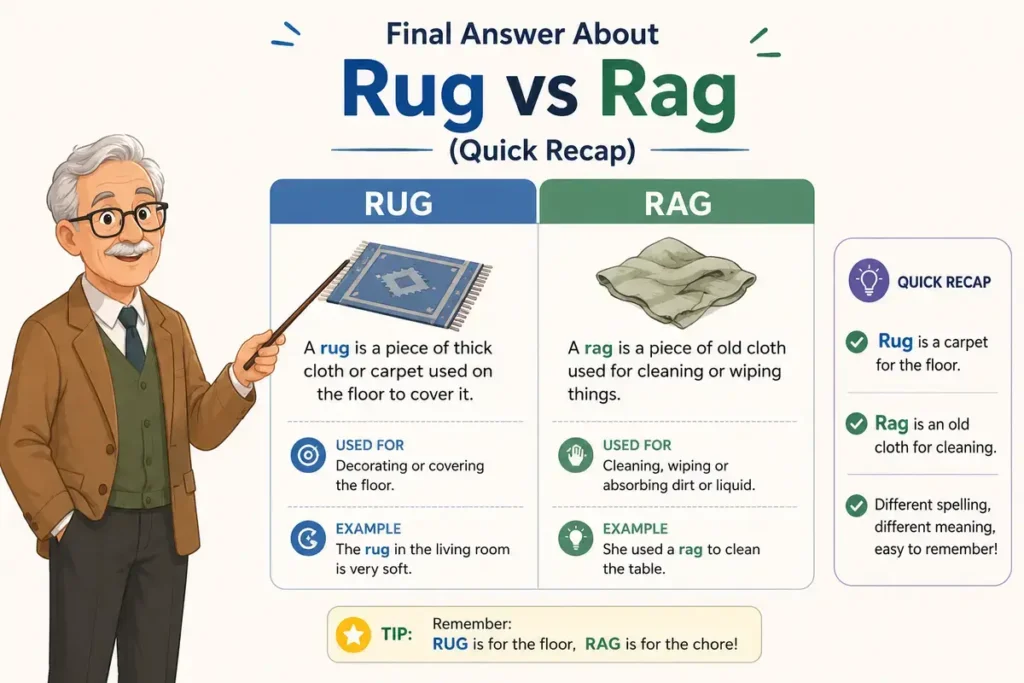
A rug is a floor covering used for comfort and decoration.
A rag is a piece of cloth used for cleaning.
If it goes on the floor, use rug. If it helps clean a mess, use rag.
Conclusion
Understanding rug vs rag is easier than many learners think. Both words are correct English words, but they have different meanings. A rug is something you place on the floor to add comfort, warmth, or decoration. A rag is a piece of cloth used for cleaning, wiping, or dusting.
The easiest rule is simple: if it belongs on the floor, use rug. If it is used for cleaning, use rag. Remembering this small difference will help you speak and write English more naturally and confidently.
You may also want to read Seing vs Seeing Explained With Easy Rules and Examples.
Frequently Asked Questions (FAQs)
What is the difference?
A rug is a floor covering. A rag is a cloth used for cleaning.
Is rug or rag correct?
Both words are correct. They simply have different meanings.
Can a rug be used for cleaning?
Not normally. A rug is designed for floors, not cleaning.
Why do people confuse?
The words look similar and are both connected to fabric or cloth.
What is a rag in simple English?
A rag is a piece of cloth used to wipe, clean, or dust surfaces.
What is a rug in simple English?
A rug is a piece of fabric placed on a floor for comfort or decoration.
Can I use rug and rag interchangeably?
No. They describe different objects and should not replace each other.
Which word should I use in writing?
Use rug when talking about floor coverings. Use rag when talking about cleaning cloths.
