
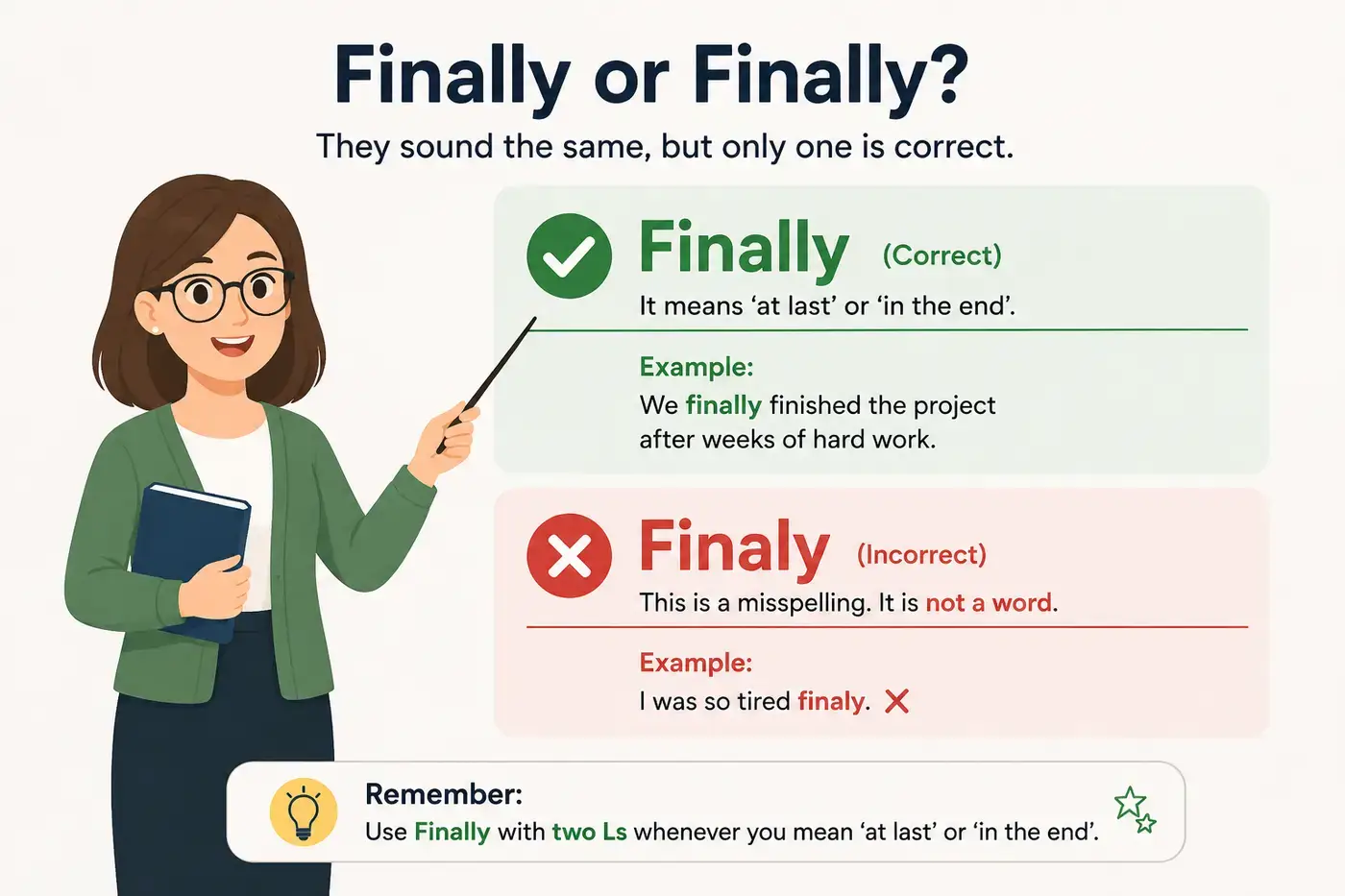
Many people get confused about finaly or finally when writing English. The two words look very similar, but only one is spelled correctly. This mistake is common because just one letter separates the two spellings.
If you have ever wondered the simple answer is easy to remember. One form follows standard English spelling rules, while the other does not. Knowing the difference can help you avoid a common writing error. In this guide, you will learn the difference which spelling is correct, how to use it, and why people often make this mistake.
Many readers also check Immerse vs Emerse: Meaning, Usage, and Correct Word Guide.
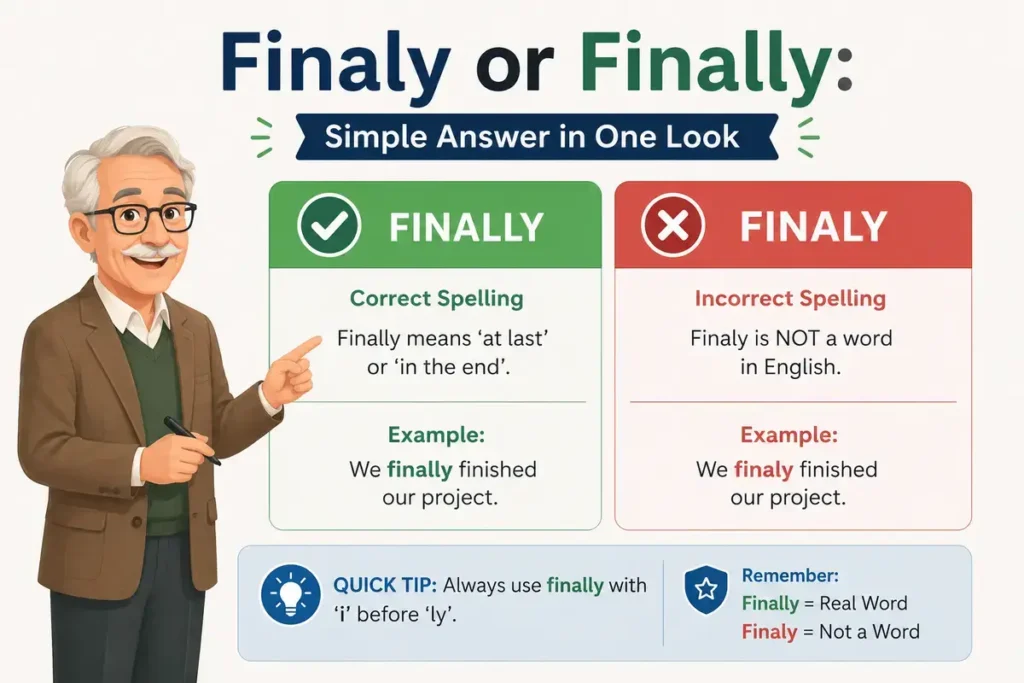
Finaly or Finally: Simple Answer in One Look
Finally is correct.
Finaly is incorrect and should not be used in standard English writing.
What Does Finaly or Finally Mean in Simple English?
The word finally means:
- At last
- After a long time
- In the end
- As the last point
People use when something happens after waiting, effort, or several steps. For example
“We finally arrived home.”
This means it took some time, but we arrived in the end. Here is another example:
“She finally finished her project.”
The project took time, and she completed it at last.
Finally Means “At Last”
Many times shows relief or happiness. Examples:
- The rain finally stopped.
- My package finally arrived.
- He finally answered my message.
In all these examples, someone was waiting for something to happen.
Finally Can Mean “The Last Thing”
Sometimes introduces the last point in a list. Example:
“Finally, remember to save your work.”
Here, the speaker is giving the last instruction.
Why Do People Mix These Words Finaly or Finally?
The confusion usually happens because of spelling. When people hear the word, they only hear the sound. They do not see the letters. Because of that, many writers accidentally remove one of the letters l and write:
- finaly
instead of:
- finally
Finaly or Finally: Double Letters Can Be Tricky
English contains many words with double letters. Examples:
- really
- carefully
- successfully
- naturally
Since people often type quickly, they sometimes forget one letter. That is why finaly appears in text messages, comments, emails, and first drafts.
Finaly or Finally: Fast Typing Causes Mistakes
Imagine you are writing quickly:
“I finaly finished my homework.”
Your fingers may skip one letter without you noticing. Spell-check tools usually catch this mistake, but not always.
The Pronunciation Sounds the Same
Another reason people mix these words is that both spellings would sound almost identical if read aloud. You hear:
“finally“
But when writing, you must remember that the correct spelling includes two l letters.
Finaly or Finally: Clear Difference Explained Simply
The difference is very simple.
| Word | Correct? | Meaning |
|---|---|---|
| Finaly | ❌ No | Misspelling |
| Finally | ✅ Yes | At last, in the end |
Quick Comparison
Finaly
- Missing one letter
- Not accepted in standard English
- Considered a spelling mistake
Finally
- Correct spelling
- Used in everyday English
- Accepted everywhere
Easy Way to Remember Finaly or Finally
Look at the word final.
Now add ly.
Final + ly = Finally
You still keep both l letters. That creates:
finally
Not:
finaly
This simple trick helps many students remember the correct spelling.
Finaly or Finally: Visual Memory Trick
Think of it like this:
final + ly = finally
The extra l stays in the word. If you only see one l, stop and check your spelling.
Finaly or Finally: Which Form Should You Use?
You should always use finally.
There is no situation where is considered the standard spelling.
Use Finally in School Writing
Examples:
- Essays
- Reports
- Homework
- Research papers
Teachers expect the correct spelling:
“Finally, I would like to thank my classmates.”
Use Finally at Work
Examples:
- Emails
- Presentations
- Business reports
- Professional messages
Correct example:
“The team finally completed the project.”
Use Finally in Everyday Writing
Examples:
- Text messages
- Social media posts
- Blogs
- Online comments
Correct example:
“I finally got tickets to the concert.”
A Simple Rule
If you are choosing always pick:
✅ Finally
That rule works every time.
How to Use Finally Correctly
The word finally can appear in different places within a sentence.
At the Beginning
Example:
“Finally, summer vacation is here.”
The sentence starts with the idea of relief or completion.
In the Middle
Example:
“We finally found the restaurant.”
The action happened after some effort or waiting.
Near the End
Example:
“The game ended finally after three extra rounds.”
This use is less common but still possible.
In a List
Example:
“First, wash your hands. Next, prepare the ingredients. Finally, start cooking.”
Common Situations Where People Use Finally
You will hear and read in many daily situations.
After Waiting
Examples:
- The bus finally arrived.
- The doctor finally called.
After Hard Work
Examples:
- She finally graduated.
- They finally completed the bridge.
After Solving a Problem
Examples:
- We finally fixed the computer.
- The team finally found the answer.
- I finally understood the lesson.
After Reaching a Goal
Examples:
- She finally won the competition.
- They finally bought a house.
- He finally got his dream job.
In each example, something happened after time, effort, or patience.
Easy Real-Life Sentences You Can Use for Finaly or Finally
Here are simple examples using correctly.
- I finally finished my homework.
- We finally reached the airport.
- She finally found her keys.
- They finally moved into their new home.
- The rain finally stopped.
- He finally passed the test.
- My friend finally called me back.
- We finally got some good news.
These are the kinds of sentences native English speakers use every day.
Common Mistakes With Finaly or Finally
Many learners make small mistakes when using this word.
Mistake 1: Writing Finaly
Incorrect:
“I finaly got the answer.”
Mistake 2: Forgetting the Meaning
Sometimes learners use finally when they simply mean “next.” Remember:
Finally usually means the last step or something that happened after waiting.
Mistake 3: Overusing Finally
Example:
“I finally woke up, finally ate breakfast, and finally brushed my teeth.”
This sounds unnatural.
Words Similar to Finally
Understanding similar words can make your writing stronger.
At Last
Example:
“At last, the train arrived.”
This has a meaning very close to finally.
Eventually
Example:
“Eventually, the snow melted.”
This means something happened after a period of time.
In the End
Example:
“In the end, everything worked out.”
This focuses on the final result.
Ultimately
Example:
“Ultimately, they chose a different plan.”
This often appears in formal writing. These words are not always exact replacements, but they share similar ideas.
Where Does Finaly or Finally Come From? (Simple History)
The word final means:
- Last
- Ending
- Coming at the end
Over time, English speakers added -ly to create finally. The new word described something happening at the end of a process or after waiting. For hundreds of years, writers have used finally in books, letters, stories, and conversations.
Why Does Finally Have Two L’s?
Many students ask this question. The answer is simple. The base word is:
final
When ly is added, the existing l remains.
Final + ly = Finally
That is why the correct spelling keeps two l letters together.
Has Finaly Ever Been Correct?
No. Standard English dictionaries recognize finally. That is why editors, teachers, and writing tools correct it.
For another common grammar confusion, see Naive vs Nieve Explained With Easy Examples.
Why Learning This Difference Matters
Small spelling mistakes can change how readers view your writing.
When you use finally, your writing looks polished and clear.
When you write finaly, readers may notice the mistake immediately.
Learning common spelling pairs like helps improve:
- School writing
- Work communication
- Emails
- Social media posts
- Everyday English
The good news is that this mistake is easy to fix once you know the rule.
Transition to the Next Section
Now that you understand the basic difference between finaly or finally, the next section will go deeper into how the word is used in stories, culture, symbolism, expressions, and everyday communication. You will also see how the idea of “finally” connects to patience, success, endings, and personal achievement.
How Finaly or Finally Is Understood in Culture and Stories
The word finally appears in stories, movies, books, and everyday conversations because it expresses a feeling many people understand. People often wait for things. They wait for good news. They wait for success. They wait for a problem to end. When the waiting is over, the word finally helps express that feeling. For example:
“After many years, the hero finally returned home.”
This sentence feels emotional because it shows that something important happened after a long time. Examples include:
- A lost child finally finds their family.
- A student finally passes a difficult test.
- A team finally wins a championship.
- A traveler finally reaches their destination.
The word creates a feeling of completion. Readers often connect it with patience, hope, and success. The misspelling does not carry any special cultural meaning because it is simply an incorrect spelling of finally.
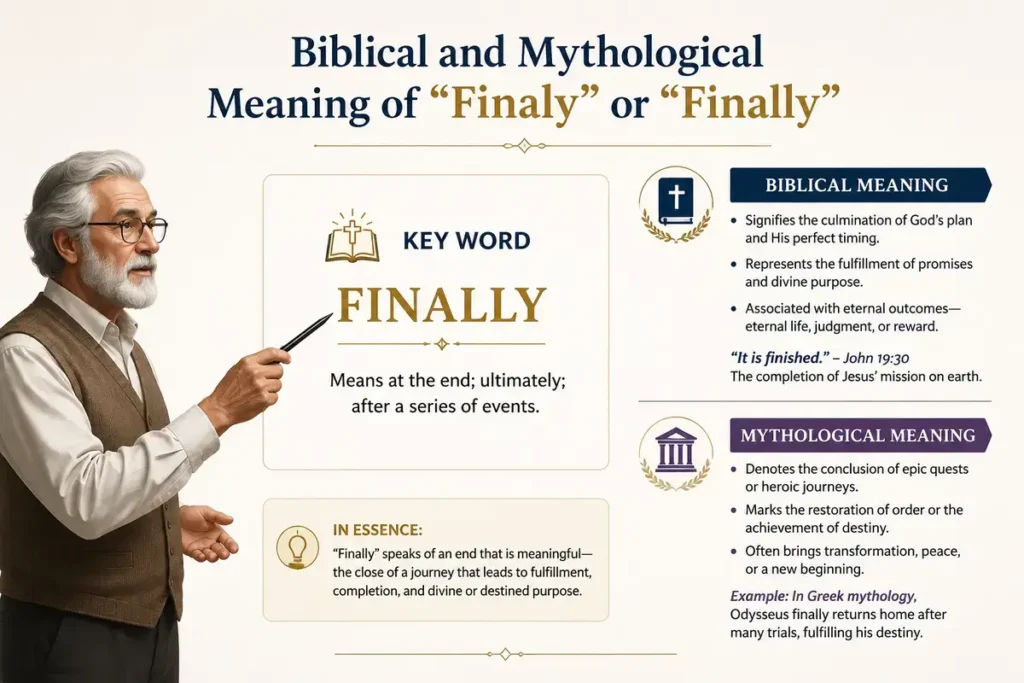
Biblical and Mythological Meaning of Finaly or Finally
The word finally appears naturally in discussions about faith, history, and mythology because many stories involve waiting for an outcome.
In Biblical Ideas
The Bible often contains stories about patience. People wait for guidance. People wait for promises to be fulfilled. People wait for difficult times to pass. When modern readers talk about these stories, they may use the word. For example:
“The people finally reached the promised land.”
The word highlights the end of a long journey.
In Mythological Stories
Many myths include heroes who face challenges before reaching their goals. Examples include:
- Long journeys.
- Difficult battles.
- Important discoveries.
When the hero succeeds, people often describe the moment using finally. For example:
“The hero finally defeated the monster.”
The word helps show that effort and patience led to success.
Does Finaly Have a Special Meaning?
No.
The spelling has no separate biblical, historical, or mythological meaning.
It is simply a spelling mistake of finally.
Symbolism Finaly or Finally Explained in Simple Words
What Finally Represents
The word often symbolizes:
- Success
- Relief
- Completion
- Achievement
- Patience
- Hope rewarded
- Reaching a goal
People feel positive emotions when they hear it. Examples:
- Finally getting a new job.
- Finally graduating.
The word often signals that something difficult has come to an end.
What Finaly Represents
The word does not have its own symbolic meaning. Because it is a misspelling, it usually represents:
- A typing error
- A spelling mistake
- A rushed message
- An editing oversight
In formal writing, it may make the writer appear less careful. That is why learning the correct spelling matters.
Finaly or Finally: Symbolic Comparison
| Word | Symbolic Meaning |
|---|---|
| Finally | Success, completion, relief, achievement |
| Finaly | Misspelling, writing error |
This comparison makes the difference easy to remember.
Related Words You Should Know about Finaly or Finally
When learning it helps to know similar words.
Final
Means the last part of something. Example:
“This is the final chapter.”
Finish
Means to complete something. Example:
“I finished my homework.”
End
Means the point where something stops. Example:
“The movie reached its end.”
Eventually
Means something happens after some time. Example:
“The storm eventually passed.”
At Last
Means after waiting for a long time. Example:
“At last, the package arrived.”
Ultimately
Means the final result. Example:
“Ultimately, they chose a different plan.”
Completed
Means fully finished. Example:
“The project was completed yesterday.”
Concluded
Means officially ended. Example:
“The meeting concluded at noon.”
These words share ideas connected to endings, completion, and results.
How People Actually Use Finally in Daily English
Native English speakers use all the time. Here are common real-life examples.
Example 1
“I finally cleaned my room.”
Example 2
“We finally arrived at the airport.”
Example 3
“She finally answered my text.”
Example 4
“The rain finally stopped.”
Example 5
“They finally bought a house.”
Example 6
“I finally found my wallet.”
Example 7
“My computer finally started working.”
Example 8
“He finally got the promotion he wanted.”
Example 9
“The teacher finally explained the answer.”
Example 10
“We finally finished the game.”
These examples sound natural because they reflect everyday situations.
Common Spoken Phrases for Finaly or Finally
People often say:
- Finally!
- Finally done.
- Finally home.
- Finally finished.
- Finally free.
- Finally got it.
- Finally worked.
These short phrases are very common in conversations.
Common Mistakes People Make With Finaly or Finally
Many learners make the same mistakes. The good news is that they are easy to fix.
Mistake 1: Writing Finaly
Correct:
“I finally got my driver’s license.”
Remember:
Finally always has two l letters.
Mistake 2: Forgetting One Letter While Typing
Fast typing often causes errors. Example:
Correct:
“She finally arrived.”
Always double-check before sending important messages.
Mistake 3: Using Finally Too Often
Incorrect:
“I finally woke up, finally ate breakfast, and finally brushed my teeth.”
This sounds repetitive. Better:
“I woke up, ate breakfast, and finally brushed my teeth before leaving.”
Mistake 4: Confusing Finally With Eventually
These words are similar but not always identical. Example:
“Eventually, the snow stopped.”
This focuses on time passing.
“Finally, the snow stopped.”
This focuses more on relief after waiting.
Mistake 5: Forgetting the Meaning
That is not correct. Finally usually means:
- At last
- In the end
- After waiting
- As the last step
Remembering this meaning helps you use the word correctly.
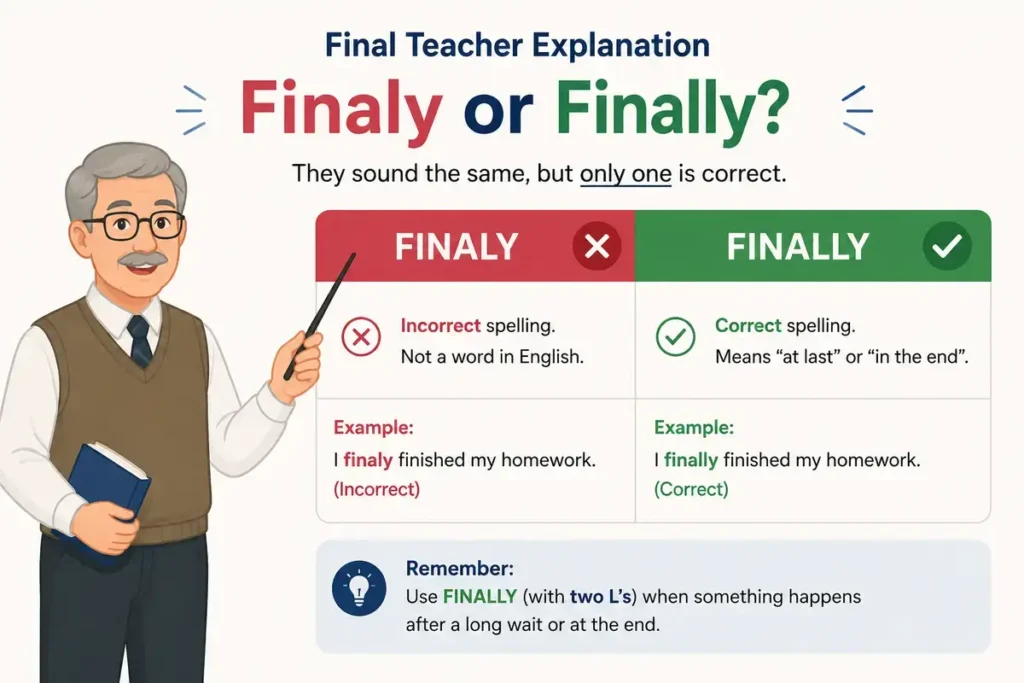
Final Teacher Explanation of Finaly or Finally
Imagine you are sitting in my classroom. A student raises a hand and asks:
“Should I write?”
My answer would be simple. Always write finally. The easiest way to remember this is to start with the word final. Then add ly.
Final + ly = Finally
Nothing disappears. Both l letters stay in the word. Also remember the meaning. Finally usually tells us that something happened after waiting, effort, or several steps. Examples:
- I finally passed the test.
- We finally got home.
- She finally found her keys.
The word often brings a feeling of relief and completion. Whenever you see finaly, think:
“I am missing an l.”
That quick check can prevent the mistake.
Conclusion
The confusion between finaly or finally is very common, especially for people learning English. The two spellings look similar, but only one follows standard English spelling rules. The correct spelling is finally. It means “at last,” “in the end,” or “after a period of waiting.” It is used in everyday conversations, school assignments, business writing, books, and online communication.
A simple way to remember the correct form is to start with the word final and add ly, which creates finally with two l letters. Once you learn this rule, choosing becomes very easy.
For another common grammar confusion, see Cheff or Chef: Easy Guide With Examples (2026).
Final Answer: Finaly or Finally?
If you are choosing the correct spelling is finally.
Finaly is incorrect and should not be used in standard English writing.
A simple memory trick is:
Final + ly = Finally
Keep both l letters, and you will always have the correct spelling.
Frequently Asked Questions (FAQs)
Is the correct spelling?
Yes. Finally is the correct spelling used in standard English.
Is finaly a real word?
No. it is considered a spelling mistake.
Why do people write finaly?
Most people accidentally forget one of the two l letters while typing.
What does finally mean in simple words?
It means “at last,” “in the end,” or “after waiting for some time.”
Can I use in formal writing?
No. Always use finally in essays, emails, reports, and professional writing.
How do I remember the spelling of finally?
Think of final + ly = finally. Keep both l letters.
Is finally used in spoken English?
Yes. Native speakers use finally very often in everyday conversations.
Can finally start a sentence?
Yes. Example: “Finally, the meeting ended.”
