
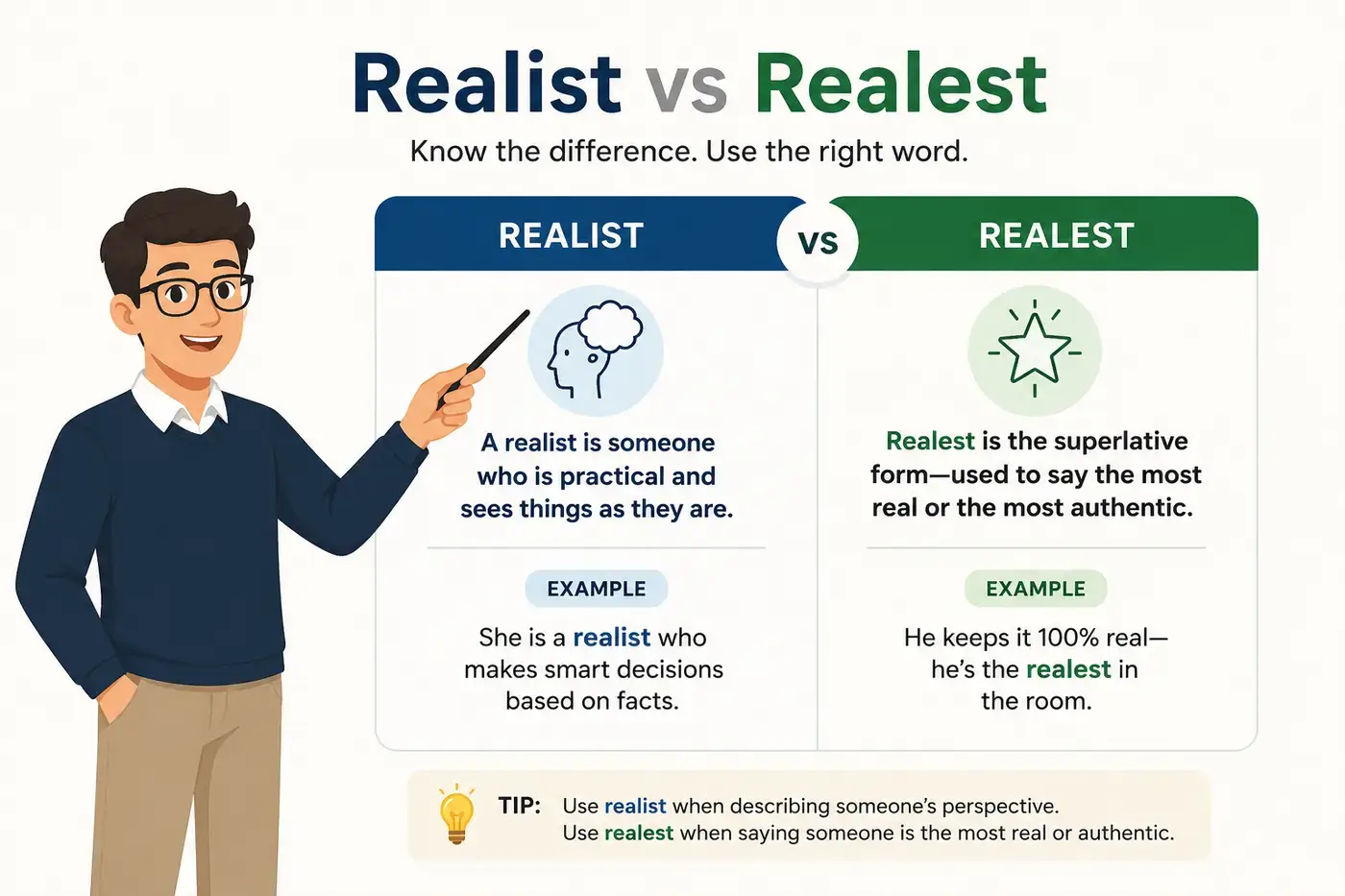
Many English learners get confused about realist vs realest because the two words look very similar. They both come from the word real, but they do not mean the same thing. If you use the wrong one, your sentence can sound strange or even incorrect.
The good news is that the difference between is easy to understand. One word names a type of person, while the other is the highest form of an adjective. They have different jobs in a sentence. This guide explains realist vs realest in very simple English. You will learn what each word means, why people mix them up, and how to use the correct one in everyday writing and speaking.
You may also want to read Wack or Whack Explained With Simple Examples (2026).
Realist vs Realest: Simple Answer in One Look
- Realist = a person who sees things as they really are.
- Realest = the highest form of real, meaning “the most real” or, in casual speech, “the most genuine.”
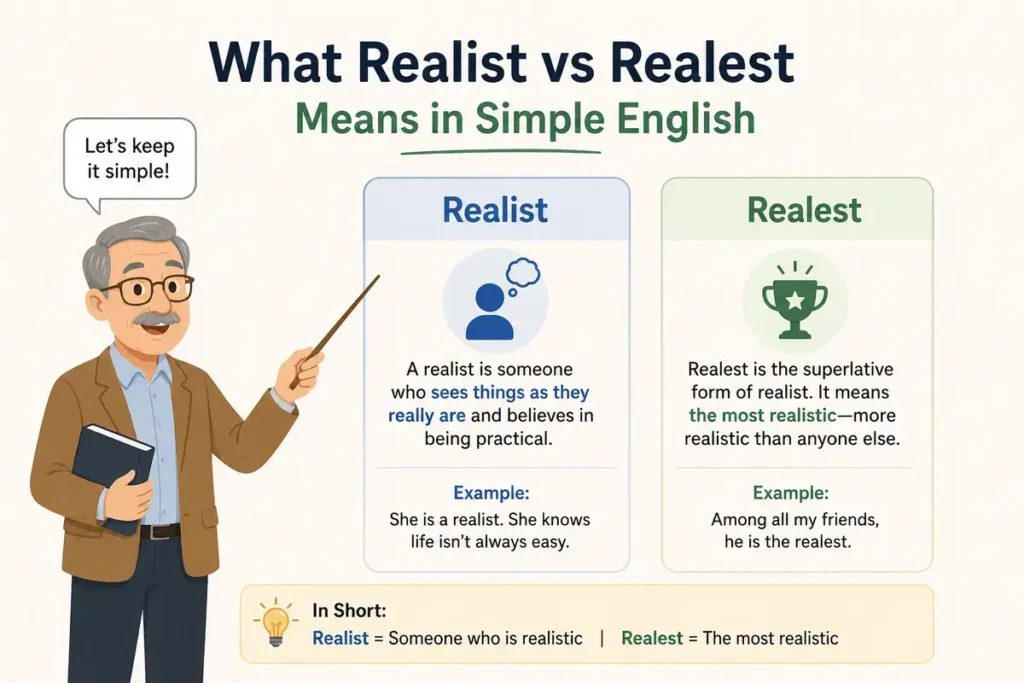
What Realist vs Realest Means in Simple English
Think about the word real first. It means something is true, not fake, or actually exists. Now add different endings. A realist is a person. This person thinks about facts instead of wishes. A realist accepts life as it is. For example:
- Sarah is a realist. She always makes careful plans.
- My father is a realist. He saves money before buying expensive things.
The word realest is different. It describes something. It means that one thing is more real than all the others. For example:
- This story feels like the realest one I have ever heard.
- She gave the realest answer in the whole class.
Many people also use realest in friendly talk to mean most honest, most loyal, or most genuine. For example:
- Jamal is the realest friend I know.
- She stayed with me during hard times. She is the realest.
So when thinking about realist vs realest, remember one simple rule.
- Realist = person
- Realest = description
That small difference changes the whole meaning.
Why People Mix These Words Realist vs Realest
Many learners see the same beginning, real-, and think the words should work in the same way. They also notice that both words are common in English conversations. Another reason is spelling. Compare them:
- real
- realist
- realistic
- realistically
- realest
They all look connected because they come from the same root word. Some students also believe realist means “more real.” That is not true. Look at these examples.
❌ He is the realist student in class.
This sentence is wrong.
✅ He is the realest student in class.
If you want to describe someone as very genuine, realest works in casual English. Now look at another example.
❌ My uncle is a realest.
Wrong.
✅ My uncle is a realist.
Here you are talking about a person who sees life based on facts. The endings change the meaning. The ending -ist often names a person. Examples:
- artist
- scientist
- pianist
- realist
The ending -est usually shows the highest degree. Examples:
- tallest
- fastest
- kindest
- realest
Knowing this pattern makes realist vs realest much easier.
Realist vs Realest: Clear Difference Explained Simply
Here is a quick comparison.
Realist
- Refers to a person
- Believes in facts and reality
- Focuses on practical ideas
- Can be used as a noun
Example:
- Emma is a realist who always checks the budget.
Realest
- Describes something or someone
- Means the most real or most genuine
- Often used in casual speech
- Works like a describing word
Example:
- That was the realest conversation we ever had.
Side-by-Side Comparison
| Realist | Realest |
|---|---|
| A person | A description |
| Accepts reality | Means most real |
| Noun | Superlative adjective |
| Talks about someone’s thinking | Talks about the highest level of being real or genuine |
If you remember person versus description, you will rarely confuse realist vs realest again.
Realist vs Realest: Which Form Should You Use?
Ask yourself one question. Are you talking about a person or describing something? If you mean a person who accepts facts and reality, choose realist. Examples:
- My teacher is a realist.
- She is a realist about money.
- The coach is a realist when planning games.
If you want to say something is the most real or the most genuine, choose realest. Examples:
- That movie had the realest ending.
- This feels like the realest experience of my life.
- He gave the realest advice in the room.
In everyday slang, many young speakers use realest to praise honesty and loyalty. Example:
- You’re the realest friend ever.
This meaning is common in music, social media, and casual conversations.
Easy Real-Life Sentences You Can Use for Realist vs Realest
Here are simple examples that show the difference.
- My mother is a realist who always plans ahead.
- Ben stayed calm because he is a realist.
- That documentary tells the realest story I have seen.
- She gave the realest answer during the meeting.
- Our coach is a realist and studies the facts.
- Mia is the realest person in our group.
- A realist knows that success takes time.
- His speech sounded the realest of them all.
Read them aloud. Notice that realist names someone, while realest describes someone or something.
Where Realist vs Realest Expression Comes From (Simple History)
The word real comes from old Latin words that were connected with things that truly exist. Over time, English created many new words from the same root. One of them was realist. It became a word for someone who believes in reality instead of dreams or impossible ideas. Writers, artists, and everyday people have used it for many years. The word realest is simply the superlative form of real. English often adds -est to short adjectives to show the highest degree. For example:
- small → smallest
- bright → brightest
- kind → kindest
- real → realest
In modern times, realest also became popular in music and everyday speech. Many people now use it to mean most authentic, most honest, or most loyal. Because both words share the same root, learners often compare realist vs realest, even though they serve different purposes.
Common Mistakes to Avoid
Many students make the same errors. Here are easy fixes.
Mistake 1: Using realist instead of realest
❌ That was the realist speech today.
✅ That was the realest speech today.
Mistake 2: Using realest for a person who thinks practically
❌ She is a realest.
✅ She is a realist.
Mistake 3: Thinking the words are interchangeable
They are not.
One names a kind of person.
The other describes the highest level of being real or genuine.
Quick Memory Trick
Remember this easy sentence:
The ending “-ist” points to a person. The ending “-est” points to the highest level.
Think about these pairs:
- artist → a person
- scientist → a person
- pianist → a person
- realist → a person
Then compare:
- tallest
- fastest
- strongest
- realest
This trick helps you choose the right word in seconds.
Difference Between Realist vs Realest in Everyday Speech
In daily conversation, people often use realest to compliment someone. For example:
- You’re the realest person I know.
- Thanks for being the realest friend.
Here, the speaker means honest, loyal, and true. A realist, however, is someone who thinks carefully about facts. For example:
- My sister is a realist. She always expects both good and bad results.
The meanings stay different even when the words sound alike.
Need another quick comparison? Read Developed vs Developped: Easy Guide for English Learners.
Which Is Correct: Realist or Realest?
The correct answer depends on your sentence.
Use realist when talking about a person who accepts reality.
Use realest when describing something as the most real or the most genuine.
Neither word replaces the other. That is why understanding is about meaning, not just spelling. As you keep reading, you will also see how these words appear in culture, stories, symbolism, and everyday life, making their differences even easier to remember.
Realist vs Realest in Culture and Stories
People often use words in different ways when they tell stories or share ideas. The same is true with realist vs realest. A realist is usually the character who stays calm and thinks about facts. This person does not expect magic or impossible things to happen. In many books and movies, the realist helps the group make smart choices. For example:
- The realist tells everyone to save food before winter.
- The realist reminds friends to make a backup plan.
The word realest is different. It often appears in songs, social media posts, and friendly conversations. Someone may say:
- She is the realest person I know.
- That was the realest advice anyone gave me.
Here, realest does not only mean “most real.” It often means most honest, most loyal, or most true to themselves. Because of this modern use, many young speakers know realest from music and online videos. At the same time, they learn about a realist in school when reading stories or discussing ideas. Understanding becomes easier when you notice the different roles each word plays.
Realist vs Realest in the Bible and Mythology
There is no special Bible story that directly teaches the meaning of realist or realest. The Bible does encourage people to speak truthfully and live honestly. Because of that, some readers connect the casual meaning of realest with being sincere and faithful. This is only a modern connection. It is not a formal Bible meaning.
Mythology is also different. Ancient myths often include heroes, monsters, and magical events. A character who questions impossible ideas and looks for practical answers might be described as a realist, but that is a modern English label rather than a mythological title. So, when comparing remember that neither word has a special religious or mythological definition.
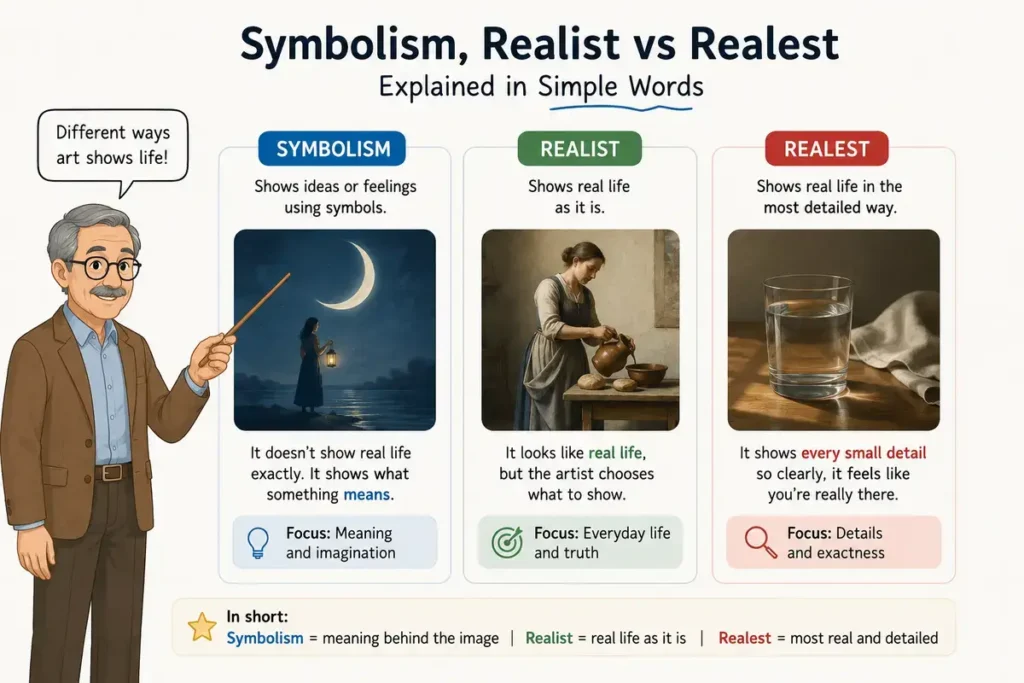
Symbolism Realist vs Realest Explained in Simple Words
Realist vs Realest: What a Realist Represents
A realist often symbolizes:
- Clear thinking
- Practical choices
- Careful planning
- Looking at facts
- Staying calm during problems
People may see a realist as someone who keeps others focused on reality instead of wishful thinking. For example:
A family member who saves money for emergencies may be called a realist because they prepare for real-life situations.
Realist vs Realest: What Realest Represents
The word realest often symbolizes:
- Honesty
- Loyalty
- Being true to yourself
- Strong friendship
- Authentic behavior
When someone says, “You are the realest,” they are usually praising that person’s character. In modern culture, realest carries warm and positive feelings. It often suggests that someone can be trusted. So the emotional difference in is easy to remember.
- A realist stands for practical thinking.
- The realest stands for genuine and honest behavior.
Related Words You Should Know
Learning nearby words makes much easier.
Real
Means true or not fake. Example:
- This diamond is real.
Reality
The way things truly are. Example:
- We must accept reality.
Realistic
Based on facts and possible results. Example:
- That is a realistic plan.
Realism
A way of thinking that focuses on real life instead of fantasy. Example:
- His writing shows realism.
Genuine
Means honest or authentic. Example:
- She gave a genuine smile.
Authentic
Means original and true. Example:
- The painting is authentic.
Practical
Means useful and sensible. Example:
- Her idea is practical.
Honest
Means telling the truth. Example:
- Please be honest with me.
Truthful
Means saying what is true. Example:
- He gave a truthful answer.
Loyal
Means staying faithful to friends or family. Example:
- A loyal friend never gives up on you.
How People Actually Use Realist vs Realest in Daily English
People use these words in very different situations. Here are natural examples.
- My brother is a realist and always checks the facts first.
- You’re the realest friend I’ve ever had.
- She’s a realist about finding a new job.
- That speech felt like the realest moment of the event.
- I try to be a realist when making big decisions.
- He stayed with me during hard times. He’s the realest.
- Our coach is a realist and prepares for every challenge.
- That movie gave the realest picture of school life.
- My grandmother is a realist, but she is still hopeful.
- Thank you for being the realest person on the team.
These examples show that realist usually talks about someone’s way of thinking, while realest often praises honesty or describes something as extremely real.
Common Mistakes People Make With Realist vs Realest
Many learners repeat the same errors. Here are the most common ones.
Mistake 1: Thinking Both Words Mean the Same Thing
They do not.
- Realist is a person.
- Realest is a description.
Mistake 2: Using Realest as a Noun
❌ My uncle is a realest.
✅ My uncle is a realist.
Mistake 3: Using Realist as an Adjective
❌ That was the realist movie.
✅ That was the realest movie.
Mistake 4: Believing Realest Is Always Formal
Many dictionaries accept realest as the superlative form of real, but its meaning of “most loyal” or “most genuine” is mainly casual and informal.
Mistake 5: Forgetting the Ending
Remember this simple pattern.
- -ist often names a person.
- -est often shows the highest level.
That small clue solves many grammar mistakes.
Final Teacher Explanation of Realist vs Realest
Imagine I am standing in front of a classroom. I write two words on the board.
Realist
Realest
Then I ask one question. “Are we talking about a person or describing something?”
If the answer is a person who believes in facts and reality, choose realist.
If the answer is the most real, the most genuine, or the most honest, choose realest.
That is the easiest way to remember the difference. You do not need difficult grammar rules. Just remember:
- Person = realist
- Description = realest
Every time you see ask yourself that one question, and the correct answer becomes clear.
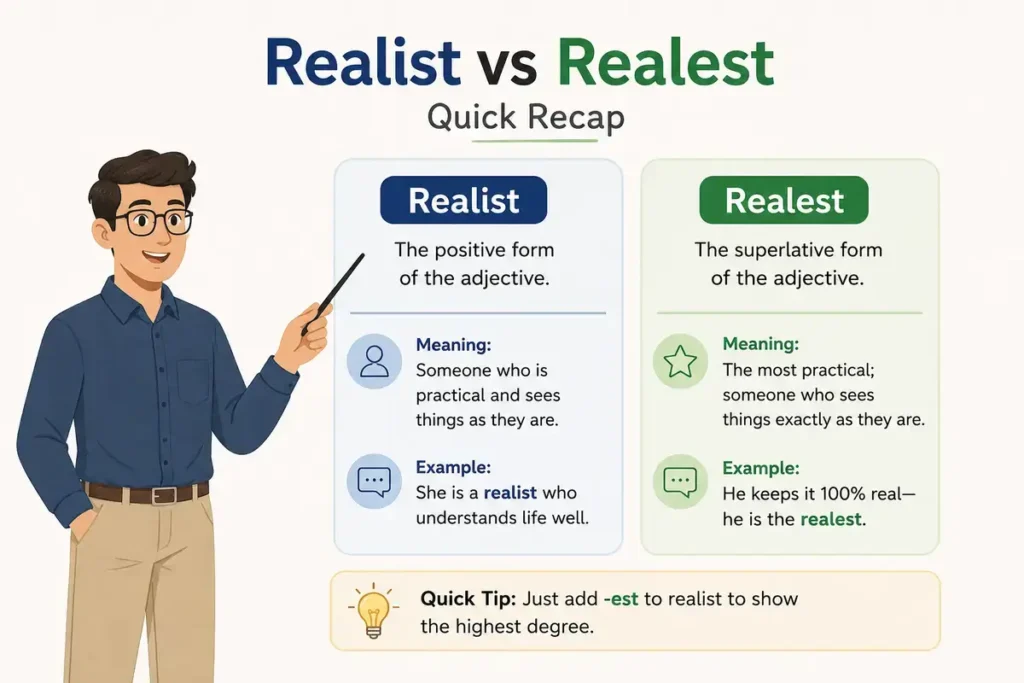
Final Answer: Realist vs Realest Quick Recap
A realist is a person who accepts reality and thinks in a practical way.
The realest means the most real or, in casual English, the most honest or genuine.
The easiest memory trick is this: -ist means a person, while -est means the highest level.
A related grammar guide is Since Vs Sense: The Simple Difference With Examples (2026).
Conclusion
The confusion between realist vs realest comes from their similar spelling, but their meanings are different. A realist is someone who looks at life through facts and practical thinking. A realest person or thing is described as the most real, genuine, or authentic. Once you remember that one word names a person and the other describes the highest level of being real, choosing the correct form becomes simple.
FAQs
What does realist mean in simple words?
A realist is a person who accepts facts and thinks about real life instead of dreams.
What does realest mean in simple words?
Realest means the most real or, in casual speech, the most genuine or honest.
Is realist or realest correct?
Both are correct. They simply have different meanings and are used in different situations.
Why do people confuse?
They share the same root word and have similar spelling, so many learners think they can replace each other.
Can I say someone is the realest friend?
Yes. In casual English, it means they are very loyal, honest, or genuine.
Can I use realist to describe an object?
No. Realist refers to a person, not an object or description.
Is realest formal English?
It can be used as the superlative of “real,” but its meaning of “most genuine” is more common in informal speech.
How can I remember the difference?
Think of this easy rule: -ist is a person, and -est shows the highest level.
