
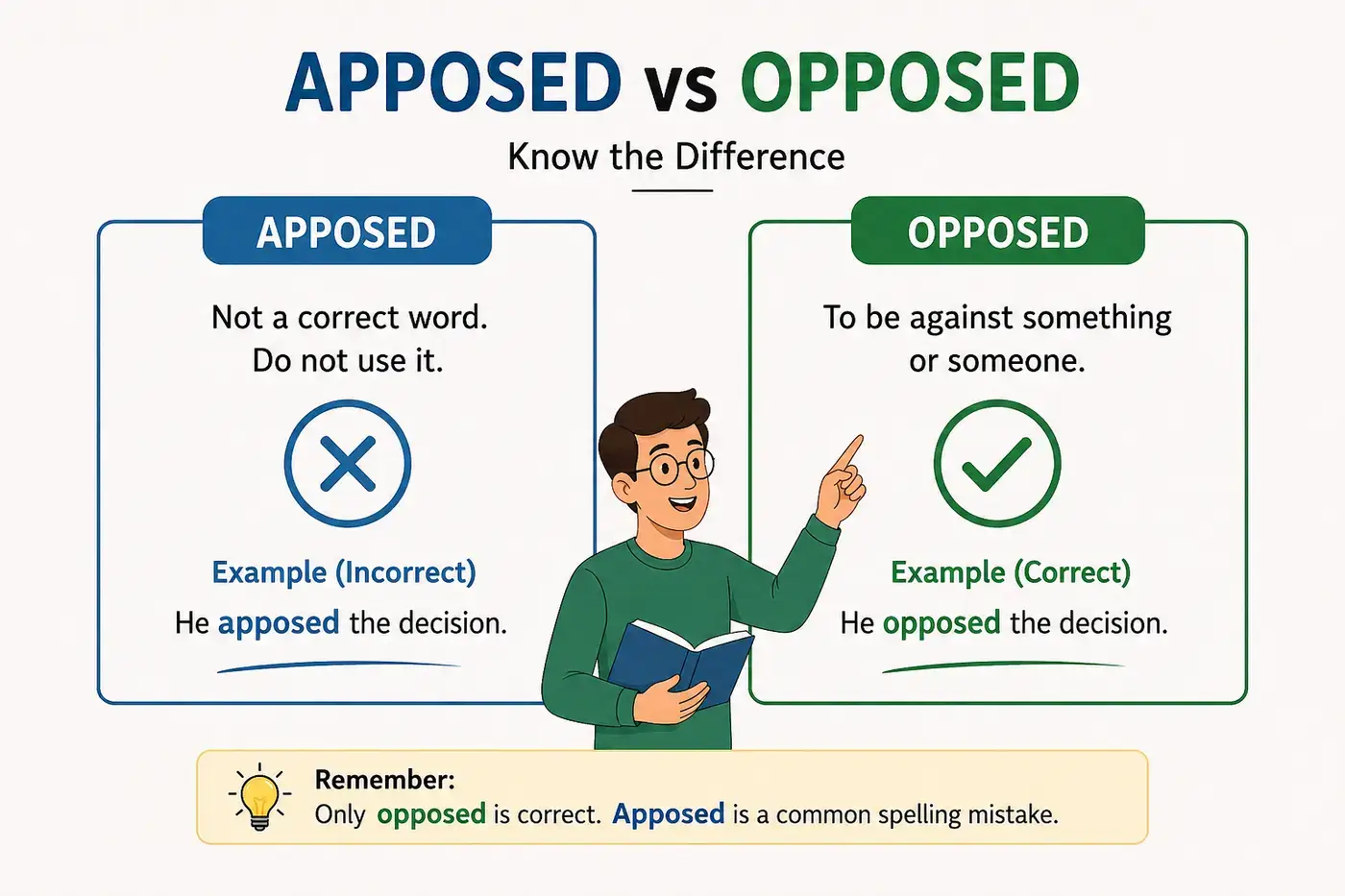
Many people get confused by apposed vs opposed because both words look almost the same. They share many of the same letters, but they do not have the same meaning. If you use the wrong one, your sentence can sound confusing or completely incorrect.
The good news is that learning the difference between is much easier than it first appears. Once you understand what each word means and see a few simple examples, you will know which one to use with confidence.
This guide explains everything in clear, everyday US English. You will learn the meanings, see real-life examples, discover why people mix these words up, and remember the difference with easy tricks that actually work.
Learn the difference in Pentoxide vs Pentaoxide: Which One Is Correct?.
Simple Answer in One Look
Apposed means placed next to something for explanation or comparison.
Opposed means against something or someone in opinion, action, or position.
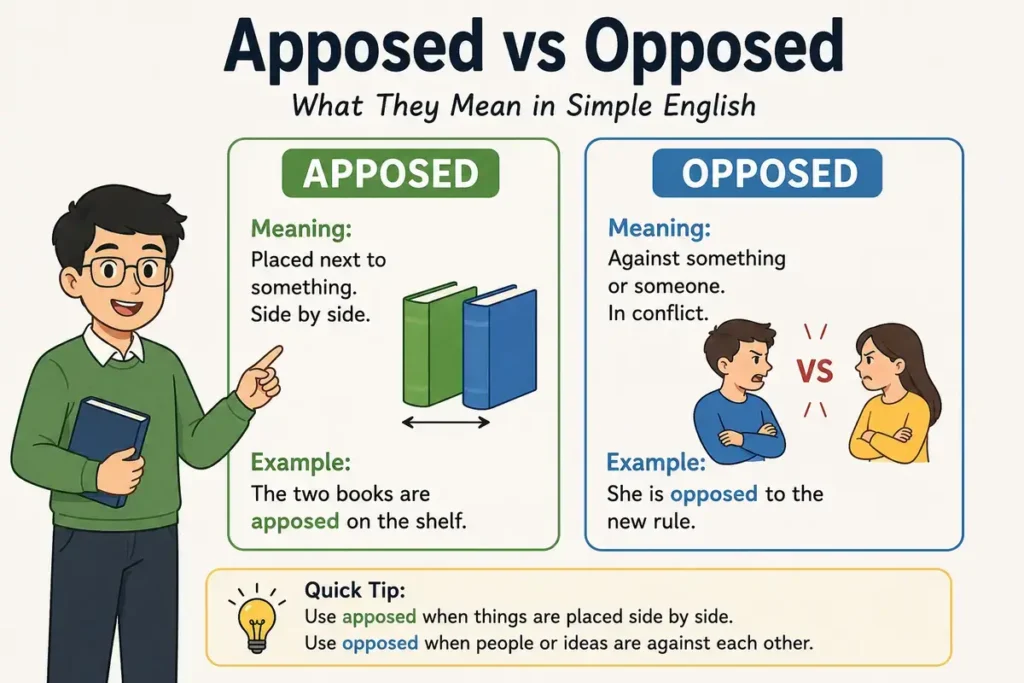
What Apposed vs Opposed Means in Simple English
The easiest way to understand these words is to think about their basic ideas. Apposed is about being beside something. Imagine putting two books next to each other on a table. They are side by side. That picture can help you remember the meaning of apposed. People also use apposed when one word or phrase is placed beside another to explain it. For example:
- “My brother, a firefighter, helped us.”
The words a firefighter are placed next to my brother to give more information. They are apposed. You will not hear apposed very often in everyday conversation. It is mostly used in writing, medicine, science, and language studies. Now look at opposed. Opposed means against.
If two sports teams are opposed, they compete against each other.
If someone is opposed to a plan, they do not want it to happen.
For example:
- Sarah is opposed to raising taxes.
- Many people opposed the new rule.
- I am opposed to wasting food.
Notice that every example shows disagreement or resistance.
That is the biggest difference between words.
- Apposed = next to
- Opposed = against
Remember these two simple ideas, and you will already understand most situations.
Why People Mix These Words
Many English learners—and even native speakers—mix these words because they look almost identical.
Here are the biggest reasons.
They Have Similar Spellings
The only visible difference is one extra letter.
- apposed
- opposed
When reading quickly, many people hardly notice the difference.
They Sound Similar
Although the pronunciation is slightly different, both words begin and end in almost the same way.
That makes it easy to hear the wrong word.
One Word Is Much More Common
Most people hear opposed often.
Examples include:
- opposed to the idea
- strongly opposed
- publicly opposed
But apposed is uncommon in daily speech.
Because of this, people sometimes write opposed when apposed is actually correct.
AutoCorrect Can Cause Problems
Spell check does not always understand what you mean.
Since opposed appears much more often in English, software may suggest it automatically.
That can lead to mistakes if you do not read your sentence carefully.
They Have Different Meanings but Similar Shapes
Many confusing English word pairs share this problem. For example:
- affect vs effect
- beside vs besides
- accept vs except
The words look alike but have completely different meanings.
These words belong to the same group.
Clear Difference Explained Simply
Here is an easy comparison.
| Apposed | Opposed |
|---|---|
| Means placed beside something. | Means against something. |
| Usually used in writing, grammar, science, or medicine. | Common in everyday English. |
| Shows closeness or placement. | Shows disagreement or resistance. |
| Less common. | Very common. |
Think about these pictures in your mind.
Apposed
📚 Book beside another book.
🧍 Person standing beside a friend.
Words placed beside another word.
Opposed
🚫 Saying “No.”
⚔️ Two teams competing.
👥 Two people disagreeing.
These simple images make the meanings much easier to remember.
Quick Memory Trick
Remember this sentence:
Apposed = Added beside.
Both words begin with Ap.
Now remember this one:
Opposed = Opposite idea.
Both words begin with Opp.
That small connection helps many students remember the difference for years.
Which Form Should You Use Apposed vs Opposed?
Ask yourself one simple question.
Are you talking about disagreement?
If yes, use opposed.
Examples:
- I am opposed to smoking.
- They opposed the decision.
- She is strongly opposed to the plan.
Are you talking about something placed beside something else?
If yes, use apposed.
Examples:
- The labels were apposed for comparison.
- The doctor described two apposed surfaces.
- The explanation was apposed to the main sentence.
Easy Rule
Use opposed when someone says no.
Use apposed when something is next to something else.
If you remember only this rule, you will choose the correct word most of the time.
Easy Real-Life Sentences You Can Use
Here are simple examples with apposed.
- The two photos were apposed on the page.
- The notes were apposed for easy reading.
- The labels were apposed beside the pictures.
- The doctor examined the apposed surfaces.
- The explanation was apposed to the main text.
Now look at examples with opposed.
- I am opposed to bullying.
- My parents opposed the idea.
- She is opposed to wasting money.
- The workers opposed the new policy.
- They were opposed from the beginning.
- Our team opposed the strongest players.
- Many people opposed the change.
- He remained opposed even after the meeting.
Notice how naturally opposed fits into everyday conversations.
You probably hear or read these kinds of sentences much more often than sentences using apposed.
Where Apposed vs Opposed Word Expression Comes From Simple History
The words apposed and opposed both come from Latin, but they grew into different meanings over time. Apposed comes from a Latin word meaning placed near or put next to. That original meaning is still easy to see today. Something apposed is placed beside something else. Opposed comes from another Latin word meaning placed against.
Over many years, English speakers began using it to describe disagreement, resistance, and competition. That is why people who are opposed usually stand against an idea instead of beside it. Even though the words have similar roots, their meanings moved in different directions. One became about closeness. The other became about conflict. That history explains why the words look similar but behave so differently in modern English.
Moving Beyond the Basic Difference
Now that you understand the basic difference between both words, the next step is learning how these words appear in culture, professional writing, literature, and specialized fields. You will also discover memory tricks, common mistakes, advanced examples, and frequently asked questions that will help you use both words naturally and confidently in real-life situations.
Many readers also check Stellar vs Steller: Meaning, Spelling, and Usage Explained.
How Is Understood in Culture and Stories
The words are not just about grammar. They also reflect two very different ideas that appear in everyday life, stories, movies, and history. Apposed gives the idea of things being side by side. They may be close together because they belong together, explain each other, or work as a pair. For example:
- Two photos placed beside each other in a family album.
- Two ideas shown together in a classroom lesson.
- Two puzzle pieces fitting next to each other.
These examples show closeness, comparison, or connection.
Opposed, on the other hand, gives the idea of conflict or disagreement. You can see this idea in many stories. For example:
- Two friends disagree about a decision.
- Two sports teams compete to win.
- A hero stands opposed to a villain.
- A family member opposes an unfair rule.
In many books and movies, the main problem starts because two people have opposite goals. That is why opposed often carries a stronger emotional feeling than apposed. One word shows things working together or existing side by side. The other shows people or ideas standing against each other. Understanding this simple picture makes much easier to remember.
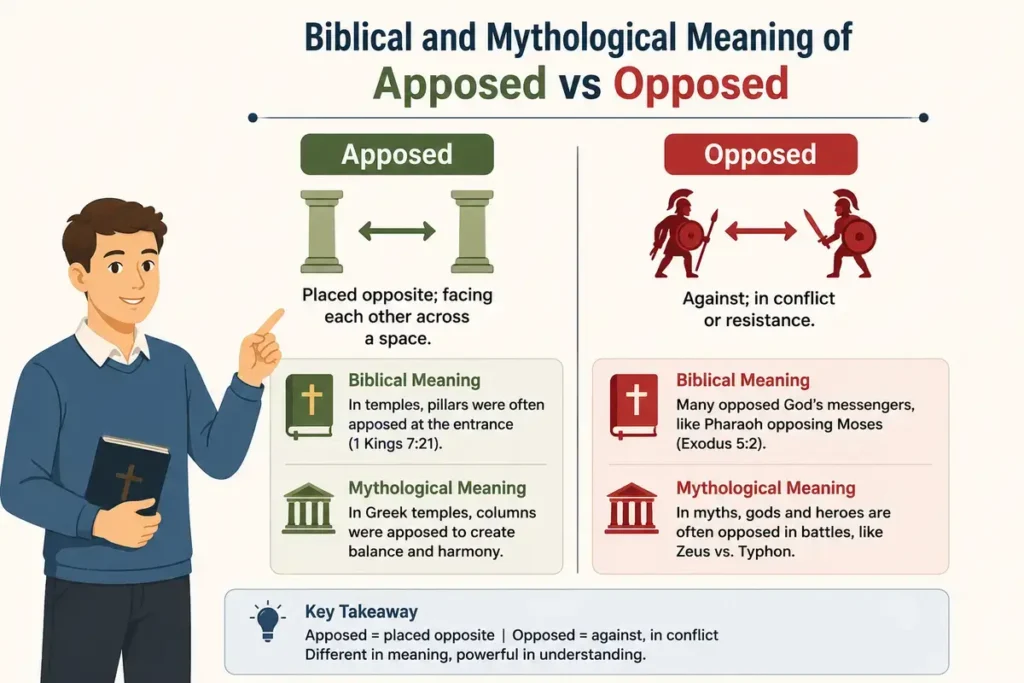
Biblical and Mythological Meaning of Apposed vs Opposed
The Bible does not use the word apposed as a special teaching word. However, the idea of things being placed side by side appears many times. For example:
- The tablets of God’s law were placed together.
- People stood beside one another during worship.
- Families gathered together in unity.
These examples reflect the general idea behind apposed, which is being near or beside something. The word opposed matches many Bible stories because people often stood against good or evil. Examples include:
- Pharaoh opposed Moses.
- Religious leaders opposed Jesus.
- David opposed Goliath.
- Evil is opposed to goodness.
These stories show disagreement, resistance, or conflict. In mythology, heroes are often opposed by monsters, enemies, or powerful gods. Stories become exciting because someone stands against another person or force. The idea of apposed is much less common in mythology because it is mainly a technical or descriptive word instead of a storytelling word.
Symbolism Explained in Simple Words
Sometimes words create pictures in our minds.
That is true.
What Apposed Represents
Apposed often represents:
- Closeness.
- Connection.
- Order.
- Balance.
- Comparison.
- Working together.
- Careful organization.
Imagine two books placed neatly beside each other on a shelf. Neither book is fighting the other. They simply belong together. That peaceful picture matches the meaning of apposed.
What Opposed Represents
Opposed usually represents:
- Disagreement.
- Conflict.
- Resistance.
- Different opinions.
- Competition.
- Standing against something.
- Personal choice.
Imagine two soccer teams facing each other before a match.
Only one team can win.
That picture represents opposed.
It reminds us that people do not always agree, and sometimes they choose different paths.
This simple comparison helps many learners remember the meanings.
- Apposed = Together.
- Opposed = Against.
Related Words You Should Know
Learning similar words makes English much easier. Here are some useful words related to keyword.
Adjacent
Means next to something. Example:
“The school is adjacent to the library.”
Beside
Means at the side of someone or something. Example:
“My backpack is beside the chair.”
Next To
A common everyday phrase meaning very close. Example:
“I sat next to my friend.”
Against
Means in opposition to something. Example:
“She voted against the plan.”
Opposite
Means facing or completely different. Example:
“Our house is opposite the park.”
Resist
Means to refuse or fight against something. Example:
“They resisted the new rule.”
Support
Means to agree with or help someone. Example:
“Many people support the project.”
Compare
Means to look at two things together. Example:
“We compared the two pictures.”
These related words help you understand both meanings even better.
How People Actually Use Apposed vs Opposed in Daily English
One interesting fact is that people use opposed every day. They rarely use apposed outside special writing or professional fields. Here are some natural examples.
- I am opposed to cheating.
- My parents opposed the idea of moving.
- She strongly opposed the decision.
- The workers opposed the new schedule.
- We were opposed from the beginning.
- Many citizens opposed the law.
- The two candidates opposed each other during the debate.
- He is opposed to smoking inside restaurants.
- The doctor examined the apposed tissues.
- The labels were apposed beside each picture for comparison.
Notice something important.
Nine out of ten daily conversations will probably use opposed, not apposed.
That is perfectly normal because apposed belongs mostly to formal, medical, scientific, or language-related writing.
Common Mistakes People Make
Many learners make the same mistakes.
The good news is that they are easy to fix.
Mistake 1
❌ I am apposed to the new rule.
✅ I am opposed to the new rule.
Remember:
When you disagree, always use opposed.
Mistake 2
❌ The two labels were opposed together.
✅ The two labels were apposed together.
If something is placed beside something else, use apposed.
Mistake 3
Choosing the more common word without checking the meaning.
Because opposed appears much more often, people sometimes use it automatically.
Always ask yourself:
“Do I mean against, or do I mean next to?”
Mistake 4
Thinking both words mean the same thing.
They do not.
Although they look alike, their meanings are completely different.
Mistake 5
Depending only on spell check.
Spell check cannot always understand your meaning.
Always read the whole sentence before clicking “Accept.”
Final Teacher Explanation About Apposed vs Opposed
Imagine we are sitting together in an English classroom. I write two words on the board.
Apposed
Opposed
I ask one question.
“What picture comes into your mind?”
If you picture two things standing beside each other, choose apposed.
If you picture someone saying no or standing against an idea, choose opposed.
That simple picture is all you need.
You do not have to memorize difficult grammar rules.
Instead, remember these easy ideas.
- Apposed means placed beside.
- Opposed means against.
Also remember that opposed is much more common in everyday English. You will hear it in conversations, news reports, classrooms, business meetings, and family discussions. Apposed is correct too, but you will mostly see it in professional writing, medicine, science, or language studies. When you stop focusing on the spelling and start focusing on the meaning, choosing the correct word becomes much easier. With a little practice, you will quickly recognize the right choice every time.
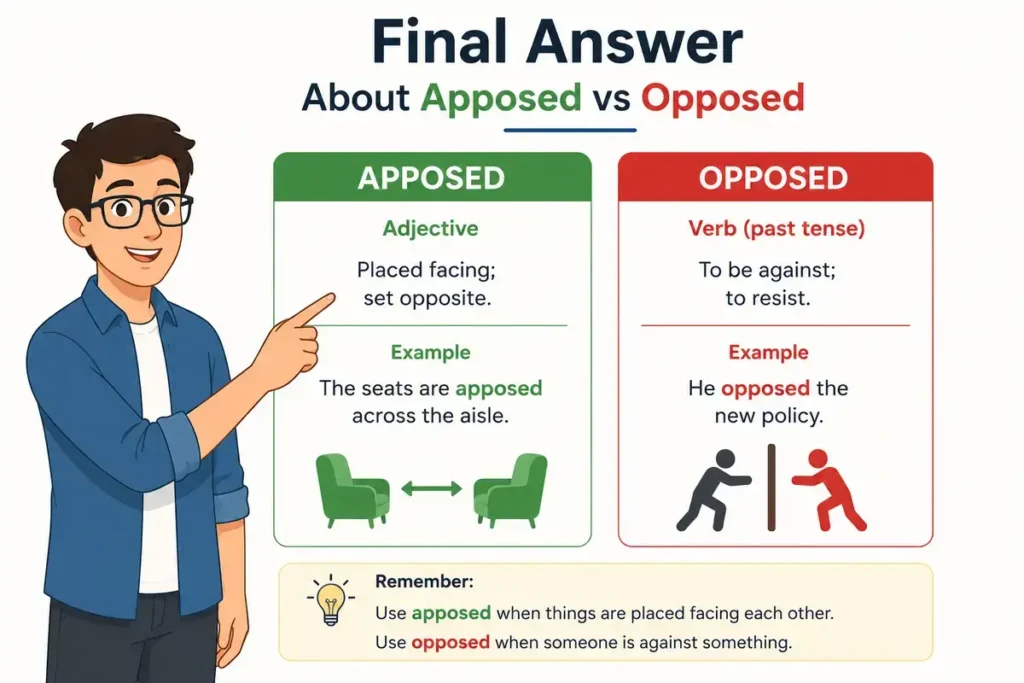
Final Answer About Apposed vs Opposed
The difference between is simple once you know the main idea.
Apposed means placed beside or next to something.
Opposed means against someone or something.
If you remember “beside” for apposed and “against” for opposed, you will almost always choose the correct word.
Learn the difference in Noteable or Notable: Complete Usage Guide(2026).
Conclusion
Many learners confuse because the words look almost the same. However, their meanings are very different. Use apposed when something is placed beside something else for comparison, explanation, or description. This word is mostly found in formal writing, medicine, science, and language studies.
Use opposed when someone is against an idea, person, plan, or action. This is the word you will hear most often in everyday conversations, news stories, classrooms, and workplaces. A simple way to remember the difference is this:
- Apposed = Beside.
- Opposed = Against.
Once you connect each word to its main idea instead of its spelling, choosing the correct word becomes easy and natural.
Frequently Asked Questions
What does apposed mean in simple words?
Apposed means something is placed next to or beside something else.
What does opposed mean in simple words?
Opposed means against someone, something, or an idea.
Is apposed or opposed more common?
Opposed is much more common in everyday English. Apposed is mostly used in formal, medical, scientific, or grammar-related writing.
Why do people confuse?
They look and sound similar, but they have completely different meanings.
Can I use apposed instead of opposed?
No. They are not interchangeable because they express different ideas.
How can I remember the difference?
Think of apposed as beside and opposed as against.
Is apposed a real English word?
Yes. It is a correct English word, but it is much less common than opposed.
Which word should I use in everyday conversation?
Most of the time, you will use opposed because it is the normal word for disagreement or resistance.
