
Many people get confused about unregister vs deregister because both words talk about removing something from a list or a system. At first, they seem to mean the same thing. That is why many English learners and even native speakers use them in the wrong place.
The truth is simple. Both words can be correct, but they are not always used in the same situation. The best choice depends on what you are talking about. For example, you may unregister a device from an app, but a business may deregister from a government office.
This guide explains in very simple English. You will learn the meaning of each word, the difference between them, when to use each one, and how to avoid common mistakes. By the end, you will feel confident using the right word in everyday English.
You may also want to read Instalments or Installments: Complete Grammar Guide 2026.
Simple Answer in One Look
Unregister means to remove a person, device, or account from a list or system.
Deregister means to officially remove something from a government, legal, or formal register.
Both words are correct. The situation decides which one you should use.
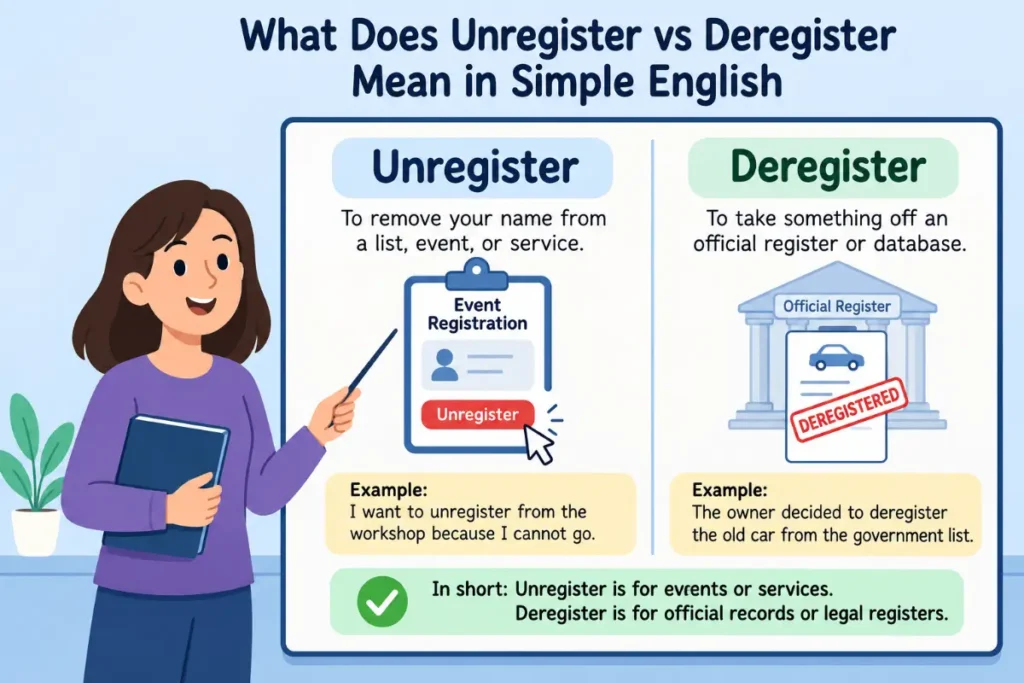
What Does Unregister vs Deregister Mean in Simple English
Think about a school class. When you join the class, your name goes on the class list. If your teacher removes your name from that list, you are no longer registered. Now imagine a company that has been officially recorded by the government. If the government removes that company from its official records, the company is deregistered. This is the easiest way to understand the difference.
Unregister usually means removing something from an ordinary system. Examples include:
- A phone from your account.
- An email address from a mailing list.
- A computer from a network.
- Your name from an event.
- A game account from a device.
Deregister usually means removing something from an official or legal record. Examples include:
- A company.
- A business.
- A charity.
- A registered vehicle.
- A legal organization.
You can remember it like this.
- Unregister is common in everyday technology and daily life.
- Deregister is common in legal, business, and government situations.
Why Do People Mix These Words
Many people think these words are exactly the same because both begin with prefixes that mean “remove.” The prefix un- often means to reverse an action. Examples include:
- Unlock
- Untie
- Unplug
- Uncover
So unregister simply means to reverse registration.
The prefix de- also means to remove or reverse something. Examples include:
- Deactivate
- Decode
- Defrost
- Declassify
Since both prefixes show removal, people naturally believe unregister and deregister always have the same meaning.
Another reason for the confusion is technology.
Many websites use unregister.
Many government websites use deregister.
If someone sees both words online, they may think they are interchangeable everywhere. Regional English also causes confusion. Some countries prefer one word more often than the other. For example, software companies often write unregister your device, while government departments often write deregister your vehicle. Because people read both versions, they sometimes mix them.
Clear Difference Explained Simply
Here is the easiest way to compare them.
| Unregister | Deregister |
|---|---|
| Used in everyday situations | Used in official situations |
| Common with apps and devices | Common with governments |
| Removes something from a normal system | Removes something from a legal register |
| Often seen in technology | Often seen in business and law |
| More common in general English | More common in formal English |
You can also remember this simple rule.
Use unregister for regular systems.
Examples:
- Unregister your laptop.
- Unregister your email.
- Unregister your account.
- Unregister from the event.
Use deregister for official records.
Examples:
- Deregister the company.
- Deregister the charity.
- Deregister the vehicle.
- Deregister the organization.
Think of unregister as removing something from a normal list.
Think of deregister as removing something from an official government book.
Which Form Should You Use Unregister vs Deregister
Most English learners ask this question first. The answer depends on the situation.
Use unregister when talking about:
- Apps
- Websites
- Computers
- Phones
- Accounts
- Online services
- Classes
- Clubs
- Events
Examples:
- Please unregister your old phone.
- I forgot to unregister from the webinar.
- You must unregister the device before selling it.
Use deregister when talking about:
- Businesses
- Companies
- Cars in some countries
- Organizations
- Government records
- Legal documents
Examples:
- The owner decided to deregister the company.
- They had to deregister the charity.
- She plans to deregister the business next month.
If you are speaking casually with friends, unregister is usually the more common choice for technology.
If you are reading legal papers or government forms, you will probably see deregister.
Easy Real-Life Sentences You Can Use
Here are simple examples you can copy into your own English.
- I need to unregister my old phone.
- Please unregister your email before leaving.
- She forgot to unregister from the online class.
- We must unregister this computer first.
- The company decided to deregister last year.
- They will deregister the organization soon.
- The business owner plans to deregister the company.
- You should unregister your account before creating a new one.
Notice how the everyday examples use unregister.
The official examples use deregister.
That pattern is easy to remember.
Where Unregister vs Deregister Word Expression Comes From Simple History
The word register comes from an old Latin word that meant a written record or list. Many years ago, governments, churches, and businesses kept written registers to record names, land, births, marriages, and other important information. As English changed over time, new words were built from register. The word unregister was created by adding the prefix un-, which means to reverse an action. It simply means to remove something that was once registered.
Later, the word deregister became common in legal and government English. The prefix de- also shows removal or reversal. Because governments often manage official registers, deregister became closely connected with legal records, businesses, and formal organizations. Today, both words are accepted in English, but people usually choose one based on the kind of registration they are talking about.
If the registration is part of everyday technology or a normal service, unregister is usually the better choice.
If the registration belongs to a government office or another official authority, deregister is usually the better choice.
As English continues to grow with new technology, unregister appears more often in apps, websites, software, and digital devices. Deregister continues to be widely used in legal documents, business records, and official government systems. Understanding this simple history makes it easier to remember why the two words are similar but still have different everyday uses.
Now that you understand the basic meanings, the next step is learning how these words are used in culture, business, technology, official documents, and everyday conversations. Seeing them in real situations will help you choose the right word naturally and avoid common mistakes.
How Is Understood in Culture and Stories
The words do not have deep cultural meanings like words such as love, hope, or freedom. Still, they appear in many parts of modern life because people register for many things every day. In today’s digital life, people register phones, computers, email accounts, online games, streaming services, and websites. When they stop using them, they often unregister them. This makes unregister feel connected to moving on, cleaning up, or starting fresh.
In business and government, deregister has a more official feeling. A company may deregister after closing. A charity may deregister if it no longer operates. A vehicle may also be deregistered in some countries. Because of this, deregister often represents the end of an official record.
In stories about technology, you may hear someone say:
“I forgot to unregister my old laptop before selling it.”
In a business story, you may hear:
“The owner decided to deregister the company after retirement.”
Even though both words describe removing something from a register, the setting changes their meaning. One sounds personal and everyday. The other sounds formal and official.
For another common grammar confusion, see Input or Imput: Which Is Correct and Grammar Tips (2026).
Biblical and Mythological Meaning of Unregister vs Deregister
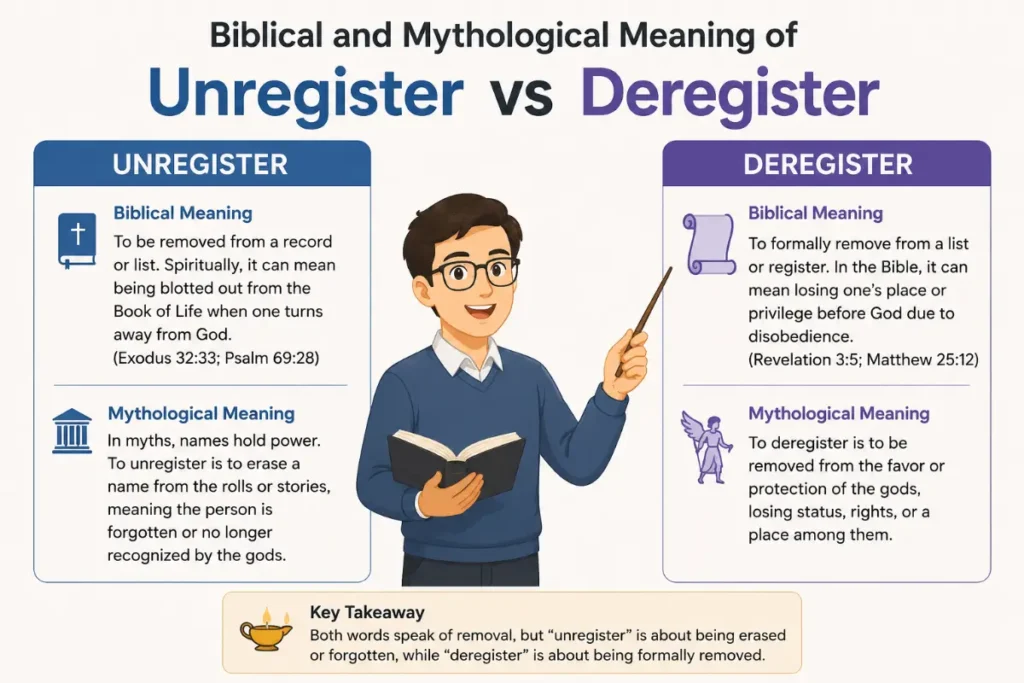
There is no direct biblical meaning. The Bible does mention names being written in books or records. These books often represent remembrance, belonging, or judgment. However, the Bible does not use the modern words unregister or deregister. In mythology, there is also no direct meaning for these words. Ancient stories were written long before these English words existed.
Some readers may think about the idea of removing a name from a list. That idea can symbolize leaving a group or ending a role. Still, this is only a modern way of thinking. It is not the original meaning of these words. So if someone asks if unregister or deregister has a biblical or mythological meaning, the simple answer is no.
Symbolism Explained in Simple Words
What Unregister Represents
In everyday life, unregister often represents a personal choice.
It can mean:
- Leaving a service.
- Removing a device.
- Cleaning up old accounts.
- Starting over.
- Taking control of your digital life.
For many people, unregister feels simple and practical. It usually happens because someone chooses to stop using something.
What Deregister Represents
Deregister often represents an official ending.
It can mean:
- Closing a business.
- Ending a legal registration.
- Removing an organization from official records.
- Completing a formal process.
Because governments and legal offices often use this word, deregister feels more serious than unregister.
Here is a simple way to remember the symbolism.
- Unregister represents a personal change.
- Deregister represents an official change.
Related Words You Should Know About Unregister vs Deregister
Learning similar words helps you understand English more naturally.
Register
To add a name, account, device, or business to a list or system. Example:
“You must register before using the website.”
Registration
The process of joining or recording something officially. Example:
“Registration closes on Friday.”
Registered
Already added to a list or system. Example:
“My phone is registered.”
Unregistered
Not registered anymore or never registered. Example:
“This device is unregistered.”
Deregistration
The official process of removing something from a legal register. Example:
“The company’s deregistration took several weeks.”
Remove
A general word that means to take something away. Example:
“Please remove this account.”
Cancel
To stop a service, booking, or agreement. Example:
“I canceled my subscription.”
Delete
To erase something completely. Example:
“Delete the old files.”
Disable
To turn something off without deleting it. Example:
“Disable notifications.”
Deactivate
To make an account or device inactive. Example:
“I deactivated my old account.”
These words are related, but each has its own meaning. Choosing the right one makes your English clearer.
How People Actually Use It in Daily English
Most people use these words only when talking about technology, business, or official records. Here are some natural examples.
- Please unregister your old phone before giving it away.
- I forgot to unregister from the online workshop.
- Can you unregister this printer from the network?
- We need to unregister the device before replacing it.
- The business owner plans to deregister the company next month.
- The charity decided to deregister after finishing its work.
- You should unregister your email if you no longer use it.
- Our office had to deregister the organization with the government.
- I finally unregistered all my old devices.
- They officially deregistered the business after selling it.
Notice something simple.
Most technology examples use unregister.
Most legal or business examples use deregister.
That pattern will help you remember the difference every time.
Common Mistakes People Make With Unregister vs Deregister
Many learners make the same mistakes. Here are the most common ones.
Mistake 1 Using Both Words As Exact Synonyms
Incorrect:
“I deregistered my phone from the app.”
Better:
“I unregistered my phone from the app.”
Reason:
Apps and devices usually use unregister.
Mistake 2 Using Unregister for Official Business Records
Incorrect:
“The company unregistered with the government.”
Better:
“The company deregistered with the government.”
Reason:
Official government records usually use deregister.
Mistake 3 Thinking One Word Is Always Wrong
Some learners believe only one word is correct.
That is not true.
Both words are correct English words.
You simply choose the one that matches the situation.
Mistake 4 Mixing Technology and Legal Language
Technology normally uses unregister.
Government and legal documents usually use deregister.
Keeping these two areas separate makes your English sound more natural.
Mistake 5 Forgetting the Audience
If you are writing instructions for an app, unregister is often the better choice.
If you are writing legal or business documents, deregister is usually the better choice.
Always think about who will read your writing.
Final Teacher Explanation
Imagine I am standing in front of a classroom. A student asks, “Teacher, which word should I use?” My answer is simple. First, ask yourself one question. “What am I removing from a list?”
If it is a phone, computer, website, account, event, or online service, use unregister.
If it is a company, business, organization, charity, or another official record, use deregister.
Do not worry because both words are correct English. The biggest difference is the situation.
Everyday systems usually use unregister.
Official records usually use deregister.
Once you remember that simple rule, you will rarely make a mistake.
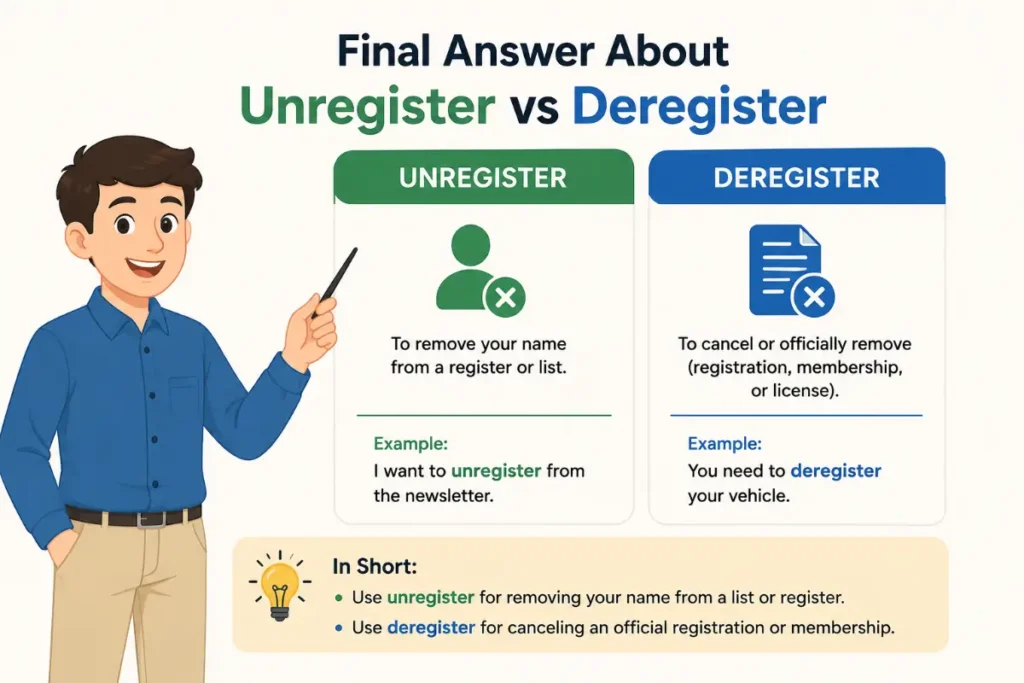
Final Answer About Unregister vs Deregister
The difference between both words are easier than many people think. Unregister usually means removing a person, account, device, or service from an everyday system. Deregister usually means officially removing a business, organization, vehicle, or another legal record from a government or formal register.
When you are talking about apps, websites, computers, or online accounts, unregister is normally the best choice. When you are talking about legal records or government documents, deregister is usually the correct word. The easiest rule to remember is this.
Use unregister for everyday systems.
Use deregister for official records.
Need another quick comparison? Read Carrer or Career: Meaning, Difference, and Examples.
Conclusion
Understanding unregister vs deregister becomes easy once you know where each word is commonly used. Both words describe removing something from a register, but they are used in different situations.
Remember that unregister usually fits technology, online accounts, devices, events, and everyday services. Deregister is more common in business, legal matters, and government records.
Keep this simple takeaway in mind: Use unregister for everyday systems and deregister for official records. That one rule will help you choose the right word with confidence.
Frequently Asked Questions FAQs
What does unregister mean in simple words?
Unregister means to remove a person, device, or account from a normal list or system.
What does deregister mean in simple words?
Deregister means to officially remove something from a government or legal register.
Is unregister or deregister correct?
Both are correct. The right choice depends on the situation.
When should I use unregister?
Use unregister for devices, apps, websites, online accounts, events, and other everyday systems.
When should I use deregister?
Use deregister for companies, organizations, charities, vehicles, and official government records.
Why do people confuse?
People confuse them because both words mean removing something from a register, but they are used in different contexts.
Can I use both words in formal writing?
Yes. Use unregister for general systems and deregister for legal or official documents.
Is deregister more formal than unregister?
Yes. Deregister is generally more formal because it is often used in business and government settings.
