
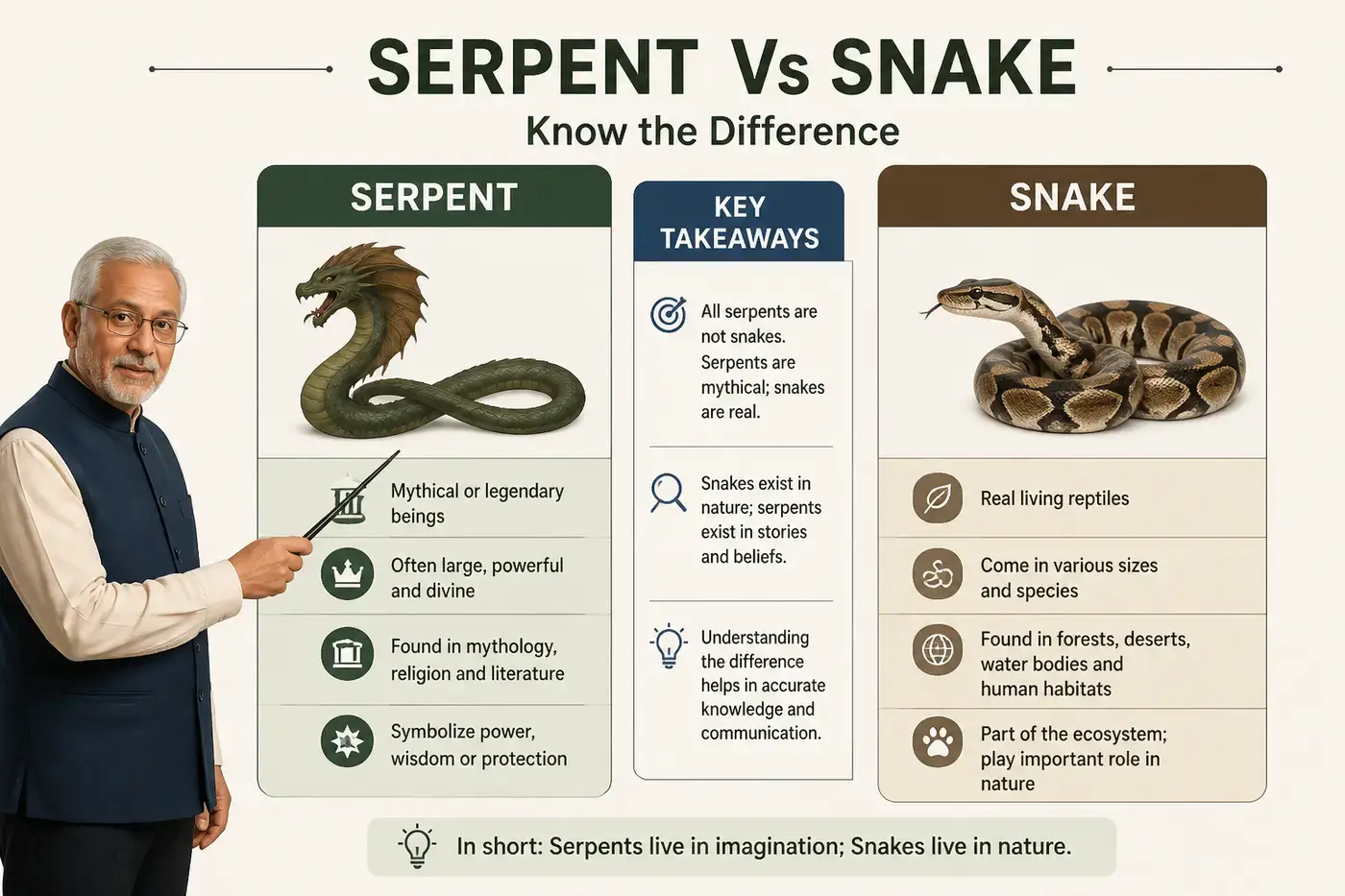
Many people ask about serpent vs snake because both words seem to mean the same thing. You may see snake in everyday conversations, but serpent often appears in stories, religion, and older books. That makes many English learners wonder if there is a real difference.
The good news is that the answer is simple. In most cases, both words describe the same animal. The biggest difference is the style and feeling of the word. Knowing when to use each one will help your English sound more natural.
In this easy guide, you will learn the meaning of words, why people confuse them, when each word is the better choice, and how to use them correctly in daily English.
Still confused? Compare Realist vs Realest: Grammar and Daily Usage Explained.
Simple Answer in One Look
Snake is the common everyday word for the animal.
Serpent is a more formal, literary, or symbolic word for the same animal.
What Serpent Vs Snake Means in Simple English
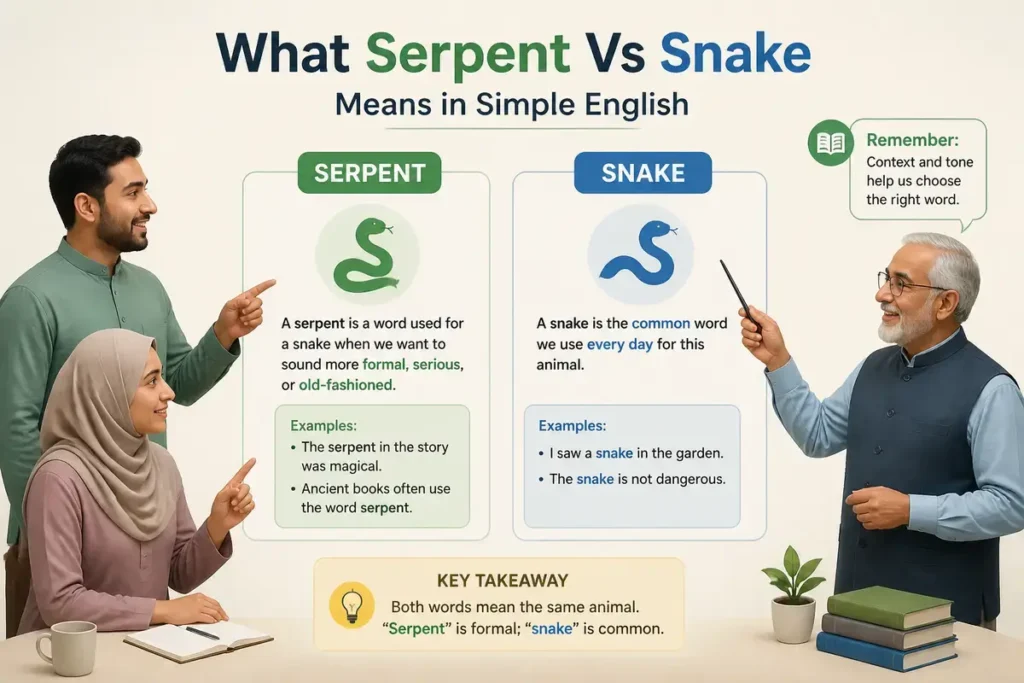
The easiest way to understand both words and it is to think about the situation where you are speaking or writing. A snake is the word people use every day. If you visit a zoo, watch a nature show, or talk about animals with friends, you will almost always hear the word snake. For example:
- I saw a snake in the garden.
- That snake is very long.
- Some snakes are harmless.
These sentences sound normal because snake is the everyday English word. The word serpent also means a snake. The animal itself does not change. The difference is that the word has a different feeling. People often use serpent in:
- Old stories.
- Religious writing.
- Fairy tales.
- Poems.
- Fantasy books.
- Symbolic writing.
For example:
- The serpent spoke to the traveler.
- The ancient serpent guarded the treasure.
These sentences sound more dramatic than everyday speech.
Think about these two examples.
Everyday English
“I found a snake near the river.”
Storytelling
“A giant serpent slept beneath the mountain.”
Both sentences describe the same kind of animal. The second one simply sounds more mysterious. You can also think about it this way.
Snake feels real.
Serpent feels special.
That is why you usually hear snake much more often in daily life.
A Simple Classroom Example
Imagine your teacher shows a picture of a cobra.
During a science class, the teacher says:
“This snake lives in warm places.”
During a literature class, the teacher reads:
“A wise serpent protected the ancient temple.”
The picture could be the same. Only the style of the language changes.
Easy Way to Remember
If you are talking about a real animal, use snake.
If you are writing a story or talking about symbols, serpent may fit better.
This small trick helps many English learners remember the difference.
Why People Mix These Words Serpent Vs Snake
Many people confuse because dictionaries often give the same meaning. When someone looks up serpent, they usually find a simple definition like this:
“A serpent is a snake.”
That is true, but it does not explain how English speakers actually use the words. Here are the biggest reasons people mix them.
They Mean the Same Animal
This is the main reason.
A cobra is a snake.
A python is a snake.
A rattlesnake is a snake.
All of these could also be called serpents in certain types of writing.
The animal stays the same.
Movies And Books Use Serpent
Fantasy movies often use the word serpent because it sounds exciting. Examples include:
- sea serpent
- giant serpent
- ancient serpent
- fire serpent
These phrases create mystery.
In a wildlife documentary, the narrator would usually say snake instead.
Religious Stories Use Serpent
Many famous religious stories use serpent instead of snake. People hear this word from childhood, so they may think it has a completely different meaning. Actually, it still refers to a snake. The older word simply fits the style of the story.
Older English Preferred Serpent
Hundreds of years ago, writers used serpent much more often than people do today.
Modern English became simpler over time.
Now, snake is the normal choice.
They Sound Different
People often believe that longer words have different meanings.
Since serpent sounds older and more formal, learners sometimes think it names a different kind of reptile.
It does not.
Online Articles Can Be Confusing
Some websites say:
- Serpents are dangerous.
- Snakes are harmless.
This is not true.
A serpent can be venomous.
A serpent can be harmless.
A snake can also be venomous or harmless.
The words do not describe danger.
They mainly describe language style.
Clear Difference Explained Simply
Here is the easiest comparison.
| Snake | Serpent |
|---|---|
| Everyday word. | Formal or literary word. |
| Used in normal conversation. | Used in stories and symbolism. |
| Common in science and nature. | Common in myths and religion. |
| Sounds modern. | Sounds older and dramatic. |
| Used by most English speakers daily. | Used much less often in daily speech. |
Here is another simple comparison.
Use Snake When You Are:
- Talking about animals.
- Watching wildlife.
- Speaking with friends.
- Reading science books.
- Writing school reports.
Use Serpent When You Are:
- Reading old stories.
- Writing fantasy.
- Reading religious texts.
- Reading poetry.
- Talking about symbolism.
Visual Memory Trick
Imagine two books.
One is a science textbook.
The other is a fantasy novel.
The science book says:
“The snake hunts at night.”
The fantasy book says:
“The ancient serpent guarded the kingdom.”
This picture helps many students remember the difference.
Which Form Should You Use?
For almost every normal conversation, use snake. That is the safest choice. Native English speakers use snake every day. Examples include:
- I saw a snake.
- That snake is dangerous.
- The snake moved quickly.
- Snakes can live in deserts.
- Some snakes climb trees.
These all sound natural.
Use serpent only when the writing needs a special feeling. For example:
- The golden serpent protected the temple.
- The serpent became a symbol of wisdom.
- A giant serpent appeared from the sea.
These examples sound like stories or legends.
Quick Rule
Talking normally?
Use snake.
Writing creatively?
You can use serpent.
Reading old books?
Expect to see serpent more often.
Is One More Correct?
No.
Both words are correct.
The best choice depends on the kind of writing.
Which Word Sounds More Natural?
In daily American English, snake sounds much more natural.
That is why English learners should use snake most of the time.
Save serpent for special situations.
Easy Real Life Sentences You Can Use Serpent Vs Snake
These examples show how people naturally use each word.
- I saw a snake near the lake yesterday.
- My brother is afraid of snakes.
- The snake hid under the rock.
- The zoo has many different snakes.
- That small snake is not dangerous.
- The old story talks about a magical serpent.
- The brave knight fought a giant serpent.
- The ancient temple showed a carved serpent on its walls.
Notice something simple.
The first five examples sound like everyday life.
The last three sound like stories, legends, or history.
That is the biggest clue when choosing between words.
Practice Exercise
Choose the better word.
“I watched a ______ cross the road.”
Answer:
snake
Now try another.
“The hero defeated the giant ______.”
Answer:
serpent
These simple examples help build confidence.
Where These Words Expression Comes From Simple History
The history of words is surprisingly simple. The word snake comes from very old English. People have used it for hundreds of years in everyday speech. Families, farmers, hunters, and travelers all used this simple word when talking about the animal. The word serpent came into English from older French and Latin words.
Because of that history, it became common in religious writing, old books, and formal literature. Many early English translations of famous stories used serpent because it sounded respectful and elegant. Over time, everyday English became simpler. People began saying snake much more often. Today, both words still exist. Their meanings are almost the same. The biggest difference is the feeling they create.
Snake sounds modern and ordinary.
Serpent sounds classic, symbolic, mysterious, or poetic.
That is why modern wildlife books nearly always use snake, while fantasy novels and ancient legends often choose serpent instead. As you continue learning English, you will notice that understanding is not about learning two different animals. It is about understanding how words can carry different feelings, styles, and meanings in different situations. In the next section, we will look at how these words appear in culture, stories, symbolism, religion, and everyday expressions so you can recognize them with confidence wherever you read them.
How Serpent Vs Snake Is Understood in Culture and Stories
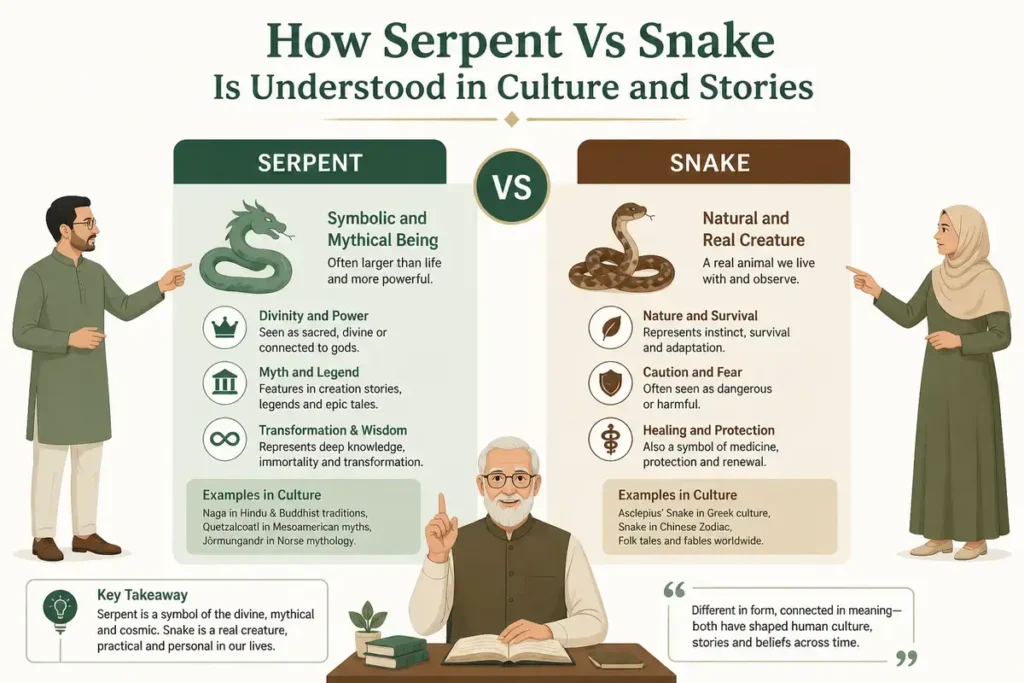
The words may describe the same animal, but they can create different feelings in stories. In everyday life, people usually say “snake.” It is the normal word for the animal you might see in nature, at the zoo, or on a farm. In stories, many writers choose the word “serpent.” It sounds older, more mysterious, and more powerful. That is why you often see it in fairy tales, legends, and fantasy books. For example, a children’s story may say:
“The giant serpent lived inside the dark cave.”
A science book would probably say:
“The snake lives in forests and grasslands.”
Both sentences talk about the same kind of animal. The writer simply wants a different style. Different cultures also tell stories about snakes and serpents. In some stories, they are wise. In some, they protect special places. they represent danger or temptation.
Some cultures even see them as symbols of healing or new life because snakes shed their skin and seem to become new again. This shows that the meaning often depends on the story, not the animal itself. When reading English books, remember that the word “serpent” often tells you the writer wants to create a stronger picture in your mind.
Still confused? Compare Contractor vs contracter: Correct Spelling and Meaning (2026).
Biblical And Mythological Meaning Of Serpent Vs Snake
The topic of both words often appears in religion and mythology. In many English Bible translations, the word “serpent” is used instead of “snake.” This is one reason the word feels older and more formal. In the story of Adam and Eve, the serpent is the creature that speaks in the Garden of Eden. Because of this story, many people connect the word “serpent” with temptation or evil.
Other Bible passages also use the word serpent in different ways. Sometimes it represents danger. Sometimes it represents wisdom. The meaning depends on the passage. In mythology from different parts of the world, serpents can have many meanings.
Some giant serpents protect rivers.
Some are powerful magical creatures.
Not every mythical serpent is bad.
Many ancient stories describe serpents as wise, strong, or connected to the earth. The word “snake” can also appear in modern retellings of these stories, but “serpent” is still the more common choice because it matches the older style. The main point is simple. In religion and mythology, the choice of word is usually about tradition and storytelling, not about a different animal.
Symbolism Explained In Simple Words
People often ask about the hidden meaning behind words. The answer is easier than many people think. Both words can represent ideas, feelings, or life lessons. The meaning changes with the story.
What Serpent Represents
A serpent often represents something larger than an ordinary animal.
It may stand for:
- Mystery.
- Ancient wisdom.
- Power.
- Change.
- Temptation.
- Magic.
- Hidden knowledge.
That is why fantasy books often choose the word serpent.
The word creates a strong image before the story even begins.
What Snake Represents
A snake usually represents the real animal. People often think about:
- Wildlife.
- Nature.
- Survival.
- Caution.
- Fear.
- Beauty.
- Different kinds of reptiles.
In daily English, the word snake usually has no hidden meaning unless the writer clearly adds one.
Simple Comparison
Think about these two sentences.
“The snake crossed the road.”
This simply describes an animal.
“The ancient serpent guarded the lost city.”
This creates mystery and imagination.
That is the easiest way to remember the symbolic difference.
Related Words You Should Know About Serpent Vs Snake
Learning a few related words makes much easier.
Reptile
A snake is a reptile. Lizards, turtles, and crocodiles are reptiles too.
Cobra
A cobra is one type of snake known for its hood.
Python
A python is a large snake that squeezes its prey.
Viper
A viper is a venomous snake found in many parts of the world.
Boa
A boa is another large snake that wraps around its prey.
Serpentine
This word means twisting like a snake. Example:
“The road followed a serpentine path.”
Venom
Venom is the harmful liquid that some snakes use to defend themselves or catch food.
Slither
Slither means to move smoothly along the ground like a snake. Example:
“The snake slithered into the grass.”
Shed Skin
Snakes shed their skin as they grow.
People sometimes use this idea as a symbol of a fresh start.
How People Actually Use it In Daily English
Most English speakers use the word “snake” almost every day if they need to talk about this animal. Here are some natural examples.
- I saw a snake in my backyard.
- Don’t touch that snake.
- My little brother is scared of snakes.
- We learned about snakes in science class.
- That snake moved very fast.
- The zoo has many kinds of snakes.
- The movie showed a giant serpent guarding the cave.
- The old legend tells the story of a golden serpent.
- The game has a magic serpent as the final enemy.
- The artist painted a beautiful serpent around the tree.
Notice something interesting.
The first six examples use “snake” because they describe normal life.
The last four use “serpent” because they sound creative, historical, or magical.
That pattern is very common in English.
Common Mistakes People Make
Many English learners make the same small mistakes.
Here are the most common ones.
Mistake One
Thinking serpent and snake are different animals.
Correct answer:
They usually mean the same animal.
Mistake Two
Using serpent in everyday conversation.
Less natural:
“I found a serpent in my garage.”
More natural:
“I found a snake in my garage.”
Mistake Three
Thinking snake cannot appear in stories.
Correct answer:
It can.
Many modern stories simply use the word snake because it sounds more natural.
Mistake Four
Thinking every serpent is evil.
Correct answer:
Not true.
Some stories show serpents as wise, protective, or magical.
Mistake Five
Believing serpent is always the better word.
Correct answer:
No.
Most everyday conversations use snake.
Use serpent only when the style calls for it.
Final Teacher Explanation Of Serpent Vs Snake
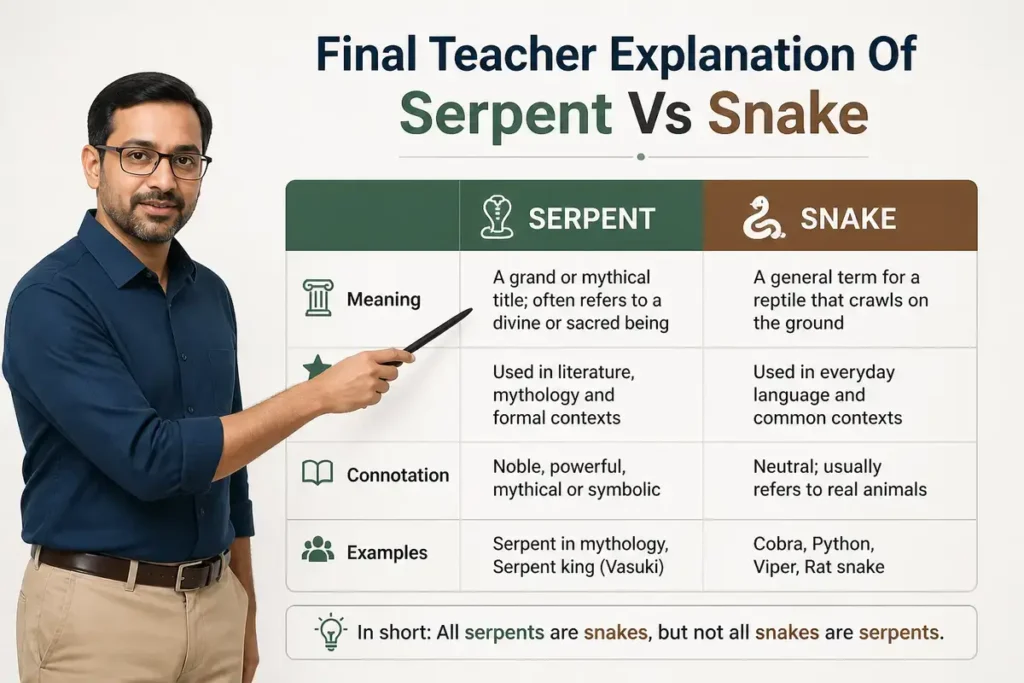
Now you know the real meaning of both words.
The two words usually describe the same animal.
The biggest difference is not the animal.
The biggest difference is the feeling of the word.
If you are talking with friends, writing about nature, or learning science, choose the word “snake.” It sounds natural because that is what native English speakers usually say. If you are reading old stories, fantasy books, poems, or religious writing, you will often see the word “serpent.”
It gives the writing a deeper and more dramatic feeling. A simple classroom trick can help you remember. If the sentence sounds like real life, use “snake.” If the sentence sounds like a legend, an old story, or a magical adventure, “serpent” is often the better choice. Once you remember this simple rule, choosing between becomes easy.
Final Answer Quick Recap
The answer is simple. Both words usually mean the same animal. Use “snake” for everyday English and real-life conversations. Use “serpent” in stories, religion, mythology, poetry, or writing that needs a stronger and more dramatic style.
Many readers also check Carrer or Career: Meaning, Difference, and Examples.
Conclusion
Understanding is much easier than it first appears. Both words usually describe the same animal, but they are used in different ways. “Snake” is the natural choice for everyday English, science, and normal conversations. “Serpent” is more common in stories, mythology, religious writing, and other places where the writer wants to create a stronger or more mysterious feeling. Once you remember that the difference is mainly about style instead of meaning, you will know exactly which word to choose in every situation.
Frequently Asked Questions
What does mean in simple words?
Both words usually mean the same animal. Snake is the common everyday word, while serpent sounds more formal or literary.
Is serpent or snake more correct?
Both are correct. The best choice depends on your sentence and writing style.
When should I use serpent instead of snake?
Use serpent in stories, myths, poems, fantasy books, or religious writing. Use snake in normal conversation.
Why do people get confused?
People see both words used for the same animal. The different writing styles make them seem like different creatures.
Can I use both words in writing?
Yes. Choose snake for simple and modern writing. Choose serpent for dramatic or symbolic writing.
Is every serpent poisonous?
No. The word serpent does not describe venom. It is simply another word for a snake in many situations.
Why does the Bible often use the word serpent?
Many English Bible translations use the older word serpent because it matches the traditional style of the text.
Do native English speakers say serpent every day?
No. Most native speakers almost always say snake in everyday conversations.
