
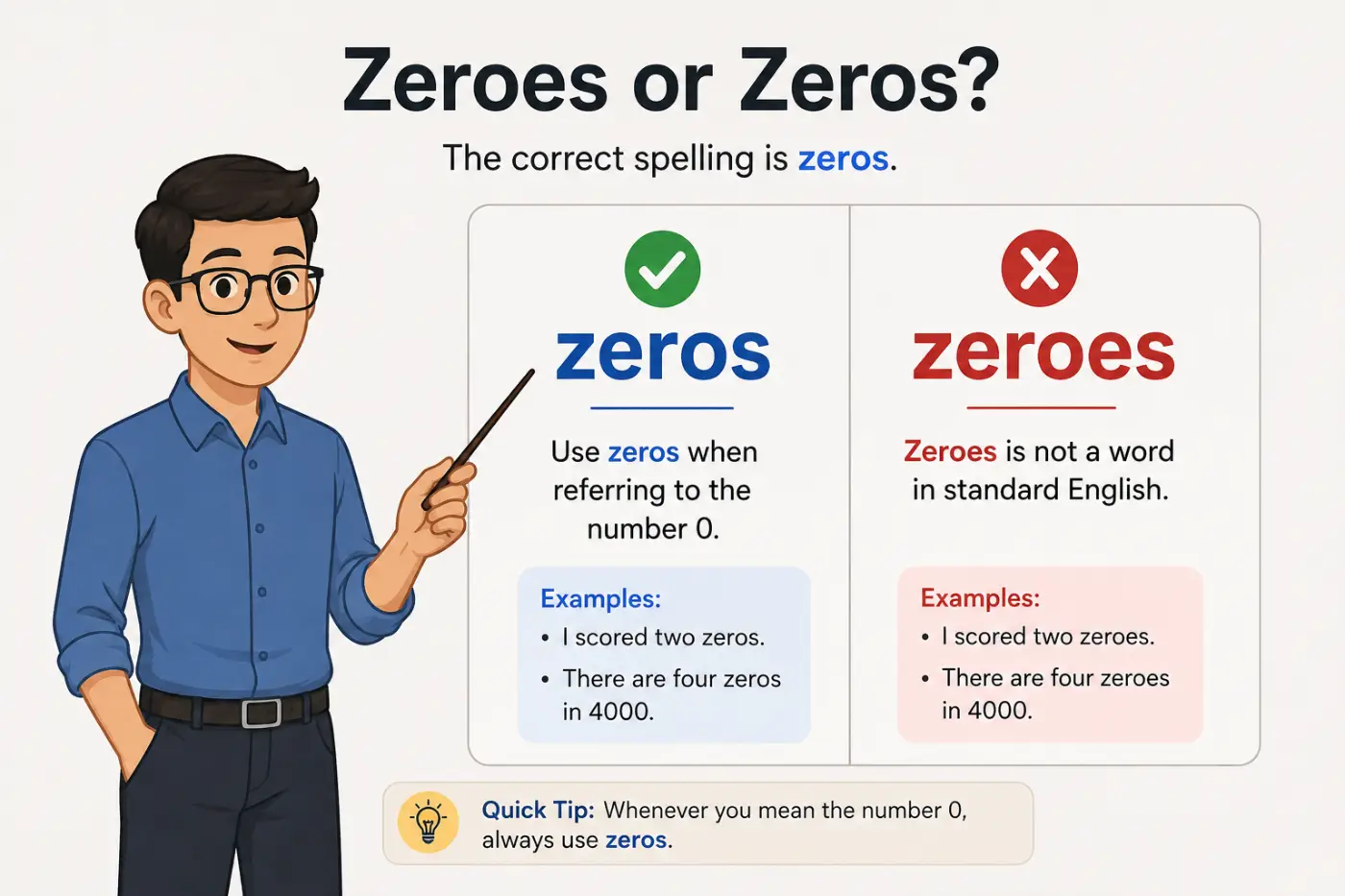
Many people wonder about zeroes or zeros because both spellings appear in books, websites, and everyday writing. The short answer is that both forms are correct. The difference depends on the style of English being used and the situation where the word appears.
The word refers to the plural form of the number zero. When you talk about more than one zero, you can use either spelling. For example, you can say “The number has three zeros” or “The number has three zeroes.”
Most modern English speakers use “zeros” more often, especially in American English. However, “zeroes” is still accepted and can be found in many types of writing. Understanding this small difference helps you choose the right form with confidence.
Learn the difference in Time Flies or Time Flys: Which Is Correct and Why (2026)?.
Simple Answer in One Look
Both words are correct spellings.
“Zeros” is more common today, especially in American English, while “zeroes” is also accepted.
What Zeroes Or Zeros Means in Simple English
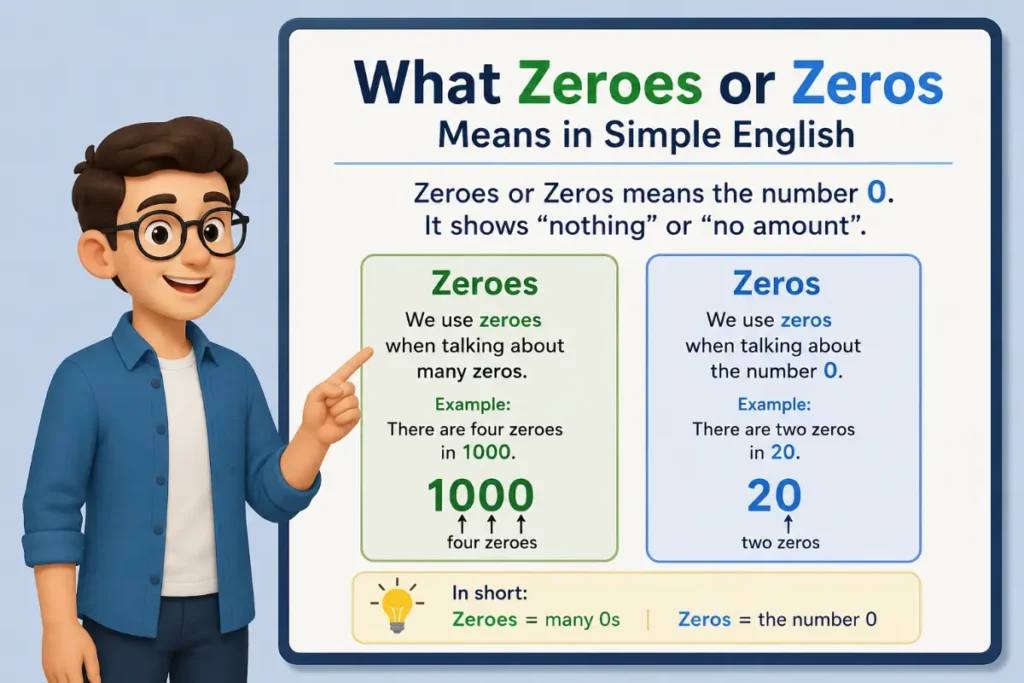
The word zero means the number 0. It represents nothing, no amount, or an empty value. When you have more than one zero, you need a plural form. A plural form simply means you are talking about two or more things.
For example:
- One zero.
- Two zeros.
- Five zeros.
The question comes because English has two accepted spellings:
- Zeros.
- Zeroes.
Both mean the same thing. They do not have different meanings.
Think of it like other words that have more than one accepted form. English changes over time, and some words keep different spelling options. For most daily writing, “zeros” is the easiest and most common choice.
Example:
“The password contains three zeros.”
This sentence means the password has the number 0 written three times.
The spelling “zeroes” can also be used:
“The computer displays extra zeroes on the screen.”
The meaning stays the same.
Why People Mix These Words
People often confuse because English usually follows simple spelling patterns, but zero does not follow the pattern everyone expects. Many people learn that when a word ends with “o,” adding “es” can make it plural.
For example:
- Tomato becomes tomatoes.
- Potato becomes potatoes.
- Hero becomes heroes.
Because of this pattern, some people naturally think:
Zero + es = zeroes.
That idea makes sense. It follows a common English pattern.
However, English has many words that do not follow one simple rule. Some words ending in “o” take only “s.”
Examples:
- Photo becomes photos.
- Piano becomes pianos.
- Video becomes videos.
The word zero can follow both styles.
This is why people see both in writing. Another reason for confusion is that people may see different versions depending on where they live. American English usually prefers “zeros,” while some writers and dictionaries still recognize “zeroes.” People also confuse the word because zero has different uses.
Zero can be:
- A number in mathematics.
- A score in a game.
- A temperature point.
- A value in computer programming.
The plural spelling remains the same in all these situations.
Examples:
“The player scored two zeros.”
“The scientist recorded three zeros in the data.”
“The program added extra zeros to the code.”
Clear Difference Explained Simply
The difference between words are not about meaning. It is mainly about spelling preference.
| Word | Meaning | Common Use |
|---|---|---|
| Zeros | More than one zero | Most common modern spelling |
| Zeroes | More than one zero | Correct but less common |
Both words describe multiple number 0 symbols.
Here are simple examples:
- The number 100 has two zeros.
- The number 1000 has three zeros.
- The calculator showed several zeroes after the calculation.
All of these sentences are understandable.
The main difference is frequency.
“Zeros” appears more often in modern American writing. It is shorter and looks simpler.
“Zeroes” follows the spelling pattern used with some other words ending in “o.”
Neither spelling is wrong.
Which Form Should You Use?
If you are writing in American English, “zeros” is usually the best choice.
It is simple, common, and widely accepted.
Use “zeros” in:
- School writing.
- Business writing.
- Emails.
- Online content.
- Everyday conversations.
Examples:
“The answer contains two zeros.”
“The bank account showed three zeros after the decimal point.”
“The player received three zeros on the scoreboard.”
You can use “zeroes” if you prefer it or if you are following a writing style that uses it.
Example:
“The old document had several zeroes written by hand.”
Better:
“The code has five zeros.”
Consistency makes your writing look cleaner.
Easy Real Life Sentences You Can Use
Here are simple sentences using both forms.
- The phone number has two zeros in the middle.
- My password starts with three zeros.
- The score was zero after the first round.
- The computer added extra zeros to complete the number.
- The machine showed several zeroes on the display.
- The price changed from 100 dollars to 1,000 dollars because more zeros were added.
- The teacher explained why zeros are important in mathematics.
- The scientist removed unnecessary zeroes from the data.
These examples show that both spellings work naturally.
Difference Between In American English
American English usually prefers “zeros.”
Many modern dictionaries and writing guides list “zeros” as the more common plural form.
This is because English speakers often choose shorter spellings when both options are accepted.
For example:
- Photos instead of photoes.
- Videos instead of videoes.
However, “zeroes” has not disappeared. Some writers still use it because it follows a traditional spelling pattern.
The choice depends on the style you want.
For simple everyday writing, choose:
“Zeros.”
For a more traditional spelling style, “zeroes” is still acceptable.
How To Use Correctly
The easiest way to use the word correctly is to remember one simple idea:
When you mean more than one number 0, both spellings work.
Examples:
Correct:
“The number has four zeros.”
Correct:
“The number has four zeroes.”
Incorrect:
“The number has four zero.”
The last sentence is wrong because “four” means more than one, so the plural form is needed.
Another point to remember is that zero can also act as a verb.
When zero means to adjust or focus something exactly, the verb form is usually “zeroes.”
Example:
“The pilot zeroes the equipment before the flight.”
Here, “zeroes” does not mean multiple number 0 symbols. It means the action of setting something to zero or making it accurate.
This is a different use of the word.
Compare:
Plural noun:
“The report contains many zeros.”
Verb:
“She zeroes the scale before measuring.”
The meaning comes from the way the word is used in the sentence.
Where Zeroes Or Zeros Word Comes From Simple History
The word zero has a long history connected with mathematics. The idea of zero developed from ancient number systems. The concept became especially important through Indian mathematicians who helped develop the use of zero as a number. Later, the idea spread to other parts of the world and became a major part of modern mathematics.
The English word “zero” came through languages such as Italian and Arabic. Over time, it became the common English name for the number 0. As the word became more common, people needed a plural form. This created the two accepted spellings:
- Zeros.
- Zeroes.
Quick Memory Trick
Remember this simple rule:
If you are talking about more than one number 0, use “zeros” in most situations.
Example:
“Add two zeros to the number.”
If you are following an older spelling style, “zeroes” is also fine.
Example:
“The page contains several zeroes.”
The meaning does not change.
The spelling choice is small, but knowing the difference helps your English look more natural.
Many readers also check Contractor vs contracter: Correct Spelling and Meaning (2026).
Transition To Deeper Meaning And Usage
Now that the basic difference between words are clear, it is helpful to look at how this word appears in culture, numbers, technology, and everyday communication. The meaning of zero goes beyond just a number because it represents ideas like emptiness, balance, starting points, and possibilities. Understanding these uses can make your vocabulary stronger and your writing more accurate.
How Zeroes Or Zeros Word Is Understood in Culture and Stories
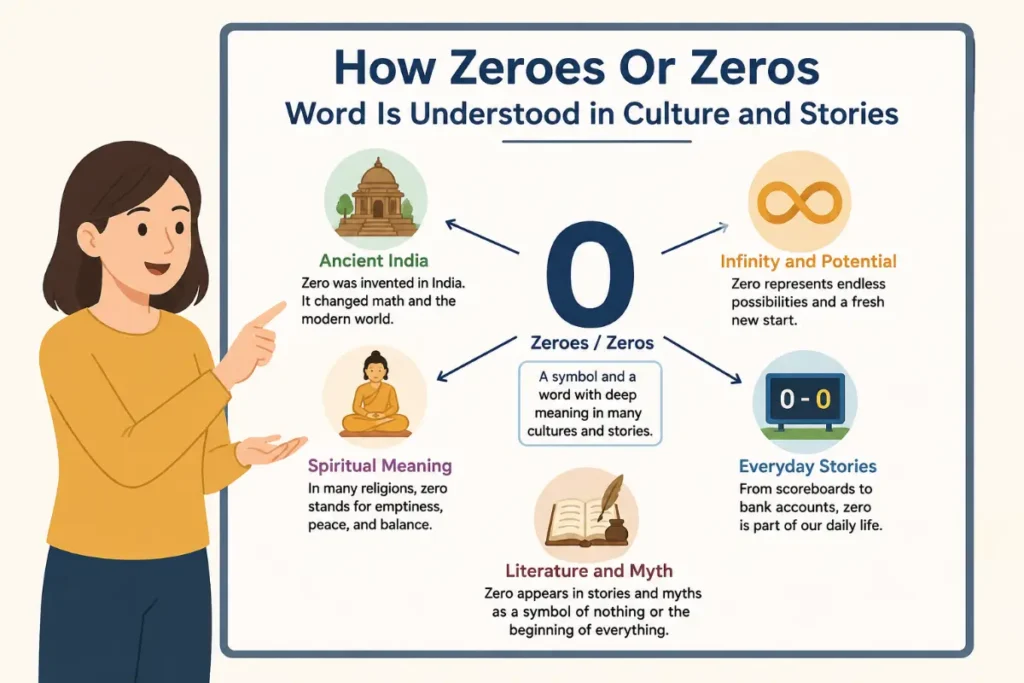
The idea of zero is more than just a number. People often connect zero with ideas like nothing, a fresh start, balance, and unlimited possibilities. In everyday life, people use zero to describe a beginning point. For example, when a runner starts a race, the timer may begin at zero. When a new project starts, people may say they are starting from zero.
The word also appears in stories and common expressions. Someone may say, “I started from zero,” which means they had nothing at the beginning but worked hard to build something. Zero can also represent a clean beginning. A person who makes a new plan after a mistake may feel like they are starting from zero again.
The plural forms appear when people talk about more than one zero. For example, a story about money may mention “many zeros” because large numbers often contain several zeros. In movies, books, and conversations, zero is sometimes used to show emptiness or a lack of something.
Examples:
- “The team had zero chances to win.”
- “The account balance showed three zeros.”
- “He started from zero and became successful.”
These uses show that zero is not only a math symbol. It has become part of everyday language and human experiences.
Biblical and Mythological Meaning
Zero does not have a direct meaning in most traditional biblical texts because the number system used in ancient biblical times was different from modern mathematics. However, the idea behind zero can connect with some simple themes found in many religious and cultural stories.
Zero can represent emptiness, humility, and the beginning of something new. Many stories talk about moments when a person has nothing and then grows through faith, effort, or change. In some traditions, nothingness is seen as a starting point before creation or transformation. The idea is that something meaningful can come from an empty beginning.
In mythology, many stories include ideas of cycles, endings, and new beginnings. Zero can symbolically connect with these ideas because it represents a point where something starts again. These meanings are symbolic, not direct definitions. The number zero itself is mainly a mathematical concept, but people often give numbers deeper meanings through stories and culture.
Symbolism Explained in Simple Words
Zero has many symbolic meanings depending on how people use it.
It can represent:
- A fresh start.
- A complete cycle.
- Nothing or emptiness.
- Balance.
- Unlimited possibilities.
The spelling difference between does not change the symbolic meaning. Both forms refer to the same idea when they mean multiple number 0 symbols.
What One Version Represents
The spelling “zeros” often represents the modern and simple style of English writing.
Because “zeros” is shorter and more common, many people connect it with modern communication, technology, and everyday language.
Examples:
- Computer systems use zeros and ones.
- Digital information contains many zeros.
- Modern data often includes zeros in large numbers.
The word “zeros” feels natural in common conversations because it is the form most people see today.
What The Other Version Represents
The spelling “zeroes” represents a traditional spelling style.
Some people choose “zeroes” because it follows the pattern of adding “es” to certain words that end with “o.”
For example:
- Hero becomes heroes.
- Potato becomes potatoes.
- Tomato becomes tomatoes.
Because of this pattern, some writers feel “zeroes” looks more complete.
However, the meaning remains the same. The spelling choice does not create a different idea.
Related Words You Should Know Zeroes Or Zeros
Learning related words helps you understand zero better.
Zero
Zero means the number 0. It shows no amount or nothing. Example:
“The answer was zero.”
Zeros
Zeros means more than one zero. It is the most common plural spelling. Example:
“The number has four zeros.”
Zeroes
Zeroes is another correct plural spelling of zero. Example:
“The document contains several zeroes.”
Nothing
Nothing means no thing or no amount. Example:
“There is nothing in the box.”
Empty
Empty means something has nothing inside. Example:
“The bottle is empty.”
Beginning
Beginning means the start of something. Example:
“The project is at the beginning stage.”
Starting Point
A starting point is the place where something begins. Example:
“Zero is the starting point on the number line.”
Decimal
A decimal is a number system that can include numbers after a point. Example:
“The price includes two decimal places.”
Digit
A digit is a single number symbol from 0 to 9. Example:
“Zero is one of the ten digits.”
Double Zero
Double zero means two zeros together. Example:
“The code begins with double zero.”
How People Actually Use Zeroes Or Zeros in Daily English
People use zero and its plural forms in many normal situations.
Here are real examples:
- The phone number has two zeros at the end.
- My password contains three zeros.
- The score was zero after the first half.
- The machine showed five zeros on the screen.
- The temperature dropped to zero degrees.
- The company started with zero customers.
- The calculator displayed extra zeros.
- The account balance had several zeros after the decimal point.
- The teacher explained why zeros are important in mathematics.
- The computer program added zeros to complete the number.
In spoken English, people usually say “zeros” because it sounds shorter and more natural.
For example:
“I need to add two zeros to this number.”
This sounds more common than:
“I need to add two zeroes to this number.”
Both are correct, but the first one is used more often.
Common Mistakes People Make
Many learners make small mistakes. These mistakes are easy to fix.
Mistake 1: Thinking Only One Spelling Is Correct
Some people believe “zeros” is correct and “zeroes” is wrong.
Correction:
Both forms are correct.
Mistake 2: Using Zero Instead Of The Plural Form
Incorrect:
“The number has three zero.”
Correct:
“The number has three zeros.”
When you talk about more than one, use the plural form.
Mistake 3: Mixing Both Forms In One Sentence
Incorrect:
“The code has two zeros and three zeroes.”
Better:
“The code has five zeros.”
Using one spelling keeps your writing clear.
Mistake 4: Confusing The Plural Noun And Verb Form
Example:
“The teacher zeroes the scale.”
Here, “zeroes” means an action.
But:
“The scale shows three zeros.”
Here, “zeros” means multiple number symbols.
The meaning depends on the sentence.
Mistake 5: Thinking Zero Means Always Nothing
Zero can mean different things.
It can mean:
- No amount.
- A starting point.
- A number value.
- A position on a scale.
The context explains the meaning.
Final Teacher Explanation About Zeroes Or Zeros
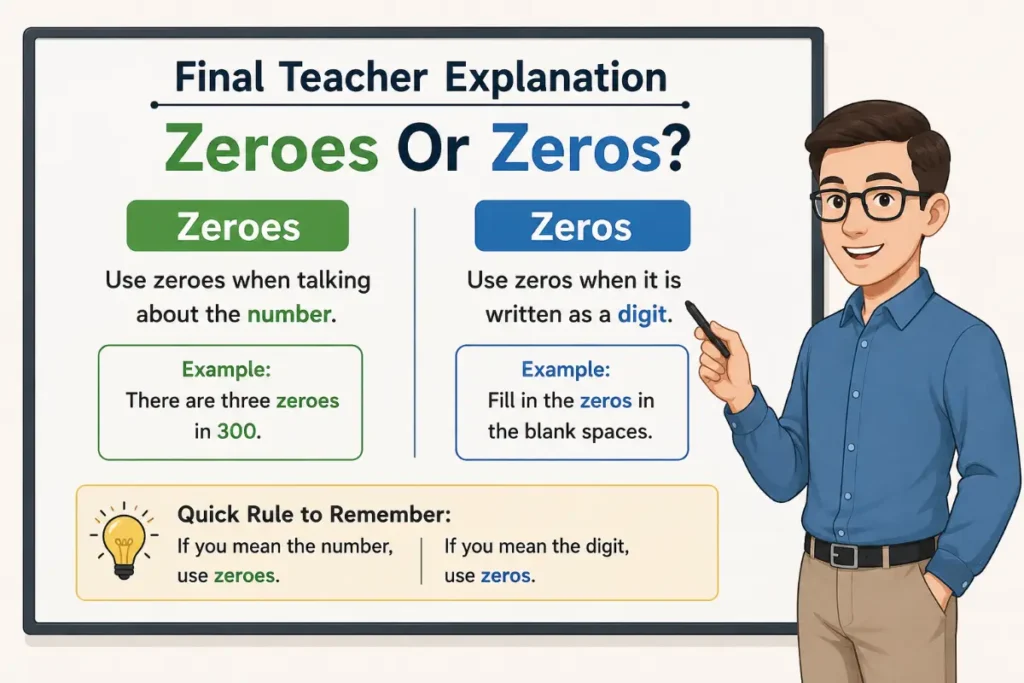
As your English teacher, the easiest way to remember: Both spellings are correct. When you are talking about more than one number 0, you can use. However, “zeros” is the spelling you will see most often in modern American English. For daily writing, school work, emails, and online content, “zeros” is usually the best choice because it is simple and familiar.
The word zero itself is very important because it helps us understand numbers, technology, money, and many parts of daily life. Remember that spelling differences do not always mean different meanings. Sometimes English allows more than one correct form. The most important thing is to use the word clearly and consistently.
Final Answer About Zeroes Or Zeros Quick Recap
The answer about words are simple. Both spellings are correct and both mean more than one zero.
“Zeros” is the more common spelling, especially in American English. “Zeroes” is also accepted and follows a traditional spelling pattern.
If you are unsure, choose “zeros.” It is simple, modern, and widely used.
Many readers also check Afterward vs Afterword: Complete English Guide 2026.
Conclusion
The difference between is only a spelling choice. Both words have the same meaning when they describe more than one zero.
Most people use “zeros” in everyday American English because it is shorter and more common. However, “zeroes” is still correct and can appear in different types of writing.
The easy takeaway is this: when you talk about more than one number 0, both are correct, but zeros is the form you will usually see.
Frequently Asked Questions FAQs
What does zero mean in simple words?
Zero means the number 0. It shows no amount or nothing.
Is it correct to use?
Yes. Both spellings are correct for the plural form of zero.
Which is more common?
Zeros is more common, especially in American English.
Why do people get confused?
People get confused because both spellings are accepted and English has different plural patterns.
Can I use both forms in writing?
Yes, but it is better to choose one form and use it consistently.
Are these different words?
No. They have the same meaning when they refer to multiple zeros.
When should I use zeros?
Use zeros in normal writing, school work, business writing, and everyday conversations.
Is zeroes wrong in American English?
No. Zeroes is still a correct spelling, but it is less common.
