
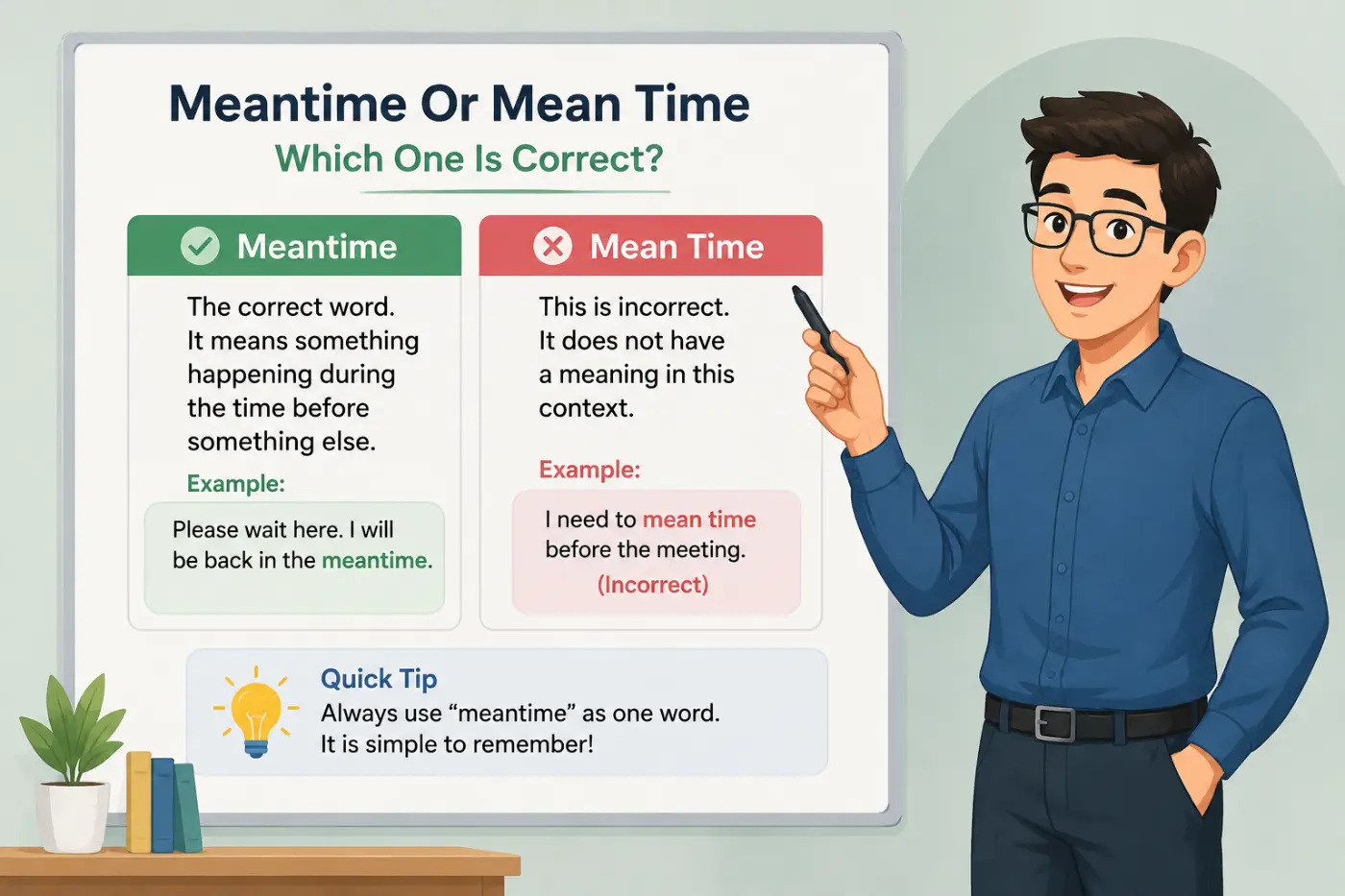
Many English learners get confused about meantime or mean time because both forms look almost the same. The good news is that both are real English. The difference is how they are used. Once you learn one simple rule you will know which one fits your sentence.
If you are asking about words the short answer is this. Meantime is usually one word and is much more common in modern English. Mean time is usually written as two words only in a few special situations or older writing.
This guide explains everything in very simple English. You will learn the meaning the difference easy examples common mistakes and the simple rule that helps you choose the correct form every time.
You may also want to read Holistic or Wholistic: Difference Explained Simply(2026).
Simple Answer In One Look
Meantime is the normal spelling in modern English.
Mean time as two words is much less common and is mainly seen in technical or older uses.
If you are not sure choose meantime.
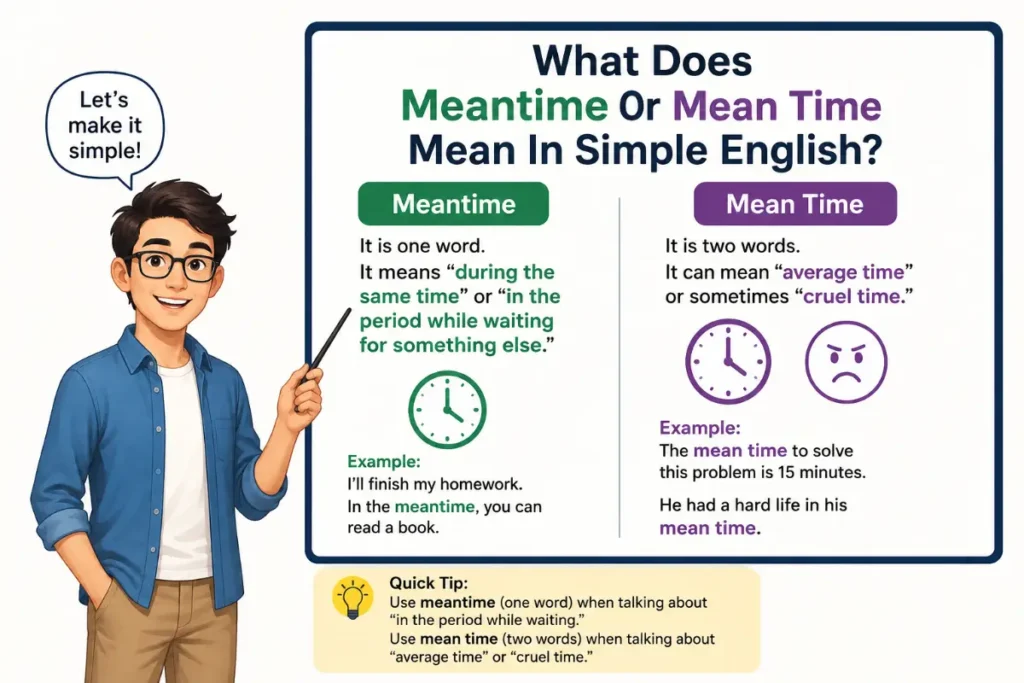
What Does Meantime Or Mean Time Mean In Simple English
The word meantime means the period between two events. It tells us that something happens while we are waiting for something else.
Think of it as saying:
- During that time.
- Until then.
- While waiting.
Here are a few simple examples.
- Dinner will be ready soon. In the meantime we can play a game.
- The doctor will see you in ten minutes. Meantime please have a seat.
- My new phone will arrive tomorrow. In the meantime I will use my old one.
In every example there is a waiting period. Something else happens during that waiting period.
The two word form mean time does not usually carry this everyday meaning. Most people writing normal English will use meantime instead.
One Simple Rule
If you mean the time between two events write meantime.
If you are writing about a special technical phrase or quoting older writing you may see mean time.
For everyday English choose meantime.
Why Do People Mix These Words
Many words in English change over time. Some words that were once written as two separate words later became one word. That is exactly what happened with meantime.
People still see mean time in some books websites and technical subjects. Because both spellings exist many learners think they are always interchangeable. Another reason is pronunciation. When people speak they sound almost the same.
For example:
- Wait here. In the meantime I will call your brother.
- Wait here. In the mean time I will call your brother.
You hear almost no difference. That makes the spelling confusing.
Some learners also compare it with words like these.
- Anytime and any time.
- Everyday and every day.
- Maybe and may be.
- Sometime and some time.
These pairs look alike but they have different uses. works in a similar way.
Clear Difference Explained Simply
Here is the easiest way to remember the difference.
| Meantime | Mean time |
|---|---|
| One word | Two words |
| Common in modern English | Rare in everyday English |
| Means the time between two events | Mostly used in special technical phrases or older writing |
| Best choice for daily writing | Usually not needed in normal conversations |
Look at these examples.
Correct:
- In the meantime I finished my homework.
- The bus will come soon. Meantime we can wait inside.
- She was cooking. In the meantime I cleaned the table.
Less common:
- Engineers discussed the mean time between failures.
- The report mentioned mean time in a technical measurement.
Notice something important.
In technical writing mean time often appears as part of a longer phrase instead of standing alone.
For example:
- Mean Time Between Failures.
- Mean Time To Repair.
These are technical terms used by engineers and computer experts.
Outside those situations meantime is almost always the better choice.
Which Form Should You Use
For almost every school paper email text message blog post or conversation use meantime.
Follow these simple rules.
- If you mean during the waiting period use meantime.
- If you write the expression in the meantime use one word.
- If you are writing normal American or British English choose meantime.
- Use mean time only if you are writing a special technical phrase that officially uses two words.
Here are more examples.
Correct:
- In the meantime keep practicing.
- Meantime I will finish the report.
- We are waiting for the rain to stop. In the meantime we can read.
Technical:
- The machine has a high mean time between failures.
- The company reduced the mean time to repair broken equipment.
The simple rule is easy.
If you are talking about everyday life write meantime.
Is In The Meantime Correct
Yes.
In the meantime is one of the most common English expressions.
It means during the waiting period before something else happens.
Examples:
- Your food will be ready soon. In the meantime please enjoy a drink.
- I am saving money. In the meantime I will not buy a new car.
- School starts next month. In the meantime enjoy your vacation.
- The movie begins at seven. In the meantime we can have coffee.
- She is finishing her project. In the meantime I will answer emails.
You will hear this expression every day in conversations movies television and books.
Can You Say Meantime Without In The
Yes.
You can use meantime by itself especially at the beginning of a sentence.
Examples:
- Meantime everyone stayed calm.
- Meantime the children played outside.
- Meantime the workers finished the job.
- Meantime nothing had changed.
- Meantime we continued our trip.
This style is correct but less common than in the meantime.
Easy Real Life Sentences You Can Use Meantime Or Mean Time
These examples sound natural in everyday American English.
- I will cook dinner. In the meantime please set the table.
- The teacher is printing the papers. In the meantime read chapter three.
- Our flight is delayed. In the meantime we will have lunch.
- She is getting ready. In the meantime I will wash the dishes.
- The game starts at eight. In the meantime we can take a walk.
- My computer is updating. In the meantime I will answer my messages.
- We are waiting for the rain to stop. In the meantime the kids are playing inside.
- He is fixing the bike. Meantime I will clean the garage.
These examples show how naturally meantime fits into daily conversation.
Where This Word Expression Comes From Simple History
The word meantime has been part of English for hundreds of years. Long ago writers often separated many words that are now written together. Over time English changed. One word forms became more common.
That is why modern dictionaries usually list meantime as the standard spelling for the time between two events.
The two word form mean time stayed alive in some technical fields because it became part of official engineering terms.
So both forms survived but they developed different jobs.
Today most people use meantime when talking about everyday life.
Engineers and technology professionals still use mean time inside fixed technical expressions.
As English continues to change modern writing strongly favors the one word spelling for general use. The simple rule has stayed the same. If you are talking about the period between two events write meantime. Save mean time for technical phrases where those two words are officially part of the name.
Understanding this small difference will make your writing clearer and more natural. In the next section you will learn how meantime is understood in culture stories everyday communication common expressions related words and the mistakes people make most often before mastering this expression with complete confidence.
Learn the difference in Zeroes Or Zeros: Which Is Correct Simple Answer (2026).
How Is Understood In Culture And Stories
The idea behind appears in many stories even when the exact words are not used. It is the idea of waiting with hope. Many stories have a time when a person cannot move forward until something happens. During that waiting period life still goes on.
A student waits for exam results. In the meantime the student keeps studying.
A family waits for a loved one to return home. In the meantime they continue their daily life.
This simple idea appears in stories from many countries. People often learn patience during the waiting time. They also learn that every day has value even if they are waiting for something important. That is why the expression in the meantime feels natural and comforting. It reminds us that life does not stop while we wait.
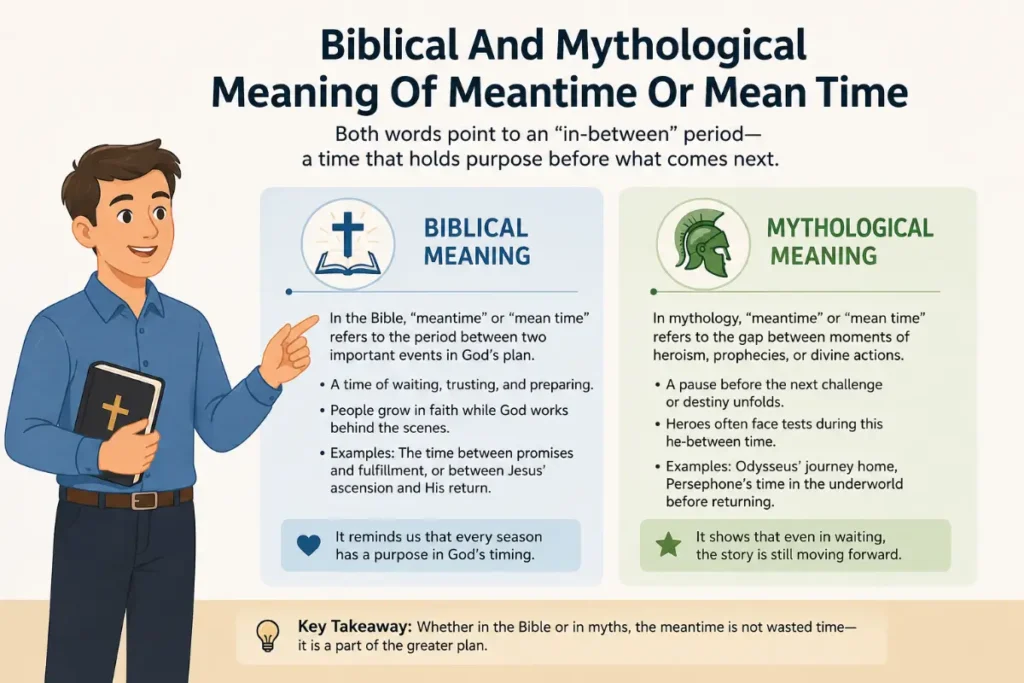
Biblical And Mythological Meaning Of Meantime Or Mean Time
There is no special biblical meaning. The Bible does not teach a special lesson about this expression itself. Still many Bible stories include the idea of waiting with faith.
People waited for answers to prayers.
People waited for a better future.
During those waiting times they continued to live serve and trust. The same idea appears in many old myths and legends. Heroes often wait before the next part of their journey begins. During that waiting period they grow stronger wiser or kinder. So while meantime is not a religious word it can remind people that waiting is often part of life.
Symbolism Explained In Simple Words
What Meantime Represents
In everyday English meantime represents the space between two moments.
It often suggests:
- Patience.
- Hope.
- Progress.
- Daily life moving forward.
- Making good use of waiting.
For example if someone says “In the meantime keep practicing” the message is positive. It means do not waste your time while you wait.
What Mean Time Represents
The two word form mean time usually represents something different.
In technical English it often refers to measuring time for machines systems or equipment.
Examples include:
- Mean Time Between Failures.
- Mean Time To Repair.
- Mean Time To Recovery.
Here the focus is not on people or emotions. It is about numbers measurements and performance.
This simple difference makes the choice easy.
Meantime usually represents everyday life.
Mean time usually represents technical measurements.
Related Words You Should Know
Learning related words makes much easier to understand.
Meanwhile
This means at the same time or during the waiting period. It is very close in meaning to meantime. Example:
Meanwhile everyone enjoyed dinner.
Until Then
This means before another event happens. Example:
Until then keep working hard.
During
This means throughout a period of time. Example:
Do not talk during the movie.
While
This shows that two actions happen at the same time. Example:
She listened to music while cooking.
At The Same Time
This means two things happen together. Example:
Both children laughed at the same time.
Waiting Period
This means the time before something happens. Example:
There is a short waiting period before the interview.
Pause
A pause is a short stop before something continues. Example:
We took a short pause before the meeting.
Delay
A delay means something happens later than planned. Example:
The flight had a long delay.
Knowing these related words helps you understand meantime more naturally.
How People Actually Use Meantime Or Mean Time In Daily English
Most people use meantime every day without thinking about grammar.
Here are natural examples.
- Dinner will be ready soon. In the meantime help me set the table.
- My phone is charging. In the meantime I will read a book.
- The teacher is checking our tests. In the meantime we can review our notes.
- The bus is late. In the meantime let’s sit inside.
- We are waiting for the rain to stop. In the meantime the kids are playing games.
- The doctor will call this afternoon. In the meantime get some rest.
- I ordered new shoes. In the meantime I will wear my old pair.
- The movie starts in twenty minutes. In the meantime we can buy popcorn.
- She is finishing her work. Meantime I will prepare dinner.
- The repair team is coming tomorrow. In the meantime be careful with the door.
Notice something simple.
Almost every example uses meantime as one word because that is the normal choice in modern English.
Common Mistakes People Make
Many learners make the same small mistakes. Once you know them they are easy to avoid.
Mistake One
Writing mean time in everyday sentences.
Incorrect:
In the mean time I watched TV.
Correct:
In the meantime I watched TV.
Mistake Two
Thinking both forms are always interchangeable.
They are not.
Use meantime for normal English.
Use mean time mainly in technical expressions.
Mistake Three
Forgetting the word the in the common expression.
Most people say:
In the meantime.
Not:
In meantime.
Mistake Four
Using meantime when talking about technical measurements.
Engineers usually write:
Mean Time Between Failures.
Not:
Meantime Between Failures.
Mistake Five
Thinking mean has the same meaning here as the adjective that describes an unkind person.
It does not.
In mean time the word mean relates to an average or mathematical idea in technical language.
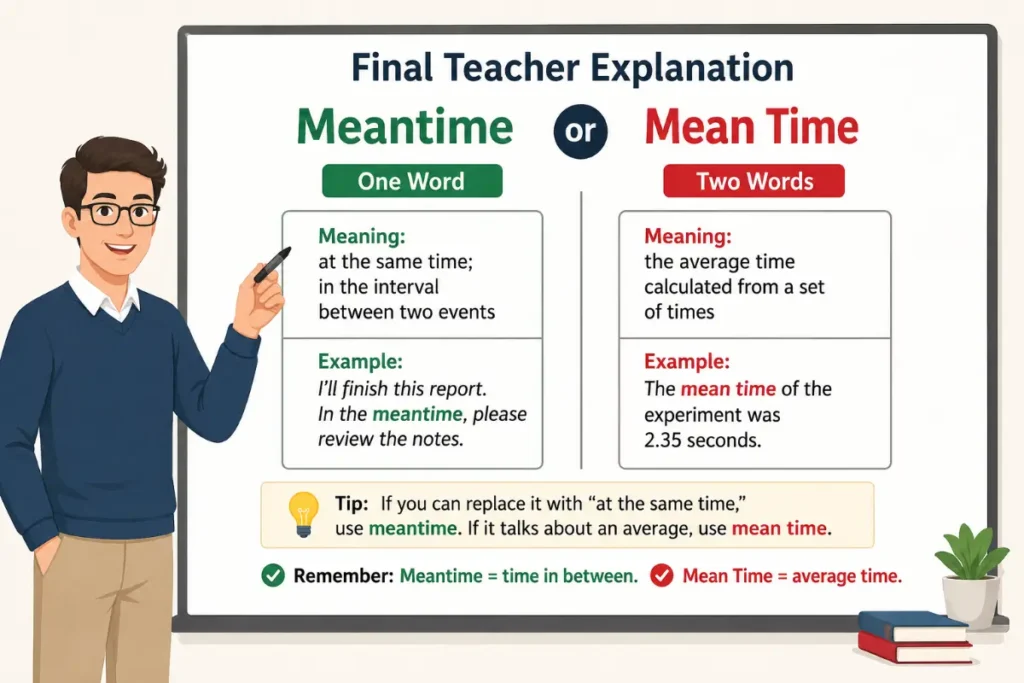
Final Teacher Explanation About Meantime Or Mean Time
Imagine you are sitting in my classroom and you ask which one you should use.
My answer is very simple.
If you are talking about the time between two events write meantime.
If you are writing a school paper an email a text message a blog post or speaking with friends meantime is almost always the correct choice.
Only use mean time if you are working with official technical terms such as Mean Time Between Failures or Mean Time To Repair.
That one simple rule will help you write naturally and confidently.
English has many word pairs that look alike. This is just one of them. The more you read and practice the easier these choices become.
Final Answer Or Quick Recap
If you still wonder about words remember this simple answer. Meantime is the standard spelling for everyday English. It means the period between two events or the time while you are waiting for something else to happen.
The two word form mean time is much less common. It usually appears only in technical fields where it is part of official expressions like Mean Time Between Failures. Outside those situations you should almost always choose meantime.
The easiest way to remember the difference is this. If you can replace the phrase with “during that time” or “until then” use meantime.
Learn the difference in Bony vs Boney: Learn the Correct Word in Minutes.
Conclusion
Understanding is much easier than it first appears. The two forms look similar but they are not used in the same way. For almost every everyday sentence meantime is the correct and natural choice.
When you see mean time remember that it usually belongs to technical expressions used by engineers or computer professionals. That is why you do not often see it in normal conversation or school writing.
Keep one simple rule in mind. If you are talking about the time between two events choose meantime. That one rule will help you use meantime or mean time correctly every time.
Frequently Asked Questions FAQs
What does meantime mean in simple words?
Meantime means the time between two events or while you are waiting for something else to happen.
Which is correct?
Both are correct. Meantime is the normal choice for everyday English. Mean time is mainly used in technical phrases.
When should I use meantime?
Use meantime when you mean during the waiting period or until something else happens.
Why do people get confused?
They sound almost the same when spoken. Many people also see both spellings in different kinds of writing.
Can I use both forms in normal writing?
No. In normal writing you should almost always use meantime.
Is in the meantime a correct expression?
Yes. In the meantime is a very common and correct English expression.
Is mean time old fashioned?
Outside technical writing it is much less common today. Modern English usually prefers meantime.
What is the easiest way to remember the difference?
If you mean “during that time” choose meantime. Save mean time for technical terms.
