
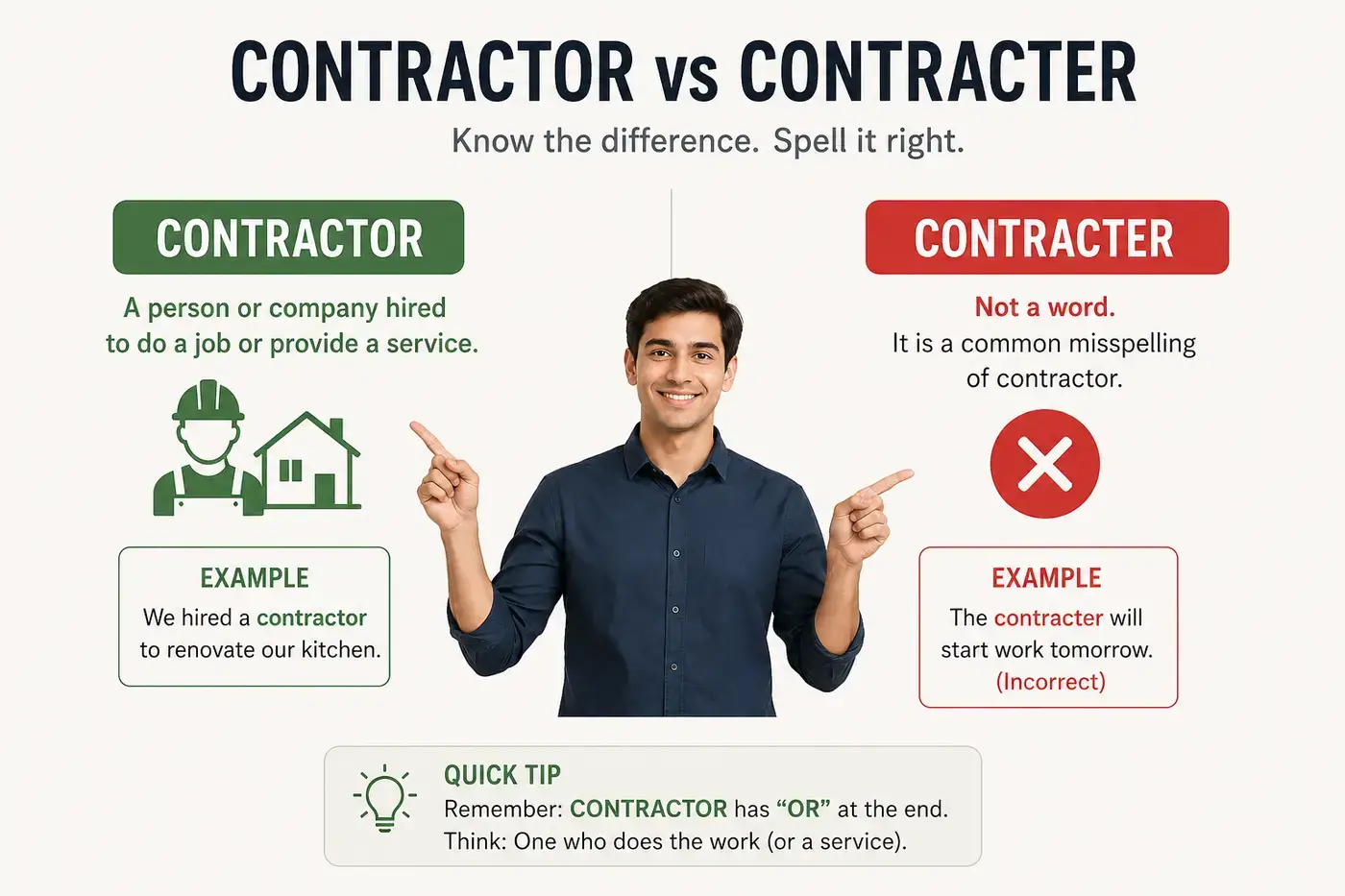
A lot of people get confused when they search contractor vs contracter. The keyword shows up often because both words look almost the same, but only one is correct in English. If you are learning English or writing for work, this small spelling difference can matter a lot.
The correct word is contractor. The word contracter is usually a mistake. People often type it by accident or guess the spelling. This confusion happens in job searches, construction work, freelancing, and business writing. So understanding helps you write better and avoid errors.
In simple terms, a contractor is a person or company that does work under a contract. The word contracter is not a standard English word. It is just a misspelling. That is the main idea behind and we will break it down step by step in this lesson.
For another common grammar confusion, see Traveled or Travelled: Which Spelling Is Correct and Mistake.
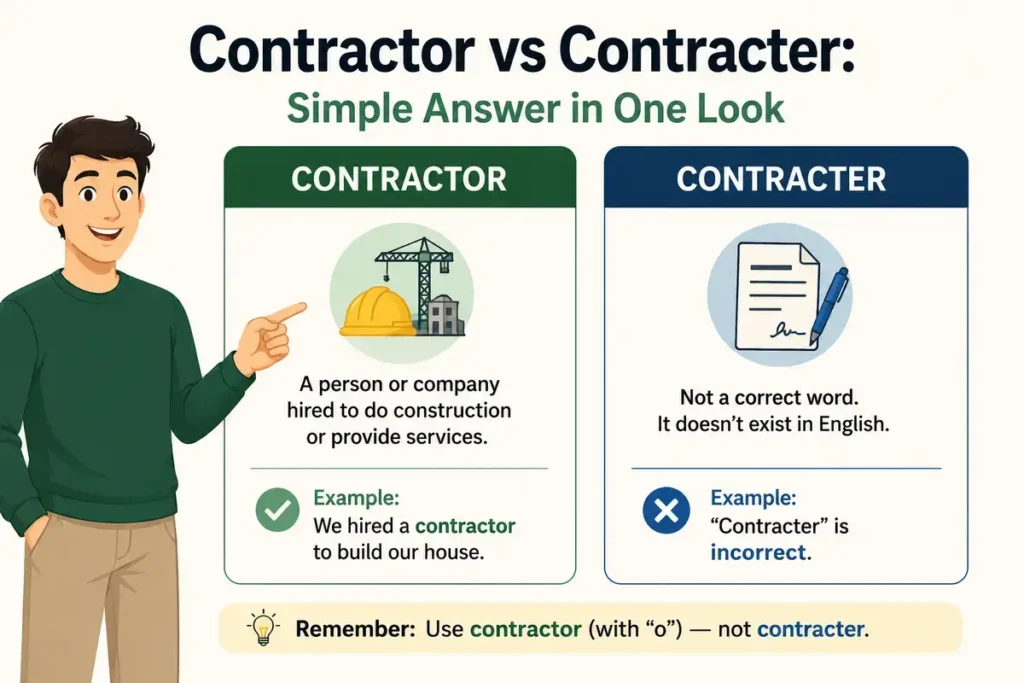
Simple Answer in One Look
The correct spelling is contractor.
Contracter is incorrect and should not be used.
Only “contractor” is accepted in English writing.
What does Contractor vs Contracter Means in Simple English
Let’s understand in very easy words. A contractor is someone who agrees to do a job for money. They sign a contract. This can be in building houses, fixing roads, or doing office work. For example:
- A builder who builds your house is a contractor.
- A freelancer who designs a website can also be a contractor.
- A company that repairs roads is a contractor.
Now here is the key point. The word contractor comes from “contract.” It means a person who works under a contract. But contracter is not a real word in modern English. You will not find it in correct dictionaries used for professional writing. It is only a spelling mistake that happens when people guess. Remember:
- Contractor = correct and real word
- Contracter = wrong spelling
This makes your English clean and professional.
Why People Mix These Words Contractor or Contracter
Many learners get stuck because the words look so similar. Here are the simple reasons: First, English spelling is not always logical. People expect “contracter” because verbs like “teach → teacher” exist. So they think “contract → contracter” should also be correct. This creates confusion.
Second, typing errors are very common. When people type fast, they add “er” at the end without thinking. So “contractor” becomes “contracter” by mistake. Third, pronunciation adds to confusion. When spoken quickly, “contractor” and “contracter” sound almost the same.
Fourth, auto-correct sometimes fails or suggests wrong forms. Some users accept the wrong suggestion without checking. So the mix-up is not about intelligence. It is just a common spelling habit and sound confusion.
Clear Difference Explained Simply
Let’s make the difference very clear. Only one form is real.
1. Contractor
- Correct spelling
- Real English word
- Used in jobs and business
- Means a person or company working under a contract
Example:
- The contractor built our school.
2. Contracter
- Incorrect spelling
- Not accepted in English writing
- No official meaning
- Should be avoided in all cases
Example:
- ❌ The contracter built our school. (Wrong)
Now look at both words side by side:
- Contractor → correct, used everywhere
- Contracter → wrong, avoid it
This is the simplest way to understand without confusion. If you remember only one thing from this lesson, remember this:
Always use contractor, never contracter. That single rule solves the problem instantly.
Which Form Should You Use for Contractor vs Contracter?
When choosing between words the rule is very simple.
Always use contractor.
Here is why: English follows standard spelling rules. Dictionaries, schools, offices, and websites all use “contractor.” So in professional writing, only “contractor” is accepted. If you write “contracter,” people may think:
- You made a spelling mistake
- You are not confident in English
- Your writing is not professional
Use contractor in every situation. This includes:
- Job applications
- Emails
- School writing
- Business documents
- Online posts
There is no situation where “contracter” is correct. That is why understanding is important for clean writing. A simple rule you can remember: If you are unsure, always choose “contractor.” That rule removes all confusion.
Easy Real-Life Sentences You Can Use for Contractor vs Contracter
Here are simple sentences using the correct word:
- The contractor fixed our roof.
- We hired a contractor for the road work.
- The contractor finished the project on time.
- She works as a contractor for a software company.
- The contractor gave us a good price.
- I met the contractor at the construction site.
- The contractor signed the agreement yesterday.
- Our house was built by a local contractor.
Notice how every sentence uses contractor, not “contracter.” This shows the correct usage. If you practice these sentences, you will never confuse again.
Where Contractor and Contracter Words Expression Comes From (Simple History)
To fully understand words it helps to know where the word comes from. The word contractor comes from the word “contract.” A contract is an agreement between two people or groups. The ending “-or” is used in English for a person who does something. For example:
- Act → actor
- Teach → teacher (different pattern)
- Contract → contractor
This is why has only one correct form. English uses “-or” here, not “-er.” The word “contracter” likely appeared because people followed the wrong pattern of adding “-er” to verbs. Over time, it stayed as a common mistake, but it was never accepted as correct English. So the history of is simple:
- Contractor = correct formation from Latin-based English rules
- Contracter = mistake created by spelling confusion
Today, only “contractor” is used in legal, business, and everyday English writing.
Bridge to Deeper Understanding
Now you understand the basic idea behind. You know the correct spelling, why the confusion happens, and how to use it in real sentences.
But there is still more to learn beyond spelling. The word “contractor” is used in many industries, job types, and even legal situations. It can change meaning depending on context, like construction work, freelancing, or government contracts. Understanding these deeper uses will help you speak and write English more naturally and confidently in real life situations.
How contractor vs contracter Is Understood in Culture and Stories
When we talk about both words culture plays a big role in how people see the word “contractor.” In daily life, a contractor is seen as a skilled worker or company that comes in to complete important jobs. People often trust contractors for building homes, fixing roads, or doing big projects.
In many cultures, a contractor is linked with responsibility and skill. For example, in construction culture, a contractor is someone who manages workers, materials, and deadlines. So the word feels professional and serious.
Now in this case, the word “contracter” does not appear in stories, culture, or real communication. People do not use it in daily speech or writing. It is only a spelling mistake that sometimes shows up online or in casual typing. So culturally:
- Contractor = trusted worker, responsible person
- Contracter = not used, not recognized
This is why it is not just about spelling. It is also about how real people understand jobs and work in real life.
Learn the difference in Sleave or Sleeve: Which Word Is Correct?.
Biblical and Mythological Meaning of contractor and contracter
When we study about words there is no direct biblical or mythological meaning for either word. The word “contractor” is modern and comes from business language, not from religious or ancient stories. It is used in law, construction, and work agreements. In simple terms:
- The Bible does not mention “contractor”
- Mythology does not include “contractor”
- The idea comes from modern work systems, not old stories
So, we can clearly say:
There is no spiritual or mythological meaning attached to either spelling.
But symbolically, people sometimes connect “contractor” with ideas like honesty, hard work, and responsibility because contractors deal with agreements and promises. Still, this is just modern thinking, not religious teaching.
Symbolism Explained in Simple Words
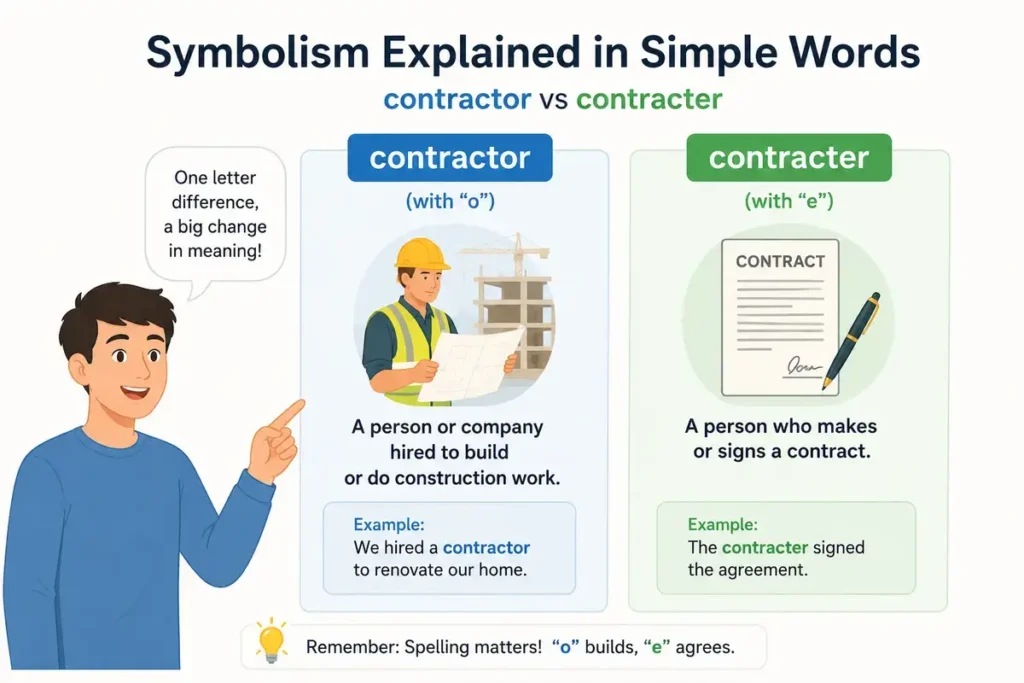
Even though contractor vs contracter is mainly about spelling, people still connect meaning and feelings to words.
What contractor Represents
A contractor represents:
- Hard work
- Responsibility
- Skill
- Trust
- Planning and structure
In real life, when people hear “contractor,” they think of someone building or fixing something important. It feels serious and professional. For example, a contractor building a school represents progress and development. So “contractor” has a strong and positive image in people’s minds.
What contracter Represents
The word contracter does not have a real meaning or symbol in English. But when people see it, they often think:
- It is a mistake
- It is incorrect spelling
- It looks unprofessional
“contracter” symbolizes confusion or error rather than meaning. This is why it is not used in writing or business communication.
Related Words You Should Know
To fully understand, here are some related words:
- Contract
An agreement between two people or groups. - Subcontractor
A person hired by a contractor to do part of the work. - Freelancer
A person who works independently on projects without long contracts. - Builder
Someone who constructs buildings or structures. - Worker
A general term for someone who does physical or skilled labor. - Company
An organization that may hire contractors for projects. - Agreement
A formal understanding between two sides.
These words help you understand how fits into real-world English.
How People Actually Use It in Daily English
In real life, people only use contractor, not “contracter.” Here are common examples:
- We need a contractor to fix the house.
- The contractor arrived early this morning.
- My uncle works as a contractor in construction.
- They hired a contractor for the school project.
- The contractor gave us a timeline for the work.
- I spoke to the contractor about the repair cost.
- The contractor finished the job quickly.
- She is a contractor for a tech company.
- The contractor is responsible for the whole project.
- We are looking for a reliable contractor.
In all these sentences, it is easy to understand:
Only “contractor” is correct and used in real English.
Common Mistakes People Make
When learning people often make a few simple mistakes.
Mistake 1: Adding “-er” automatically
People think every job word ends with “-er,” so they write “contracter.”
But the correct form is “contractor.”
Mistake 2: Typing too fast
Many people type quickly and misspell “contractor” as “contracter.”
Always slow down and check spelling.
Mistake 3: Trusting wrong auto-correct
Sometimes devices suggest “contracter,” but it is still wrong.
Always choose “contractor.”
Mistake 4: Mixing pronunciation
Both words sound similar, so learners get confused.
But only one spelling is correct.
the main correction is simple:
Always remove “contracter” from your writing.
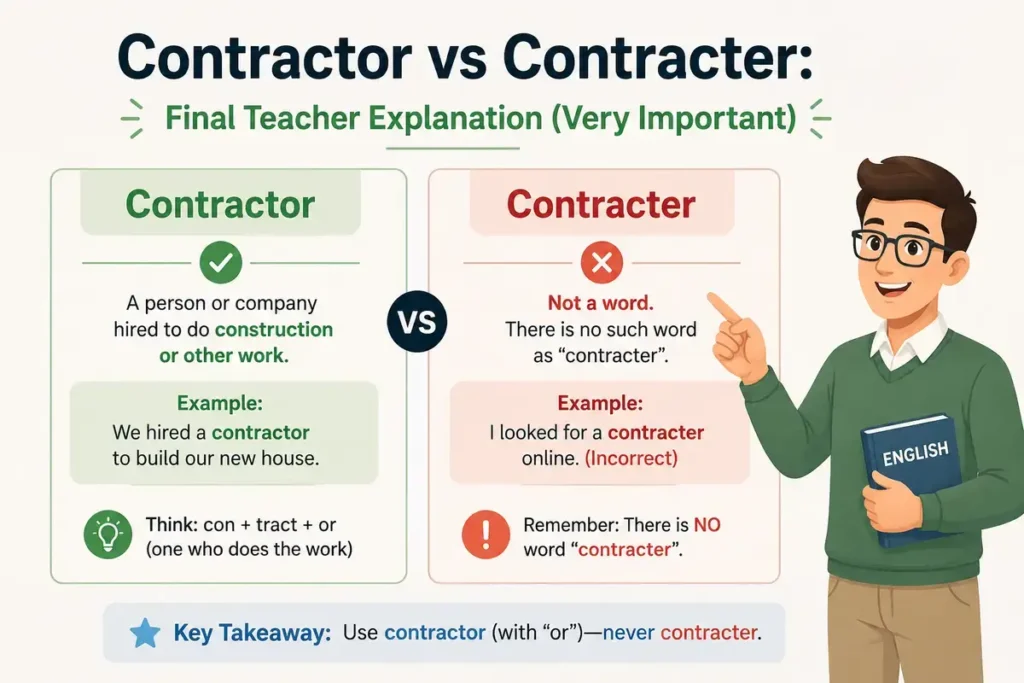
Contractor vs Contracter: Final Teacher Explanation (Very Important)
Let’s finish like a classroom lesson. Think of this word like a test question. You are given two choices:
- contractor
- contracter
Only one is real English. That is contractor. A contractor is a real person or company that does work under a contract. You see them in construction, freelancing, and business jobs every day. But “contracter” is not real. It is just a spelling mistake. It has no job, no meaning, and no place in correct English writing.
So if you ever feel confused about words remember this simple teacher rule: “Contractor is always correct. Contracter is always wrong.” If you follow this rule, your English will stay clean, simple, and professional.
Final Answer (Quick Recap)
In contractor vs contracter, only “contractor” is correct.
“Contracter” is a spelling mistake and should never be used.
Always use “contractor” in writing, speaking, and exams.
Many readers also check Unregister vs Deregister: Which Word Should You Use (2026).
Conclusion
The difference in contractor vs contracter is very easy once you see it clearly. One word is real, and the other is just a mistake.
A contractor is a person or company that works under a contract. You see contractors in construction, repair work, freelancing, and many business jobs. It is a correct, standard English word used everywhere.
But contracter is not correct. It has no real meaning in English and should never be used in writing, exams, or professional work. It usually appears only because of spelling confusion or typing errors. So the final rule is simple:
Always use contractor. Never use contracter.
If you remember this, your writing will stay clean, correct, and professional every time you deal.
Frequently Asked Questions (FAQs)
What does mean in simple words?
It means checking the correct spelling. “Contractor” is right, “contracter” is wrong.
Is contracter a real English word?
No, “contracter” is not a correct English word.
When should I use contractor?
Use “contractor” when talking about a person or company doing work under a contract.
Why do people get confused?
Because both words sound similar and look almost the same.
Can I use contracter in writing?
No, you should always avoid it. Only “contractor” is correct.
What is a contractor in simple English?
A contractor is a person or company hired to do a job or project.
Is contractor used in business English?
Yes, it is widely used in construction, freelancing, and corporate work.
What is the easiest way to remember?
Just remember: contractor = correct, contracter = mistake.
