
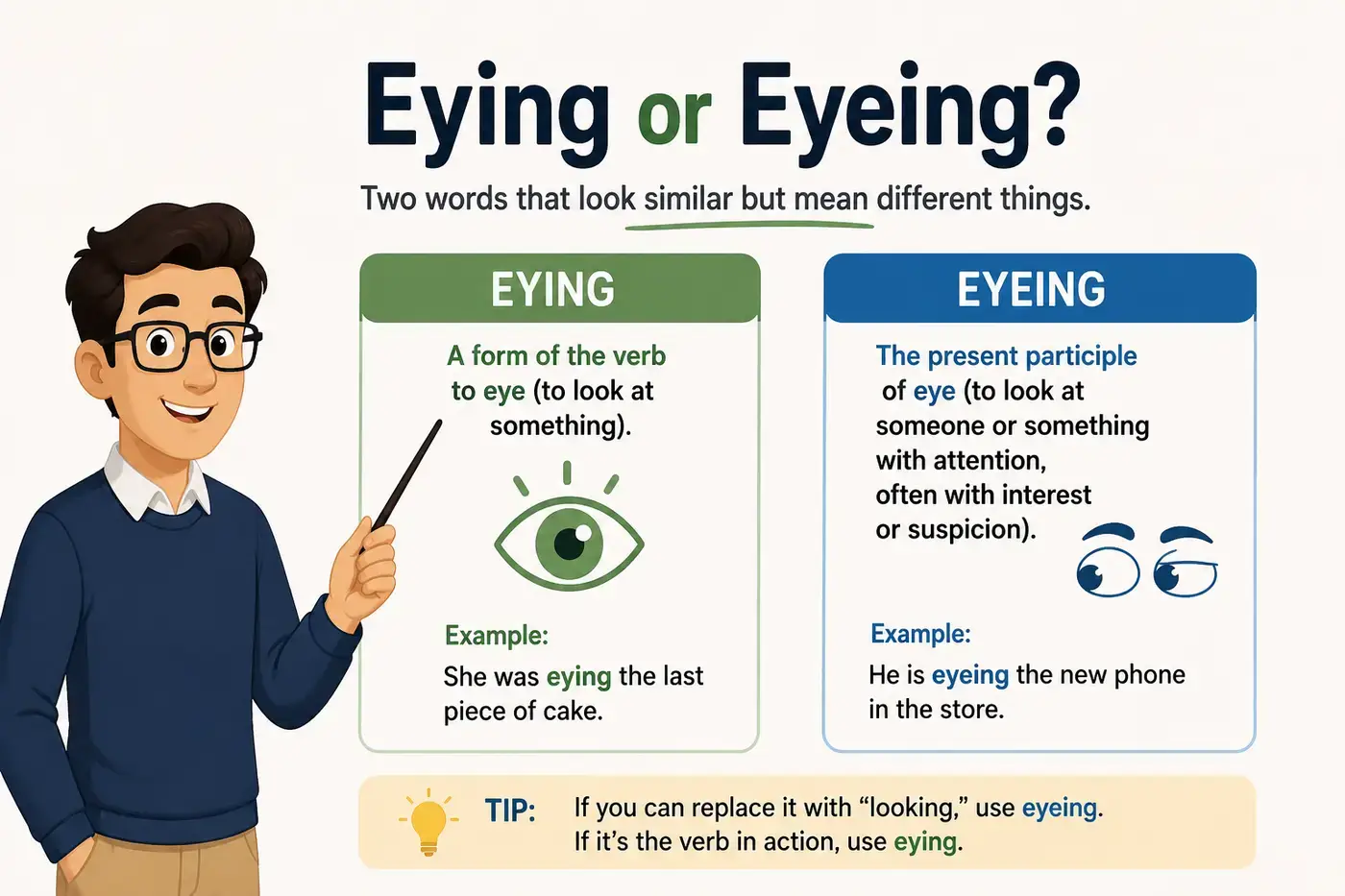
If you have ever wondered about eying or eyeing, you are not alone. Many English learners and native speakers see both spellings and ask the same question: which one is correct?
The good news is that both are accepted spellings. They come from the verb eye, which means to look at something carefully or with interest. Still, one spelling is used much more often in modern English.
When people compare they usually want to know which form looks more natural and which one they should use in everyday writing. In most cases, eyeing is the preferred choice because it is more common and easier for readers to recognize.
Still confused? Compare Witnesss Or Witness: Avoid Common Spelling Mistake (2026).
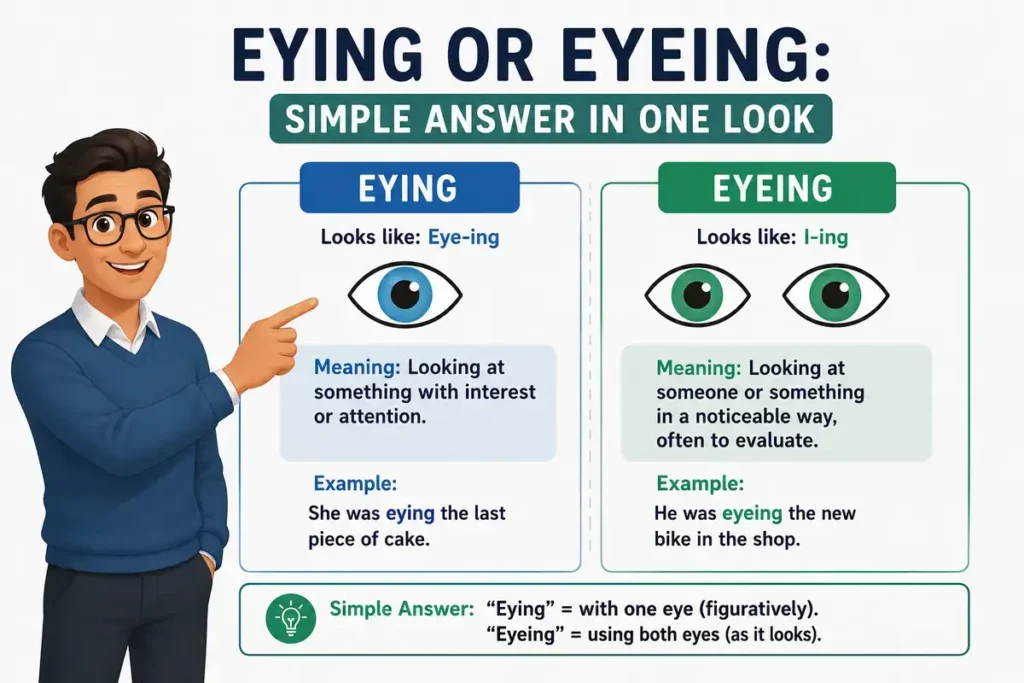
Eying or Eyeing: Simple Answer in One Look
Eyeing and eying are both correct.
However, eyeing is the spelling most writers, editors, and readers prefer today.
What Eying or Eyeing Means in Simple English
The words have the same meaning. They describe the action of looking at someone or something carefully. Usually, the person is showing interest, curiosity, or desire. For example:
- A child may be eyeing a cookie.
- A shopper may be eyeing a new phone.
- A student may be eyeing the clock before class ends.
In each case, the person is not just looking. They are paying special attention. Think of it this way: If you are eyeing something, you are looking at it because it matters to you. You may want it. You may simply find it interesting.
Simple Definition of Eying or Eyeing
Eyeing means looking at something closely or with interest.
Eying means exactly the same thing.
The meaning does not change. Only the spelling changes.
Common Situations
People often use this word when talking about:
- Buying something
- Watching someone
- Considering an opportunity
- Looking at a goal
- Paying close attention
Examples:
- She is eyeing a new car.
- He is eyeing the last piece of cake.
- They are eyeing a larger house.
These examples all show interest or attention.
Why People Mix Eying or Eyeing
The confusion comes from English spelling rules. Many English verbs drop the final e before adding -ing. Look at these examples:
- Make → making
- Take → taking
- Drive → driving
- Write → writing
Because of this pattern, many people naturally think:
- Eye → eying
That seems logical. But English is not always predictable. Some words keep letters that help readers recognize the original word. That is one reason why eyeing became popular.
The Word “Eye” Stays Visible
Compare these spellings:
- eyeing
- eying
In eyeing, you can clearly see the word eye. Many readers find that easier to understand. In eying, the original word is less obvious. That makes some people stop and look twice.
Eying or Eyeing: Both Spellings Appear in English
Another reason for confusion is that both forms can be found in dictionaries, books, and websites. Someone may read eyeing in one article and eying in another. Then they start wondering if one of them is wrong. The truth is simple: Both are accepted. One is simply more common.
Similar English Confusions
This spelling question is not unusual. English has many words that create similar confusion. For example:
- Aging or ageing
- Judgment or judgement
- Canceled or cancelled
Writers often choose one version based on style, region, or preference.
Eying or Eyeing: Clear Difference Explained Simply
When comparing the meaning stays exactly the same. The difference is mainly how the word is spelled. Here is a simple comparison.
| Feature | Eying | Eyeing |
|---|---|---|
| Correct spelling | Yes | Yes |
| Meaning | Looking carefully | Looking carefully |
| Common in modern writing | Less common | More common |
| Easy to recognize | Sometimes | Usually |
| Recommended for most writers | Not usually | Yes |
Quick Rule for Eying or Eyeing
If you are unsure which spelling to use, choose eyeing. It is the form most readers expect to see.
Side-by-Side Examples
Sentence with eyeing:
- She is eyeing the necklace in the store.
Sentence with eying:
- She is eying the necklace in the store.
The meaning is exactly the same. Nothing changes except the spelling.
Visual Difference
Many teachers explain it like this:
Eyeing keeps the whole word eye.
Eying removes one letter from the original word.
That small difference is why many people find eyeing easier to read.
Eying or Eyeing: Which Form Should You Use?
For most writing, use eyeing. It is the safest and most widely accepted choice. You will often see it in:
- News articles
- Magazines
- Blogs
- School writing
- Business writing
- Professional websites
Because it is so common, readers usually recognize it immediately.
When Is Eying Okay?
You can still use eying.It is not wrong. Some dictionaries list it as a valid spelling. Some writers simply prefer it. As long as you stay consistent, most readers will understand your meaning.
The Best Rule for Students
If you are learning English, remember this:
Both spellings are correct, but eyeing is more common.
That simple rule works in nearly every situation.
What Editors Usually Prefer
Many editors choose eyeing because it is easier for readers to recognize.
That does not mean eying is incorrect.
It simply means eyeing has become the more popular spelling over time.
Professional Writing Tip
When writing for:
- School assignments
- Work reports
- Online articles
- Client projects
- Public documents
Choose eyeing.
It will look familiar to most readers.
Easy Real-Life Sentences You Can Use for Eying or Eyeing
Here are some simple examples using eyeing.
- I am eyeing a new bicycle.
- She is eyeing the last cookie.
- We are eyeing a trip to California.
- The cat is eyeing the bird outside.
- He is eyeing a promotion at work.
- They are eyeing a bigger apartment.
- My friend is eyeing a new laptop.
- The child is eyeing the toy shelf.
Here are a few examples using eying.
- I am eying a new jacket.
- She is eying the last piece of pizza.
- They are eying a house near the park.
- He is eying the empty seat.
- The dog is eying the food on the table.
Both sets of examples are correct.
Common Everyday Expressions
You may hear people say:
- Eyeing a new opportunity
- Eyeing the prize
- Eyeing the competition
- Eyeing a better job
- Eyeing a chance to win
These phrases all suggest interest, attention, or desire.
Spoken English Examples
Here are some natural conversations.
Friend 1: Why are you looking at that phone?
Friend 2: I’m eyeing it because I might buy it.
Another example:
Mom: Why is the dog staring at dinner?
Child: He’s eyeing the chicken.
These examples show how naturally the word fits into daily speech.
Where Eying or Eyeing Comes From (Simple History)
The word eye has been part of English for hundreds of years. At first, it was mainly used as a noun. It referred to the body part used for seeing. Later, people started using eye as a verb. As a verb, it meant: To look at something carefully. That meaning remains the same today.
How Eye Became a Verb
English often turns nouns into verbs. Here are some examples:
- Hammer → to hammer
- Brush → to brush
- Phone → to phone
- Email → to email
- Eye → to eye
The same thing happened with eye. People began using it to describe the action of looking closely.
How Eyeing and Eying Appeared
Once eye became a verb, writers needed a form that showed an ongoing action. That created spellings such as:
- Eyeing
- Eying
Over time, both forms appeared in books and printed materials. Neither spelling disappeared completely.
Why Eyeing Became More Popular
Many readers preferred eyeing because they could instantly recognize the base word eye. Look at these examples:
- eye + ing = eyeing
- ey + ing = eying
The first spelling clearly shows the original word. Because of that, eyeing gradually became the more popular form in modern English.
Is Eyeing More Common Today?
Yes. If you read newspapers, magazines, blogs, and books, you will usually see eyeing more often than eying. Language changes over time. Sometimes one spelling becomes the favorite choice. That is what happened here. Still, both spellings remain acceptable.
Transition to the Next Section
Now you know the basic answer to eying or eyeing, the difference between the spellings, and which form is usually preferred. In the next section, we will go deeper into cultural meaning, symbolism, common expressions, hidden meanings, and how people use this word in stories, conversations, and everyday life.
Learn the difference in Blankie or Blanky: Simple Meaning and Examples (2026).
How Eying or Eyeing Is Understood in Culture and Stories
The idea behind eying or eyeing appears in many stories, movies, and everyday conversations. People often use this word when someone wants something, notices something important, or is paying close attention. For example, in a movie, a treasure hunter may be eyeing a hidden map. In a story, a child may be eyeing a birthday gift before opening it.
The word often creates a feeling of interest. It tells readers that someone is focused on a person, object, or opportunity. Sometimes the feeling is positive. Examples include:
- Eyeing a dream job.
- Eyeing a new home.
- Eyeing a prize.
Sometimes the feeling is negative. Examples include:
- Eyeing someone with suspicion.
- Eyeing a rival.
- Eyeing something that does not belong to you.
That is why this word appears so often in storytelling. It quickly shows attention, desire, curiosity, or concern.
Eying or Eyeing in Movies and Books
Writers use this word because it helps readers picture a scene. Instead of saying: “He looked at the bicycle.” A writer may say: “He was eyeing the bicycle.” The second sentence feels stronger. It suggests interest. Maybe he wants the bicycle. He plans to buy it. Maybe he is thinking about it. The reader instantly understands more.
Eying or Eyeing and Human Behavior
People naturally watch things they care about. They eye things they want. They eye opportunities. Because this behavior is common everywhere, the word works across many cultures and languages.
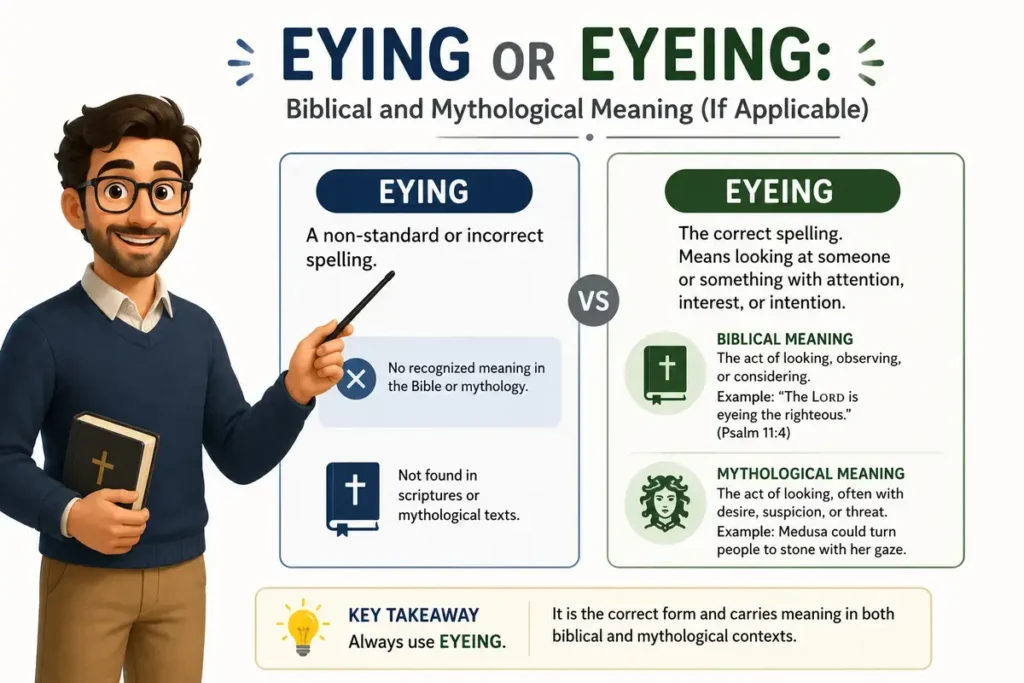
Eying or Eyeing: Biblical and Mythological Meaning (If Applicable)
The words are not special biblical terms. However, the idea of watching, observing, and paying attention appears throughout many religious and mythological stories. In the Bible, eyes often symbolize:
- Awareness
- Understanding
- Wisdom
- Attention
People are encouraged to watch carefully and make wise choices. In mythology, powerful characters are often described as seeing things others cannot see. Their eyes represent knowledge or insight. Because eyeing means looking carefully, it can sometimes connect with these broader ideas of attention and awareness. Still, in everyday English, the word usually keeps its simple meaning: Looking at something with interest or attention.
Symbolism Eying or Eyeing Explained in Simple Words
Words often carry small emotional meanings beyond their dictionary definitions. The same can happen.
What Eyeing Represents
The spelling eyeing is the form most people recognize today. Because the whole word eye remains visible, many readers find it clear and easy to understand. Symbolically, it can suggest:
- Attention
- Curiosity
- Focus
- Interest
- Desire
- Observation
For example: “She is eyeing a promotion.” This suggests hope and ambition. “He is eyeing the finish line.” This suggests determination. The word often creates a picture of someone concentrating on a goal.
What Eying Represents
The spelling eying carries the same meaning. The emotional idea behind it does not change. It still suggests:
- Looking closely
- Paying attention
- Showing interest
- Considering something
The difference is mainly visual. Some readers may find eying less familiar because the original word eye is not as easy to spot. Still, the message remains the same. Both spellings point to careful attention.
Simple Comparison of the Symbolism
| Spelling | Symbolic Idea |
|---|---|
| Eyeing | Clear focus and attention |
| Eying | The same focus and attention |
| Main Difference | Appearance, not meaning |
So when comparing the symbolism stays almost identical.
Related Words You Should Know about Eying or Eyeing
Learning related words can make understanding easier. Here are some useful terms connected.
Looking
The most general word. It simply means directing your eyes toward something.
Watching
Looking at something for a period of time. Example:
Watching a movie.
Staring
Looking for a long time without looking away. Example:
Staring at a painting.
Glancing
Looking very quickly. Example:
Glancing at the clock.
Observing
Watching carefully to notice details. Example:
Observing birds in a park.
Noticing
Seeing or becoming aware of something. Example:
Noticing a mistake.
Considering
Thinking about something seriously. Example:
Considering a new job.
Admiring
Looking at something because you like it. Example:
Admiring a beautiful car.
Studying
Looking carefully to learn or understand. Example:
Studying a map.
All of these words connect in some way to the idea behind.
How People Actually Use Eying or Eyeing in Daily English
Native speakers use this word in many everyday situations. Most of the time, it sounds natural and friendly. Here are some real-life examples.
Talking About Buying Something
“I’m eyeing a new laptop.”
This means you are thinking about buying it.
Talking About Food
“She’s eyeing the last cookie.”
This means she wants the cookie.
Talking About Jobs
“He’s eyeing a management position.”
This means he hopes to get the job.
Talking About Travel
“We’re eyeing a vacation next summer.”
This means the vacation is being considered.
Talking About Sports
“The team is eyeing a championship.”
This means the team hopes to win.
Talking About Houses
“They’re eyeing a bigger house.”
This means they may move there.
Talking About Opportunities
“I’m eyeing a chance to work abroad.”
This means the opportunity looks attractive.
Talking About Competition
“The company is eyeing new markets.”
This means the company wants to expand.
Talking About School
“The students were eyeing the clock.”
This means they were waiting for class to end.
Talking About Pets
“The dog is eyeing my sandwich.”
This means the dog wants the food. These examples show why the word is so common. It works in many different situations.
Common Mistakes People Make using Eying or Eyeing
Many learners make small mistakes. The good news is that they are easy to fix.
Mistake 1: Thinking One Form Is Wrong
Some people believe only one spelling is correct.
Correction:
Both spellings are accepted.
However, eyeing is more common.
Mistake 2: Using the Word for Every Type of Looking
Not every look is eyeing. Example:
Correct:
“I was eyeing the new bicycle.”
Incorrect:
“I was eyeing the sky for one second.”
A quick look is usually a glance, not eyeing.
Mistake 3: Forgetting the Meaning
The word usually suggests interest. If there is no interest, another word may fit better. Example:
- Looking
- Watching
- Glancing
- Observing
Choose the word that best matches the situation.
Mistake 4: Worrying Too Much About the Spelling
Many learners spend a lot of time deciding.
Correction:
Use eyeing if you are unsure.
Most readers expect that spelling.
Mistake 5: Confusing It With Staring
Eyeing does not always mean staring. Someone can eye an object briefly while still showing interest. The two words are related but not identical.
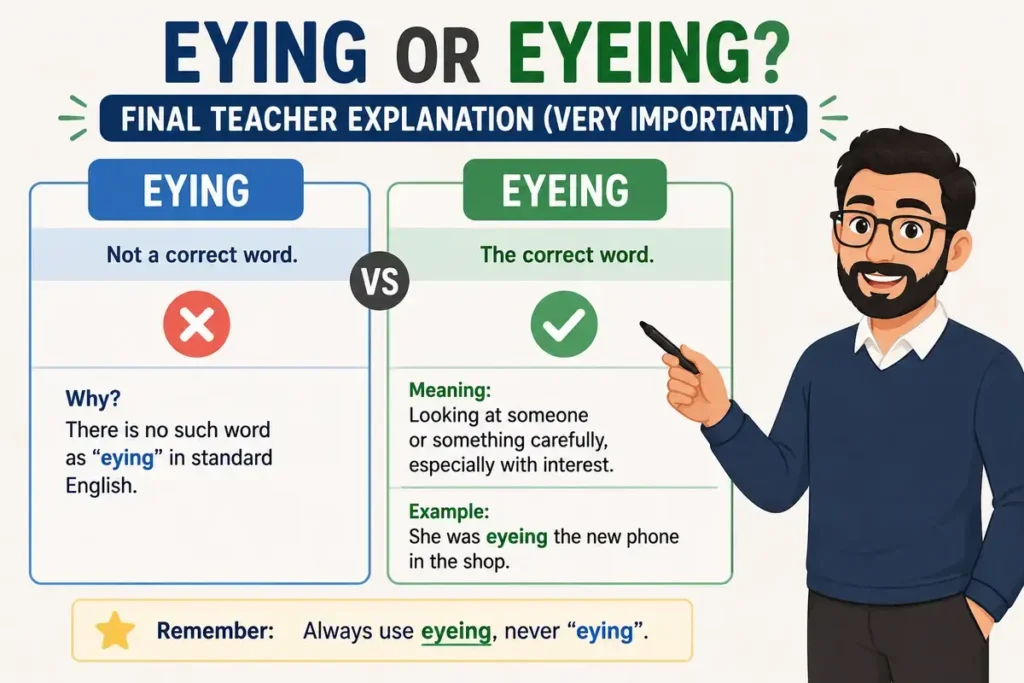
Eying or Eyeing: Final Teacher Explanation (Very Important)
Imagine you are sitting in a classroom and asking: Both are correct. Both mean looking at something carefully or with interest. The spelling eyeing is the one you will see most often in modern English. That makes it the safest choice for students, writers, and professionals. Remember these three points:
- Both spellings are accepted.
- Both have the same meaning.
- Eyeing is more common today.
If you remember those three facts, you will rarely make a mistake. The goal is not just to memorize a spelling. The goal is to understand how people actually use the word. When someone is eyeing something, they are paying attention to it because it matters to them. That simple idea explains almost every use of the word.
Eying or Eyeing: Final Answer (Quick Recap)
When comparing eying or eyeing, both spellings are correct and both mean looking at something with interest or attention. However, eyeing is the more common spelling in modern English and is usually the best choice for school, work, and everyday writing. If you are unsure, use eyeing. It is the spelling most readers expect to see.
Learn the difference in Enrol or Enroll: Correct Usage, Meaning, and Simple Rules.
Conclusion
The question of eying or eyeing is easier than it first appears. Both spellings are accepted and both carry the same meaning: looking at something carefully, closely, or with interest. The real difference is usage. Over time, eyeing has become the preferred spelling because it clearly shows the original word eye and feels more natural to many readers.
For students, writers, and English learners, the simplest rule is to choose eyeing in most situations. It is widely recognized and commonly used in books, articles, business writing, and everyday English. Understanding this small spelling difference can help you write with more confidence and avoid confusion in the future.
Frequently Asked Questions (FAQs)
What does mean in simple words?
It means looking at something carefully or with interest.
Is eyeing correct?
Yes. Eyeing is correct and is the most common spelling today.
Is eying correct?
Yes. Eying is also correct, but it is less common.
Which is better?
Most writers prefer eyeing because readers recognize it more easily.
Why do people get confused ?
Many English words drop the final letter “e” before adding “-ing,” which makes people expect “eying.”
Can I use both forms in writing?
Yes. Both are accepted, but eyeing is usually the safer choice.
Is eyeing used in professional writing?
Yes. It is common in business writing, news articles, blogs, and school work.
Does the meaning change?
No. Both spellings have the same meaning.
