
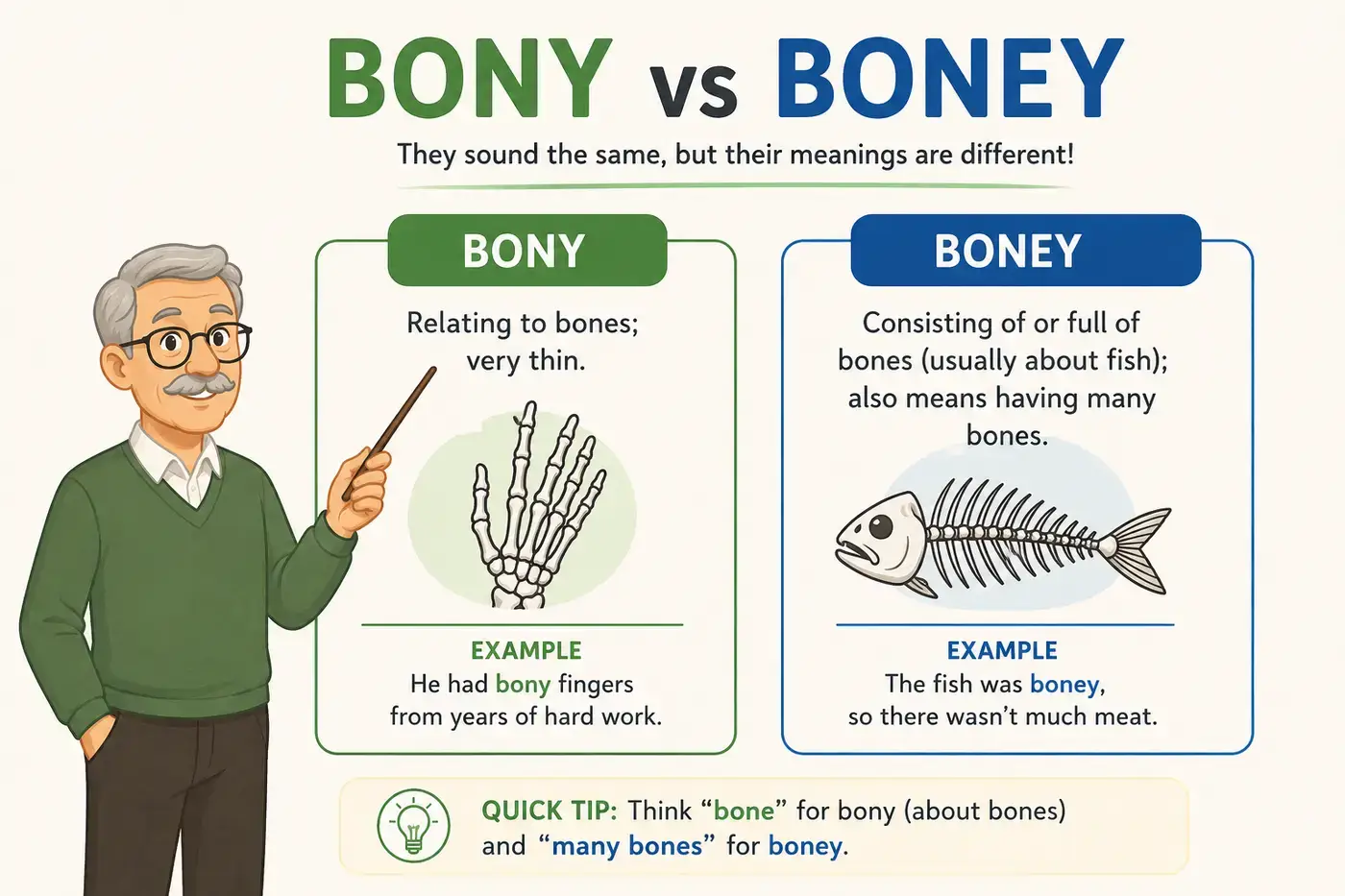
Many English learners get confused about bony vs boney because both spellings appear in books, articles, and online writing. You may wonder if they have different meanings or if one spelling is wrong. The good news is that the answer is simple once you know the rule.
When comparing bony vs boney, both words describe someone or something with noticeable bones. However, bony is the standard spelling in modern English. Boney is an accepted variant, but it is much less common and often appears in older writing, names, or special expressions.
If you have ever stopped while writing because you were unsure which spelling to choose, you are not alone. This guide explains the difference in very simple English. By the end, you will know which form to use and why.
A related grammar guide is Scarey or Scary: Common Mistakes Explained Simply Today.
Bony vs Boney: Simple Answer in One Look
Bony is the standard and preferred spelling in modern English.
Boney is an alternative spelling that is much less common and is mostly seen in older texts, names, or certain phrases.
For everyday writing, choose bony.
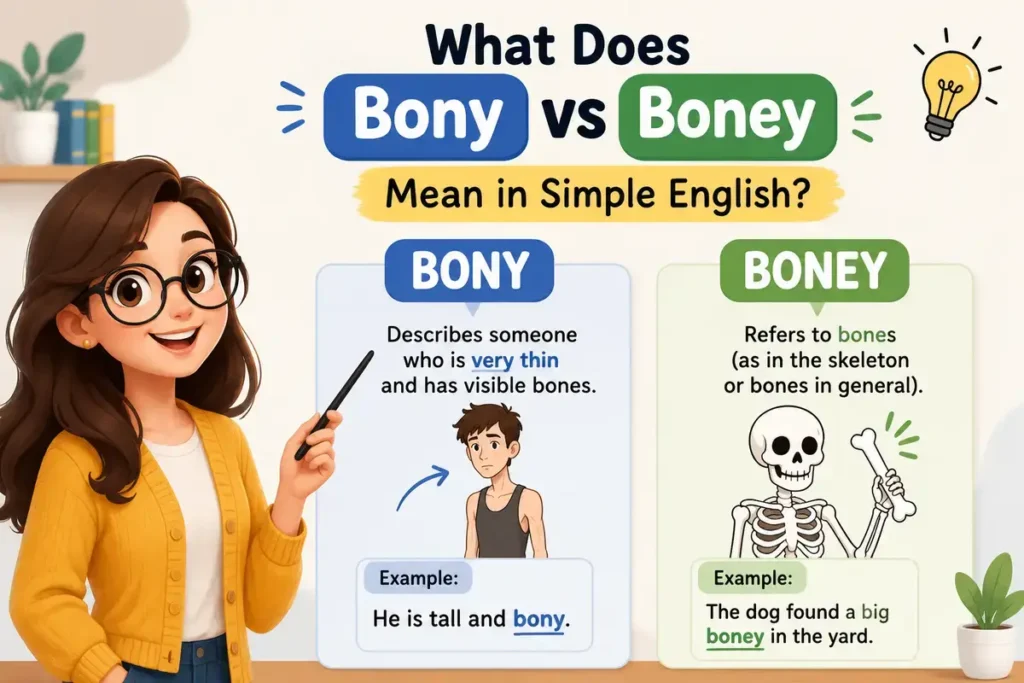
What Does Bony vs Boney Mean in Simple English?
When talking about bony vs boney, both words have the same basic meaning. They describe a person or animal whose bones are easy to see because there is very little fat or muscle covering them. They can also describe body parts where the bones stand out. For example:
- A bony hand has fingers with visible bones.
- A bony shoulder has very little flesh.
- A bony dog looks thin enough that you can see its ribs.
The spelling boney means exactly the same thing. The difference is that modern dictionaries and style guides almost always recommend bony for normal writing. Think of it this way:
- Bony = the spelling you should normally use.
- Boney = an older or less common spelling.
Why Do People Mix Up Bony vs Boney?
Many people become confused because English has words that end in -y and others that end in -ey. For example:
- Blue → Bluey (nickname)
- Bone → Boney
- Stone → Stoney (family name)
Because of patterns like these, some writers naturally think boney must be the correct spelling. Another reason is that people sometimes see Boney used as:
- A last name
- A business name
When they later write about a thin person or animal, they accidentally choose boney instead of bony. Search engines also show both spellings, making the confusion even stronger. The easiest rule is this: If you are describing someone’s appearance, use bony.
Clear Difference Between Bony vs Boney Explained Simply
Although the meanings are almost the same, the spellings are used differently.
| Bony | Boney |
|---|---|
| Standard modern spelling | Less common spelling |
| Preferred in schools | Often found in older writing |
| Used in books and news | Seen in names and special expressions |
| Best for everyday English | Rare in normal writing |
Here is another easy comparison.
Bony
- Standard English
- Most dictionaries list it first.
- Best choice for essays, emails, blogs, and school work.
- Sounds natural to most readers.
Boney
- Alternative spelling.
- Less common today.
- Sometimes appears in historical writing.
- Often used in proper names instead of normal descriptions.
The safest choice is almost always bony.
Which Form Should You Use in Bony vs Boney?
If you are writing modern English, use bony. That simple rule works almost every time. Choose bony when you describe:
- A thin person
- A skinny animal
- Hands
- Knees
- Shoulders
- Elbows
- Faces
- Fingers
Examples:
- The boy had bony knees.
- Her bony fingers were cold.
- The dog looked bony after getting lost.
- His bony shoulders showed through his shirt.
Use boney only if:
- It is part of someone’s name.
- It appears in an older quotation.
- You are copying the original spelling from a historical source.
For almost every school or professional situation, bony is the correct answer.
Easy Real-Life Sentences Using Bony vs Boney
These examples show how people normally use the word.
- The kitten looked bony after being sick.
- His bony elbows rested on the table.
- The horse became too bony during the winter.
- She had a bony face with sharp cheekbones.
- The doctor said the child looked too bony.
- We could see the dog’s bony ribs.
- His bony hands shook from the cold.
- The old photo showed a very bony man.
Now look at examples with boney.
- That is Boney as a family name.
- The museum kept the old spelling boney in the original document.
Notice that these are much less common than the examples with bony.
Where Does Bony vs Boney Come From? (Simple History)
The word bony comes from the noun bone. English speakers added the ending -y to describe something that has many bones or looks like bone. Over time, bony became the normal spelling in dictionaries and everyday English.
The spelling boney also appeared many years ago. Older writers sometimes added -ey instead of -y to some words. As English spelling became more consistent, bony became the preferred form. Today, both spellings can still be found, but bony is the spelling that most people expect to see in modern writing. So if you are deciding between bony vs boney, remember this simple history:
- Both spellings have existed.
- Bony became the standard spelling.
- Boney survives mostly in names and older writing.
As you continue learning it also helps to see how the word is used in stories, culture, common expressions, and different situations. In the next section, you will discover deeper meanings, symbols, popular sayings, and practical tips that make this easy word even easier to understand.
How Bony vs Boney Is Understood in Culture and Stories
When people hear the word bony, they often picture someone or something that is very thin. In books and stories, a bony character may look weak, hungry, old, or tired. Writers use this word to help readers imagine how a person looks. For example, a story might say:
“The old man had bony hands that shook as he opened the door.”
This simple description helps readers picture the character without giving many details. Animals can also be called bony in stories. A lost dog or horse may be described as bony to show that it has not eaten enough. The spelling boney is much less common in modern stories. If you see it, it is usually because the writer is using an older spelling or it is part of a person’s name. So, when thinking remember that modern books and articles almost always use bony.
Many readers also check Me Either vs Me Neither: Which One Is Correct (2026)?.
Biblical and Mythological Meaning of Bony vs Boney
The Bible does not compare bony vs boney as different words. However, the word bones appears many times in the Bible. Bones often stand for life, strength, death, or hope. One famous example is the story of the Valley of Dry Bones. In this story, dry bones become alive again to show hope and new life. When someone is called bony, it simply describes how they look. It does not carry a special biblical meaning by itself.
In mythology, bones often represent strength, death, or the past. Heroes sometimes find bones of great animals or ancient creatures. These stories use bones as symbols, not the adjective bony. So, there is no special religious difference between the two spellings.
Symbolism Explained in Simple Words for Bony vs Boney
What Bony Represents
The word bony can represent different ideas depending on the situation. It may suggest:
- Thinness
- Weakness
- Hunger
- Old age
- Survival
- Simplicity
- Hard work
Sometimes a bony person is simply naturally thin. Other times, the word shows that someone has gone through difficult times. The meaning depends on the story.
What Boney Represents
The word boney usually represents the same ideas because it has the same meaning. The difference is mostly about spelling instead of symbolism. When people see boney, they may think of:
- Older English writing
- Family names
- Nicknames
- Traditional spellings
So the emotional meaning stays almost the same. The spelling is what changes.
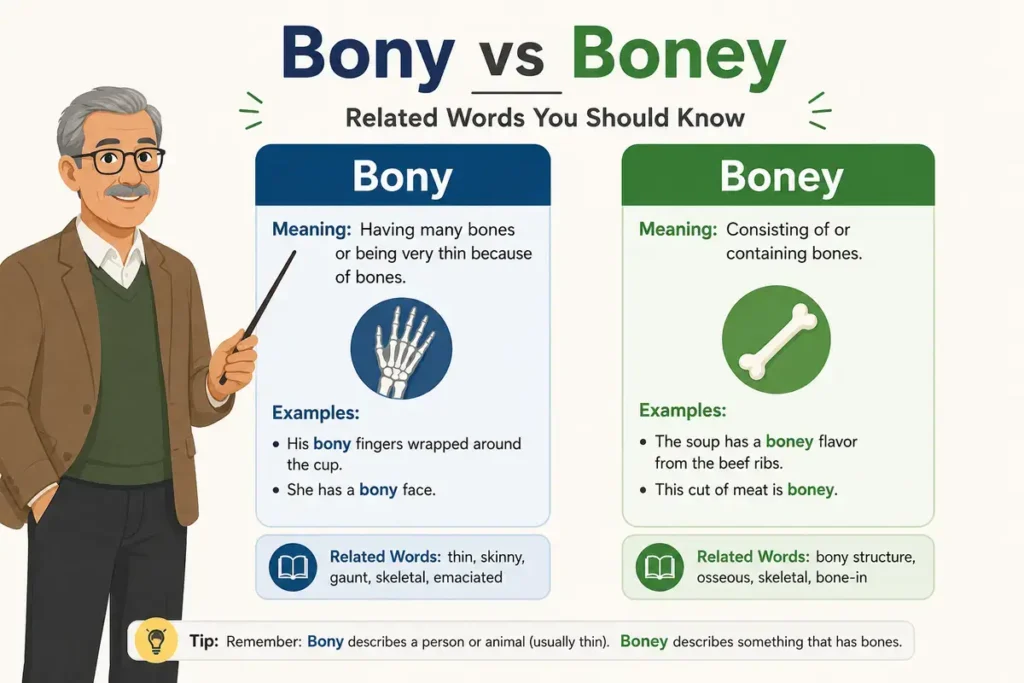
Related Words You Should Know About Bony vs Boney
Learning related words makes English easier.
Bone
The hard part inside your body that supports you.
Bones
More than one bone.
Skinny
Very thin. This word is common in everyday speech.
Thin
Not having much fat or width.
Lean
Thin in a healthy and strong way.
Slim
Pleasingly thin.
Gaunt
Very thin because of illness, age, or hunger.
Scrawny
Very thin and often weak-looking.
Skeletal
Looking almost like a skeleton because someone is extremely thin.
Emaciated
Very thin because of serious illness or lack of food.
These words have similar meanings, but each one gives a slightly different picture.
How People Actually Use Bony vs Boney in Daily English
Here are real examples that sound natural in everyday conversations.
- My dog looked bony after he was lost for a week.
- His bony knees stuck out through his jeans.
- She has bony fingers but very warm hands.
- The old horse became bony during the winter.
- That chair hurts because the seat is hard and my back is bony.
- I could feel my baby’s tiny bony shoulders.
- He isn’t sick. He’s just naturally bony.
- The doctor said the cat was too bony and needed better food.
- I almost never use the spelling boney in normal writing.
- My teacher told us that bony is the preferred spelling.
Notice that almost every example uses bony, not boney.
Common Mistakes People Make with Bony vs Boney
Many English learners make the same mistakes.
Mistake 1: Using boney in everyday writing
❌ She has boney arms.
✅ She has bony arms.
Modern English prefers bony.
Mistake 2: Thinking the meanings are different
Some people believe bony and boney describe different kinds of people. That is not true. Both spellings mean the same thing.
Mistake 3: Thinking boney is wrong
Some learners think boney is completely incorrect. It is not. It is simply much less common today.
Mistake 4: Copying old spellings
Older books sometimes use boney. Modern writing usually changes to bony unless the old spelling needs to stay exactly the same.
Mistake 5: Using the spelling from someone’s name
If you know a person named Boney, remember that this is their name. That does not change the normal spelling of the adjective, which is bony.
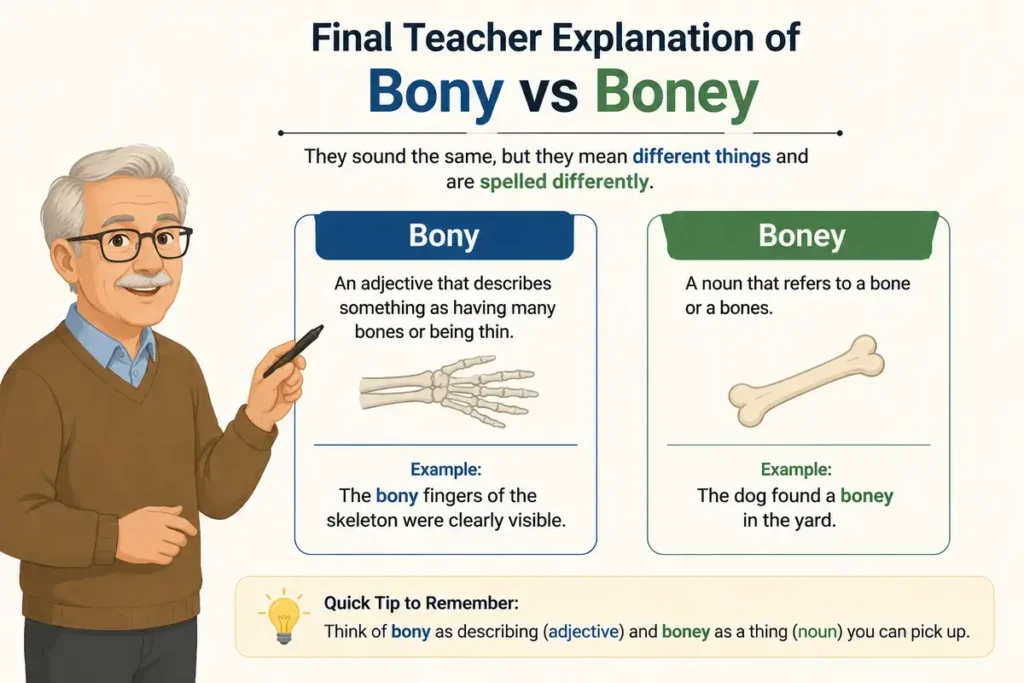
Final Teacher Explanation of Bony vs Boney
Imagine you are sitting in an English classroom. A student raises a hand and asks, “Which one should I write, bony or boney?” My answer is simple.
Write bony.
It is the spelling that teachers, dictionaries, newspapers, and most writers use today. The spelling boney is not completely wrong. It still appears in some older books, names, and special situations. But you do not need it for normal English. Here is the easiest way to remember it.
If you are describing a thin person, animal, or body part, choose bony. If you see boney, it is usually because you are reading older writing or looking at someone’s name. That one simple rule will help you almost every time.
Final Answer About Bony vs Boney (Quick Recap)
When comparing bony vs boney, bony is the standard spelling in modern English. Boney is an older and much less common spelling that still appears in some names and historical writing. If you are unsure, always choose bony. It is the safest and most natural option.
For another common grammar confusion, see Zeroes Or Zeros: Which Is Correct Simple Answer (2026).
Conclusion
The choice between bony vs boney is easier than many people think. Both words share the same meaning, but bony is the spelling you should use in almost every situation. It is the standard form found in modern dictionaries, schools, books, and everyday writing. Boney still appears from time to time, mainly in older texts, family names, or special expressions. If you remember one simple rule, make it this: Use bony for normal English, and you will almost always be correct.
Frequently Asked Questions (FAQs)
What does bony mean in simple words?
It means someone’s bones are easy to see because they have very little fat or muscle.
Is bony or boney correct?
Both exist, but bony is the correct and preferred spelling for modern English.
Why do people confuse?
Both words have the same meaning, and older books sometimes use the spelling boney.
Can I use boney in school writing?
It is better to use bony because teachers and dictionaries prefer it.
Is boney an incorrect word?
No. It is an accepted alternative spelling, but it is much less common today.
Does bony have a negative meaning?
Not always. It simply describes appearance. Sometimes it is neutral, and sometimes it suggests someone is very thin.
Is bony used for animals too?
Yes. People often describe thin dogs, cats, horses, and other animals as bony.
How can I remember the difference?
Remember this easy rule: Bony is for modern everyday English. Boney is mostly for older writing and names.
