
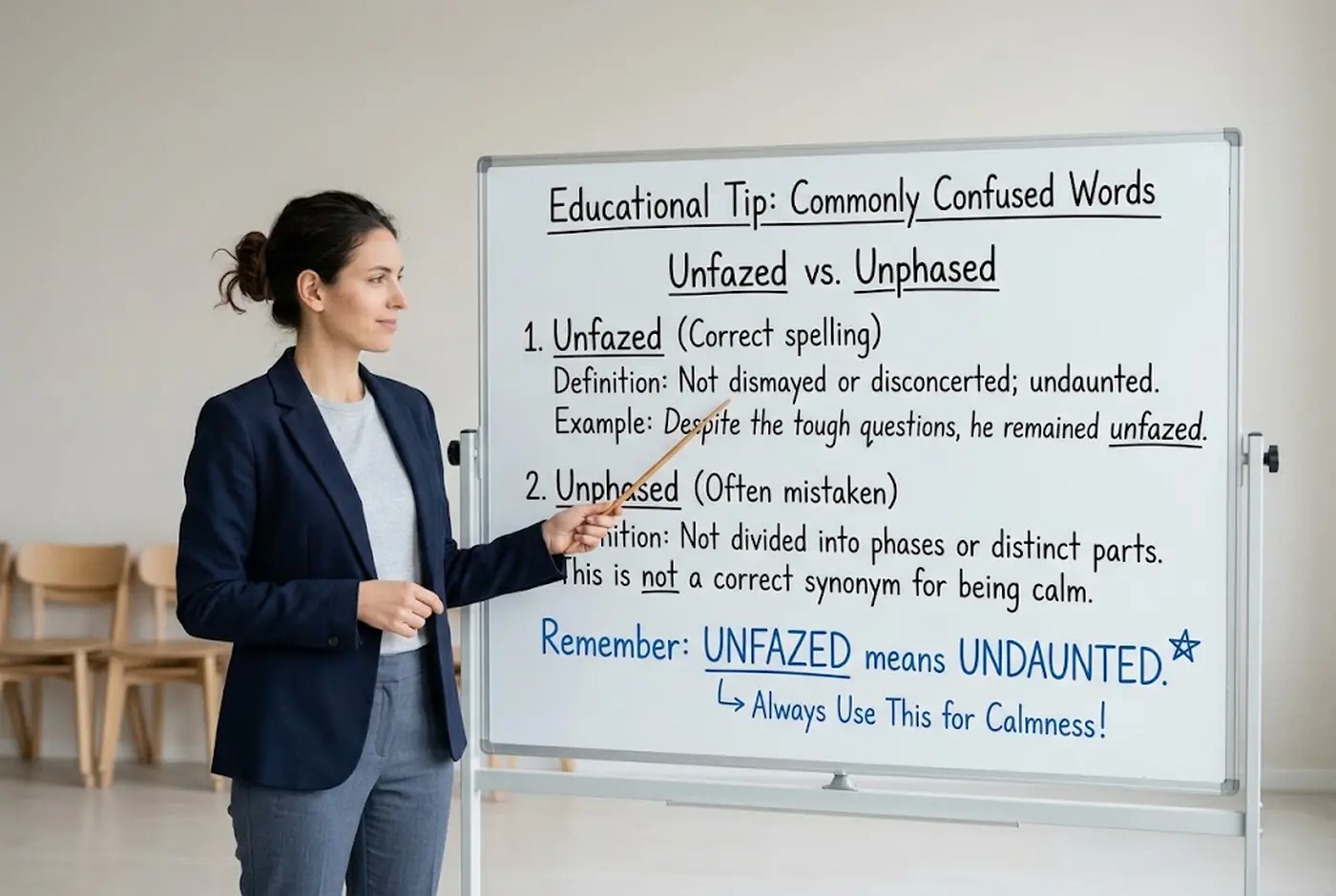
Have you ever wanted to say that someone stayed calm during a difficult situation? You may wonder if the right word is unphased or unfazed. These two words look and sound very similar, but they do not have the same meaning. In most everyday English, unfazed is the correct word when you mean “not bothered” or “not worried.”
Unfazed describes a person who stays calm when something surprising, difficult, or upsetting happens. For example, “She was unfazed by the loud noise.” The word unphased is much less common. It can appear in special contexts where something has not been divided into phases or stages, but it is not the normal choice for describing a calm person.
So, if you are writing an email, school assignment, social media post, or everyday sentence, choose unfazed when you mean calm and unaffected. Once you understand this simple difference, you will have no trouble choosing the right word.
You may also want to read Loose vs Lose: Simple Powerful Grammar Guide (2026).
Simple Answer in One Look
Unfazed is the correct word when you mean calm, unworried, or not affected by something.
Unphased is rare in standard everyday English. It may be used in technical or special contexts to mean not divided into phases.
| Word | Simple meaning | Common use |
|---|---|---|
| Unfazed | Not worried or bothered | Everyday English |
| Unphased | Not divided into phases | Rare or specialized use |
Example:
“She was unfazed by the criticism.”
This means she did not become worried or upset because of the criticism.
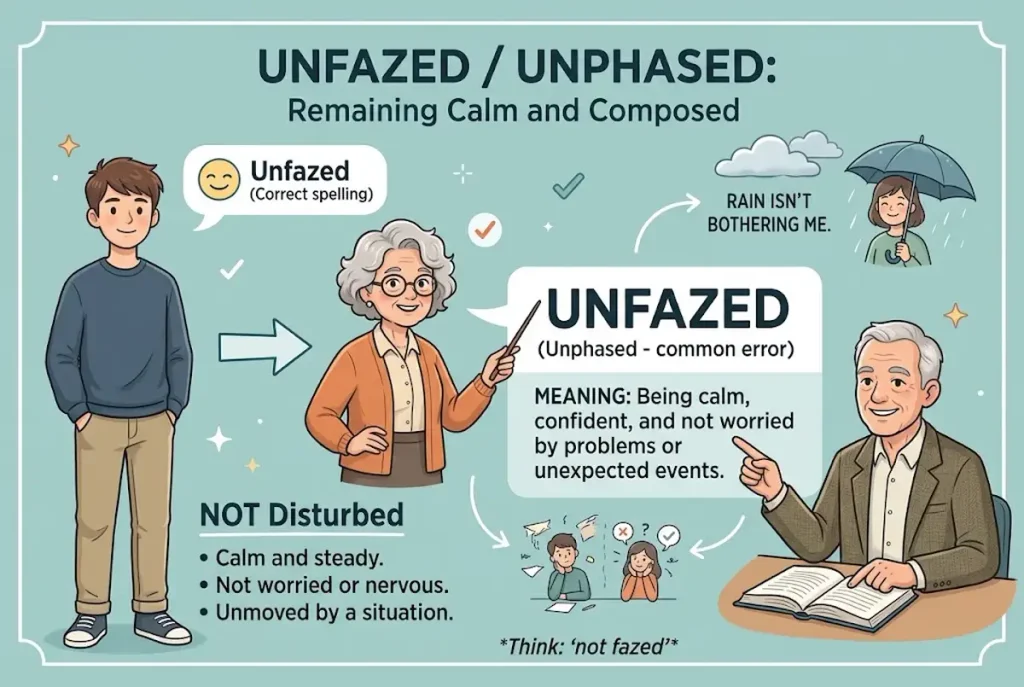
What Unphased or Unfazed Means in Simple English
Think about a student who walks into a classroom and finds a surprise test waiting on the desk. Some students may become nervous. Others may worry because they did not study. But one student simply sits down and starts working.
You could say:
“The student was unfazed by the surprise test.”
The word unfazed tells us that the student was not bothered or worried by what happened.
It can describe someone who remains calm when facing:
- Bad news.
- A difficult task.
- Criticism.
- A surprise.
- A stressful situation.
- A frightening event.
- An unexpected problem.
For example:
“Tom was unfazed by the difficult question.”
Tom may have found the question hard, but he did not panic.
Another example is:
“Maria was unfazed when everyone looked at her.”
Maria stayed calm even though she had everyone’s attention.
The key idea is simple: unfazed means not bothered by something that might normally cause worry, fear, surprise, or stress.
Now compare this with unphased.
The word unphased does not normally mean calm. If you use it to describe a person who is not bothered, many readers will see it as a spelling mistake for unfazed.
That is why unfazed is the safe and natural choice in normal English.
Why People Mix These Words
The confusion between both words are very common because the words look almost identical. They both begin with “un” and contain the letters “faz” or “phas.” They also sound similar when people say them quickly. But their meanings come from different ideas.
Unfazed is connected to the word faze.
To faze someone means to make that person worried, confused, nervous, or upset.
So:
faze = bother or disturb someone
Add “un” to the word:
unfazed = not bothered or disturbed
This makes the meaning easier to remember.
For example:
The loud music fazed him.
He was bothered or disturbed by the loud music.
Now change it:
The loud music did not faze him.
He was not bothered by it.
You can also say:
He was unfazed by the loud music.
Both ideas point to the same basic meaning.
The confusion becomes stronger because phase is also a real English word.
A phase means a stage or part of a process.
For example:
The project has three phases.
That means the project has three stages.
Here is an easy way to remember it:
Unfazed → calm
Phase → stage
So if you are talking about someone’s reaction to a problem, surprise, or stressful event, unfazed is the word you want.
Clear Difference Explained Simply
The difference between words becomes much easier when you focus on the meaning.
Unfazed
Unfazed means calm and not bothered by something.
Examples:
“She was unfazed by the bad news.”
She stayed calm after hearing the bad news.
“He remained unfazed during the argument.”
He did not become nervous or upset during the argument.
“The teacher was unfazed by the student’s question.”
The question did not make the teacher uncomfortable or worried.
Unphased
Unphased is not the normal word for “not bothered.” It may appear in special writing connected with phases, stages, signals, cycles, or other technical ideas.
For example, a technical writer might use a form such as “unphased” to describe something that has not been placed into separate phases. However, this use is uncommon in ordinary English.
That gives us a simple rule:
Talking about emotions or reactions? Use unfazed.
Talking about phases or stages in a special context? Unphased may appear, but check the context carefully.
A Quick Visual Test
Ask yourself:
Does the sentence mean “not bothered”?
If yes, use:
Unfazed.
Ask yourself:
Does the sentence relate to phases or stages?
If yes, unphased might be intended, but it is much less common.
For most English learners, writers, and everyday speakers, this rule is enough.
Which Form Should You Use?
If you are choosing between words, use unfazed when you mean that someone stayed calm.
Here is the easiest rule:
Use “unfazed” for a calm reaction.
For example:
Correct:
“She was unfazed by the criticism.”
Incorrect for this meaning:
“She was unphased by the criticism.”
Why is the first sentence better?
Because criticism can faze a person. If criticism does not bother someone, that person is unfazed.
You can also remember the related expression:
“It didn’t faze me.”
This is a very common English sentence.
For example:
“The long wait didn’t faze me.”
It means:
“The long wait didn’t bother me.”
You can turn that idea into an adjective:
“I was unfazed by the long wait.”
The two sentences express almost the same idea.
Here are some more examples:
“The criticism didn’t faze her.”
“She was unfazed by the criticism.”
“The difficult interview didn’t faze him.”
“He was unfazed by the difficult interview.”
This connection between faze and unfazed can help you remember the spelling.
What About “Unphased”?
You may still see unphased online or in informal writing. Seeing a word does not always mean that it is the best choice. English contains many spellings that people use because they sound right or look familiar. Some become common mistakes. So if your sentence is about a person who remains calm, use unfazed.
For example:
“The firefighter remained unfazed by the dangerous situation.”
Not:
“The firefighter remained unphased by the dangerous situation.”
The first sentence clearly communicates the intended meaning.
Easy Real Life Sentences You Can Use
Here are simple examples that show how unfazed works in normal conversation.
- She was unfazed by the sudden change in plans.She stayed calm even though the plans changed.
- He seemed unfazed by the bad weather.The bad weather did not bother him.
- The teacher was unfazed by the difficult question.The difficult question did not make the teacher nervous.
- I was unfazed by the criticism.The criticism did not upset me.
- The dog was unfazed by the loud thunder.The thunder did not seem to bother the dog.
- She remained unfazed during the interview.She stayed calm during the interview.
- He looked completely unfazed after making a mistake.He did not seem worried or upset about the mistake.
- The team was unfazed by the early setback.The team stayed confident after the problem.
Notice something important in these examples. Unfazed usually describes a reaction to something. A person can be unfazed by criticism, pressure, noise, problems, questions, changes, or surprises. That makes the word useful in both everyday speech and formal writing.
Where Unphased vs Unfazed Word Comes From?
The history of unfazed also helps explain why the spelling is different from phase. The word faze has been used in English for several centuries. It developed from an older word related to ideas such as frightening, disturbing, or disconcerting someone. Over time, faze became the familiar English verb meaning to upset, worry, or disturb someone.
Then English speakers used the prefix un to create the opposite idea:
faze → unfaze → unfazed
So:
faze someone = bother or disturb someone
unfazed = not bothered or disturbed
The word phase has a completely different history and meaning. It refers to a stage, period, or part of a process.
For example:
“The first phase of the project is complete.”
Here, phase means a stage.
That is why faze and phase should not be treated as the same word simply because they look and sound somewhat alike.
The difference is easier when you connect each word to its meaning:
Faze → bother
Unfazed → not bothered
Phase → stage
This small memory trick can prevent the spelling mistake.
A Simple Bridge to Deeper Meaning
Now you know the main difference between words. In everyday English, unfazed is the clear choice when you want to describe someone who stays calm and does not let a difficult situation bother them. But the word can also tell us something about a person’s attitude, confidence, and response to pressure. Understanding these deeper uses will help you recognize unfazed in conversations, books, news stories, and everyday writing. know which spelling is correct. In the next section, we will explore cultural meaning, symbolism, daily usage, common mistakes, practical examples, and frequently asked questions to help you remember the correct word forever.
You may also want to read Developed vs Developped: Easy Guide for English Learners.
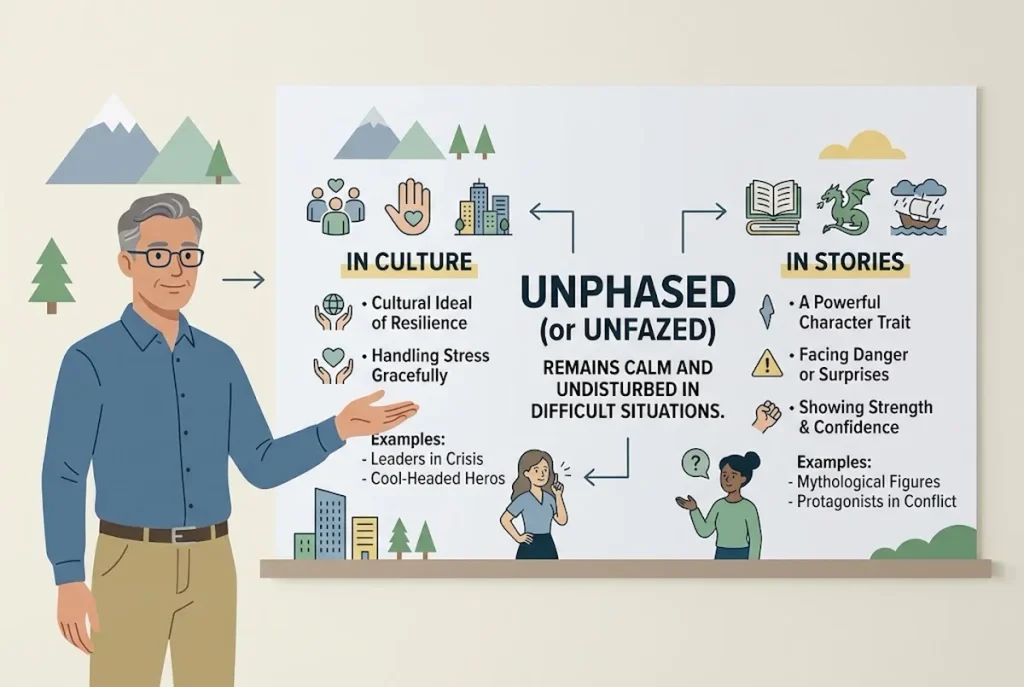
How Unphased or Unfazed Word Is Understood in Culture and Stories
The word unfazed is often used to describe brave, calm, or confident people. In books and movies, the main character may stay unfazed even when something dangerous happens. For example:
- The hero remained unfazed during the storm.
- The detective stayed unfazed after hearing the bad news.
People admire someone who does not panic in a difficult situation. That is why unfazed often has a positive meaning. The spelling unphased does not carry this meaning because it is generally considered incorrect.
Biblical and Mythological Meaning
The word unfazed does not have a direct biblical meaning. However, many religious stories describe people who stay calm and trust God during hard times. You could describe their behavior by saying they remained unfazed in the face of danger. In myths and legends, heroes also stay calm while fighting monsters or facing great challenges. The idea is courage and confidence, not fear.
Symbolism Explained in Simple Words
What Unfazed Represents
The word unfazed often represents:
- calmness
- courage
- confidence
- self-control
- inner strength
Example:
- She stayed unfazed during the emergency.
What Unphased Represents
The spelling unphased does not have an accepted meaning in standard English. It is usually just a spelling mistake made because phase and faze sound alike. For correct writing, choose unfazed.
Related Words You Should Know
Calm
Not nervous or excited. Example:
- Stay calm during the test.
Relaxed
Free from stress. Example:
- He looked relaxed after work.
Composed
Able to control emotions. Example:
- She stayed composed during the meeting.
Confident
Sure about yourself. Example:
- The speaker sounded confident.
Steady
Not changing or shaking. Example:
- Keep your hands steady.
Fearless
Not afraid. Example:
- The firefighter was fearless.
These words have similar ideas and can help improve your vocabulary.
How People Actually Use Unphased and Unfazed in Daily English
Here are natural examples.
- She was unfazed by the loud thunder.
- He stayed unfazed during the interview.
- The doctor remained unfazed under pressure.
- We were unfazed by the delay.
- My brother looked unfazed after the mistake.
- The captain stayed unfazed during the storm.
- The teacher seemed unfazed by the noise.
- They remained unfazed despite the bad weather.
- The athlete was unfazed before the final match.
- The child stayed unfazed around strangers.
Common Mistakes People Make
Mistake 1: Writing unphased instead of unfazed
Wrong:
- She was unphased by the accident.
Correct:
- She was unfazed by the accident.
Mistake 2: Thinking phase and faze mean the same thing
They are different words. Phase means a stage or period. Example:
- The project entered its second phase.
Faze means to disturb or upset someone. Example:
- The loud noise did not faze me.
Mistake 3: Trusting incorrect social media posts
Many online posts use unphased by mistake. That does not make it correct.

Final Teacher Explanation for Unphased or Unfazed
Imagine we are in class together. You ask me, “Should I write?” My answer is simple. Always choose unfazed when you mean calm or not bothered. The spelling unphased is almost always a mistake caused by confusing phase with faze. If you remember the base word faze, you will almost never spell it incorrectly again. That one small trick can save you many writing mistakes.
Final Answer (Quick Recap)
When comparing only unfazed is the standard and correct spelling. It means calm, not worried, or not affected by something. Unphased is usually a misspelling and should be avoided in formal and everyday writing.
For another common grammar confusion, see Nonresponsive vs Unresponsive: Easy Examples and Rules.
Conclusion
The answer is clear. Unfazed is the correct spelling and means someone stays calm or is not bothered by a difficult situation. Unphased is usually an incorrect spelling that appears because the words sound alike. For school, work, professional writing, and everyday English, always use unfazed. It is the accepted and trusted form in standard English.
Frequently Asked Questions (FAQs)
Which is correct?
Unfazed is the correct spelling in standard English.
Is unphased a real word?
It is generally considered a misspelling of unfazed.
What does unfazed mean?
It means not worried, not surprised, or not bothered.
Why do people write unphased?
Because phase and faze sound almost the same.
Can I use unphased in school writing?
No. It is better to use unfazed.
What is the verb behind unfazed?
The base verb is faze, which means to disturb or upset someone.
How can I remember the correct spelling?
Think: If it doesn’t faze you, you are unfazed.
Is unfazed used in both American and British English?
Yes. Unfazed is accepted and widely used in both varieties of English.

1 thought on “Unphased or Unfazed: Which Is Correct and How to Use (2026)?”