
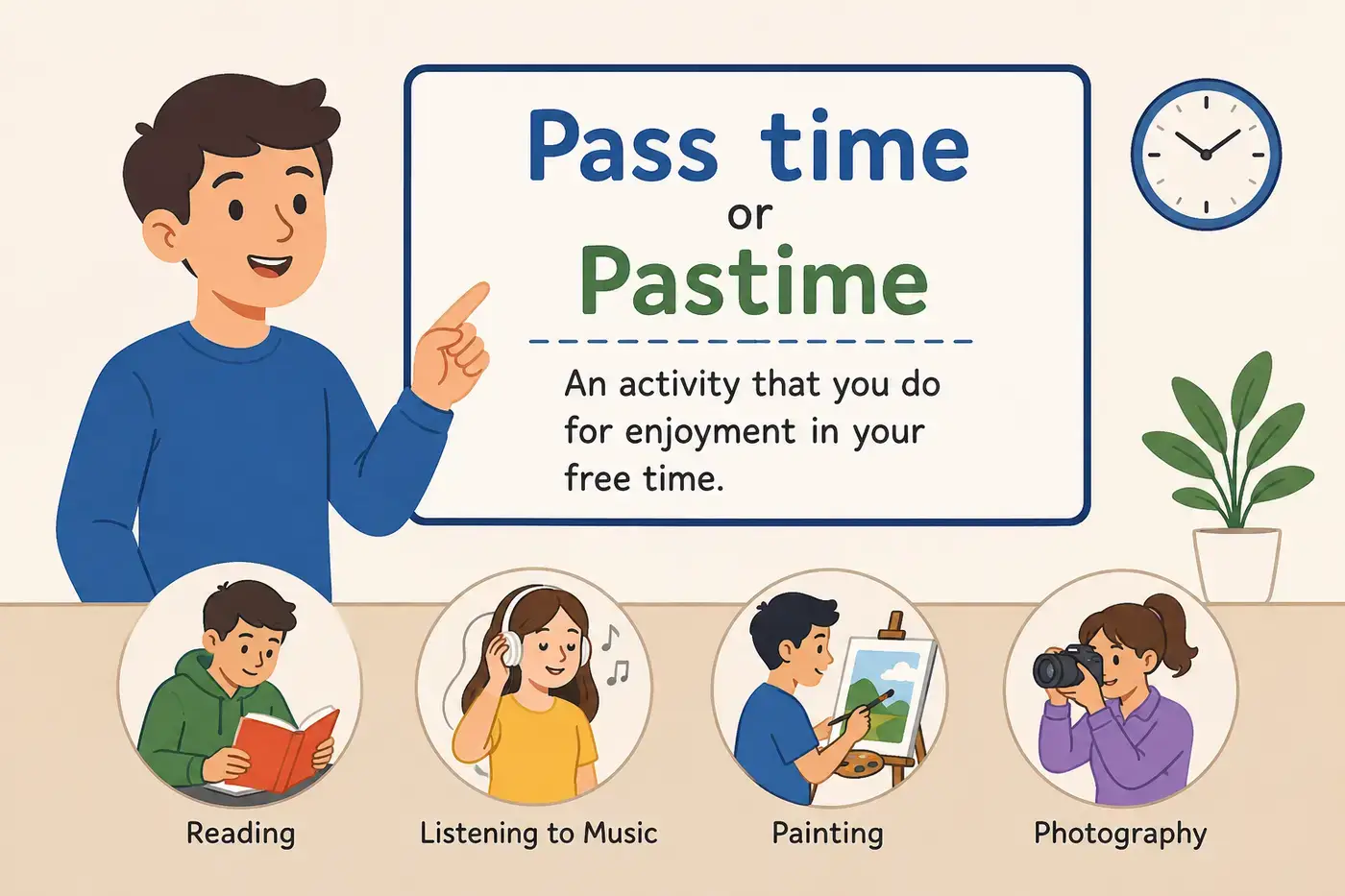
Many English learners get confused about passtime or pastime because both words look possible at first. You may see someone write passtime in a text message or online post and wonder if it is a real English word. That question is very common.
The short answer is simple. Pastime is the correct English word. Passtime is a spelling mistake. If you want to talk about a hobby or an activity you enjoy in your free time you should always write pastime.
In this guide you will learn the difference between in very easy English. You will also see simple examples easy tips and a little history so you can remember the correct spelling every time.
You may also want to read Contractor vs contracter: Correct Spelling and Meaning (2026).
Simple Answer in One Look
Pastime is the correct word. It means a hobby or something you enjoy doing in your free time.
Passtime is not a correct English word. It is only a common spelling mistake.
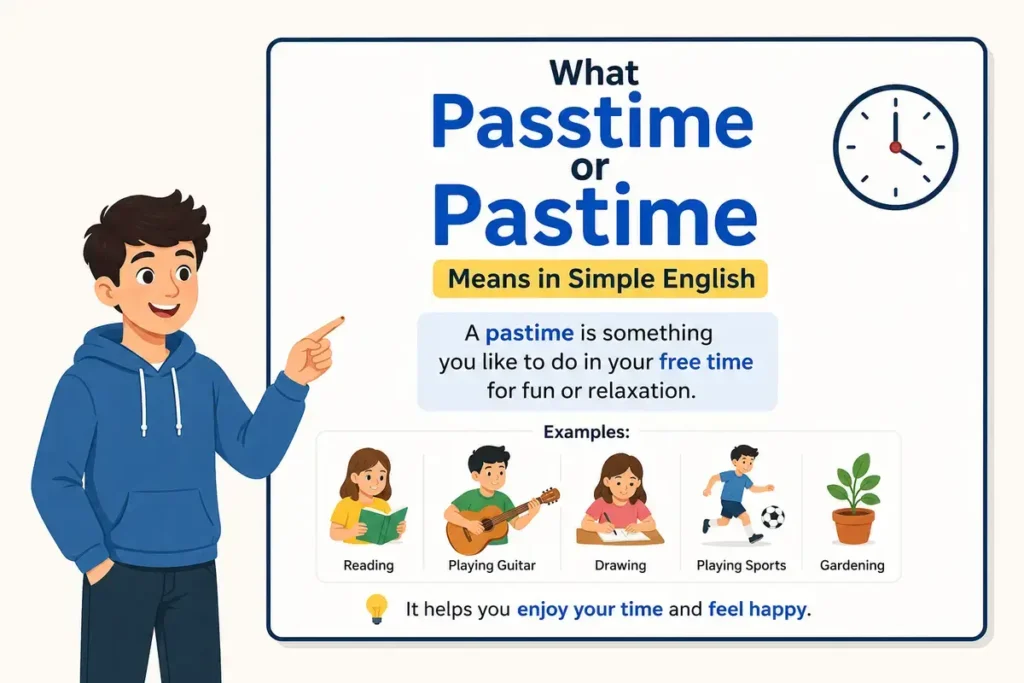
What Passtime or Pastime Means in Simple English
A pastime is an activity that helps you relax have fun or enjoy your free time. Most people have at least one pastime. Your pastime can be something you do every day or only on weekends. It does not have to cost money. It simply needs to be something you enjoy. Here are some common pastimes.
- Reading books.
- Playing soccer.
- Drawing pictures.
- Cooking new meals.
- Watching movies.
- Gardening.
- Fishing.
- Playing video games.
Think of a pastime as your favorite way to spend free time. For example.
- Reading is my favorite pastime.
- Her pastime is painting beautiful flowers.
- Our family has many fun pastimes.
Notice that the word always stays pastime. You should never write passtime.
Why People Mix These Words
Many people spell these words because they hear the sound of the word instead of thinking about its spelling. The middle sound can make people believe there should be two letters s. There are a few reasons this happens.
The Word Sounds Like Pass
When people say pastime quickly it may sound a little like pass time.
Because of that they write passtime without checking the dictionary.
They Think It Comes From Pass
Some learners believe the word is connected to the verb pass.
For example they think it means passing time.
That idea seems reasonable but it is not how the word is spelled today.
Typing Fast
Many spelling mistakes happen while typing.
People often type extra letters without noticing them.
Spell check may catch the mistake but not always.
Seeing Other Mistakes Online
Sometimes people copy incorrect spelling from websites comments or social media posts.
Seeing a mistake many times does not make it correct.
Remember this easy rule.
If you mean a hobby or enjoyable activity always write pastime.
Clear Difference Explained Simply
Here is the easiest way to remember the difference between both words.
| Word | Correct | Meaning |
|---|---|---|
| Pastime | ✅ Yes | A hobby or activity you enjoy in your free time. |
| Passtime | ❌ No | Incorrect spelling of pastime. |
You can also remember it like this.
- Pastime belongs in dictionaries.
- Passtime does not.
- Pastime is used in books schools and newspapers.
- Passtime should be avoided in all writing.
Quick Memory Trick
Think of this sentence.
My pastime makes my free time happy.
The word has only one s after pa.
Which Form Should You Use?
Always choose pastime.
Use it in school writing.
Use it in work emails.
Never use passtime because it is not accepted as a correct English spelling. Ask yourself one simple question. Am I talking about a hobby or something I enjoy doing? If the answer is yes then write pastime. Here are a few examples.
Correct.
- Music is my favorite pastime.
- Swimming became her new pastime.
- Chess is a relaxing pastime.
Incorrect.
- Music is my favorite passtime.
- Swimming became her new passtime.
- Chess is a relaxing passtime.
Easy Real Life Sentences You Can Use
These examples show how people naturally use pastime every day.
- Reading is my favorite pastime.
- My grandfather enjoys fishing as a pastime.
- Painting became her weekend pastime.
- We found a new pastime during summer vacation.
- Playing basketball is a healthy pastime.
- His favorite pastime is solving puzzles.
- Watching birds is a peaceful pastime.
- My sister turned baking into a fun pastime.
Notice that every sentence uses pastime.
None of them use passtime.
Where these Words Expression Comes From Simple History
The word pastime has been part of English for hundreds of years. Long ago people used it to describe something that helped pass pleasant hours with fun or enjoyment. Over time the two ideas became one word. That is why we write pastime as a single word today. English kept this spelling and dictionaries continue to list only pastime as the correct form.
Even though the word is connected to spending time happily modern English does not spell it passtime. That spelling has never become a standard English word. As you continue reading you will discover how pastime is used in different cultures books daily conversations and common expressions. You will also learn simple memory tips common mistakes and expert advice that will help you remember the correct spelling with confidence every time.
How does we Understood in Culture and Stories
People all over the world enjoy having a pastime. Even if they speak different languages, everyone likes doing something fun during free time. A pastime helps people relax, learn new skills, and spend time with family and friends. In many stories, a character’s pastime tells us something about who they are. A person who enjoys reading may be curious. Someone who loves painting may be creative. A child who enjoys soccer may like teamwork and exercise.
Many famous books also show characters with favorite pastimes. Some enjoy gardening. Others collect stamps, play music, or write stories. These activities make the characters feel more real. When talking about words, remember that stories, books, newspapers, and dictionaries always use pastime. You will not find passtime in correct published English. A pastime can also bring people together. For example:
- Families play board games together.
- Friends enjoy hiking on weekends.
- Children build model airplanes.
- Grandparents enjoy knitting or fishing.
These activities create happy memories. That is one reason the word pastime has stayed popular for hundreds of years.
Many readers also check Provider vs Providor: Meaning, Usage, and Mistakes.
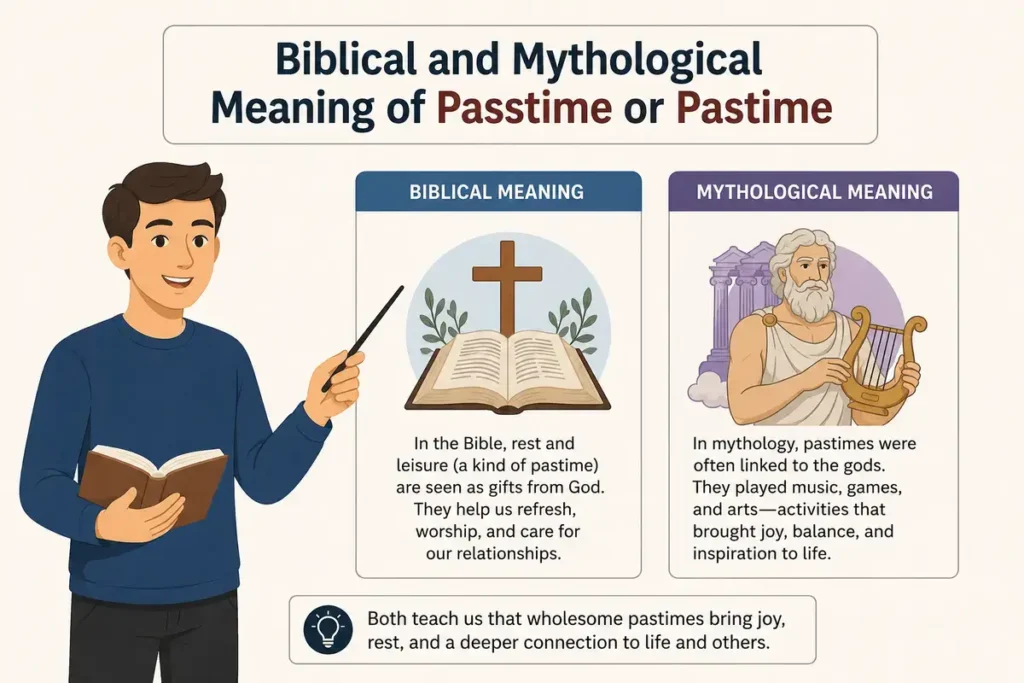
Biblical and Mythological Meaning of Passtime or Pastime
The word pastime does not have a special meaning in the Bible. It is not used as an important religious word. Still, the Bible shows many people enjoying peaceful activities. Shepherds watched their sheep. Musicians played songs. Families celebrated together. These activities were part of everyday life, even if they were not called pastimes.
In mythology, people often see heroes practicing skills like hunting, music, or storytelling. These activities helped shape their character. They were enjoyable, but they also helped people grow stronger or wiser. So, when thinking about both words, there is no religious difference. The only real difference is spelling.
Pastime is correct.
Passtime is not.
Symbolism Explained in Simple Words
Words can sometimes carry ideas beyond their basic meaning. The comparison between is a good example because one word has meaning while the other is simply an error.
What Pastime Represents
A pastime often represents happiness. It can also stand for:
- Free time.
- Relaxation.
- Learning something new.
- Creativity.
- Family fun.
- Healthy habits.
- Personal growth.
- Balance between work and rest.
Many people believe a good pastime makes life more enjoyable. It gives your mind a chance to rest after school or work. Someone who enjoys drawing may become more creative. Someone who enjoys reading may learn new ideas every day. A pastime reminds us that life is not only about work. It is also about enjoying simple moments.
What Passtime Represents
Passtime does not represent anything in standard English because it is not a real word. Instead, it usually represents a spelling mistake. People may write passtime because:
- They hear the pronunciation.
- They type too quickly.
- They confuse it with the verb pass.
- They copy incorrect spelling from the internet.
If you write passtime, readers may think you made a spelling error. That is why professional writers, teachers, and editors always use pastime.
Related Words You Should Know
Learning related words helps you remember the correct meaning.
Hobby
A hobby is something you enjoy doing regularly for fun. Example:
My hobby is painting.
Interest
An interest is something you enjoy learning about or doing. Example:
Science is one of her biggest interests.
Recreation
Recreation means fun activities that help you relax. Example:
Swimming is good recreation.
Leisure
Leisure means free time when you are not working. Example:
He likes reading during his leisure time.
Entertainment
Entertainment is something that makes people happy or amused. Example:
The movie gave us great entertainment.
Activity
An activity is something you do. Example:
Drawing is a fun activity for children.
Relaxation
Relaxation means resting your body and mind. Example:
Listening to music helps with relaxation.
Free Time
Free time means the hours when you are not busy with work or school. Example:
She spends her free time baking cakes.
All of these words are connected to pastime, but none of them should be spelled passtime.
How People Actually Use it in Daily English
People use pastime naturally in everyday conversations. Here are some examples.
- Reading is my favorite pastime.
- Fishing became my father’s favorite pastime after retirement.
- My brother has a new pastime every summer.
- Cooking is more than a pastime for her.
- Photography started as a pastime but became a career.
- Hiking is a healthy pastime for the whole family.
- Playing chess is a relaxing pastime.
- My children enjoy drawing as a pastime.
- Watching birds is a peaceful pastime.
- Music has always been his favorite pastime.
You can also hear people ask questions like these.
- What is your favorite pastime?
- Do you have a new pastime?
- Is gardening your pastime?
- Which pastime helps you relax?
These are all natural English sentences.
Common Mistakes People Make
Many learners make the same mistakes. The good news is they are easy to fix.
Mistake One
❌ My favorite passtime is swimming.
✅ My favorite pastime is swimming.
Mistake Two
❌ Passtime helps me relax.
✅ Pastime helps me relax.
Mistake Three
❌ I have many passtimes.
✅ I have many pastimes.
Mistake Four
❌ Reading is a good pass time.
✅ Reading is a good pastime.
Although pass time can sometimes appear as a verb phrase, it is different. Example:
- We passed time by telling funny stories.
Here, passed time is part of the verb pass, not the noun pastime. Remember these simple rules.
- Pastime is the noun for a hobby.
- Pass time is a verb phrase that means spending time.
- Passtime is incorrect.
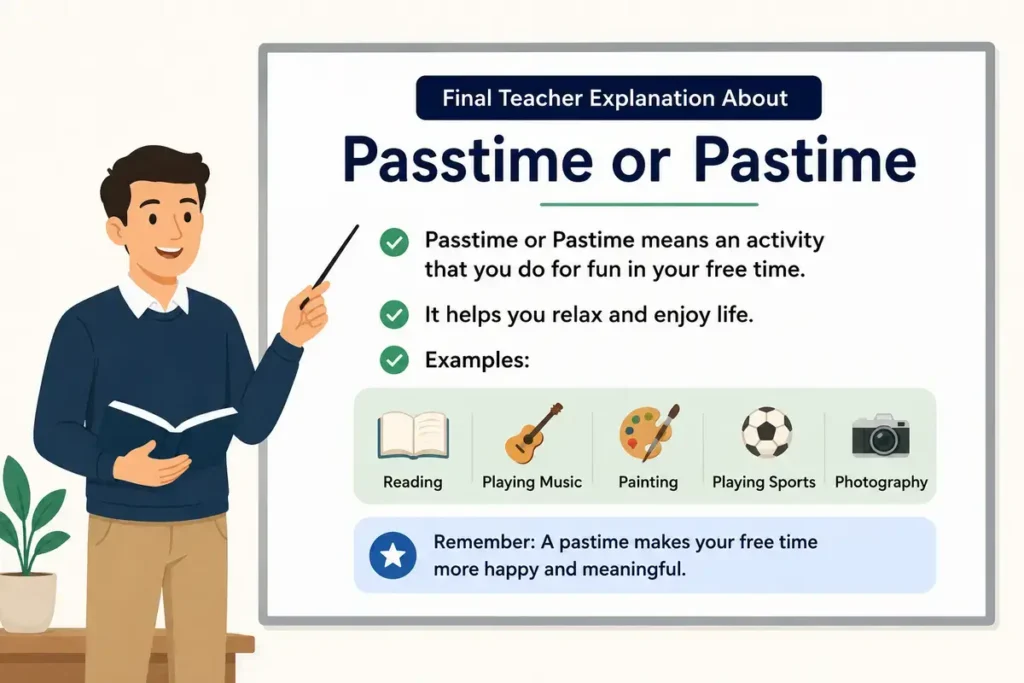
Final Teacher Explanation About Passtime or Pastime
Imagine you are sitting in my classroom. You raise your hand and ask, “Should I write?” My answer is simple. Always choose pastime when you mean a hobby or an enjoyable activity. There is no situation in standard English where passtime is the correct spelling.
A good way to remember this is to think about your favorite hobby. Maybe you enjoy reading. Maybe you love soccer. Whatever activity makes you happy is your pastime. If you keep seeing passtime online, do not copy it. People sometimes make spelling mistakes, and those mistakes spread across the internet.
Professional writers, teachers, schools, dictionaries, and English exams all use pastime. The more you read and write the correct spelling, the easier it becomes to remember. Soon you will not even have to think about it. Your brain will automatically know that pastime is the correct word.
Final Answer and Quick Recap
If you are choosing between both words the correct answer is always pastime. A pastime is a hobby or something enjoyable that you do in your free time. Passtime is simply a spelling mistake and should not be used in correct English writing. Remember this simple rule, and you will always choose the right word with confidence.
For another common grammar confusion, see Village vs Subdivision: Which Word Should You Use?.
Conclusion
Many learners stop for a moment when they see both words, but the answer is much easier than it looks. Pastime is the only correct spelling in standard English when you are talking about a hobby or an activity you enjoy in your free time. Passtime is simply a spelling mistake that often happens because people hear the word and assume it should contain two s letters. By remembering that a pastime is something fun like reading, painting, cooking, fishing, or playing sports, you will always know which word to use. The next time you write an email, complete homework, publish a blog post, or chat with a friend, choose pastime with confidence. A small spelling choice makes your English look clear, correct, and professional.
Frequently Asked Questions
What does pastime mean in simple words?
A pastime is a hobby or fun activity that you enjoy during your free time.
Which is correct?
Pastime is correct. Passtime is an incorrect spelling.
Why do people confuse?
Many people think the word comes from pass, so they accidentally add another s while spelling it.
Can I use passtime in school or work?
No. Always use pastime in school, work, emails, and professional writing.
Is pastime one word or two words?
Pastime is one word when it means a hobby or enjoyable activity.
What is the difference between pastime and pass time?
Pastime is a noun that means a hobby. Pass time is a verb phrase that means spending time doing something.
Is reading a pastime?
Yes. Reading is one of the most common pastimes around the world.
How can I remember the correct spelling?
Think of this sentence: Reading is my favorite pastime. Practice writing pastime until it becomes natural.
