
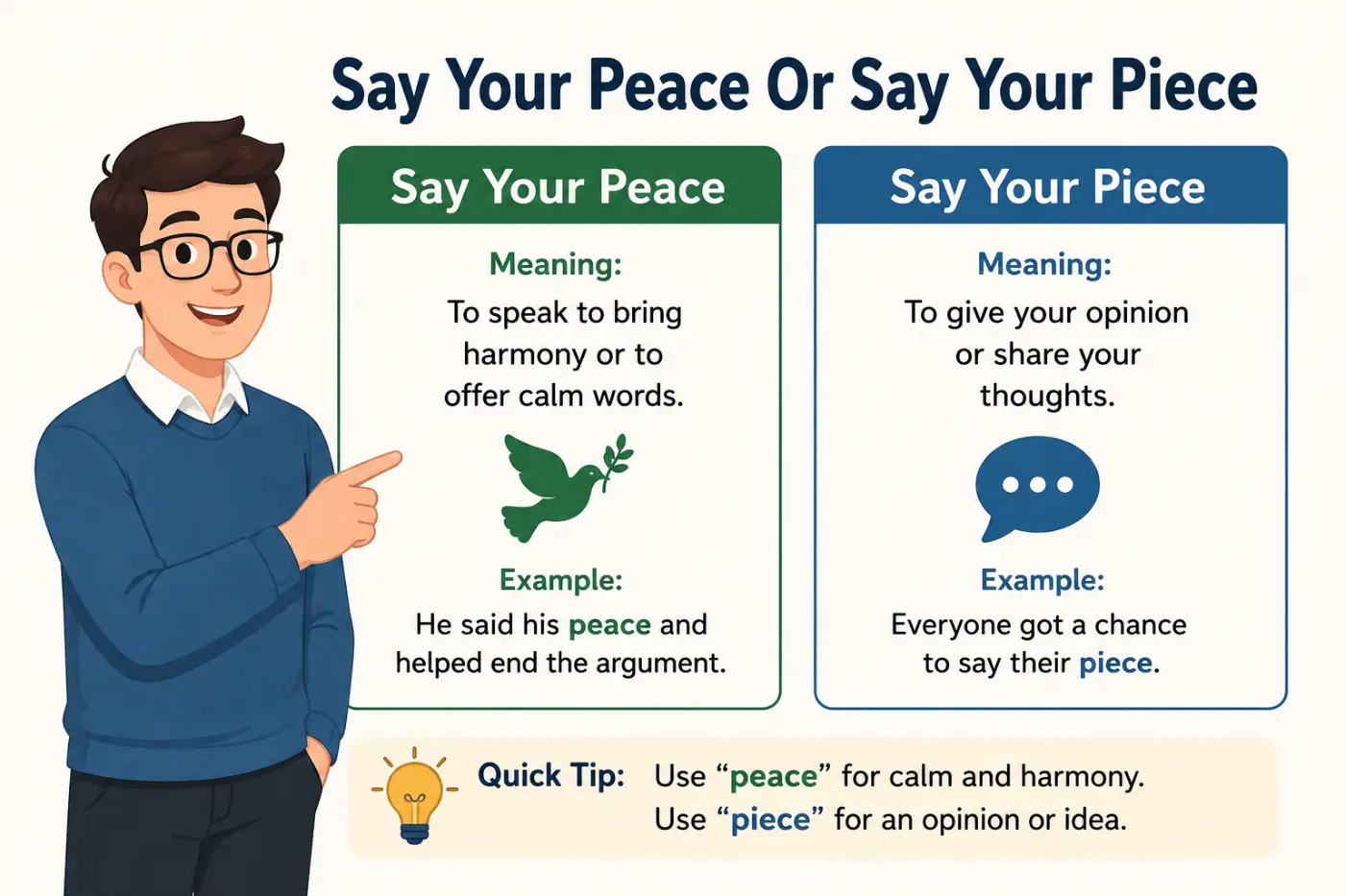
Many people wonder about say your peace or say your piece because both expressions sound exactly the same. This makes them easy to confuse in speech and writing. If you have ever stopped before typing one of them you are not alone.
The correct expression is say your piece when you mean to share your opinion or speak your mind. Another is sometimes used by people because it sounds the same but it does not have the same meaning in modern English.
This guide will explain in very simple English. You will learn the meaning the difference easy examples and the history behind the expression. By the end you will know which one to use with confidence.
Many readers also check Dought vs Doubt: Which Is Correct and How Should You Use It?.
Simple Answer In One Look
Say your piece is the correct expression when you mean to express your thoughts or opinions.
Say your peace is usually considered a mistake in this situation although some people use it because it sounds the same.
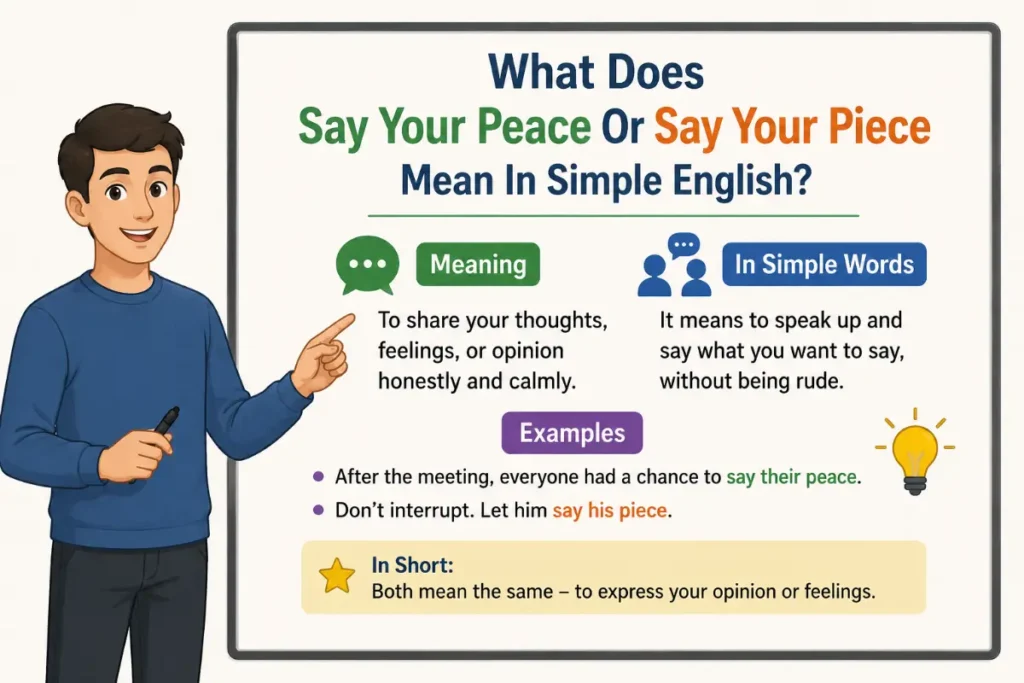
What Does Say Your Peace Or Say Your Piece Mean In Simple English
The easiest way to understand is to think about what each word means. The word piece means a part of something. In this expression it means your part of the conversation. It is your chance to speak. It is your opinion or your side of the story. When someone says say your piece they are telling another person to speak honestly before the conversation moves on.
Here are a few simple examples.
- You have not spoken yet. Go ahead and say your piece.
- Everyone listened while she said her piece.
- Before we end the meeting I want everyone to say their piece.
concord means calm quiet or the absence of conflict. If you say the words suggest speaking about harmony or reaching a peaceful feeling. That is not what the common expression means. Because both words sound the same many people write the wrong one without noticing.
That one small difference helps you choose the right expression every time.
What Does Say Your Piece Really Mean
When someone says they are giving another person permission to speak freely.
It often happens during a discussion disagreement or meeting.
The speaker is saying something like this.
- Tell us what you think.
- Share your opinion.
- Speak your mind.
- Explain your side.
It does not mean the other people will agree. It simply means everyone gets a chance to speak.
For example imagine two friends arguing.
One friend says.
Go ahead and say your piece. Then we can decide what to do.
This means the friend wants to hear everything before making a decision.
What Does Say Your Peace Mean
The phrase is not the standard expression for sharing an opinion.
Some people still write it because it sounds exactly like say your piece.
Others may use it creatively to mean speaking until they feel peaceful. That meaning is possible in a personal or poetic way but it is not the accepted English idiom.
If you are writing for school work business emails articles or social media it is much safer to use say your piece.
Why People Mix These Words
The confusion around happens for one simple reason. The two words sound exactly alike. Words that sound the same but have different meanings are called homophones.
English has many pairs like this.
- Right and write.
- Flower and flour.
- Sea and see.
When people hear an expression they often guess the spelling instead of learning its history.
Imagine hearing someone say this.
“You can say your piece now.”
If you never saw the expression written you might naturally think they said accord because that word is more common in everyday life. That is why this mistake appears in emails books online posts and even newspaper comments. Another reason is that both words seem to make some sense. Someone may think.
“If I speak honestly I will finally have treaty.”
That idea sounds logical.
But English expressions often keep older meanings that do not match modern thinking.
The traditional expression is still say your piece.
Real Life Situations Where People Get Confused
Here are a few examples.
A student writes.
I just wanted to say my tranquility before leaving.
The correct version is.
I just wanted to say my piece before leaving.
A worker sends an email.
Please let everyone say their concord.
The better version is.
Please let everyone say their piece.
A family member says.
Let him say his reconciliation first.
Again the correct form is.
Let him say his piece first.
These small spelling changes make your English look more natural.
Clear Difference Explained Simply
Here is an easy comparison.
| Say your piece | Say your peace |
|---|---|
| Correct expression | Usually considered incorrect in this meaning |
| Means share your opinion | Means calm or harmony if taken literally |
| Common in conversations | Often caused by spelling confusion |
| Used in speaking and writing | Rarely correct as an idiom |
Easy Memory Trick
Imagine a group discussion.
Every person gets one piece of speaking time.
Everyone shares their piece.
Nobody is sharing peace.
This picture makes the expression much easier to remember.
Which Form Should You Use Say Your Peace Or Say Your Piece
If your meaning is to express your opinion always use say your piece.
Use it when someone is speaking during a meeting.
Use it when friends are discussing a problem.
Use it when family members want everyone to share their thoughts.
Use it when writing articles stories emails or messages.
That sentence is correct because the topic is tranquility.
But if you mean sharing an opinion the correct expression stays the same.
She said her piece before leaving.
A Quick Rule To Remember
Ask yourself one question.
Am I talking about an opinion or about calmness.
If the answer is opinion choose piece.
If the answer is calmness choose truce.
This simple question prevents the mistake.
Easy Real Life Sentences You Can Use
Here are simple examples using the correct expression.
- Please say your piece before the meeting ends.
- She said her piece and then sat down.
- Everyone should have a chance to say their piece.
- He wanted to say his piece before making a decision.
- I listened while my friend said her piece.
- They all said their piece respectfully.
- You can say your piece now if you are ready.
- After everyone said their piece the team voted.
Now compare them with incorrect examples.
- Please say your accord before the meeting ends.
Short Conversation Example
Emma said.
“I think we should change the plan.”
Jake replied.
“Go ahead and say your piece.”
Emma explained her ideas.
The team listened carefully.
After everyone said their piece they agreed on a new plan.
This is exactly how the expression is used in everyday English.
Where Say Your Peace Or Say Your Piece Expression Comes From Simple History
The history of say your piece is connected to the older meaning of the word piece. Many years ago piece could mean a part of a performance speech or conversation. Each person had their own part to contribute. Over time people started using say your piece to mean speaking your own part during a discussion. The expression stayed popular because it clearly described sharing your thoughts before moving on.
As English changed many people forgot the older meaning of piece. Since harmony sounds exactly the same some writers began spelling it the wrong way. This kind of change happens with many English expressions. People hear them often but rarely see them written. That is why spelling mistakes become common even among native English speakers.
Even today dictionaries and English teachers continue to recommend say your piece as the correct idiom for expressing an opinion. The mistaken version appears often online because people write what they hear instead of what the expression originally meant. Learning the history makes the correct spelling much easier to remember. Your piece is your part of the conversation. That idea has stayed the same for hundreds of years.
As English continues to grow some confusing expressions become even more common because of social media text messages and everyday speech. Understanding why people mix it is only the beginning. The next part explains how this expression appears in culture stories and daily life along with common mistakes related words practical tips and a simple teacher style recap that will help you remember it for years.
How Is Understood In Culture And Stories
The expression is more than just a grammar question. It also shows how people value honest communication. Across many cultures people believe everyone should have a chance to speak before a decision is made.
When someone says say your piece they are showing respect. They are giving another person time to explain their thoughts without interruption. This idea appears in families schools workplaces and even courts. Listening before judging is seen as fair and kind.
Many stories also follow this pattern. Before a problem is solved each person explains what happened. Every character gets a chance to share their side. That is another way of saying they get to say their piece.
In movies a judge may ask each lawyer to speak before making a decision. In a family story parents may ask each child to explain what happened before deciding who was right. These moments teach that listening matters.
The mistaken form first word has become common because people hear the words more often than they read them. Even so the accepted expression in modern English is still say your piece when talking about sharing an opinion. Good communication starts with listening. That is one reason this expression has stayed popular for many years.
You may also want to read Tear vs Tare: Powerful Grammar Tips for (Guide 2026).
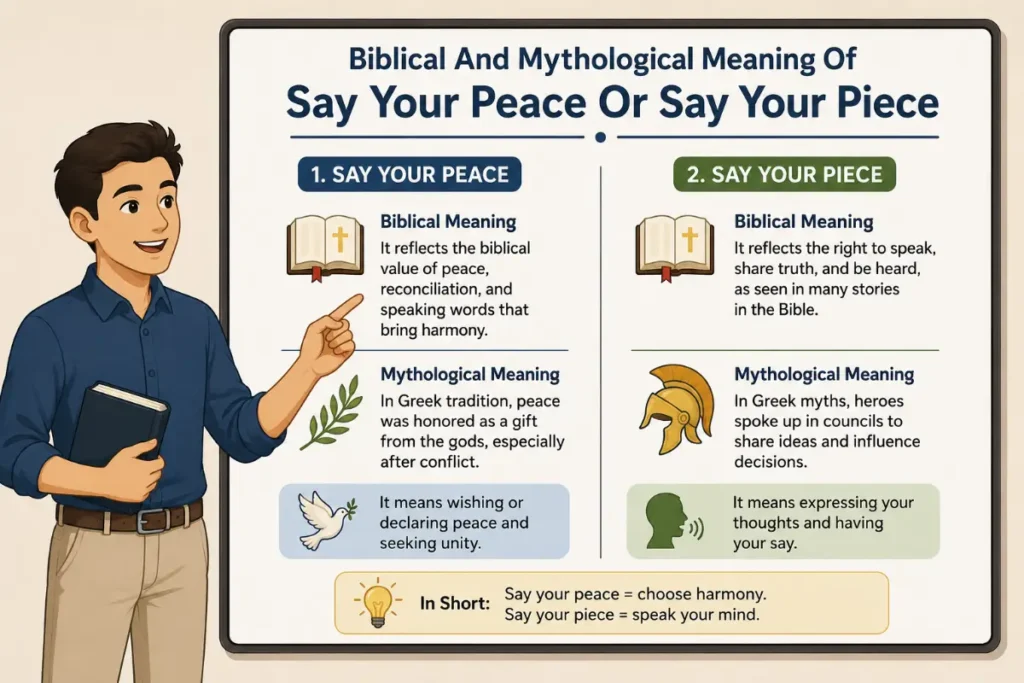
Biblical And Mythological Meaning Of Say Your Peace Or Say Your Piece
There is no Bible verse that uses the exact expression say your piece. The Bible often encourages people to speak honestly kindly and wisely. It also teaches people to listen before making judgments. Those ideas match the meaning behind say your piece even though the exact words are not used. The word ceasefire appears many times in the Bible. It usually means calm hope safety and a good relationship with God and other people.
That can confuse some readers because they think reconciliation must be the correct expression. The spelling looks meaningful because the Bible often talks about ceasefire. Still the common English idiom for sharing your opinion remains say your piece.
In mythology there is also no famous story built around this expression. Many myths show heroes speaking before kings or leaders. They are sharing their thoughts or defending themselves. In simple English they are saying their piece. So while the ideas of speaking and treaty both appear in religion and old stories they do not change the correct modern expression.
Symbolism Explained In Simple Words
When people hear say your piece they often think about speaking honestly.
It represents:
- Sharing your opinion.
- Speaking before a decision.
- Telling your side of the story.
- Being heard with respect.
- Open and honest communication.
The expression reminds us that every person deserves a chance to speak.
It often represents:
- Calm feelings.
- Quiet moments.
- Harmony between people.
- Hope after conflict.
- Emotional comfort.
These meanings are positive but they are different from the idiom say your piece.
Related Words You Should Know About Say Your Peace Or Say Your Piece
Here are some related words and expressions that are useful.
Speak your mind
This means to say exactly what you think without hiding your opinion.
Share your opinion
This means to tell other people what you believe or think.
Have your say
This means everyone gets a chance to speak before a decision is made.
Voice your thoughts
This means expressing your ideas clearly.
Express yourself
This means showing your feelings thoughts or opinions through words.
State your case
This means explaining why you believe you are right.
Give your opinion
This is a simple everyday way to ask someone what they think.
Be heard
This means people listen carefully to what you say.
Learning these expressions will help you understand conversations that have a similar meaning to say your piece.
How People Actually Use It In Daily English
You may hear this expression in many everyday situations.
Here are some natural examples.
- Before we finish the meeting everyone can say their piece.
- I listened while my sister said her piece.
- He wanted to say his piece before leaving the room.
- Please let her say her piece without interrupting.
- Dad told us to say our piece one at a time.
- The coach let every player say their piece after the game.
- My friend finally said her piece and felt much better.
- We all said our piece before making the final choice.
- The manager asked each worker to say their piece.
- Go ahead and say your piece. We are listening.
These examples sound natural in spoken American English because they match the true meaning of the idiom.
Common Mistakes People Make About Say Your Peace Or Say Your Piece
Many English learners and even native speakers make the same mistakes.
Mistake One
When writing expression.
Correct:
Say your piece before we vote.
Incorrect:
Say your truce before we vote.
Mistake Two
Thinking both expressions are equally correct.
Only say your piece is the accepted idiom when you mean sharing your opinion.
Mistake Three
Using reconciliation because it sounds nicer.
The spelling may seem logical but English idioms do not always follow modern meanings.
Mistake Four
Using the expression for silent situations.
The idiom is about speaking.
If nobody is talking the expression does not fit.
Mistake Five
Changing the words.
People sometimes write things like:
Say your part.
Say your words.
Speak your piece of mind.
These are not the standard expression.
The correct form is simply say your piece.
Final Teacher Explanation
Imagine we are sitting together in an English classroom. A student asks me which one is correct. My answer is always simple. If you want someone to share an opinion use say your piece. Think about the word piece as your part of the conversation. Every person gets one part to share. Do not choose concord just because it sounds the same. The word tranquility means calm and harmony. That meaning is different from speaking your opinion.
Whenever you feel unsure remember this classroom rule.
One letter changes the whole meaning.
That is why careful spelling matters.
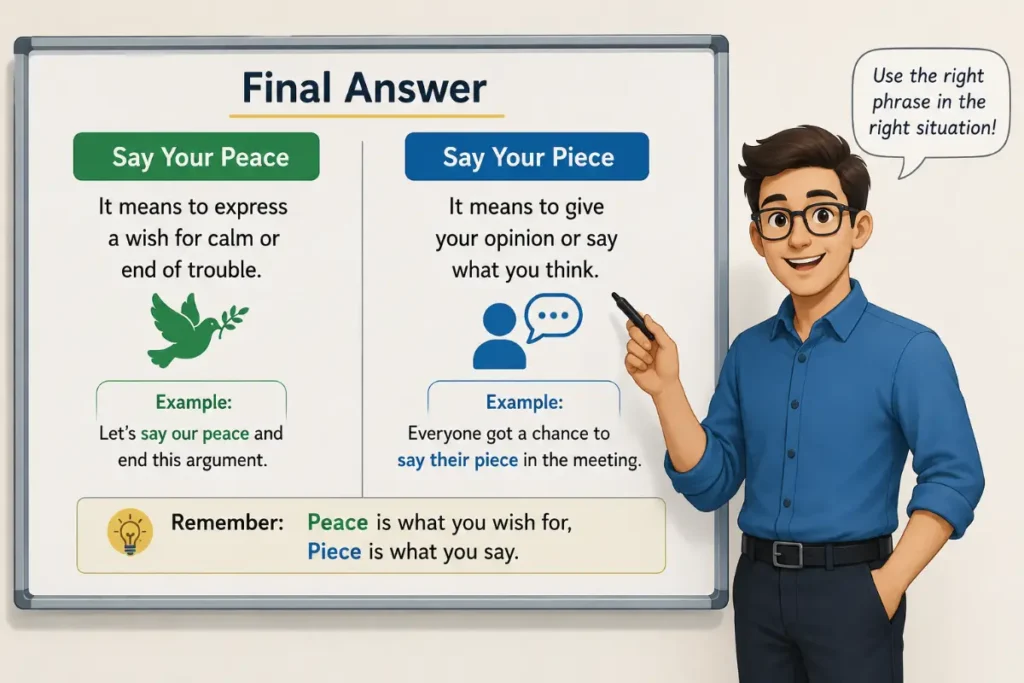
Final Answer About Say Your Peace Or Say Your Piece
If you are choosing between the correct expression is say your piece when talking about sharing your thoughts opinions or side of a story.
People often confuse the two because both words sound exactly alike. Even native English speakers sometimes make this mistake in writing. The accepted English idiom has always been say your piece.
The easiest way to remember it is very simple. Your piece is your part of the conversation. Your accord is calm and quiet. If you keep that idea in mind you will almost never choose the wrong spelling.
Learn the difference in Provider vs Providor: Meaning, Usage, and Mistakes.
Conclusion
The question about both words is one of the most common spelling confusions in English. The good news is that the answer is easy once you understand what each word means.
Use say your piece when you want someone to speak honestly or share an opinion. Use harmony only when talking about calmness harmony or the absence of conflict.
The best takeaway is this. Your piece is your voice.
Frequently Asked Questions
What does say your piece mean in simple words?
It means to share your opinion or tell your side of the story.
Which is correct?
Say your piece is the correct English expression for sharing your thoughts.
Why do people confuse?
The both words sound exactly the same but have different meanings.
Can I use in formal writing?
No. If you mean expressing an opinion use say your piece in formal and informal writing.
When should I use say your piece?
Use it during conversations meetings discussions or arguments when someone is sharing their thoughts.
Does the Bible use the phrase say your piece?
No. The exact expression does not appear in the Bible even though the Bible often talks about speaking wisely and living in accord.
Is say your piece common in American English?
Yes. It is a common idiom in American English and is widely understood.
